
A top-scoring tender answer does four things: it commits to the buyer's requirement in the first line, proves it with a number, names who does what and when, and tells the buyer how to check it. Everything below is that rule applied to seven real-style UK questions.
Each example is written twice. The weak version is the answer most small firms submit. The strong version is what an evaluator marks 5 out of 5. The gap between them is rarely writing talent. It's evidence.
The numbers behind every UK tender answer
Social value weighting
PPN 002
10% minimum
In-scope central government contracts must weight social value at no less than 10% of the total score.
PPN 002 guide (gov.uk)Typical scoring scale
Per quality question
0 to 5
0 is unacceptable, 3 is good, 5 is outstanding. Many councils also exclude any bid that scores 0 on a single question.
Brent Council ITT scoring matrixProcurement Act 2023
Most advantageous tender
In force
Buyers now award on the "most advantageous tender" and must publish award criteria and weightings upfront.
Procurement Act 2023 (legislation.gov.uk)Word limits
Per question
Set per question
Each question carries its own word or page limit in the ITT. Text past the limit may not be read or scored, so check every one.
AI in bids
PPN 017
Allowed
Buyers may ask whether you used AI to write your bid. Using it is fine. Unproven claims are the risk.
PPN 017 (gov.uk)Minimum pass mark
Common ITT rule
3 of 5
Brent excludes bids scoring under 3 on two or more questions. One weak answer can sink a cheap price.
If you have never opened an ITT pack, start with our explainer on what tender documents contain, then come back. If you want a full template for the biggest question in any cleaning bid, the cleaning method statement guide walks through every section.
What's in this guide
- How to write a tender answer, step by step
- Anatomy of a top-scoring answer
- Seven bid writing examples: cleaning, security, grounds maintenance, waste, catering, social value, mobilisation and TUPE
- How evaluators score your answer (the 0-5 scale and real weightings)
- Common mistakes that cost marks
- A copyable answer structure
- FAQs
How to write a tender answer, step by step
Use this for any quality question, in any soft FM sector. It works whether you write by hand, hire a bid writer or use software.
Step 1· 5 minutes
Pull the question, weighting and word limit into one line
Copy the exact question, its weighting and its word limit to the top of your draft. The weighting tells you how many hours this answer deserves.
Step 2· 20 minutes
Find the marking guide and the specification clause
Read the scoring descriptors in the ITT and the matching part of the specification. List every requirement the question points to. Each one needs a sentence.
Step 3· 10 minutes
Write the commitment first
Sentence one answers the question in the buyer's own words. "We will deliver X to Y standard, checked by Z." No company history.
Step 4· 1 hour
Prove it with numbers and named evidence
Add one fact per claim: an audit score, a response time, a contract you already run, a certificate number. If you can't prove it, cut it.
Step 5· 45 minutes
Say who, what, when
Name the role, the task, the frequency and the time. "Area supervisor audits every site monthly using BICSc-aligned checks" beats "we monitor quality".
Step 6· 15 minutes
Close with how the buyer checks you
End with the report, KPI or meeting that lets the contract manager verify delivery. This is where most answers lose the last mark.
Step 7· 20 minutes
Cut to the limit and mirror the headings
Trim to under the word limit. Use the buyer's sub-question order as your headings so the evaluator can tick each one off.
Anatomy of a top-scoring answer
Evaluators sit with a marking sheet and a pile of bids. They look for the requirement, then look for proof. Make both easy to find. Every strong answer in this guide follows the same five-part shape:
| Part | What it does | Example line |
|---|---|---|
| 1. Commitment | Answers the question in the buyer's words | "We will clean all 22 sites to the specification's Grade A standard from day one." |
| 2. Method | Who does what, how often, with what | "Two mobile supervisors, each covering 11 sites, audit weekly." |
| 3. Proof | A number or contract that shows you already do it | "Across [existing contract], audits averaged 96% in 2025/26." |
| 4. Risk | What goes wrong and your fix | "If a cleaner is absent, a floating operative covers within 2 hours." |
| 5. Assurance | How the buyer checks you | "Monthly KPI report and quarterly review with the contract manager." |
Five parts. Order matters less than presence. Miss one and you usually drop from 5 to 3.
Our view: a plain answer with five proven facts beats a beautifully written answer with none. Evaluators can't score prose. They score evidence against a descriptor.
7 bid writing examples, scored weak vs strong
Each question below reads like one you'd find in a UK council, NHS trust or school ITT. Tap between the weak and strong answers to see how the score changes, and why. Client names appear as placeholders like [client name] so you can drop in your own.
1. Cleaning: quality monitoring (council offices)
Describe how you will monitor and maintain cleaning standards across the Council's 22 office and depot sites, including how you will identify and rectify failures and report performance to the Council.
We will audit every one of the 22 sites at least monthly and fix any failure within 4 working hours. **Monitoring.** Two area supervisors each cover 11 sites. They run a scored audit on a tablet using the specification's room-by-room standards, with photos attached. High-traffic areas (toilets, kitchens, depot welfare units) are audited fortnightly. **Rectification.** Any item scoring below standard triggers a job to the site cleaner and supervisor. Toilets and kitchens: fixed within 2 hours. Everything else: within 4 working hours. The supervisor closes the job with an after photo. **Trends.** Two failures on the same item in a month trigger a retraining session, logged against the operative's record. **Proof.** On [existing council contract], 14 sites, this system averaged 96.8% across 2025/26, with 94% of failures closed inside target. **Reporting.** By the 5th working day of each month you receive a KPI report: audit scores by site, failures raised and closed, complaints and response times. We meet your contract manager quarterly to review trends and agree actions.
Why it scores
- First line commits to a frequency and a fix time.
- Names roles, site split and audit method.
- Real performance number from a comparable contract.
- Answers all three parts: monitor, rectify, report.
- Tells the buyer exactly what lands on their desk and when.
Illustrative answer written by CleanTender for this guide. Scores use the 0-5 scale published in Brent Council's ITT evaluation criteria and scoring matrix (0 unacceptable, 3 good, 5 outstanding). Real buyers publish their own scale in the ITT, so check yours.
Quality monitoring is the question most cleaning firms underwrite. We list the other repeat offenders in the cleaning tender mistakes that lose bids, and the wider playbook sits in how to bid for cleaning contracts.
2. Security: staffing and vetting (NHS hospital site)
Explain how you will recruit, vet, license and retain security officers for the Trust's main hospital site, including how you will maintain cover during sickness and holidays.
Every officer on your site will hold a front-line SIA licence, pass BS 7858 screening before their first shift, and complete healthcare conflict training in week one. **Recruitment.** We recruit locally within 15 miles of the hospital, so officers can reach short-notice shifts. Interviews include a scenario test on de-escalating an agitated relative in A&E. **Vetting.** BS 7858 screening covers five years of history, identity, right to work and a basic DBS check. We run SIA licence status checks monthly and before every new placement. **Training.** On top of licence training: conflict management for healthcare, safeguarding adults and children (Level 2), lone working, and your Trust's own escalation procedure. We log completion in our training matrix, which your security manager can view. **Retention.** We pay at least the Real Living Wage, rota officers on fixed patterns agreed four weeks ahead, and run quarterly one-to-ones. On [existing NHS contract], 12-month officer retention reached 84% in 2025/26. **Cover.** A trained relief pool of 6 officers knows your site from induction shadow shifts. Holidays are booked 6 weeks ahead. Sickness is covered within 2 hours, day or night, by our 24/7 control room. Cover rate on [existing NHS contract] was 99.6% of rostered hours. We report staffing, cover rate and licence checks in the monthly contract report.
Why it scores
- Names the actual standard (BS 7858) and licence type.
- Training list fits a hospital, not a car park.
- Retention and cover backed by real rates.
- Explains how cover works at 3am, not just in theory.
- Every claim can be checked on the monthly report.
Illustrative answer written by CleanTender for this guide. Scores use the 0-5 scale published in Brent Council's ITT evaluation criteria and scoring matrix (0 unacceptable, 3 good, 5 outstanding). Real buyers publish their own scale in the ITT, so check yours.
Security bids fail on vetting detail more than price. Our breakdown of why security tender bids fail covers the other five reasons, and how to win security tenders shows where the SIA Approved Contractor Scheme earns marks.
3. Grounds maintenance: seasonal programme (school estate)
Provide your proposed annual grounds maintenance programme for the Trust's 9 school sites, showing how you will schedule works around the school day and term dates while keeping pupils safe.
We will deliver a fixed 12-month programme for all 9 sites, with machinery work done outside pupil hours or in fenced zones, and every visit logged with photos. **Programme.** - Grass (playing fields and amenity): 18 cuts, March to October, fortnightly with weekly cuts in May and June. - Sports pitches: marked before each half term; cut to 25-35mm through the season. - Hedges: 2 cuts, outside the bird nesting season (after 31 August). - Shrub beds and weeding: 6 visits. - Leaf clearance: weekly, October to December, with paths and playgrounds first. - Winter: gritting on call from 1 November to 31 March, main paths clear by 7:45am. **Working around the school day.** Mowers, strimmers and blowers run before 8:15am, during lessons away from occupied areas, or after 3:30pm. Big jobs (hedge cutting, pitch renovation) sit in half terms and the summer holiday. We agree a site calendar with each business manager each July. **Pupil safety.** All operatives hold enhanced DBS checks. Machinery zones are coned and barriered. Operatives sign in at reception and stop work if pupils enter the zone. **Records.** You get a monthly visit log per site with before and after photos.
Why it scores
- Gives an actual programme with frequencies the buyer can price against.
- Respects nesting season and term dates without being asked twice.
- Pupil safety has concrete controls, not reassurance.
- Monthly photo log makes delivery checkable.
Illustrative answer written by CleanTender for this guide. Scores use the 0-5 scale published in Brent Council's ITT evaluation criteria and scoring matrix (0 unacceptable, 3 good, 5 outstanding). Real buyers publish their own scale in the ITT, so check yours.
Want the full template this answer comes from? The grounds maintenance method statement guide has it section by section, and how to win grounds maintenance tenders covers pricing and frameworks.
4. Waste: missed collections and compliance (council depots)
Describe how you will manage the collection, transfer and disposal of general, recycling and hazardous waste from the Council's buildings, including your approach to missed collections and Duty of Care documentation.
We will collect from all sites on fixed days, return for any missed collection within 24 hours, and give you a full Duty of Care audit trail every month. **Collections.** General waste and dry mixed recycling collected weekly, food waste twice weekly from kitchens. Routes and days are fixed in the mobilisation plan and only change with 4 weeks' notice. **Missed collections.** Drivers log every lift by in-cab tablet with a timestamp and photo. Reported misses are collected within 24 hours at no charge. We report miss rate monthly; on [existing council contract] it was 0.3% of scheduled lifts in 2025/26. **Hazardous waste.** Fluorescent tubes, batteries and chemicals are collected on request by a separate licensed vehicle, with consignment notes for every movement. **Duty of Care.** We hold an upper-tier waste carrier registration. Annual waste transfer notes cover routine streams, and every disposal site we use holds a valid environmental permit. We keep copies for at least 2 years and upload them to your document portal. **Recycling.** Current diversion from landfill on comparable contracts: 71%. We will report tonnage by stream monthly and agree a 12-month improvement target at mobilisation.
Why it scores
- Commits to a return time and a record for every lift.
- Hazardous waste handled as its own route with consignment notes.
- Duty of Care described in checkable terms, not a promise.
- Tonnage reporting gives the Council data for its own targets.
Illustrative answer written by CleanTender for this guide. Scores use the 0-5 scale published in Brent Council's ITT evaluation criteria and scoring matrix (0 unacceptable, 3 good, 5 outstanding). Real buyers publish their own scale in the ITT, so check yours.
Waste evaluators read Duty of Care answers against the waste duty of care code of practice. The rest of the scoring picture is in how to win waste management tenders.
5. Catering: menus and allergens (primary schools)
Describe how your menus will meet the School Food Standards, how you will manage allergens and special diets, and how you will increase meal uptake across the 6 primary schools.
Every menu will meet the School Food Standards, every allergen request will run through a signed-off process before a child eats, and we will aim to lift paid meal uptake by 5 percentage points in year one. **Menus.** A three-week cycle, changed twice a year, checked against the School Food Standards by our qualified nutritionist before sign-off. Every day includes a vegetarian main and at least one portion of vegetables or salad. Fish every week; no more than two portions of fried or batter-coated food per week. **Allergens and special diets.** Parents complete a diet form backed by a medical note. Our nutritionist writes an individual menu within 5 school days. Each kitchen keeps a photo list of pupils with allergies at the service point. The 14 major allergens are listed for every dish. Special diet meals are plated separately, labelled with the child's name, and handed over by a named cook. **Food safety.** Each kitchen runs HACCP-based controls. All 12 of our current school kitchens hold a food hygiene rating of 5. **Uptake.** Pupil taste sessions each term, a pupil food council in every school, and theme days tied to the curriculum. On [existing school contract], paid uptake rose from 41% to 49% over two years. We report uptake, allergen incidents (target zero) and pupil feedback to each head teacher termly.
Why it scores
- Names the School Food Standards and shows real rules from them.
- Allergen process covers who, when and how a mistake is prevented.
- Hygiene rating and uptake shown with real figures.
- Termly report ties it back to the head teacher.
Illustrative answer written by CleanTender for this guide. Scores use the 0-5 scale published in Brent Council's ITT evaluation criteria and scoring matrix (0 unacceptable, 3 good, 5 outstanding). Real buyers publish their own scale in the ITT, so check yours.
School catering bids live or die on allergens. Our guides to winning school catering contracts and how to win catering tenders cover the rest of the question set.
6. Social value: local employment (any soft FM contract)
Describe the commitments you will make to create employment and skills opportunities for local residents during the contract, and how you will measure and report delivery.
Over the 3-year contract we will fill at least 60% of new roles with residents of the borough, create 4 paid apprenticeships, and report every figure quarterly. **Local hiring.** Every vacancy is advertised first through the Council's employment support service and local Jobcentre Plus for 10 working days before wider release. Target: 60% of new starters live in the borough (measured by home postcode at hire). **Apprenticeships.** 4 apprenticeships (Level 2) over the term, 2 starting in year one. Priority for care leavers and residents who have been out of work for 6 months or more. **Skills.** 20 accredited qualifications for staff on the contract by year three (for example BICSc, first aid, food hygiene Level 2). 2 work placements a year for local schools or colleges. **Pay.** All staff on the contract paid at least the Real Living Wage from day one. **Measurement.** A named social value lead reports quarterly against each target, using the Council's reporting template, with anonymised postcode evidence. Where we fall behind, we set out a recovery plan in the same report. On [existing contract], 67% of 2025/26 hires were local residents.
Why it scores
- Every commitment has a number and a date.
- Says who measures and how (postcode at hire).
- Includes a recovery plan if targets slip, which evaluators love.
- A delivered figure from a live contract proves you can do it.
Illustrative answer written by CleanTender for this guide. Scores use the 0-5 scale published in Brent Council's ITT evaluation criteria and scoring matrix (0 unacceptable, 3 good, 5 outstanding). Real buyers publish their own scale in the ITT, so check yours.
Social value is the easiest 10% to win and the easiest to throw away. Most small firms write it last, at midnight, as a mission statement. Write it first. Evaluators treat measurable, reportable commitments the way they treat a KPI.
7. Mobilisation and TUPE (any soft FM contract)
Set out your mobilisation plan for the first 8 weeks of the contract, including how you will manage the TUPE transfer of the incumbent's 38 staff and keep service running from day one.
We will run an 8-week mobilisation led by a named mobilisation manager, transfer all 38 staff on their existing terms, and hit full service on day one with a 10% staffing buffer. **Weeks 1-2.** Kick-off meeting with the Council and the incumbent. Request employee liability information, which the incumbent must supply at least 28 days before transfer. Confirm sites, keys, access and consumables. **Weeks 2-4.** Written information to the incumbent on any measures we plan (we plan none affecting terms). Group briefings at each site, then one-to-one meetings with every transferring employee, with a union rep or colleague present if they wish. Answer pay, pension and uniform questions in writing. **Weeks 4-6.** Load staff onto payroll and check right to work. Issue uniforms, ID badges and PPE. Site inductions on our procedures and COSHH. **Weeks 6-8.** Shadow shifts, recruit to fill any gaps, and set up the monthly KPI report. Go/no-go review with the Council in week 7. **Day one.** Mobilisation manager on site. Relief staff at 10% of hours on standby for the first 4 weeks. Daily check-in call with your contract manager for the first 2 weeks. **Proof.** On [existing contract], we transferred 44 staff in 2025 with zero missed shifts in the first month.
Why it scores
- Week-by-week plan the buyer can hold you to.
- Gets the TUPE mechanics right (liability information, 28 days, measures).
- Talks to staff as people, which reassures the buyer about service.
- Day-one buffer and daily check-ins show risk thinking.
Illustrative answer written by CleanTender for this guide. Scores use the 0-5 scale published in Brent Council's ITT evaluation criteria and scoring matrix (0 unacceptable, 3 good, 5 outstanding). Real buyers publish their own scale in the ITT, so check yours.
The legal steps behind that answer are in our guide to TUPE in soft FM tenders. Before you price a TUPE contract, run the numbers through the TUPE cost estimator. Inherited pay rates sink more margins than bad answers.
How evaluators score your answer
Most UK councils score each quality question from 0 to 5, then multiply by the question's weighting. Brent Council's published ITT matrix is a clean example of the scale, so we used it for every example above:
| Score | Brent's label | What it means in practice |
|---|---|---|
| 0 | Unacceptable | Missing, or fails to answer. Often grounds for exclusion. |
| 1 | Poor | Serious omissions. Claims without evidence. |
| 2 | Fair | Meets some parts, raises concerns on others. |
| 3 | Good | Satisfactory in most respects, no major concerns. |
| 4 | Very good | Full answer, good evidence, gives confidence. |
| 5 | Outstanding | Strong evidence on every requirement, exceeds expectations. |
Source: Brent Council ITT evaluation criteria and scoring matrix. Brent also excludes bids scoring 0 on any question, or under 3 on two or more.
Lowest bid gets full marks, others pro rata
Largest quality question
Matches the PPN 002 minimum
Brent Council weighted quality at 60% and price at 40%. Social value alone carried 10%, the same floor PPN 002 sets for central government. A single quality question can outweigh the difference between two prices. Source: Brent Council ITT evaluation criteria and scoring matrix
Do the maths on that. A 23% question scored 5 instead of 3 is worth 9.2 marks. To win the same 9.2 marks on price, you'd need to come in roughly a quarter cheaper than the lowest rival. Nobody should cut price by a quarter. Plenty of firms could lift one answer from 3 to 5.
Buyers must publish their award criteria and weightings under the Procurement Act 2023, so read them before you plan your hours. If a tender's weighting doesn't suit you, the bid/no-bid decision tool helps you walk away quickly.
Common mistakes that cost marks
- Opening with your history. The evaluator already has your SQ.
- Adjectives instead of evidence. "Professional", "high quality", "committed". Delete them and see what's left.
- Answering the question you wish they'd asked.
- Ignoring sub-questions. If the question has three parts, the marking guide has three boxes. Miss one and you cap yourself at 3.
- Going over the word limit. Evaluators stop reading. Anything past the limit scores zero.
- Promising things you can't prove. "ISO 14001 accredited" when you're "working towards" it. Buyers check, and a false claim can exclude you.
- "Details on award." Scores 0.
- Copy-paste from the last bid. The wrong council's name in paragraph three. It happens every week.
A copyable answer structure
Paste this under any quality question and fill the brackets. It works for method statements, staffing, quality, social value and mobilisation.
| Section | Fill in | Words (of 300) |
|---|---|---|
| Commitment | We will [deliver requirement] to [standard] across [sites], checked by [measure]. | 30 |
| Method | [Role] does [task] every [frequency] using [tool or standard]. | 90 |
| Proof | On [existing contract], [metric] was [number] in [year]. | 50 |
| Risk and fix | If [likely problem], we [action] within [time]. | 50 |
| Assurance | You receive [report] every [period]; we meet [who] every [period]. | 50 |
| Buffer | Leave spare words for the buyer's own sub-headings. | 30 |
Word split for a 300-word answer. Scale it up for longer limits, but keep the commitment short.
Should a human or software write this? We compared the costs and output in bid writer vs AI bid tool, and ranked the options in our AI tender software comparison. Short version: software for the first draft, a human for the proof.
Turn the examples into your own answers (product walkthrough)
The same structure as the examples above, drafted from your own profile, contracts and evidence. You edit and prove. CleanTender does the blank page.
Eight steps from "never bid public sector" to a complete SQ response on the buyer's portal. First scan is free.
Step 1· 10 minutes
Build your soft FM company profile
Set your sector to soft FM, your service regions, the sectors you deliver (cleaning, security, grounds, waste, catering), your accreditations, insurance levels, turnover, and operative count. CleanTender uses this to fit-score every live tender against your real capability so you only see the ones you can win.
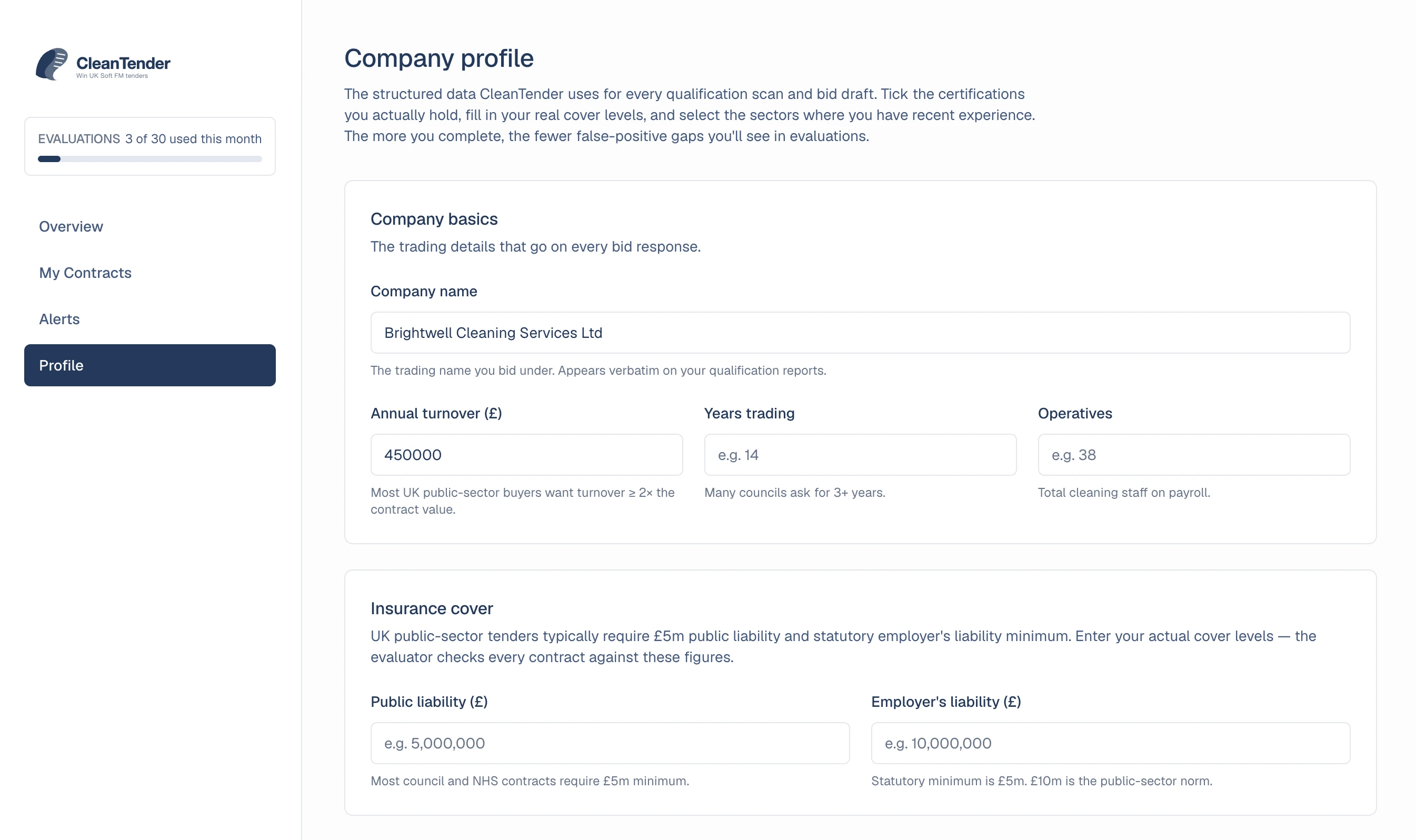
Profile setup defines what you are bid-ready for Step 2· 5 minutes daily
Open the live soft FM-tender feed
Every UK soft FM tender, in one feed. Pre-filtered to your sector and geography. No false positives, no manual portal-trawling across FTS, Contracts Finder, and dozens of buyer e-procurement portals.
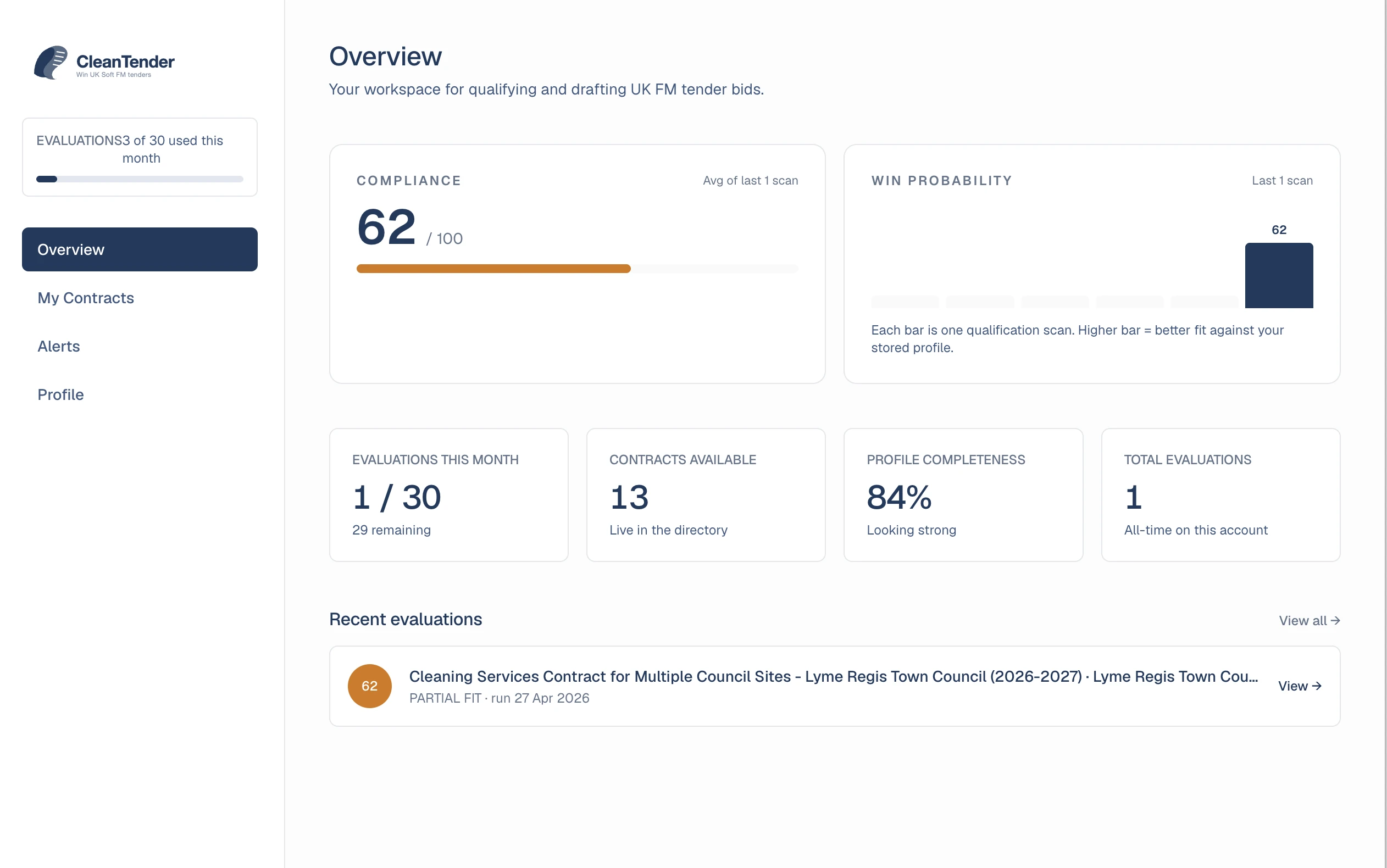
Live feed of in-scope soft FM tenders, fit-scored Step 3· Daily digest
Get email alerts for new in-scope tenders
New soft FM tenders matching your profile land in your inbox the day they publish. CleanTender batches them into a daily digest so you do not get notification fatigue, and links straight back to the in-app fit score.
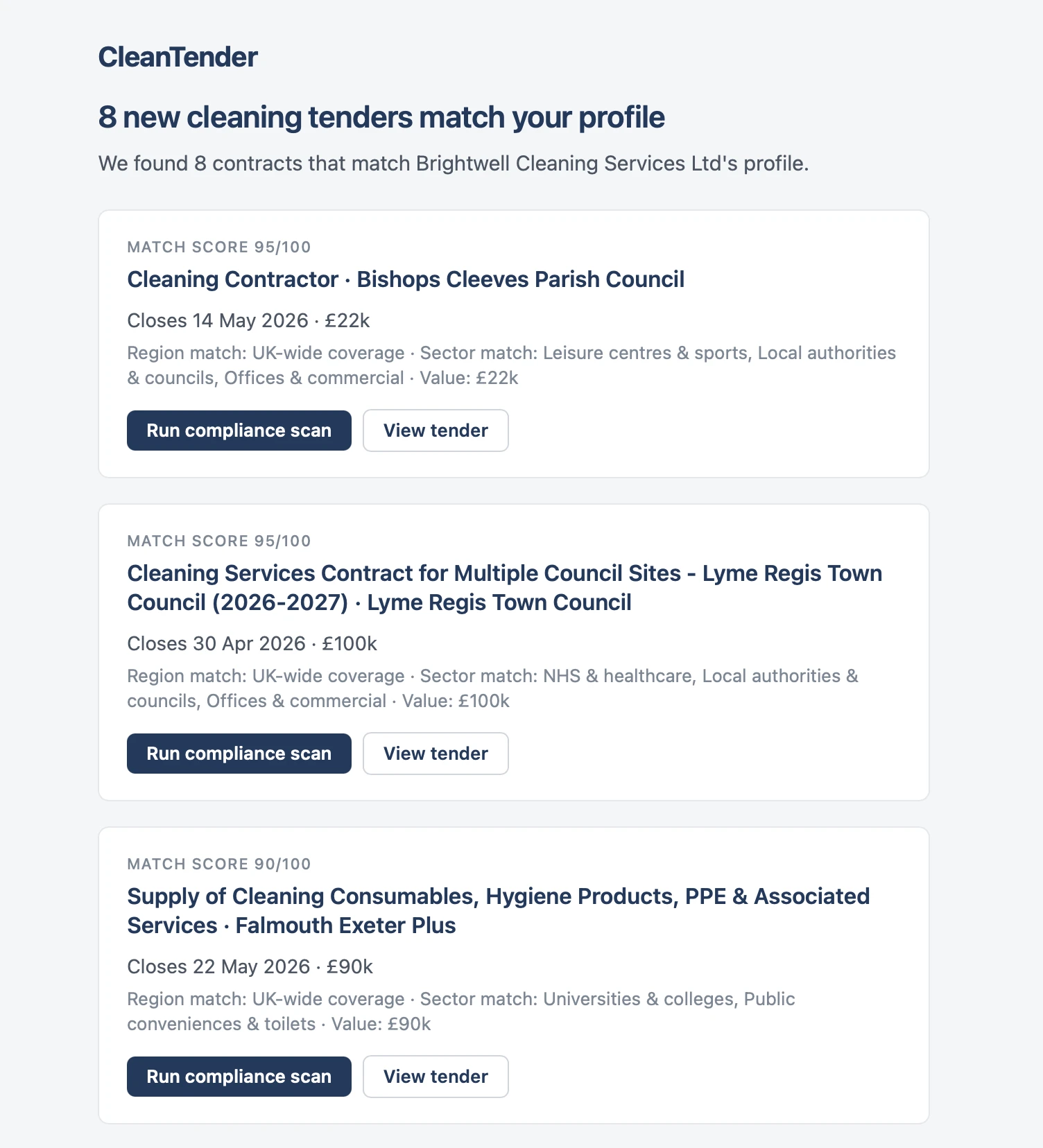
Daily alerts for new in-scope tenders Step 4· 30 seconds
Run a fit-score evaluation on a target tender
One click runs a CleanTender Evaluation against the tender pack: scope match, geography fit, scale fit, compliance gap, and a plain-English win probability. Stops you bidding contracts you were never going to win.
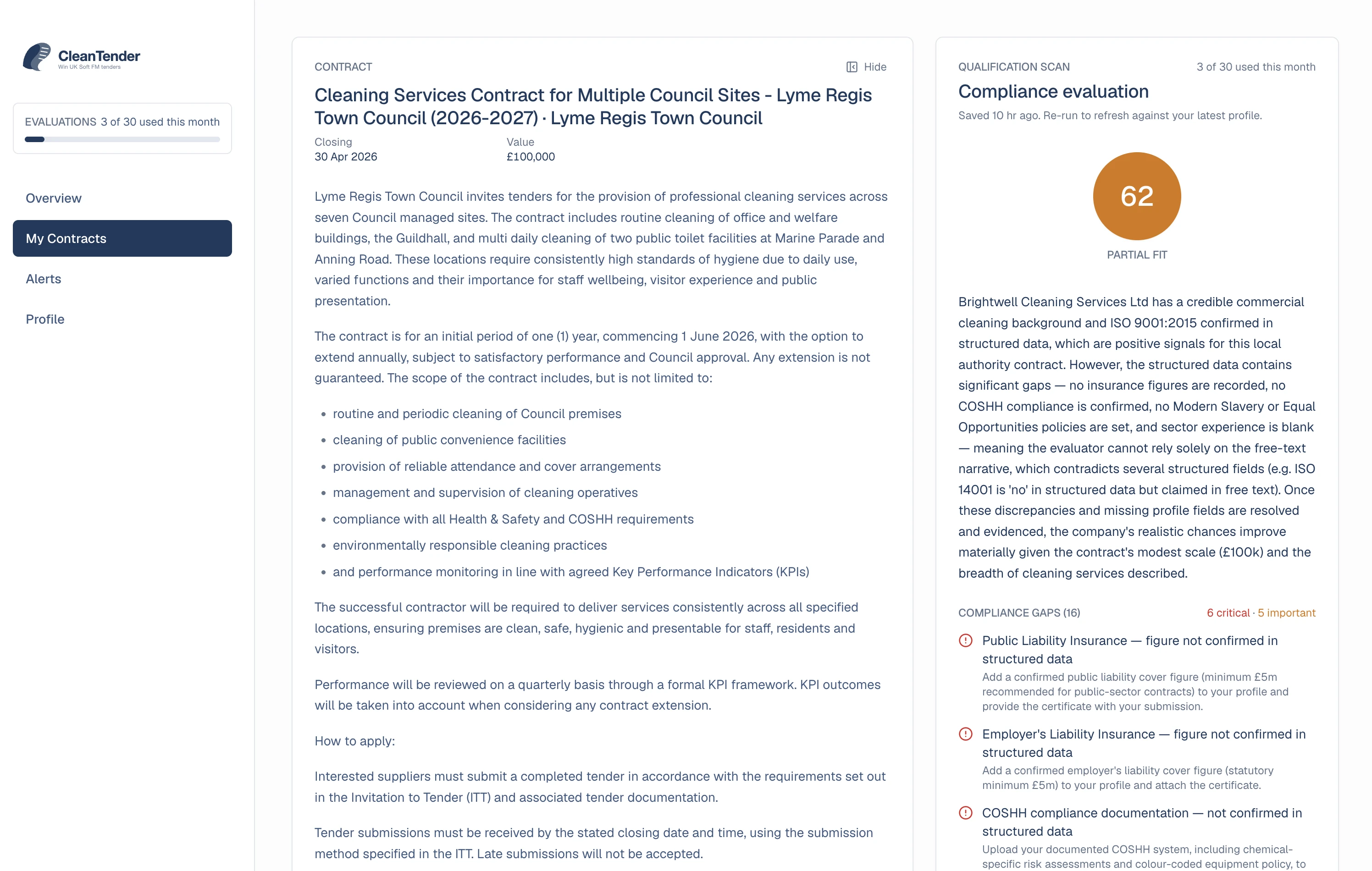
Fit-score and win-probability before you commit a weekend Step 5· 1 minute
Spot compliance gaps before you start drafting
CleanTender runs a named compliance check against the tender pack: SSIP accreditation, ISO 9001, SIA licensing and ACS, waste carrier registration, food hygiene rating, insurance levels. Anything missing is flagged before you sink hours into a bid that auto-fails at SQ.
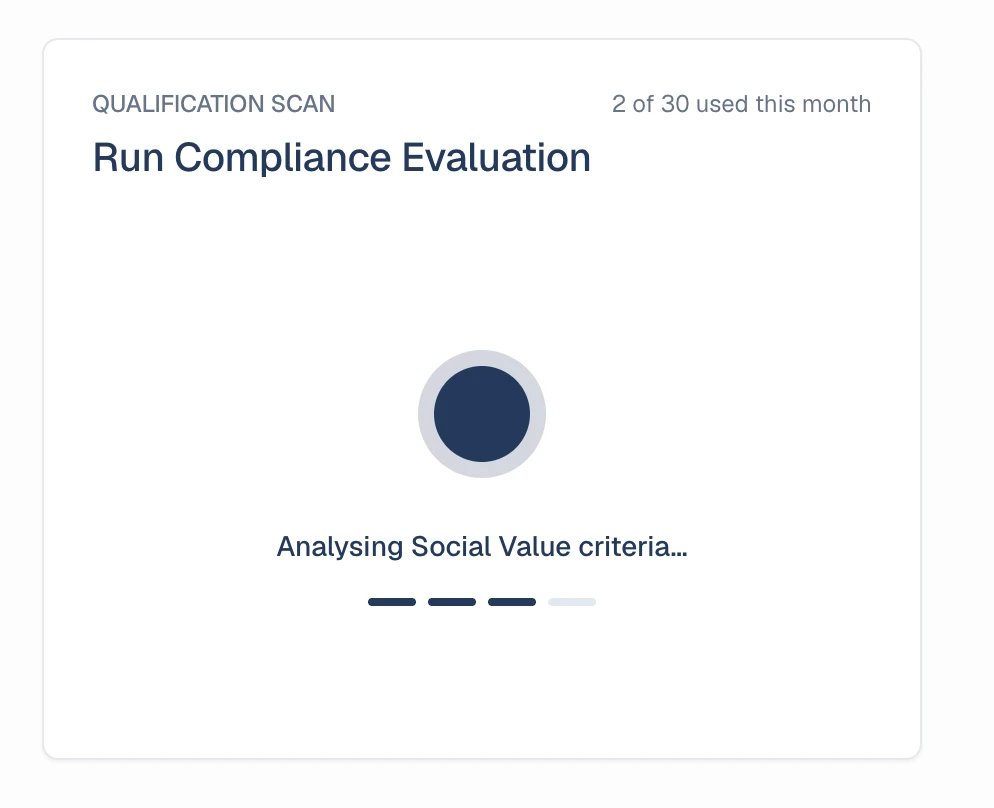
Compliance gaps surfaced before drafting Step 6· 2 minutes generation
Generate a full SQ + method-statement draft
CleanTender drafts a complete Standard Selection Questionnaire response using your profile data and the tender requirements: declaration block, company overview, contract experience, quality, training, COSHH, social value, H&S, insurance schedule. All ten sections, in one pass.
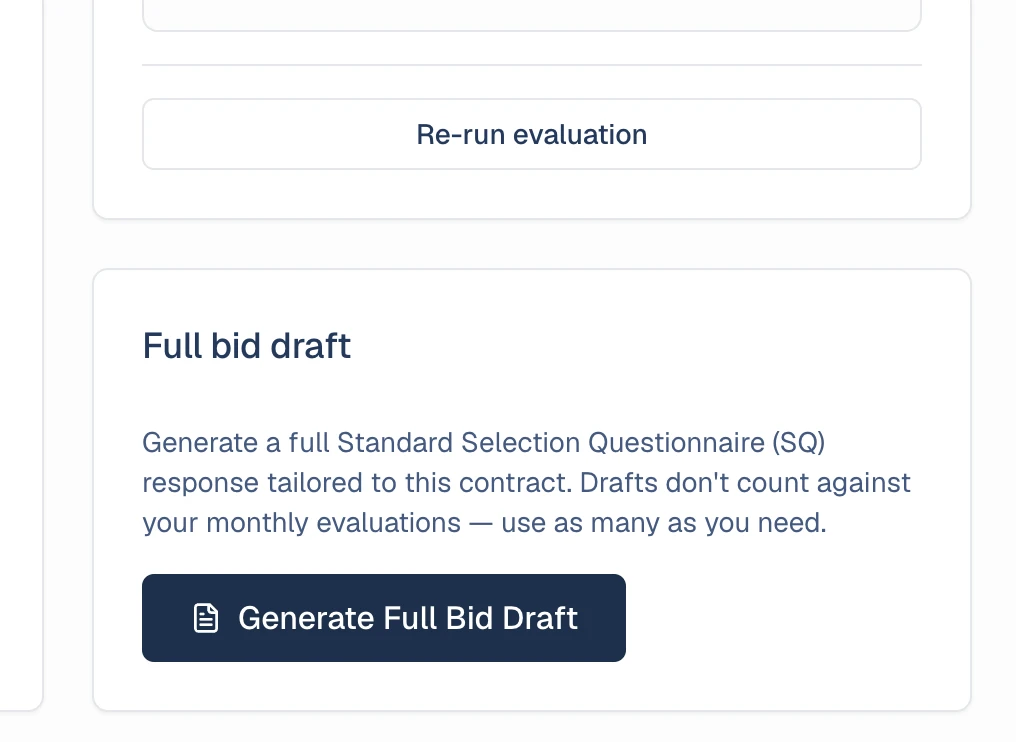
Full SQ draft generated in minutes, not days Step 7· Half a day
Refine, add evidence, and submit
Tune the draft, drop in named referees and certificate numbers, layer your quantified social value commitments, and submit through the buyer's portal. Most users compress a 30-60 hour first bid to 8-12 hours of focused review.
Step 8· Ongoing
Track outcomes and improve
Every bid logs in CleanTender with status, score, and (after standstill) the buyer's feedback. Use the standstill data to tune your next bid. Win rate compounds; first-bid completion is the only thing standing between you and a public-sector revenue line.
Browse live work by sector: cleaning tenders, security guarding tenders, grounds maintenance tenders, waste management tenders and catering tenders.
Sources
- Brent Council: ITT evaluation criteria and scoring matrix · Source of the 0-5 scale and the weightings chart.
- PPN 002: Taking account of social value in the award of contracts (gov.uk) · Sets the 10% minimum social value weighting.
- PPN 002 guide to using the Social Value Model (gov.uk)
- Procurement Act 2023 (legislation.gov.uk)
- PPN 017: Improving transparency of AI use in procurement (gov.uk)
- TUPE Regulations 2006 (legislation.gov.uk)
- Acas: TUPE guidance
- SIA Approved Contractor Scheme (gov.uk)
- Waste duty of care code of practice (gov.uk)
- School Food Standards resources (gov.uk)
- Food Hygiene Rating Scheme (Food Standards Agency)
- National Standards of Healthcare Cleanliness 2025 (NHS England)
- COSHH (HSE)
- British Institute of Cleaning Science (BICSc)
FAQs
Frequently asked questions
- A good example of bid writing answers the buyer's question in the first sentence, proves every claim with a number, names who does what and how often, and ends with how the buyer can check delivery. For a cleaning quality question, that means "we will audit all 22 sites monthly and fix failures within 4 hours" followed by the audit method, a real audit score from an existing contract, and the monthly report the council receives. Weak examples open with company history and use words like "high standards" and "regularly". Evaluators can't score adjectives. They score evidence against a marking guide, usually on a 0-5 scale.
- Start with the exact question, its weighting and its word limit. Read the marking descriptors and the matching part of the specification, then write in five parts: a one-line commitment in the buyer's words, your method (roles, tasks, frequencies), proof from a comparable contract, what you do when something goes wrong, and how the buyer checks you. Use the buyer's sub-questions as your headings and finish under the word limit. Replace every adjective with a figure. If you can't prove a claim, cut it rather than risk a false statement.
- Most UK public buyers score each quality answer on a 0-5 or 0-10 scale, then multiply by the question's weighting. On Brent Council's published scale, 0 is unacceptable, 3 is good and 5 is outstanding. Many ITTs set a minimum: Brent excludes any bid that scores 0 on a question or under 3 on two or more. Quality and price scores are added together, and price is often scored pro rata against the lowest bid. Under the Procurement Act 2023 buyers publish their criteria and weightings upfront, so you always know what each answer is worth.
- Numbers, dates and a reporting method. A strong social value answer commits to measurable outputs such as a percentage of new hires from the local area, a set number of apprenticeships, or qualifications gained by staff, and says how you'll measure each one and how often you'll report. It names who owns delivery and what happens if you fall behind. On central government contracts, PPN 002 sets social value at a minimum 10% of the total score, so treat it like any other quality question. Avoid vague pledges about "giving back" and charity donations unrelated to the buyer's priorities.
- As long as the word limit, minus a small buffer, and no longer. Most soft FM quality questions cap answers between 250 and 1,000 words. Evaluators often stop reading at the limit, so anything past it earns nothing. Short answers lose marks too: a 120-word reply to a 400-word question rarely has room for method, proof and assurance. Aim for 90-95% of the limit, spend the most words on method and proof, and keep your opening commitment to one or two sentences.
- Copy the structure, not the words. Evaluators read dozens of bids, and generic text is easy to spot and scores poorly because it doesn't match their sites or specification. The examples in this guide use placeholders like [client name] and figures you'd replace with your own. The proof has to be yours: your audit scores, your retention rate, your contracts. Never claim a number, accreditation or contract you can't evidence. Buyers can ask for proof, and a false claim can exclude you from the procurement.
- A method statement explains how you'll deliver the service: who does the work, what they do, how often, with what equipment and to what standard, plus how you manage risk and check quality. In soft FM tenders it's usually the highest-weighted quality question. A cleaning method statement covers frequencies, staffing, supervision, COSHH and audits. A grounds one covers the seasonal programme and site safety. Write it against the buyer's specification, section by section, and back each claim with evidence from a contract you already run.
- Yes. UK buyers can't ban it outright, and PPN 017 lets them ask whether you used AI so they can judge the risk. The risk isn't the tool. It's unchecked claims. AI drafts fast, but only your own records prove an audit score, a retention rate or a contract reference. Use software to get from a blank page to a first draft, then check every figure against your evidence before you submit. Tools that flag claims you can't back up save you from the answer that looks great and gets you excluded.