
A winning method statement on a UK public-sector cleaning tender has eight named sections. Scope, frequencies, products, equipment, staffing, COSHH, monitoring, escalation. Each one maps to a scoring criterion in the buyer's marking matrix. Brochure copy fails every time.
Below: the eight-section structure that scores 8-9 out of 10, two worked examples (council office and NHS ward block), and the swap list of phrasing that loses points versus phrasing that wins.
If your method statement could be copy-pasted into a competitor's bid by changing the firm name, you wrote brochure copy. Evaluators are not scoring your firm. They are scoring your understanding of this contract.

What's in this guide
- How to write a winning cleaning method statement, step by step (CleanTender walkthrough)
- What evaluators are actually scoring against
- The eight-section structure that scores
- A worked example: 1,200m² council office
- A worked example: 60-bed NHS ward block
- Common phrasing that loses points (and what to write instead)
- How to map your statement to the marking matrix
- FAQs on COSHH, BS EN 1276, supervisor qualifications
How to win a UK cleaning method statement tender, step by step
The complete end-to-end flow inside CleanTender. From sector setup to a submitted cleaning method statement bid in the time it used to take to read a single tender pack.
Eight steps from "never bid public sector" to a complete SQ response on the buyer's portal. First scan is free.
Step 1· 10 minutes
Build your cleaning method statement company profile
Set your sector to cleaning method statement, your service regions, BICSc accreditation, COSHH compliance, ISO 9001 status, colour-coded equipment system, sector experience (NHS / schools / offices), staff training records, insurance levels, turnover, and operative count. CleanTender uses this to fit-score every live tender against your real capability so you only see the ones you can win.
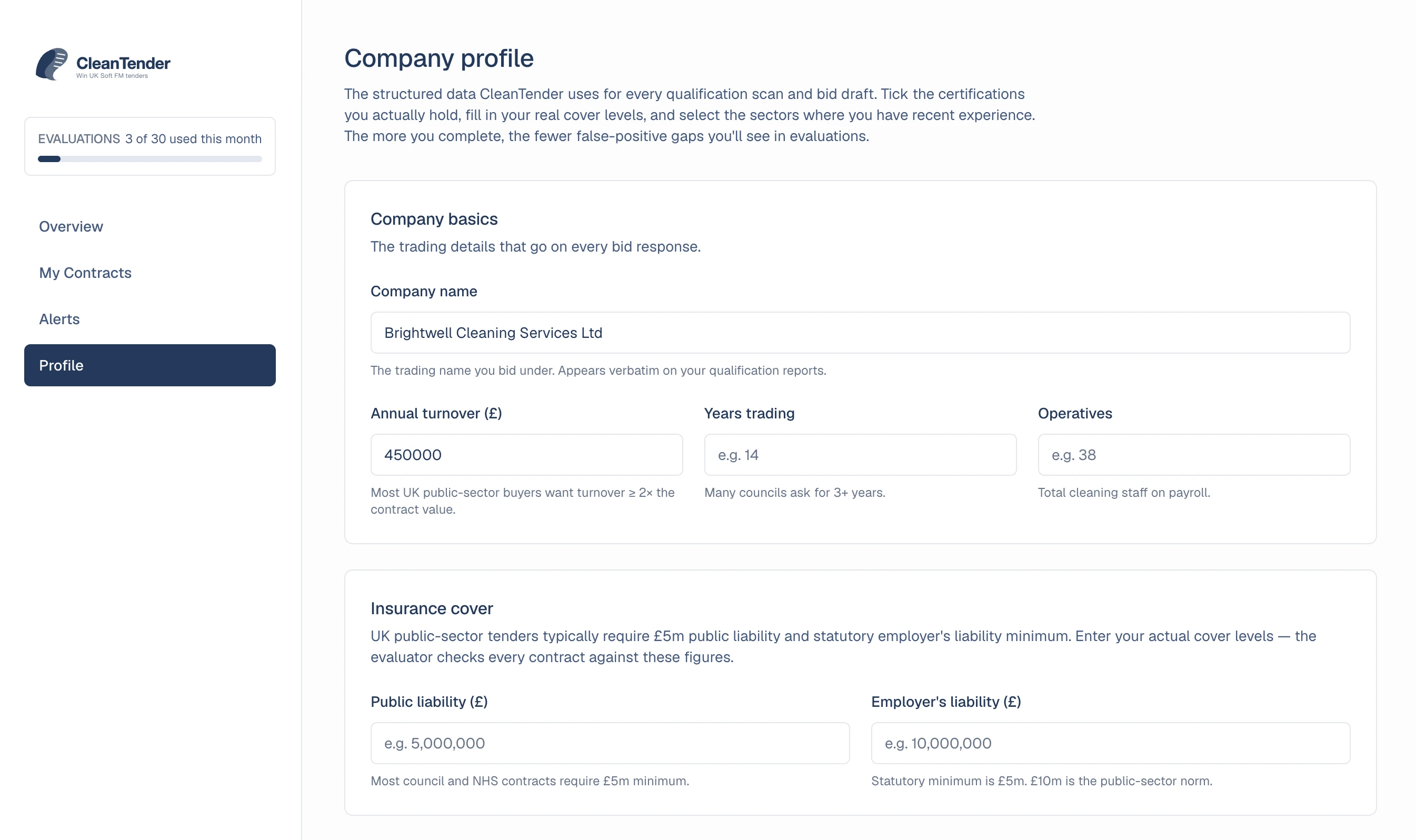
Profile setup defines what you are bid-ready for Step 2· 5 minutes daily
Open the live cleaning-tender feed
Every UK council, NHS Trust, school, university, MoD, and central government cleaning tender, in one feed. Pre-filtered to your sector and geography. No false positives, no manual portal-trawling across FTS, Contracts Finder, and dozens of buyer e-procurement portals.
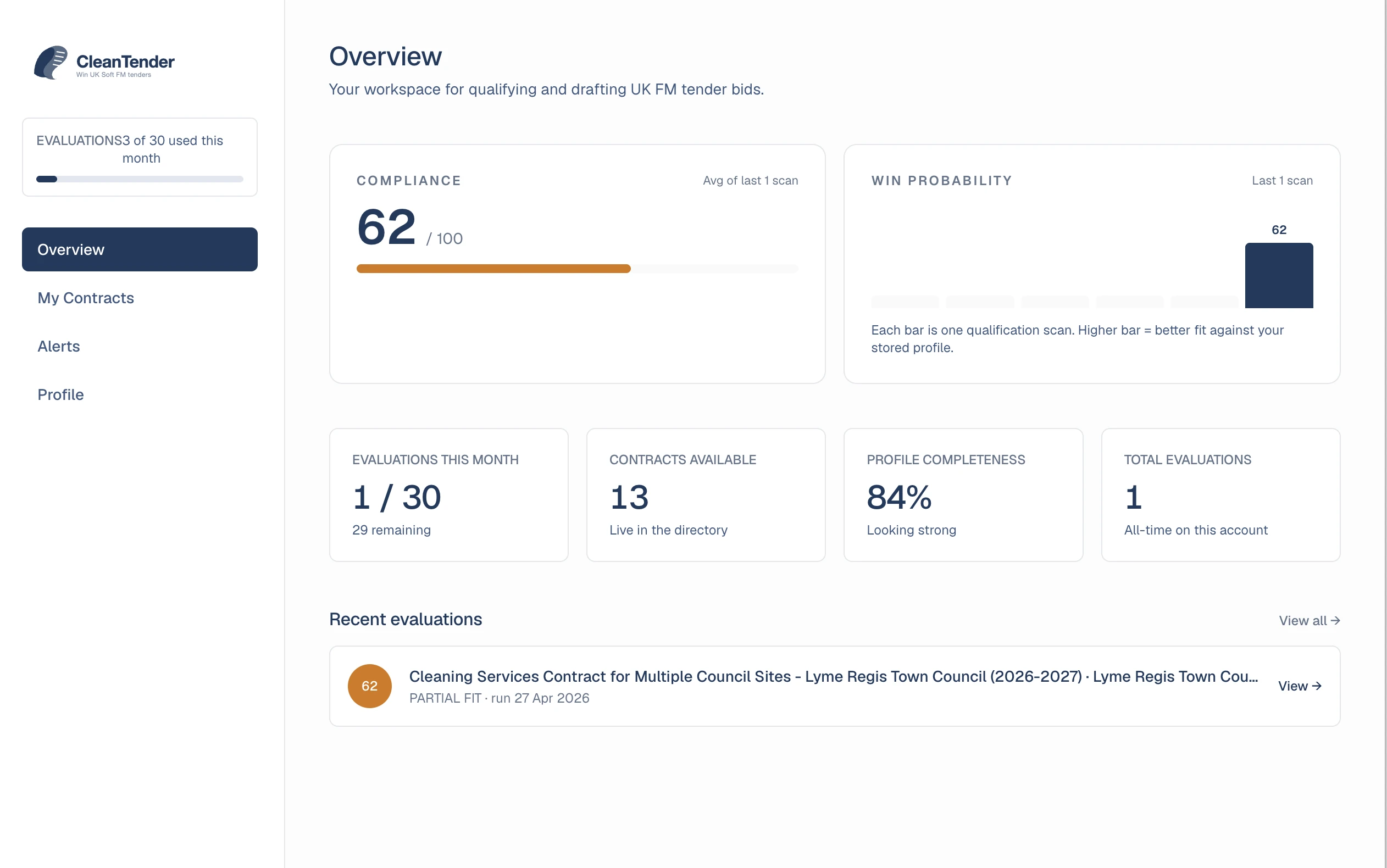
Live feed of in-scope cleaning tenders, fit-scored Step 3· Daily digest
Get email alerts for new in-scope tenders
New cleaning method statement tenders matching your profile land in your inbox the day they publish. CleanTender batches them into a daily digest so you do not get notification fatigue, and links straight back to the in-app fit score.
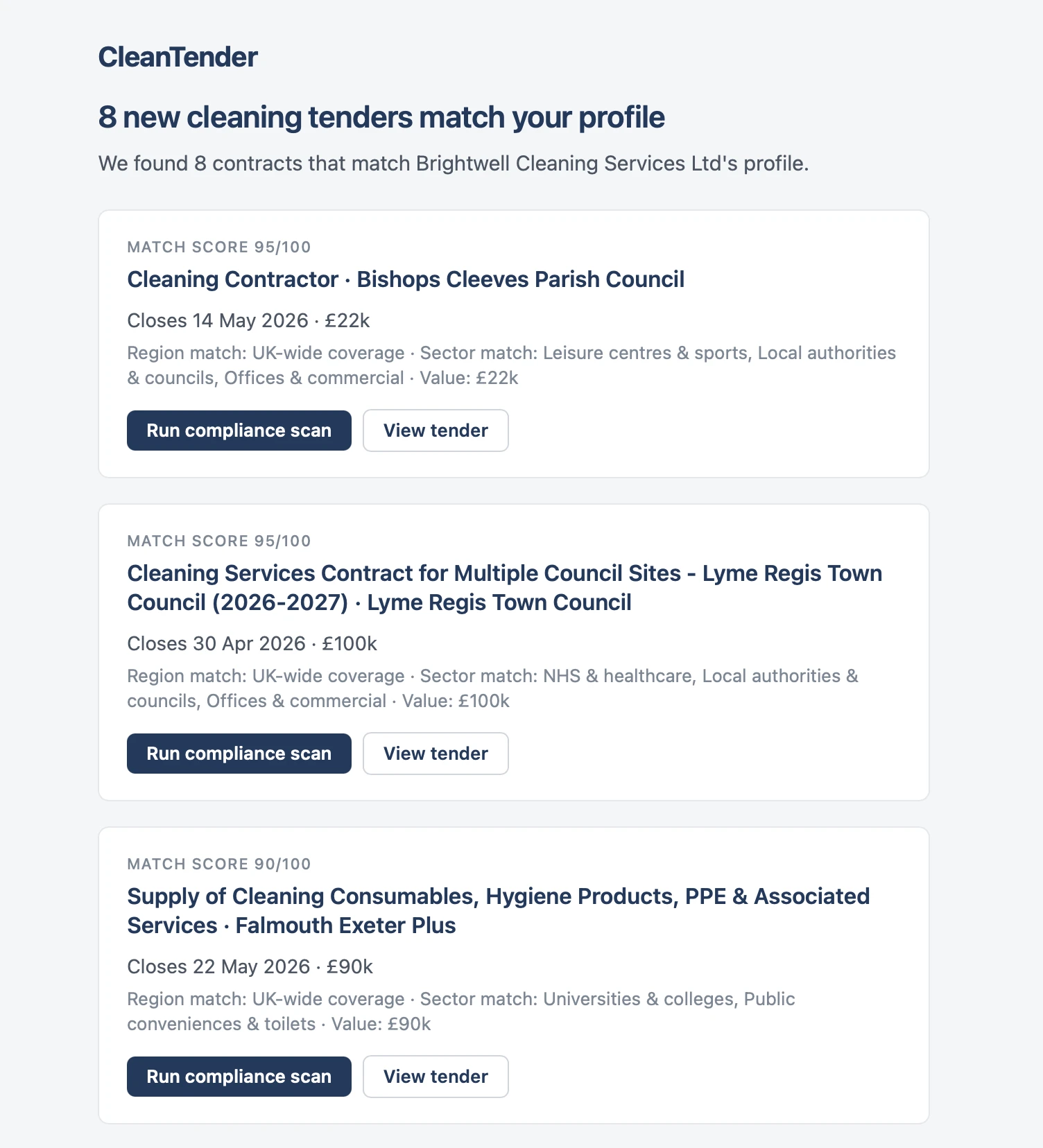
Daily alerts for new in-scope tenders Step 4· 30 seconds
Run a fit-score evaluation on a target tender
One click runs a CleanTender Evaluation against the tender pack: scope match, geography fit, scale fit, compliance gap, and a plain-English win probability. Stops you bidding contracts you were never going to win.
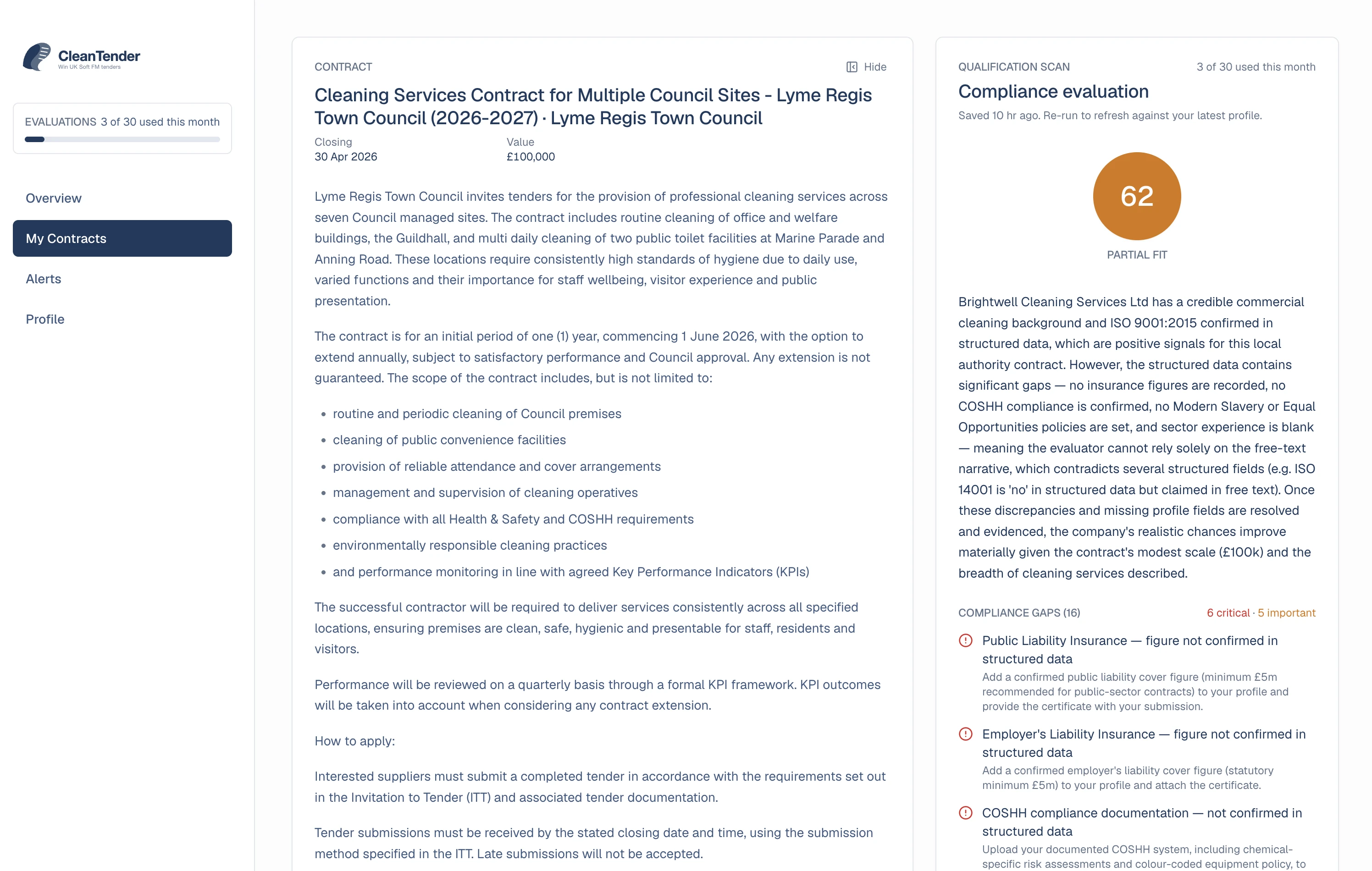
Fit-score and win-probability before you commit a weekend Step 5· 1 minute
Spot compliance gaps before you start drafting
CleanTender runs a named compliance check against the tender pack: BICSc, COSHH, ISO 9001, ISO 14001 if held, SSIP, TUPE pack, social value plan, method statement structure (8 sections). Anything missing is flagged before you sink hours into a bid that auto-fails at SQ.
Compliance gaps surfaced before drafting Step 6· 2 minutes generation
Generate a full SQ + method-statement draft
CleanTender drafts a complete Standard Selection Questionnaire response using your profile data and the tender requirements: declaration block, company overview, contract experience, quality, training, COSHH, social value, H&S, insurance schedule. All ten sections, in one pass.
Full SQ draft generated in minutes, not days Step 7· Half a day
Refine, add evidence, and submit
Tune the draft, drop in named referees and certificate numbers, layer your quantified social value commitments, and submit through the buyer's portal. Most users compress a 30-60 hour first bid to 8-12 hours of focused review.
Step 8· Ongoing
Track outcomes and improve
Every bid logs in CleanTender with status, score, and (after standstill) the buyer's feedback. Use the standstill data to tune your next bid. Win rate compounds; first-bid completion is the only thing standing between you and a public-sector revenue line.
What evaluators are scoring against
Public-sector procurement teams use a marking matrix. The buyer wrote it before the tender went live. It says, for each quality question, what scores 0, 3, 5, 7, and 10. Most matrices are now published in the tender pack itself or released on request under the Procurement Act 2023's transparency rules.
Read the matrix before you write the answer. If the 10/10 row says "Bidder names cleaning products with EN standards, provides daily and weekly frequency tables broken out by room type, and includes a named QA supervisor with relevant qualifications", that is the answer you write. Three things, in that order, with that level of detail.
| Score | What it looks like |
|---|---|
| 10/10 | Site-by-site detail. Named products with EN standards. Frequency tables by room type. Named supervisor and QA process. Clear escalation. References COSHH and BS EN 1276. |
| 7/10 | Mostly site-relevant. Some named products. Frequencies broken into broad categories (daily/weekly). Named supervisor role but not person. COSHH mentioned. |
| 5/10 | Generic but coherent. "Industry best practice". Frequencies referenced but not tabled. No named products. Generic supervisor structure. |
| 3/10 | Marketing copy. "We pride ourselves on quality." No frequencies. No product names. No COSHH reference. |
| 0/10 | Off-topic, missing, or copy-pasted from a different sector. |
Typical 10-point marking matrix for a council cleaning method statement.
The eight-section structure that scores
Use the same eight sections on every cleaning method statement. The buyer may ask for them in a different order, but the content is the same. Build it once, modify per bid.
- Scope confirmation: what areas, what frequencies, what specialist tasks (window cleaning, carpet, floor strip-and-seal). Reference the page numbers in the spec.
- Frequency table: daily, weekly, monthly, quarterly tasks broken out by room type.
- Cleaning products: named with EN standards (BS EN 1276 for disinfectants, BS EN 14476 for virucides). COSHH safety data sheets attached as appendix.
- Equipment: vacuums (HEPA where required), microfibre cloths colour-coded for cross-contamination control, scrubber-dryers if applicable, ladders and access equipment for high-level cleaning.
- Staffing model: number of operatives per shift, supervisor ratio, named site supervisor with qualifications (NVQ Level 2 in Cleaning and Support Services minimum, BICSc accreditation a plus).
- COSHH and risk management: chemical storage, PPE issued, training records, incident reporting flow.
- Quality monitoring: how you check the work. BICSc audits, customer satisfaction surveys, monthly KPI reports to the contract manager.
- Escalation: what happens when something goes wrong on a Saturday at 3am. Named on-call number, response time, deputy supervisor cover.
Worked example: 1,200m² council office, 5 days a week
Tender pack says: 1,200m² of council office space, 80 desks, 6 meeting rooms, 4 kitchens, 8 toilets (4 male, 4 female, 1 accessible), Monday to Friday cleaning between 17:00 and 21:00, with washroom servicing at 12:00. 12-month base term, two 12-month extensions.
Here is what scores 8-9 out of 10 on a typical council marking matrix.
| Area | Daily (5x/wk) | Weekly | Monthly | Quarterly |
|---|---|---|---|---|
| Open-plan desks (80) | Empty bins, dust desks, vacuum carpet, spot-clean spillages | Full carpet vacuum including under desks, dust monitor screens | Damp wipe all hard surfaces, vent grilles | Deep extraction carpet clean (booked separately) |
| Meeting rooms (6) | Empty bins, wipe table tops, vacuum floor, restock whiteboard pens | Damp clean chairs, wipe AV equipment | Window cleaning (internal) | Furniture move-out + deep clean |
| Kitchens (4) | Wipe surfaces, empty bins, mop floor, restock supplies | Damp wipe cupboard fronts, descale kettles, sanitise fridge | Deep clean inside microwave, behind appliances | Floor strip and reseal |
| Toilets (8) | Twice daily: 12:00 servicing + full evening clean. Sanitise all touch-points (BS EN 1276 disinfectant). Restock consumables. | Descale taps and toilet bowls | Damp wipe ceiling vents, deep grout clean | Full mechanical floor scrub |
| Common touch-points (door handles, lift buttons, reception desk) | Daily disinfection with BS EN 1276 wipes (verified at 5-min contact time) | n/a | n/a | n/a |
Frequency table extract for a 1,200m² council office cleaning contract.
Now the staffing model. Two operatives between 17:00 and 21:00 (8 staff hours per night). One mid-day washroom attendant for the 12:00 sanitise (1 hour). Site supervisor (NVQ Level 2 in Cleaning and Support Services, BICSc Cleaning Operators Proficiency Certificate) on site three evenings a week and on call the other two. Total: 41 staff hours per week, plus 4 supervisor hours.
Notice what is in there. Real numbers. Real qualifications. Real product references. Real time windows that match the spec. An evaluator scoring against the matrix has six things to tick: scope confirmed, frequencies tabled, products named with EN standards, equipment described, supervisor named with qualifications, and a clear staffing model. That is an 8-9 out of 10.
Worked example: 60-bed NHS ward block
NHS cleaning is a different animal. The National Standards of Healthcare Cleanliness 2025 set six Functional Risk Categories (FR1 to FR6, expanded from the four in the 2021 version) with audit target scores and frequencies. Your method statement has to reference these by name and number, not paraphrase them.
| FR Category | Audit target | Audit frequency | Examples of covered areas |
|---|---|---|---|
| FR1 | 98% and above | Weekly | Operating theatres, ICU, A&E/resuscitation, chemotherapy units, pharmacy aseptic areas |
| FR2 | 95% and above | Monthly | Acute and community wards, treatment rooms for invasive procedures, endoscopy, dialysis |
| FR3 | 90% and above | Every 2 months | Mental health wards, urgent care centres, mortuaries, emergency patient transport vehicles |
| FR4 | 85% and above | Every 3 months | General outpatient departments, waiting areas, public corridors, consulting rooms, entrances and receptions |
| FR5 | 80% and above | Every 6 months | Main receptions, non-emergency patient transport vehicles, visiting rooms not directly attached to a ward |
| FR6 | 75% and above | Every 12 months | Administration and office areas, medical records, stores departments, education and training centres |
Functional Risk Categories under the National Standards of Healthcare Cleanliness 2025, with audit targets and frequencies.
Two things to know. Audit results are reported as both a percentage score and a 1-5 star rating for public display. And NHS organisations can run a "blended area approach" where rooms inside a larger functional area get assigned different risk categories (an FR5 office inside an FR2 ward, for example), as long as they have a documented rationale.
On NHS bids, your method statement must show you understand which areas are which FR category, what audit cycle applies, and which products and processes meet the requirement. Generic answers fail. "We use NHS-approved products" fails. "We use BS EN 1276 and BS EN 14476 disinfectants on FR1 and FR2 areas, with verified 5-minute contact time, and sodium hypochlorite at 1,000ppm for terminal clean of FR1 areas after suspected outbreak cases" passes.
Phrasing that loses points (and what to write instead)
Most cleaning method statements use the same eight or nine phrases. They sound professional. They score 3-5 out of 10. Here is the swap list.
| Loses points | Scores points |
|---|---|
| We use industry best practice | Cleaning to BS EN 1276 and BS EN 14476 standards on all touch-points, with documented 5-minute contact time |
| Our staff are fully trained | All operatives hold BICSc Cleaning Operators Proficiency Certificate. Site supervisor holds NVQ Level 2 in Cleaning and Support Services |
| We provide a high-quality service | Monthly BICSc-aligned audits with 95% target score. Customer satisfaction survey quarterly. Monthly KPI report to the contract manager |
| We offer 24/7 support | On-call duty supervisor 18:00 to 06:00 weekdays, 24h weekends. Response within 2 hours for any issue affecting the site |
| We use eco-friendly products where possible | EU Ecolabel certified products on all daily-use chemicals. Concentrated dilution system reduces chemical use by 70% and packaging by 95% |
| We have a strong quality management system in place | ISO 9001:2015 certified by NQA (UKAS-accredited). Monthly internal audits, six-monthly external surveillance |
Common method-statement phrases that lose points, and what to write instead.
Map your statement to the marking matrix
Once you have written the eight sections, do one final pass. Open the marking matrix from the tender pack. Read the 10/10 description for each scoring criterion. Highlight the words that show up: "frequency", "COSHH", "named supervisor", "BS EN standards", "audit", "escalation".
Now Ctrl-F your draft for each of those words. If they do not appear, add them. The evaluator's eye is trained to look for those terms. Make her work easy. Score points.
If your draft is still scoring under 7 after that pass, the upstream problem is usually bid selection, not writing. Most cleaning bids that score under 7 on quality were the wrong bids to start. The seven mistakes cleaning companies make in public tenders covers the qualification gates that filter wrong-fit bids before you waste a method statement on them.
What to do this week
- Pull a method statement from a recently lost bid. Score it yourself against the eight-section structure. The gaps will be obvious.
- Build a master document of named products with EN standards. BS EN 1276 (disinfectant), BS EN 14476 (virucide), BS 6263 (floor coatings). One page. Reuse on every bid.
- Check your supervisor qualifications register. NVQ Level 2 in Cleaning and Support Services and BICSc Cleaning Operators Proficiency Certificate are the two most-cited on UK public-sector tenders.
- Map the eight sections to your last five bids. If three of them are missing the same section, that is the biggest single fix you can make this month.
- On the next bid, read the marking matrix before you write the answer. Write to the 10/10 description, not to a template.
Sources
- National Standards of Healthcare Cleanliness 2025 (NHS England) · FR1-FR6 risk categorisation and audit frequencies for NHS cleaning
- BS EN 1276 (BSI) · European standard for chemical disinfectants and antiseptics
- BICSc Cleaning Operators Proficiency Certificate · Industry qualification for cleaning operatives
- COSHH Regulations 2002 (HSE) · Mandatory chemical risk control on every UK cleaning contract
- Procurement Act 2023 (legislation.gov.uk) · Transparency rules for marking matrix publication
FAQs
Frequently asked questions
- Eight sections in this order: scope confirmation (with page references to the tender spec), a frequency table broken out by room type, named products with EN standards (BS EN 1276 for disinfectants, BS EN 14476 for virucides), equipment list, staffing model with named supervisor and qualifications, COSHH and risk management, quality monitoring (BICSc-aligned audits, customer surveys, monthly KPI reports), and escalation procedures with named on-call cover. Each section maps to a scoring criterion in the buyer's marking matrix.
- BS EN 1276 is the bactericidal efficacy standard cited in most UK public-sector cleaning tenders. BS EN 14476 covers virucidal efficacy for healthcare and high-risk environments. NHS contracts under the National Standards of Healthcare Cleanliness 2025 also require sodium hypochlorite at 1,000ppm for terminal cleans of isolation rooms. EU Ecolabel certification adds points on environmental scoring sections. Always include the EN standard number in your method statement, not just the brand name.
- NVQ Level 2 in Cleaning and Support Services is the most commonly cited supervisor qualification on UK council and NHS cleaning tenders. The BICSc (British Institute of Cleaning Science) Cleaning Operators Proficiency Certificate is the standard for operatives. NHS contracts may also require additional infection prevention and control training. Larger or higher-risk contracts (FR1 NHS areas, secure sites) may require the BICSc Cleaning Supervisor Certificate or equivalent. Name the actual qualification standard in your method statement, not just "trained staff".
- Most council cleaning tenders cap method statements at 4-8 sides of A4 per quality question, with 12pt font and standard margins. NHS frameworks often go higher (8-15 sides). Word counts of 1,500-3,500 words per question are typical. Fill the space with named products, frequency tables, and site-by-site detail rather than padding. Tables count for the page limit. Marking matrices reward density of relevant evidence, not prose length.
- A method statement describes how you will deliver the service. A risk assessment identifies what could go wrong and how you mitigate it. Most public-sector cleaning tenders require both. The method statement covers products, frequencies, staffing, and quality monitoring. The risk assessment covers chemical handling, slip and trip hazards, working at height, lone working, and biohazard procedures. Both should reference COSHH (Control of Substances Hazardous to Health) Regulations 2002 and align to your ISO 9001 quality management system if you hold one.