
UK public-sector grounds maintenance buyers are no longer scoring the cheapest cut-price-per-hectare.
Five regulatory shifts now sit at the heart of every council, NHS Trust, school, MoD, university, and housing-association grounds tender. Miss one in your method statement and the technical score caps at 4/10 before the evaluator has even looked at your fleet inventory.
Regulatory landscape at a glance
Each card is a named framework an evaluator will look for in your SQ. Reference all five, with documented evidence, to score in the 8-9 band.
BS 7370
Grounds maintenance code of practice (4 parts)
Backbone
Parts 1-4 cover general, hard areas, sports surfaces, and soft landscape. Named on most council tender specs as the technical baseline.
BSI standards pageSustainable Use of Pesticides
Plant Protection Products Regs 2012 (retained)
PA1 + PA2/PA6
Every operator using plant protection products on amenity land needs NPTC PA1 plus PA2 (boom) or PA6 (knapsack). Spray records per application.
legislation.gov.ukWildlife and Countryside Act 1981
Section 1: protection of wild birds
1 Mar – 31 Aug
Documented nesting-bird protocol required for all hedge and rough-grass work. Evidence outside the window also triggers protection.
legislation.gov.ukBiodiversity Net Gain
Environment Act 2021
10% min
Major development from Feb 2024, small sites from April 2024. Councils now expect grounds contractors to support BNG monitoring on managed estate.
gov.uk collectionProcurement Act 2023
SQ structure + most-advantageous-tender rules
Live
Restructured SQ, new "abnormally low tender" rejection mechanics, transparent rate-stack pricing now favoured over opaque flat rates.
legislation.gov.ukPPN 002
Social Value Model
10% weighting
Mandatory minimum on central government tenders; most councils and NHS Trusts now match or exceed. Quantified, dated commitments score 8-9.
gov.uk publicationTree work adds a sixth layer that catches generalists at scoring: NPTC CS30/CS31 chainsaw tickets, CS38 climbing, plus LOLER 1998 inspection records on every piece of lifting equipment. For the underlying method-statement structure that scores 8-9 on these compliance sections, see the grounds maintenance method statement guide. For ISO 14001 versus ISO 9001 trade-offs when budgets are tight, see ISO 9001 vs ISO 14001 for FM tenders.
What's in this guide
- What buyers score on (the marking matrix patterns)
- Pricing factors: rate per hectare, frequency, fleet, arb work, sundries
- The 6 main public-sector grounds maintenance markets
- Method statement structure tuned for grounds tenders
- Social value commitments that score in grounds maintenance
- When NOT to bid
- How to win a UK grounds maintenance tender (step by step in CleanTender)
What buyers score on (the marking matrix patterns)
| Criterion | Typical weighting | What scores 8-9/10 |
|---|---|---|
| Price (rate per hectare or per visit, sundries, capex contribution) | 30-40% | Transparent rate per hectare by terrain type (amenity grass, sports turf, ornamental, woodland edge), per-visit pricing on hard areas, named CPI uplift mechanism with cap, no hidden surcharges |
| Method / technical capability | 25-35% | BS 7370 Part 1-4 referenced by section, mowing frequency by zone, hedge programme with nesting-bird window, sports-turf renovation programme, fleet inventory with electric or hybrid percentage |
| Environmental and biodiversity | 10-20% | ISO 14001 certified, biodiversity baseline survey, pollinator-friendly verge or meadow conversion, integrated pest management evidence, peat-free policy with named substitute |
| Social value (PPN 002) | 10-20% minimum | Apprentice horticulturists, community planting days, partnership with local biodiversity trust, social-prescribing green-care sessions, local SME plant nursery supply |
| Health, safety, and compliance | 5-10% | ISO 9001 + ISO 14001 + ISO 45001, SSIP-recognised certificate, NPTC ticket evidence per operator, LOLER 1998 inspection records, COSHH Regs 2002 inventory |
Typical scoring breakdown on UK public-sector grounds maintenance tenders in 2026.
Pricing factors for UK grounds maintenance tenders
Grounds pricing is layered. A council parks contract, a school playing-field contract, and an NHS Trust hospital-grounds contract have completely different cost structures.
The contractor's margin sits on the gap between the headline rate per hectare and the true loaded cost of mowing fuel, ride-on capex, arb fleet, NPTC training cycle, sundries, and weather contingency.
| Component | Rough range (2026) | Notes |
|---|---|---|
| Amenity grass mowing (per hectare per cut) | £28-£55 per hectare | Varies with terrain, obstacle density, slope, transport. Park gangs lower; school sites higher. |
| Sports turf maintenance (per pitch per year) | £3,500-£8,500 per pitch | Football, rugby, cricket pitches; mowing, marking, aeration, scarification, top-dressing, end-of-season renovation |
| Hedge cutting (per linear metre per cut) | £0.45-£1.20 per metre | Subject to nesting-bird protocol; height and access affect rate |
| Tree work (per hour, three-person team plus chipper) | £140-£220 per hour | Specialist crews, MEWP hire when needed, traffic management adds £200-£500 per day on highway-side work |
| Litter pick (per hectare per visit) | £15-£35 per hectare | Council parks contracts often bundle with mowing; volume varies post-event |
| Spray operator (per visit, qualified PA1/PA6) | £60-£120 per visit | Plus chemicals; integrated pest management reduces spray frequency |
| Plant and equipment overhead | 12-22% of contract value | Ride-on mowers (£40k-£90k each, 7-year cycle), pickups, chippers, vans, telehandlers, arb gear |
| Training and accreditation cycle | £250-£500 per operator per year | NPTC revalidation, CPD, first aid, manual handling, CDM awareness |
Cost components in a typical UK public-sector grounds maintenance contract.
The 6 main UK public-sector grounds markets
| Sector | Key standards | Typical contract shape |
|---|---|---|
| Local authority parks, highways verges, cemeteries | BS 7370 Parts 1-4, Wildlife and Countryside Act 1981, Hedgerow Regs 1997, NPTC PA1/PA6, biodiversity net gain support | 5-7 year contracts, often £1m-£20m. Frameworks via YPO, ESPO, NEPO. Increasing scope for biodiversity and pollinator deliverables. |
| State schools and academy trusts | BS 7370 Parts 3-4, NPTC PA1/PA6, enhanced DBS for grounds-staff working during term, sports-pitch renovation | Mowing, sports-pitch maintenance, term-time access constraints. Multi-academy trust frameworks growing. |
| NHS Trust estates | BS 7370 Parts 1-4, ISO 14001, infection-control awareness near clinical zones, dementia-friendly garden design familiarity | Hospital grounds, helipad clearance, mental-health unit therapeutic gardens. 5-7 year contracts via NHS Supply Chain or Trust-direct. |
| MoD (defence estate) | BS 7370, security clearance (BPSS, CTC depending), DEFCON-bound contracts, training-area habitat awareness | Living-in establishments, training estates, MoD housing. Specialist sector with sustained workload. |
| Universities and FE colleges | BS 7370, BREEAM and SKA-rating familiarity, sustainability commitments, biodiversity baselines | Campus grounds, sports facilities, ornamental planting. Often part of integrated FM or standalone sustainability-led. |
| Social housing (housing associations and councils) | BS 7370 Part 4, communal-area maintenance, schedule of rates (SOR) familiarity, tenant-engagement protocol | Estate grounds, communal lawns, hedges, paths. £500k-£8m per landlord, 5-year terms via SBS, Procurement for Housing, etc. |
UK public-sector grounds maintenance markets and the standards each requires.
Most SME grounds contractors cluster around local authority and social housing work. NHS estate work needs infection-control awareness near clinical zones and clear vehicle-access protocols. School work has term-time access constraints and sports-pitch peaks. MoD requires security clearance and DEFCON contract familiarity. University work increasingly carries biodiversity and BREEAM expectations. Match your bid scope honestly to your operational base.
Method statement structure for grounds tenders
- Scope confirmation: site list with hectares by terrain type (amenity grass, sports turf, ornamental beds, hedges, woodland edge, hard areas), service frequency by zone, BS 7370 Part references for each. Reference page numbers in the tender spec.
- Mowing programme: cut frequencies by season (typically 16-22 cuts per year for amenity grass), mower type by site (ride-on, pedestrian, flail, cylinder), arisings management, sports-turf height-of-cut bands.
- Hedge and shrub programme: cut windows aligned to Wildlife and Countryside Act 1981 (no cutting 1 March to 31 August unless ecology survey clears the work), pre-works check methodology, named ecologist contact.
- Tree work: NPTC ticket inventory (CS30/CS31, CS38, CS39), LOLER 1998 inspection schedule, MEWP hire arrangement, traffic management protocol for highway-side work, TPO and Conservation Area consent process.
- Pesticide regime: NPTC PA1 plus PA2 or PA6 ticket evidence per operator, integrated pest management policy, spray records per application, peat-free and glyphosate-reduction approach.
- Sports turf programme: pitch-by-pitch annual maintenance cycle, end-of-season renovation, line marking, drainage and aeration, sport-by-sport governing body standards (RFU, FA, ECB).
- Compliance evidence: ISO 9001 + ISO 14001 + ISO 45001 if held, SSIP-recognised certificate, BALI or APL membership if held, public liability insurance level, employer's liability level.
- Biodiversity and environment: pollinator-friendly verge or meadow conversion plan, peat-free policy, electric or hybrid mower percentage with year-three target, water-use approach, wildlife-friendly mowing schedule.
- Reporting and KPIs: monthly site reports with photos, complaint response time, sports-pitch playability metric, audit cycle, customer satisfaction surveys.
- Escalation: weather-disrupted programme catch-up plan, named on-call manager for storm response, deputy cover, escalation up to operations director, business continuity plan.
Social value commitments that score in grounds
PPN 002 (live 1 October 2025) sets a 10% minimum social value weighting on UK central government tenders, and most local authorities and NHS Trusts now match or exceed that. Grounds maintenance contracts have natural social value angles that score well when quantified.
- Apprentice horticulturists: "Three Level 2 horticulture apprenticeships in year one, drawn from the contract area, working toward Level 3 by year three. Active partnership with [local FE college]."
- Pollinator-friendly conversion: "Year-one conversion of 5 hectares of mown verge to species-rich pollinator meadow, with named annual monitoring by [local biodiversity trust]. Forecast biodiversity gain measured against the DEFRA metric."
- Community planting days: "Quarterly community-planting days on the contract estate, partnered with local schools and community groups. Forecast 800 hours of community engagement per year."
- Social prescribing green-care: "Year-one partnership with [NHS social prescribing link worker network] to host weekly green-care sessions for adults referred by primary care for low-mood, anxiety, or social isolation."
- Local SME plant nursery supply: "Year-one supply chain spend with SME plant nurseries within 50 miles of the contract area to reach 30% of plant and bulb spend, reported quarterly. Peat-free supply prioritised."
When NOT to bid
- Geography mismatch. Grounds work is intensely local. Mowing economics break beyond a 30-mile travel radius from depot. Bidding 60+ minutes from your operational base is usually unprofitable.
- Terrain mismatch. Bidding sports turf when your team has only mown amenity grass. Pitch renovation, drainage, and end-of-season programmes catch out generalists at scoring.
- Scale mismatch. Total contract value above 2x your turnover. Buyers worry about ride-on fleet availability, depot capacity, and supplier collapse risk.
- No ISO 14001. The certification gate is increasingly hard. UKAS-accredited ISO 14001 takes 6-12 months and £4,000-£8,000 first year.
- No NPTC PA1/PA6 spray operator. If chemical control is in scope and you do not have certified spray operators, the bid is auto-failed at SQ.
- No nesting-bird protocol on hedge work. Wildlife and Countryside Act 1981 prosecutions damage reputation and kill bid pipeline; bids without a documented protocol fail technical scoring.
How to win a UK grounds maintenance tender, step by step
The complete end-to-end flow inside CleanTender. From sector setup to a submitted grounds maintenance bid in the time it used to take to read a single tender pack.
Eight steps from "never bid public sector" to a complete SQ response on the buyer's portal. First scan is free.
Step 1· 10 minutes
Build your grounds maintenance company profile
Set your sector to grounds maintenance, your service regions, BS 7370 capability, NPTC ticket inventory (PA1/PA6, CS30/CS31, CS38), ISO 14001 status, fleet inventory, insurance levels, turnover, and operative count. CleanTender uses this to fit-score every live tender against your real capability so you only see the ones you can win.
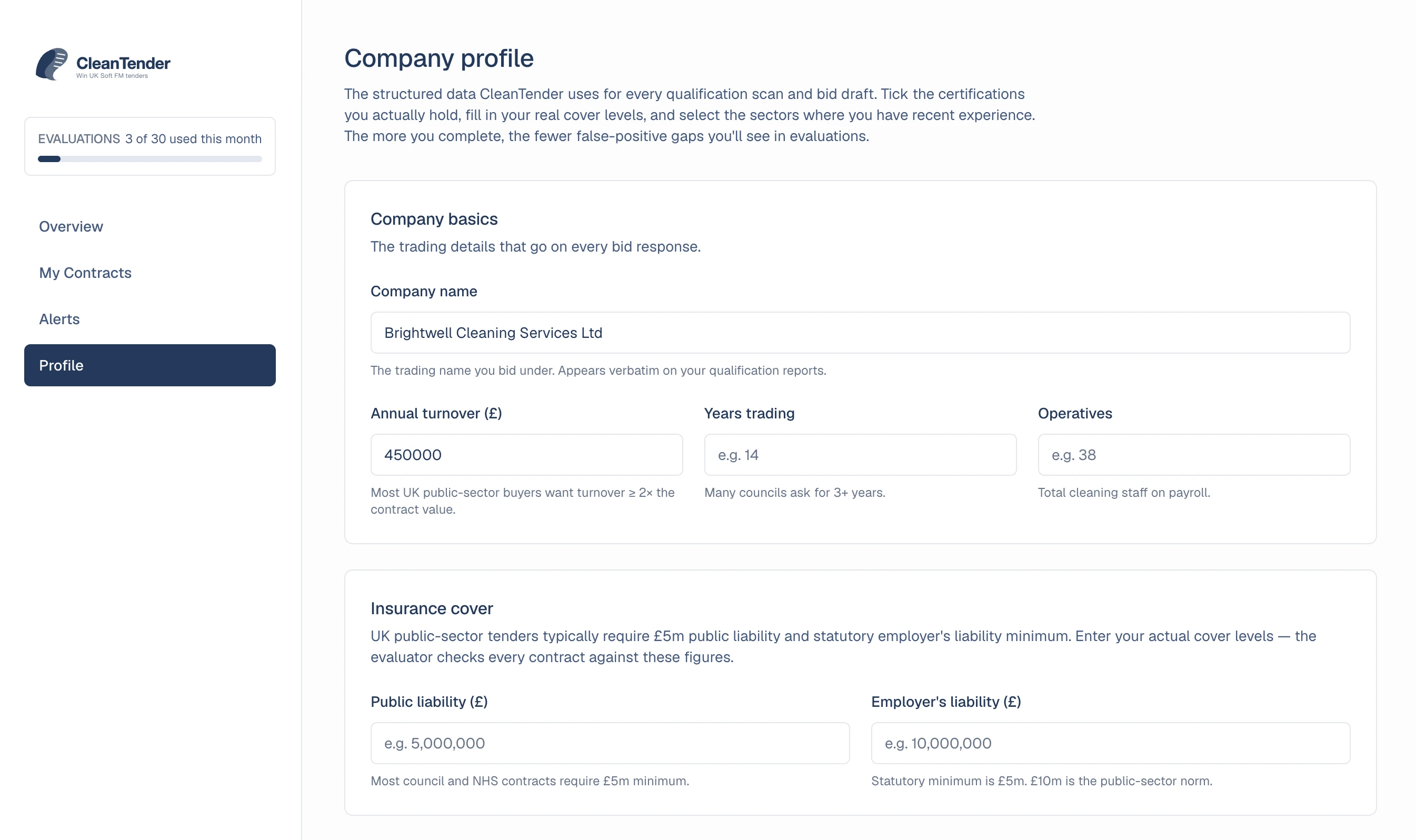
Profile setup defines what you are bid-ready for Step 2· 5 minutes daily
Open the live grounds-tender feed
Every UK council, NHS Trust, school, MoD, university, and housing-association grounds maintenance tender, in one feed. Pre-filtered to your sector and geography. No false positives, no manual portal-trawling across FTS, Contracts Finder, and dozens of buyer e-procurement portals.
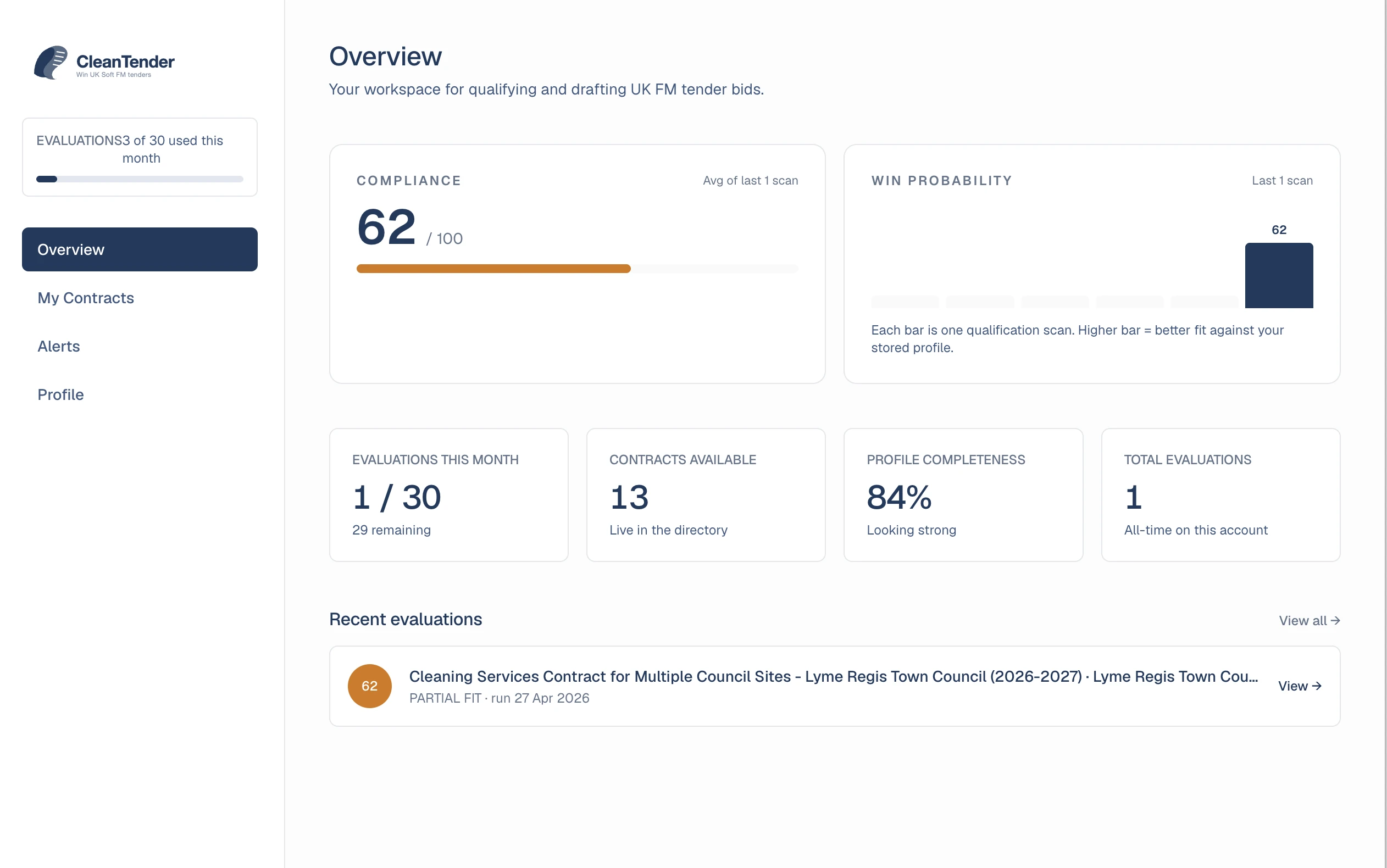
Live feed of in-scope grounds tenders, fit-scored Step 3· Daily digest
Get email alerts for new in-scope tenders
New grounds maintenance tenders matching your profile land in your inbox the day they publish. CleanTender batches them into a daily digest so you do not get notification fatigue, and links straight back to the in-app fit score.
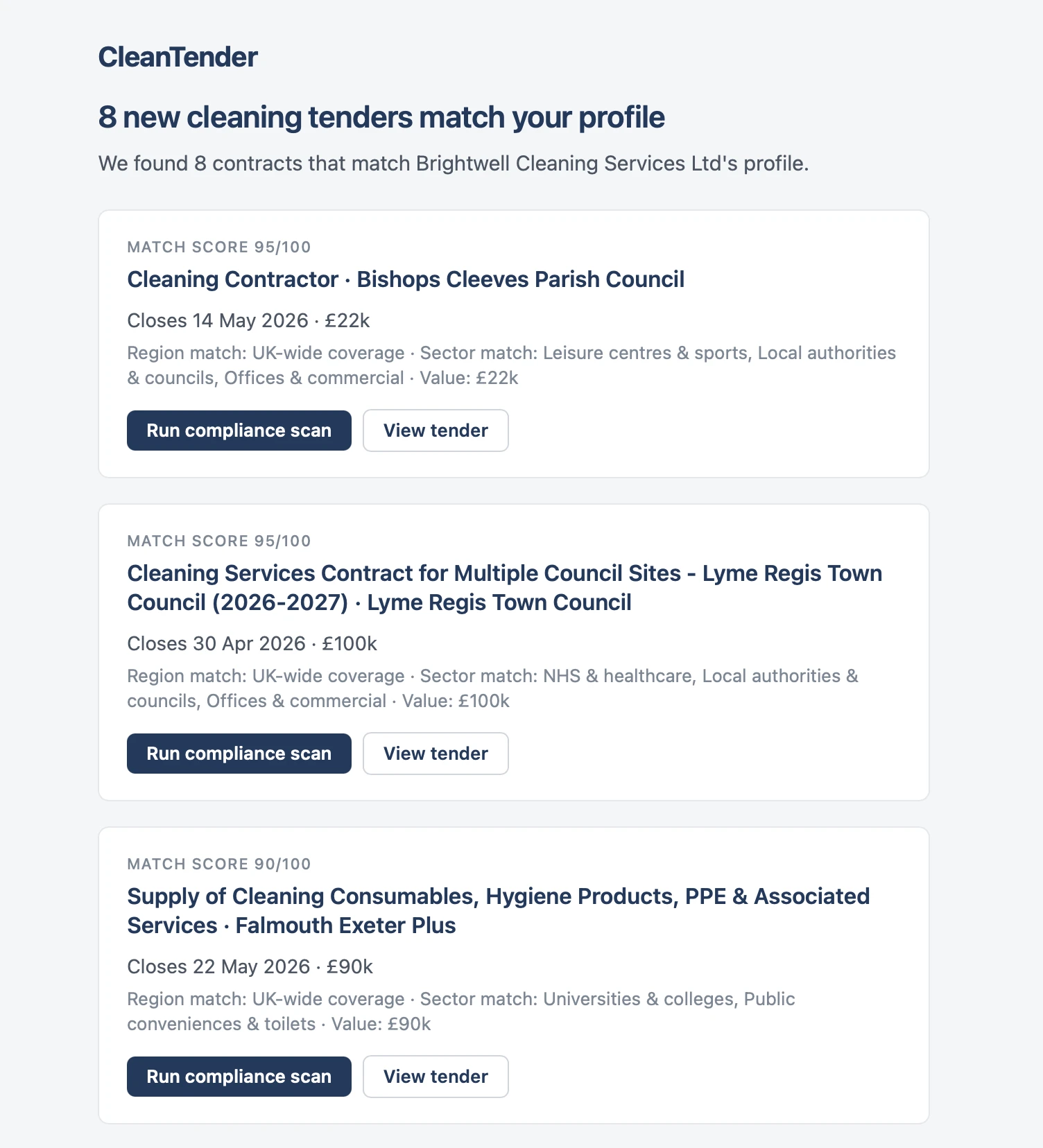
Daily alerts for new in-scope tenders Step 4· 30 seconds
Run a fit-score evaluation on a target tender
One click runs a CleanTender Evaluation against the tender pack: scope match, geography fit, scale fit, compliance gap, and a plain-English win probability. Stops you bidding contracts you were never going to win.
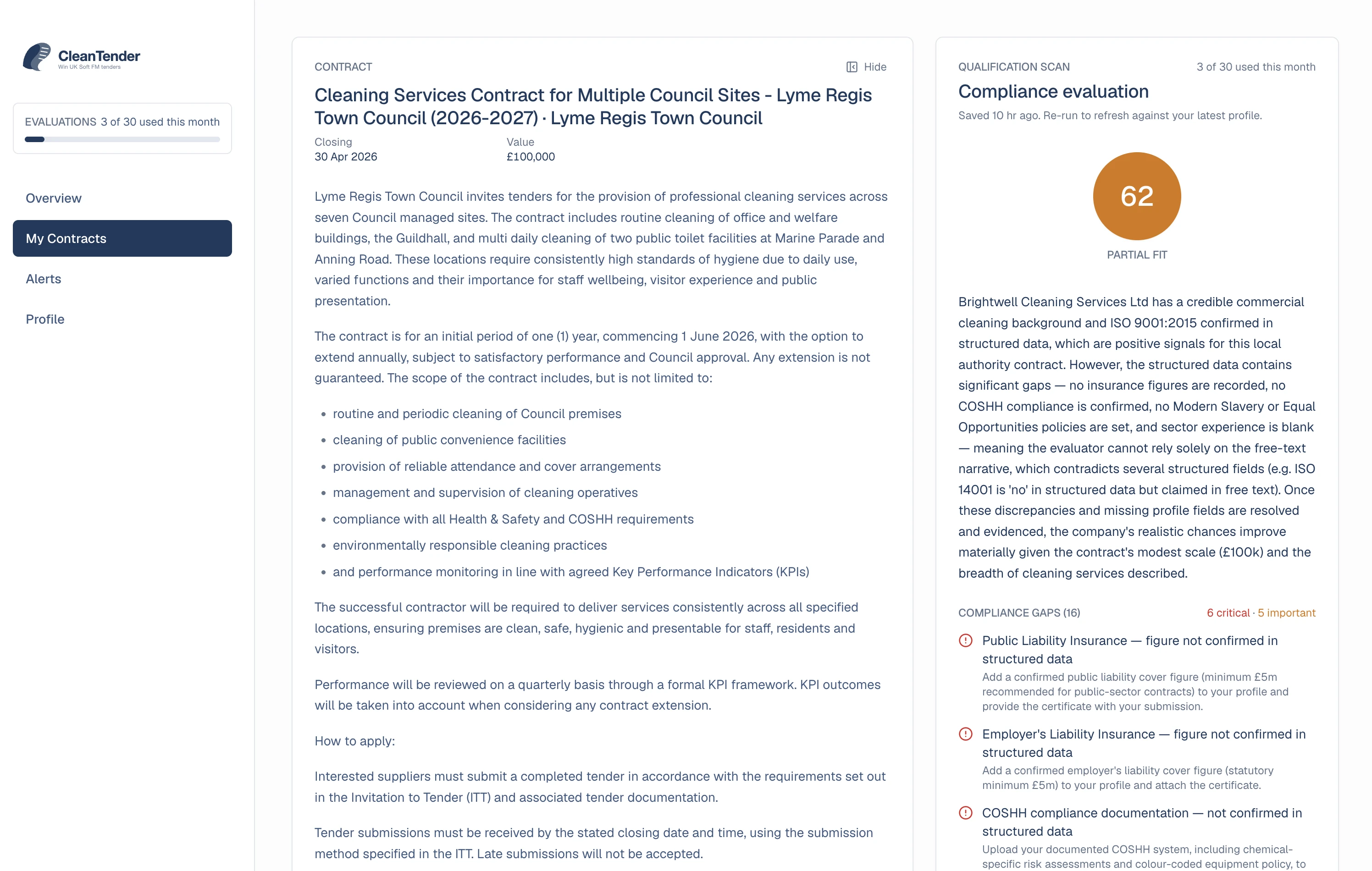
Fit-score and win-probability before you commit a weekend Step 5· 1 minute
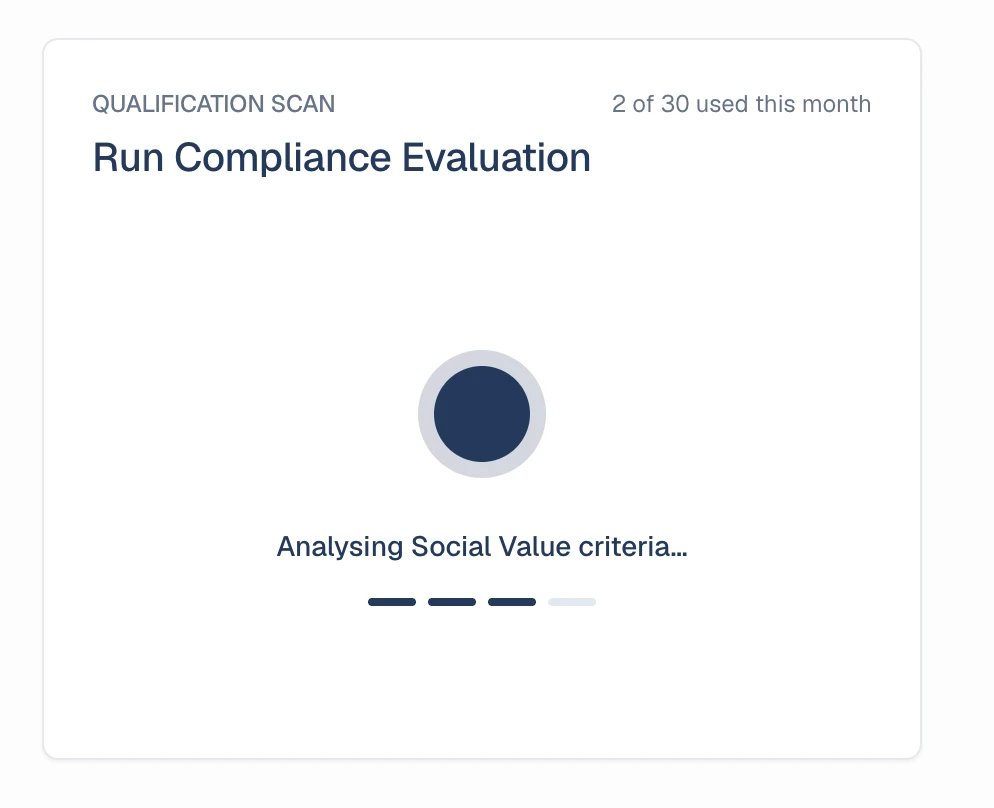
Spot compliance gaps before you start drafting
CleanTender runs a named compliance check against the tender pack: ISO 14001, NPTC PA1/PA6, CS30/CS31, LOLER 1998 inspection records, SSIP, social value plan, biodiversity approach. Anything missing is flagged before you sink hours into a bid that auto-fails at SQ.
Compliance gaps surfaced before drafting Step 6· 2 minutes generation
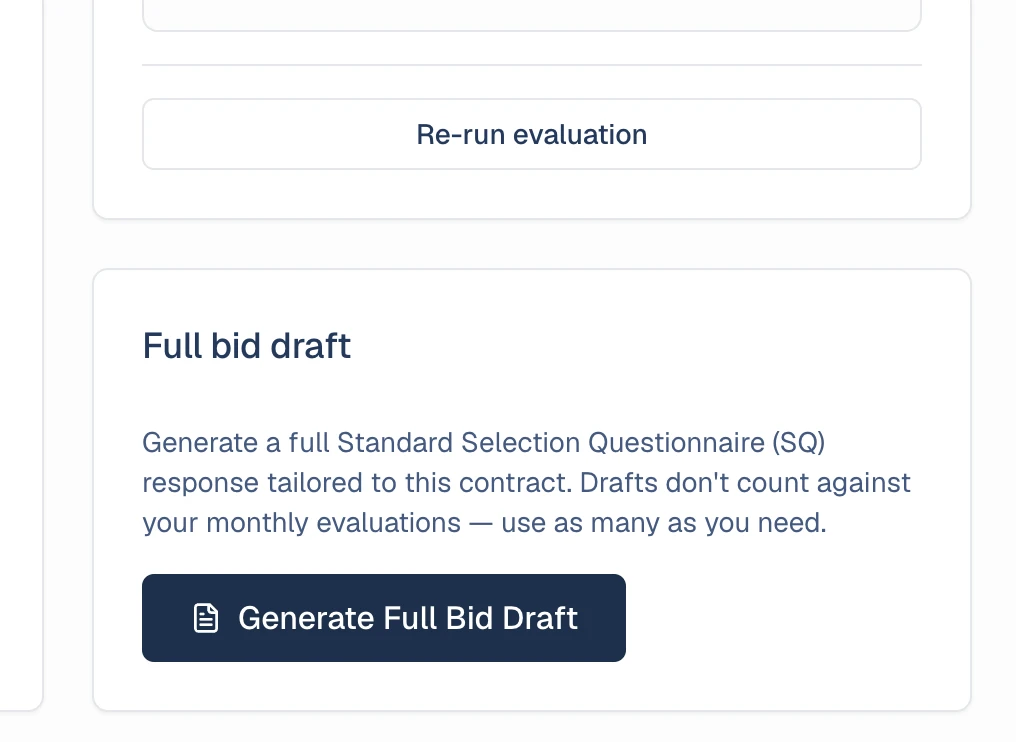
Generate a full SQ + method-statement draft
CleanTender drafts a complete Standard Selection Questionnaire response using your profile data and the tender requirements: declaration block, company overview, contract experience, quality, training, COSHH, social value, H&S, insurance schedule. All ten sections, in one pass.
Full SQ draft generated in minutes, not days Step 7· Half a day
Refine, add evidence, and submit
Tune the draft, drop in named referees and certificate numbers, layer your quantified social value commitments, and submit through the buyer's portal. Most users compress a 30-60 hour first bid to 8-12 hours of focused review.
Step 8· Ongoing
Track outcomes and improve
Every bid logs in CleanTender with status, score, and (after standstill) the buyer's feedback. Use the standstill data to tune your next bid. Win rate compounds; first-bid completion is the only thing standing between you and a public-sector revenue line.
Sources
- BS 7370 Grounds maintenance code of practice (BSI, four parts) · Part 1 (general); Part 2 (hard areas); Part 3 (sports surfaces); Part 4 (soft landscape). Backbone of UK grounds tender specs.
- Plant Protection Products (Sustainable Use) Regulations 2012 · Requires NPTC PA1 plus PA2 or PA6 tickets for spray operators on amenity land
- Wildlife and Countryside Act 1981 (legislation.gov.uk) · Section 1: protection of wild birds during nesting; basis for the typical 1 March to 31 August no-cut window on hedges
- Hedgerow Regulations 1997 (legislation.gov.uk) · Removal protections for important hedgerows; consultation with local planning authority required
- Environment Act 2021 (Biodiversity Net Gain) · Mandatory 10% biodiversity net gain on major development from February 2024, on small sites from April 2024; council estate management following suit
- ISO 14001 (BSI) · Environmental management standard now a hard SQ gate on most council and NHS grounds tenders
- NPTC City and Guilds Pesticide Application qualifications · PA1 (foundation), PA2 (boom sprayer), PA6 (handheld and knapsack), PA6A (knapsack) referenced on most council grounds tenders
- BALI British Association of Landscape Industries · Industry accreditation often listed as a scoring uplift on UK grounds tenders
- PPN 002: Social Value Model (Cabinet Office) · Mandatory from 1 October 2025; 10% minimum social value weighting on central government tenders
- Procurement Act 2023 (legislation.gov.uk) · Live since 24 February 2025; reshapes SQ structure and award criteria
FAQs
Frequently asked questions
- Three big shifts. First, Biodiversity Net Gain became mandatory on major developments from February 2024 (and small sites from April 2024) under the Environment Act 2021, which is reshaping how councils manage their wider estate; grounds contractors are increasingly expected to support BNG monitoring and habitat plans. Second, the Procurement Act 2023 went live on 24 February 2025, restructuring SQ documents and award criteria. Third, PPN 002 (Social Value Model) became mandatory on central government tenders from 1 October 2025, with a 10% minimum weighting that most local authorities and NHS Trusts now match. The technical backbone everywhere remains BS 7370 (four parts), NPTC PA1/PA6 spray tickets, the Wildlife and Countryside Act 1981 nesting-bird protocol, and ISO 14001.
- Increasingly, yes. UKAS-accredited ISO 14001 is now listed as a hard SQ gate on most council and NHS grounds tenders, especially anything above £100,000. Some local authorities require it on all parks, highways verge, and cemetery contracts. ISO 9001 (quality) is usually paired with it. ISO 45001 (occupational health and safety) is increasingly required where tree work, working at height, or chemical control are in scope. First-year cost for ISO 14001 is £4,000-£8,000 with surveillance audits at £1,500-£3,000 in years 2-3. If you do not hold it and you are bidding council grounds work, start the application before your next target tender window.
- Section 1 of the Wildlife and Countryside Act 1981 makes it an offence to intentionally damage or destroy the nest of any wild bird while it is in use or being built. The typical no-cut window for hedges on amenity land runs 1 March to 31 August, but evidence of nesting activity outside that window also triggers the protection. For tender bids, your method statement must show: a documented pre-works ecology check methodology for hedges and scrub before any cutting; a decision tree for what to do if a nest is found (delay works, exclusion zone, evidence record); awareness of bat roosts under the Conservation of Habitats and Species Regulations 2017; and a named ecologist or trained-in-house spotter who carries the responsibility. Bids that omit this fail the technical section and risk regulator action mid-contract. Bids that name the protocol with a worked example score 8-9/10.
- Rate per hectare is more layered than the headline number suggests. Amenity grass mowing is typically £28-£55 per hectare per cut, varying with terrain, obstacle density, slope, and transport distance. Sports turf maintenance runs £3,500-£8,500 per pitch per year covering mowing, marking, aeration, scarification, top-dressing, and end-of-season renovation. Hedge cutting is typically £0.45-£1.20 per linear metre per cut. Tree work runs £140-£220 per hour for a three-person team plus chipper, with MEWP hire and traffic management adding £200-£500 per day on highway-side work. Spray operator visits cost £60-£120 plus chemicals. On top, plant and equipment overhead is 12-22% of contract value (ride-on mowers run £40k-£90k each on a seven-year cycle), and training and accreditation cycle costs £250-£500 per operator per year. Build the rate stack transparently in your bid with a CPI uplift mechanism with cap; opaque flat rates lose to transparent stacks under the Procurement Act 2023 most-advantageous-tender rules.
- Quantified, local, measurable commitments aligned to PPN 002 themes (jobs, growth, wellbeing, environment, equal opportunity). Strong examples: "Three Level 2 horticulture apprenticeships in year one drawn from the contract area, working toward Level 3 by year three, partnered with [local FE college]". "Year-one conversion of 5 hectares of mown verge to species-rich pollinator meadow, monitored annually by [local biodiversity trust], biodiversity gain measured against the DEFRA metric". "Quarterly community planting days on the contract estate partnered with local schools and community groups, forecast 800 hours of community engagement per year". "Year-one partnership with NHS social prescribing link workers to host weekly green-care sessions". "Year-one supply chain spend with local SME plant nurseries within 50 miles to reach 30%, peat-free prioritised". The five themes give you a structure. Quantify each commitment with a number and a date. Generic "we care about the environment" copy scores 4/10. Five quantified commitments score 8-9/10 on a 10% category.