
UK school catering is a £2 billion-a-year market. Single-school contracts pay £80k to £200k. Multi-academy trust frameworks run £300k to £1.5m. County-council framework call-offs hit £4m+. Margins are tight and the work is steady. The contracts go to the suppliers who've learned how to bid them.
Bidding for school catering isn't the same as bidding for cleaning. Different vocabulary, different evaluation criteria, different TUPE risk. Here's the version that gets you to a submitted bid you can actually deliver.
What's in this guide
- How to win a UK school catering tender, step by step (CleanTender walkthrough)
- What counts as a school catering contract
- What schools actually score on at SQ stage
- FHRS, HACCP, Natasha's Law, GBSF (the four-letter checklist)
- UIFSM and how to cost a school meal in 2026
- TUPE in school catering (the bit that sinks new bidders)
- Special diets: IDDSI, religious provision, allergen-safe lines
- Common SQ questions for school catering
- Pricing without going broke
- What to do when you lose your first bid
How to win a UK school catering tender, step by step
The complete end-to-end flow inside CleanTender. From sector setup to a submitted school catering bid in the time it used to take to read a single tender pack.
Eight steps from "never bid public sector" to a complete SQ response on the buyer's portal. First scan is free.
Step 1· 10 minutes
Build your school catering company profile
Set your sector to school catering, your service regions, FHRS rating per kitchen, Universal Infant Free School Meals (UIFSM) experience, allergen-management software, term-time + holiday capacity, supplier accreditations, enhanced DBS coverage, insurance levels, turnover, and operative count. CleanTender uses this to fit-score every live tender against your real capability so you only see the ones you can win.
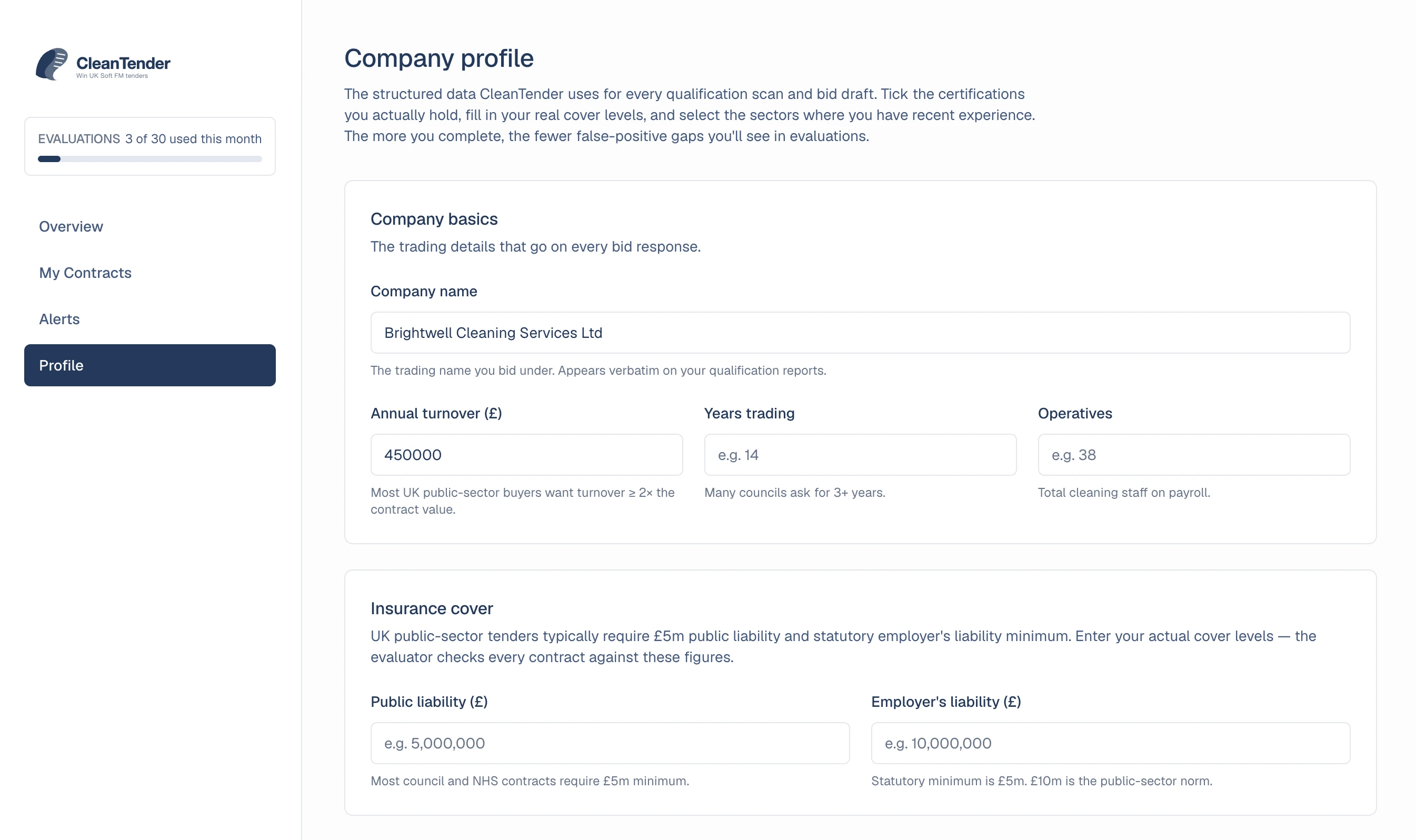
Profile setup defines what you are bid-ready for Step 2· 5 minutes daily
Open the live school catering-tender feed
Every UK academy trust, multi-academy trust (MAT), local authority, and individual maintained school catering tender, in one feed. Pre-filtered to your sector and geography. No false positives, no manual portal-trawling across FTS, Contracts Finder, and dozens of buyer e-procurement portals.
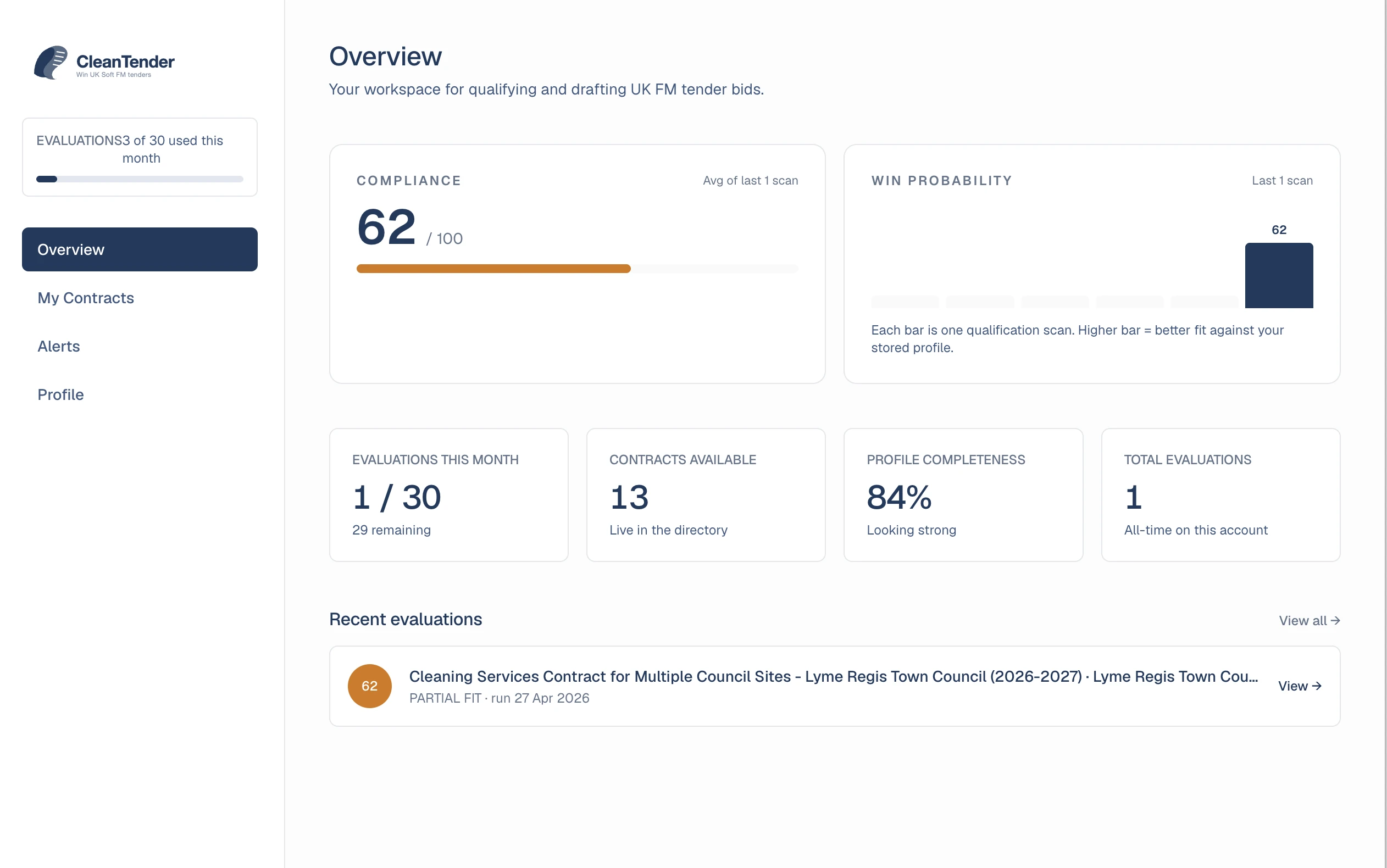
Live feed of in-scope school catering tenders, fit-scored Step 3· Daily digest
Get email alerts for new in-scope tenders
New school catering tenders matching your profile land in your inbox the day they publish. CleanTender batches them into a daily digest so you do not get notification fatigue, and links straight back to the in-app fit score.
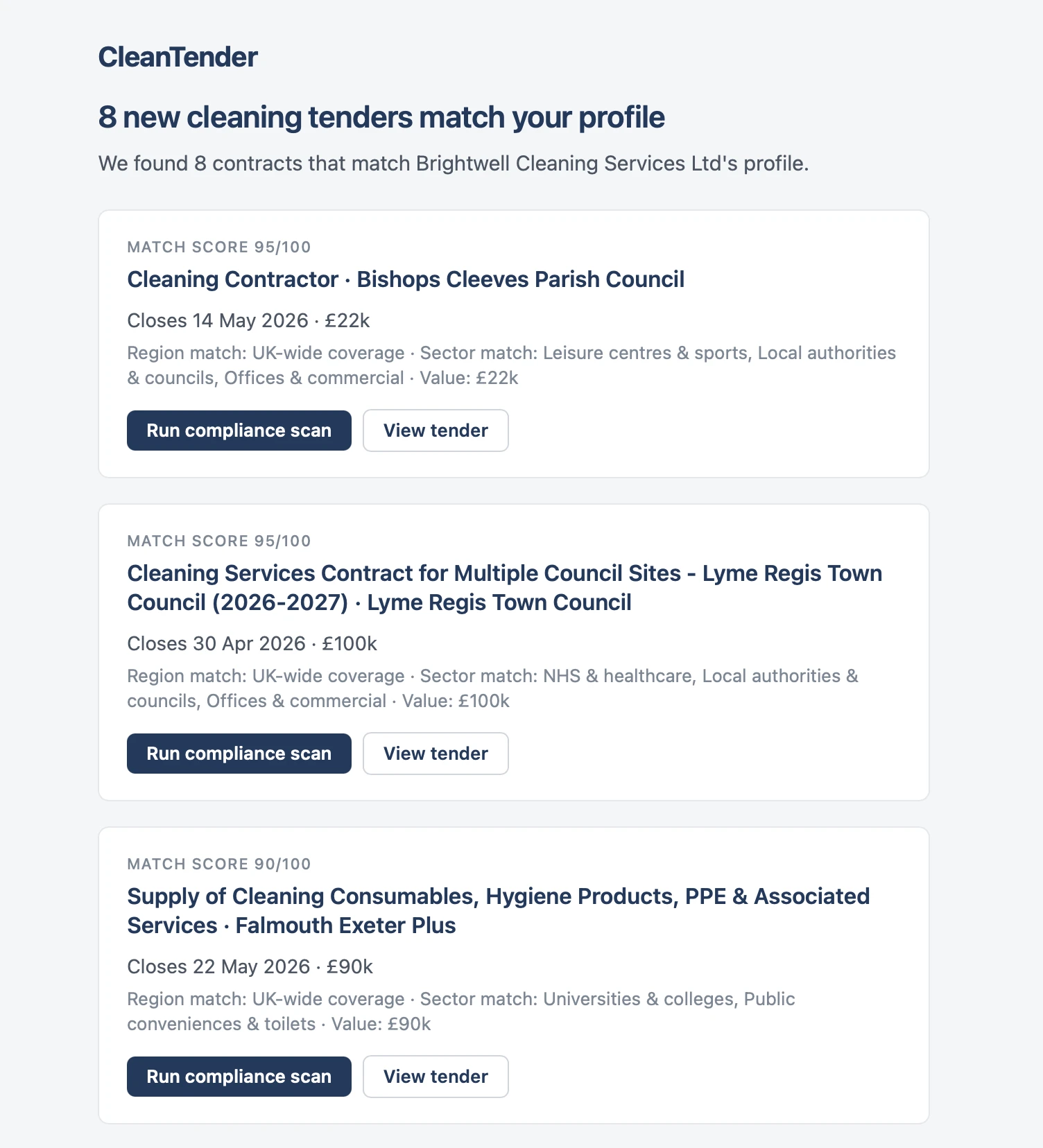
Daily alerts for new in-scope tenders Step 4· 30 seconds
Run a fit-score evaluation on a target tender
One click runs a CleanTender Evaluation against the tender pack: scope match, geography fit, scale fit, compliance gap, and a plain-English win probability. Stops you bidding contracts you were never going to win.
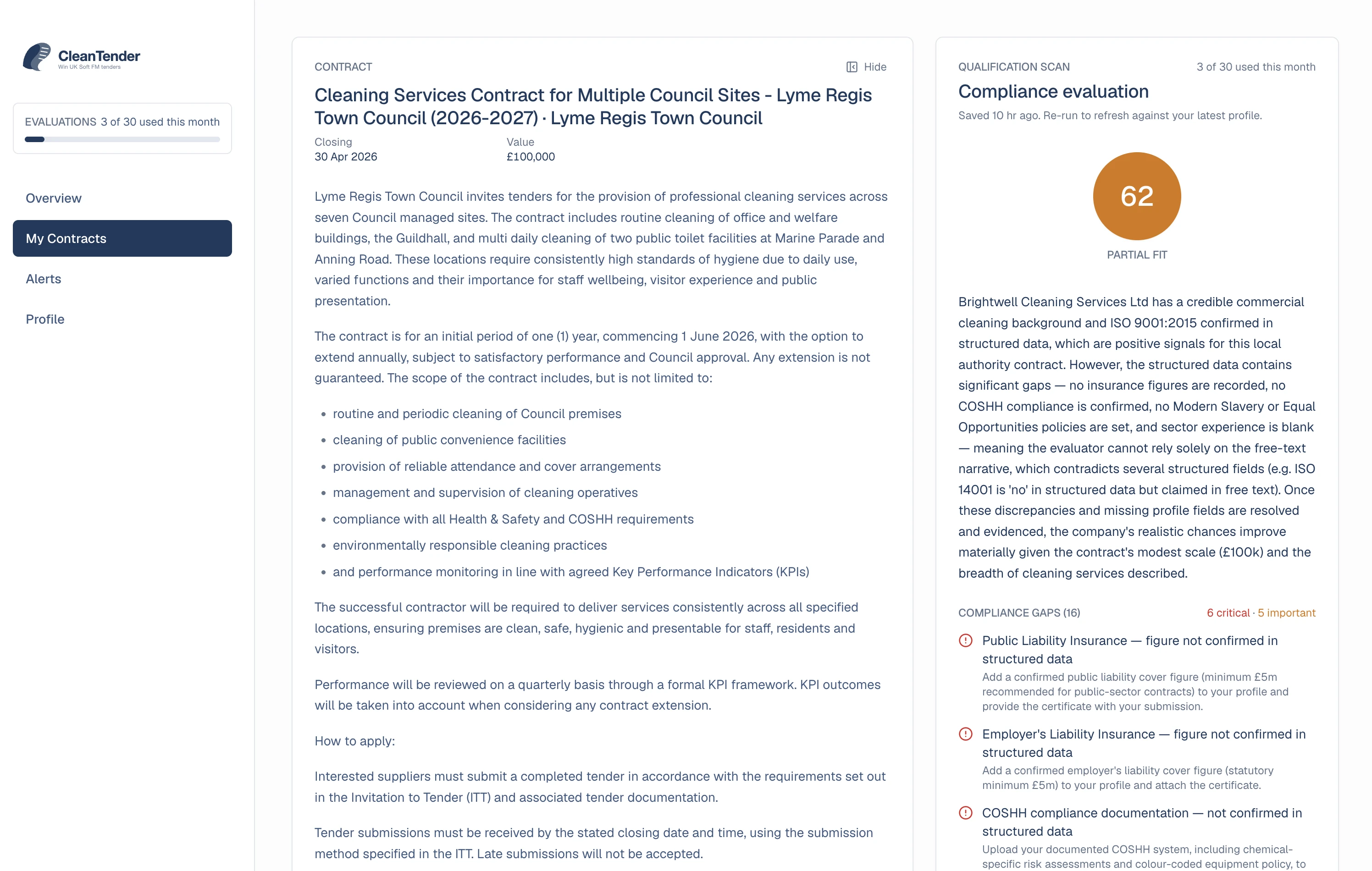
Fit-score and win-probability before you commit a weekend Step 5· 1 minute
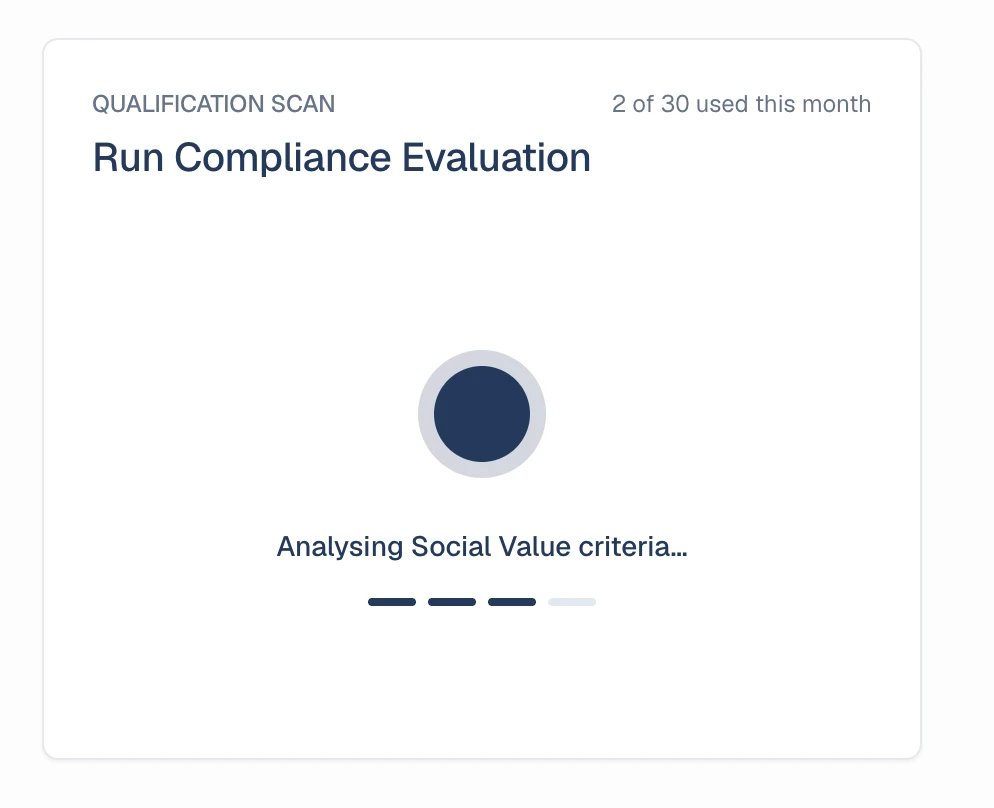
Spot compliance gaps before you start drafting
CleanTender runs a named compliance check against the tender pack: FHRS 4-5, HACCP plan, School Food Standards (DfE), Natasha's Law PPDS workflow, enhanced DBS for kitchen staff, allergen training records, social value plan. Anything missing is flagged before you sink hours into a bid that auto-fails at SQ.
Compliance gaps surfaced before drafting Step 6· 2 minutes generation
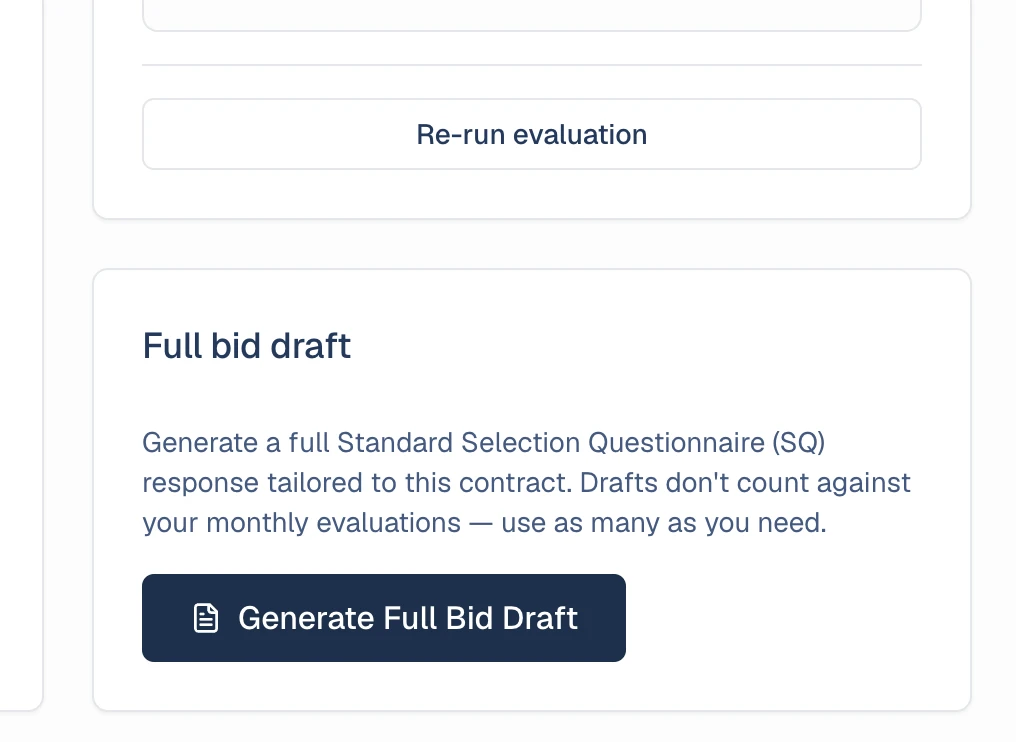
Generate a full SQ + method-statement draft
CleanTender drafts a complete Standard Selection Questionnaire response using your profile data and the tender requirements: declaration block, company overview, contract experience, quality, training, COSHH, social value, H&S, insurance schedule. All ten sections, in one pass.
Full SQ draft generated in minutes, not days Step 7· Half a day
Refine, add evidence, and submit
Tune the draft, drop in named referees and certificate numbers, layer your quantified social value commitments, and submit through the buyer's portal. Most users compress a 30-60 hour first bid to 8-12 hours of focused review.
Step 8· Ongoing
Track outcomes and improve
Every bid logs in CleanTender with status, score, and (after standstill) the buyer's feedback. Use the standstill data to tune your next bid. Win rate compounds; first-bid completion is the only thing standing between you and a public-sector revenue line.
What counts as a school catering contract
Five buyer types. Each one buys catering slightly differently and asks slightly different evaluation questions.
- Local authority frameworks. County or unitary council buys catering for primary schools maintained by the LA. Single contract covers 30 to 200+ sites. £1m to £4m a year. Awarded as a framework with annual call-offs.
- Multi-academy trust (MAT) frameworks. The trust procures for all member academies. Smaller scale than LA but tighter margins. £300k to £1.5m a year. 4-year terms common.
- Single academy or independent school. One school, one contract. £80k to £200k a year. Direct procurement, often via the school business manager.
- Special educational needs (SEN) schools. Mandatory IDDSI texture-modified menus, dietitian-approved meal plans, named allergy protocols. Specialist contracts at £150k+.
- Boarding and 24-hour-care provision. Three meals a day plus snacks, often with weekend cover. Independent schools, residential SEN. £250k+ a year per site.
What schools actually score on at SQ stage
Most school catering Selection Questionnaires run on weighted scoring against a published award criteria matrix. Typical breakdown for 2026:
- Quality / method statement: 40 to 50%. Menu structure, allergen handling, special diets, food safety system, supervision, KPI reporting.
- Price: 30 to 40%. Per-meal cost, fixed-price guarantee duration, indexation clauses.
- Social value: 10 to 25%. Mandatory at 10% from 1 October 2025 under PPN 002. Many councils run 15-20% on catering.
- Sometimes innovation / sustainability: 5 to 10% on contracts asking for plant-based menu shift, food-waste reduction, local-supply commitments.
What separates 4/5 from 2/5 on quality is specificity. Not "we deliver high-quality meals." That scores 1. "Each menu cycle delivers 14 hot main options across 4 weeks, with 100% allergen-coded recipes against the 14 declared allergens, 30% plant-based, all certified to GBSF nutrition standards, with named sub-options for halal, vegetarian, gluten-free, dairy-free, and IDDSI Level 5/6/7 texture-modified diets where SEN provision is needed." That scores 5.
FHRS, HACCP, Natasha's Law, GBSF (the four-letter checklist)
Every school catering SQ asks about these four. Get them in your stored profile before you bid.
FHRS (Food Hygiene Rating Scheme)
Public Food Standards Agency rating from 0 to 5 based on local-authority Environmental Health inspection. Most school contracts ask for a minimum FHRS rating of 5 ("very good") on every kitchen you operate. The rating is checked against the FSA public register at food.gov.uk. Below 5, expect to be flagged at SQ stage.
HACCP (Hazard Analysis and Critical Control Points)
Mandatory under retained EU Regulation 852/2004. Every catering operation needs a documented HACCP system identifying critical control points (cooking temperatures, cooling times, cross-contamination risks) with monitoring records. Schools want the procedure document, the monitoring forms, the corrective-action log, and evidence of annual review.
Natasha's Law (allergen labelling)
The Food Information Amendment Regulations 2019 require pre-packed-for-direct-sale items to be labelled with the 14 declared allergens. School catering needs to evidence: full allergen matrix per recipe, cross-contamination procedure, signed-off staff training, named allergen champion, and a customer-facing allergen-disclosure process for parents and pupils.
GBSF (Government Buying Standard for Food and Catering Services)
Cabinet Office guidance, mandatory on most central-government catering contracts and increasingly referenced by local authorities. Sets standards across nutrition (Eatwell Guide alignment, sugar/salt thresholds), sustainability (deforestation-free supply chains, MSC fish), animal welfare (Red Tractor minimum on meat), and waste reduction. Many SQs now ask whether your catering operation is GBSF-aligned ("none / partial / full").
UIFSM and how to cost a school meal in 2026
UIFSM (Universal Infant Free School Meals) covers all pupils in Reception, Year 1, and Year 2 in state-funded schools in England. The funding rate is set annually by the Department for Education. For 2025-26 it's around £2.58 per meal, paid to the school which then pays the catering supplier. Expect a small uplift for 2026-27.
Build the per-meal cost from the ground up. National Living Wage in 2026 is £12.21. School catering pays NLW or slightly above (£12.50-£13.50) due to TUPE inheritance from existing council contracts.
- Direct food cost (raw ingredients, plate cost). 30-40% of the meal price. Depends on menu mix and supply chain.
- Direct labour. Staff time per meal served. 25-35%. NLW + holiday + NI + pension.
- Equipment, consumables, cleaning chemicals. 5-8%.
- Site overhead (if you provide management). 5-10%.
- Central support (procurement, payroll, HR, training, software). 8-12%.
- Profit margin. 4-8% is typical for school catering. Below 4%, you're undercutting yourself; above 10%, you're losing on price.
Realistic per-meal pricing in 2026: £2.40-£2.80 for primary (UIFSM-aligned), £2.80-£3.50 for secondary, £3.20-£4.00 for SEN with IDDSI provision. Boarding and 24-hour care priced separately, usually £8-£15 per day per pupil for three meals plus snacks.
TUPE in school catering (the bit that sinks new bidders)
TUPE applies to almost every school catering re-tender. When the contract changes hands, the incumbent's kitchen staff transfer to you on their existing terms. Pay rate, pension contributions, holiday balance, length of service.
- Demand the Employee Liability Information (ELI) from the incumbent or buyer at least 28 days before the transfer. Pay rates, pension status, disciplinary history, holiday balance, hours per week. Without it you're pricing blind.
- Inherited cost base often includes Local Government Pension Scheme (LGPS) admitted-body status. Defined-benefit pensions for transferred staff. Get the actuarial certificate before you price.
- ETO (Economic, Technical, Organisational) reasons for changing terms post-transfer must survive a tribunal. Most price-cuts won't.
- If the incumbent is paying £14.00 to staff who've been on site for 12 years, you pay £14.00 from day one. Don't promise £12.50 in your price submission.
Special diets: IDDSI, religious provision, allergen-safe
Schools with SEN provision, religious schools, and any school with a high-allergen pupil intake will weight special diets heavily. Three areas to evidence:
- IDDSI texture-modified diets. International Dysphagia Diet Standardisation Initiative. Levels 0-7 across drinks and foods. Critical on SEN contracts and any school with pupils requiring modified texture for swallowing safety. BAPEN dietary alignment is the corresponding adult / hospital framework.
- Religious provision. Halal certification (Halal Authority Board, Halal Food Authority). Kosher certification (London Beth Din). Vegetarian / vegan menu lines as standard. Faith-school contracts ask for menu rotation evidence and certified-supply chains.
- Allergen-safe cooking lines. Dedicated allergen-free prep areas, colour-coded equipment, named allergen champion, segregated cooking lines, full traceability from supplier to plate. Cross-contamination protocol signed off and audited.
Common SQ questions for school catering
Build a stock answer for each. Tweak per contract.
- How do you make sure FHRS rating 5 across all sites? Named EHO liaison, monthly internal audit cycle, quarterly external audit, corrective-action tracking.
- What's your HACCP system? Procedure document, monitoring records (cooking temp, cooling time, fridge temp twice daily), critical-control-point review annually, named HACCP-qualified manager.
- How do you handle the 14 allergens? Recipe-level allergen matrix, cross-contamination protocol, daily allergen check at service, allergen champion per site, customer-facing disclosure process.
- What's your training cadence? Level 2 Food Safety in Catering for handlers, Level 3 for supervisors, allergen training annually, HACCP awareness refresh annually. Records audit-ready.
- How do you handle special diets? Named dietitian or dietitian-approved menu, IDDSI capability for SEN, religious certification, halal/kosher menu lines, allergen-safe cooking lines.
- What menu structure do you use? Cycle length, variety per cycle, plant-based proportion, GBSF alignment, seasonal variation, pupil-feedback integration.
- How do you handle TUPE? Day-1 transfer plan, consultation meetings, ELI integration, pension-scheme continuity, named HR liaison.
- Social value? SMART local commitments. Local supply chain percentage, apprentice intake, work-experience placements, school-community engagement.
What to do when you lose your first bid
First three bids will probably lose. Use section 50 feedback under the Procurement Act 2023 and apply the lessons to bid four. Most school catering SMEs win their first contract on bid four to seven, usually a single-school or small academy trust before they win a county-council framework call-off.
If you want a faster route from notice to qualified shortlist, register on CleanTender and run a free fit check on the next live school catering tender that catches your eye. For the broader Procurement Act 2023 framework, our how to bid for a UK government contract guide covers the regime end to end. For pricing strategy that wins, our how to win cleaning contracts strategy guide applies the same qualify-before-you-write logic to soft FM more broadly.
Many trusts buy cleaning the same way they buy catering. For the cleaning side, see the guide to school cleaning tenders.
Sources
- Procurement Act 2023 · In force 24 February 2025. Section 50 feedback rights, exclusion grounds in Schedules 6 and 7
- PPN 002: Social Value Model · Mandatory from 1 October 2025, 10% minimum weighting on central government
- Government Buying Standard for Food and Catering Services · Cabinet Office guidance on nutrition, sustainability, animal welfare, waste
- FSA Food Hygiene Rating Scheme · Public register of food hygiene ratings checked by buyers at SQ stage
- Natasha's Law (Food Information Amendment Regulations 2019) · 14-allergen labelling for pre-packed-for-direct-sale items
- IDDSI framework · International Dysphagia Diet Standardisation, levels 0-7 for drinks and foods
FAQs
Frequently asked questions
- Get the paperwork in place: FHRS rating 5 on every kitchen, documented HACCP system, Natasha's Law allergen matrix, Level 2/3 food safety training records, GBSF alignment evidence. Register on Find a Tender, which carries new school catering notices from £30,000 incl. VAT (£12,000 for central government) upwards. Set saved-search alerts on CPV codes 55520 (catering services), 55523 (catering for institutions), 55524 (school catering). When a notice catches your eye, qualify against your profile before you commit, draft a Selection Questionnaire response in the standard sections, submit 24 hours before deadline.
- Most UK school catering tenders ask for a minimum Food Hygiene Rating Scheme score of 5 across all kitchens you operate. Public-facing register at food.gov.uk. Buyers check the rating themselves at SQ evaluation. Below 5, expect to be flagged or excluded. The rating is set by local-authority Environmental Health Officers based on hygienic food handling, structural condition, and confidence in management.
- Government Buying Standard for Food and Catering Services. Cabinet Office guidance covering nutrition (Eatwell Guide alignment, sugar/salt thresholds), sustainability (deforestation-free supply chains, MSC fish), animal welfare (Red Tractor minimum on meat), and waste reduction. Mandatory on most central-government catering contracts. Increasingly referenced by local authorities and NHS Trusts on school and hospital catering. SQs ask whether your operation is "none / partial / full" GBSF-aligned.
- TUPE applies to almost every school catering re-tender. The incumbent's kitchen staff transfer to you on existing terms. Pay rates, pension contributions (often LGPS admitted-body status with defined-benefit pension), holiday balance, length of service. Demand the Employee Liability Information from the incumbent at least 28 days before transfer. Without it you're pricing blind. Most ETO-based pay reductions don't survive a tribunal.
- 2026 typical pricing: £2.40 to £2.80 per primary meal (aligned with UIFSM funding rate of around £2.58), £2.80 to £3.50 per secondary meal (paid by parents), £3.20 to £4.00 per SEN meal with IDDSI texture-modified provision. Boarding and 24-hour care priced separately at £8 to £15 per pupil per day for three meals plus snacks. Build the cost up from National Living Wage (£12.21 in 2026), 12% holiday accrual, 13.8% NI, 3% pension, plus food, equipment, supervision, and 4-8% margin.
- International Dysphagia Diet Standardisation Initiative. Eight texture levels (0-7) across drinks and foods to make texture-modified diets safe and consistent for people with swallowing difficulties (dysphagia). Critical on SEN school catering contracts and any school with pupils requiring modified texture for safety. BAPEN provides the corresponding hospital and care-home framework. SQs ask for IDDSI capability evidence: trained staff, kit (blenders, moulds), documented recipes by level, and dietitian sign-off. Without it, SEN contracts will exclude you.