
UK public-sector security buyers are no longer scoring the cheapest hourly guard rate. The Terrorism (Protection of Premises) Act 2025 (Martyn's Law) places new duties on venues and event spaces. SIA Approved Contractor Scheme (ACS) accreditation, BS 7858:2019 vetting, BS 7499 static guarding code, and BS 7984 keyholding code remain the technical backbone of any compliant bid. The Procurement Act 2023 (live 24 February 2025) tightened SQ structure, and PPN 002 sets a 10% minimum social value weighting on central government tenders from 1 October 2025.
The security contractor that wins in 2026 brings SIA ACS membership, documented BS 7858 vetting on every officer, ISO 9001 (and increasingly ISO 14001 and ISO 45001), a credible Martyn's Law engagement plan for any venue contract, and a real-time incident management platform. The one that loses still leads with "competitive guard rate" and a list of customer logos.
The Act introduces a new tiered framework, with requirements proportionate to the activity that takes place at premises and the number of individuals present at any given time.
UK Government, Terrorism (Protection of Premises) Act 2025 (Martyn's Law) explanatory notes
What's in this guide
- How to win a UK security tender, step by step (CleanTender walkthrough)
- The 5 regulatory frameworks that govern UK public-sector security tenders
- What buyers score on (the marking matrix patterns)
- Pricing factors: officer cost, mobile patrol, technology, contingency
- The 6 main public-sector security markets
- Method statement structure tuned for security tenders
- Social value commitments that score in security
- When NOT to bid
How to win a UK security tender, step by step
The complete end-to-end flow inside CleanTender. From sector setup to a submitted security bid in the time it used to take to read a single tender pack.
Eight steps from "never bid public sector" to a complete SQ response on the buyer's portal. First scan is free.
Step 1· 10 minutes
Build your security company profile
Set your sector to security, your service regions, SIA ACS membership, BS 7858:2019 vetting status per officer, NSI Gold or BSIA membership if held, incident management platform, response times, fleet for mobile patrol, insurance levels, turnover, and operative count. CleanTender uses this to fit-score every live tender against your real capability so you only see the ones you can win.
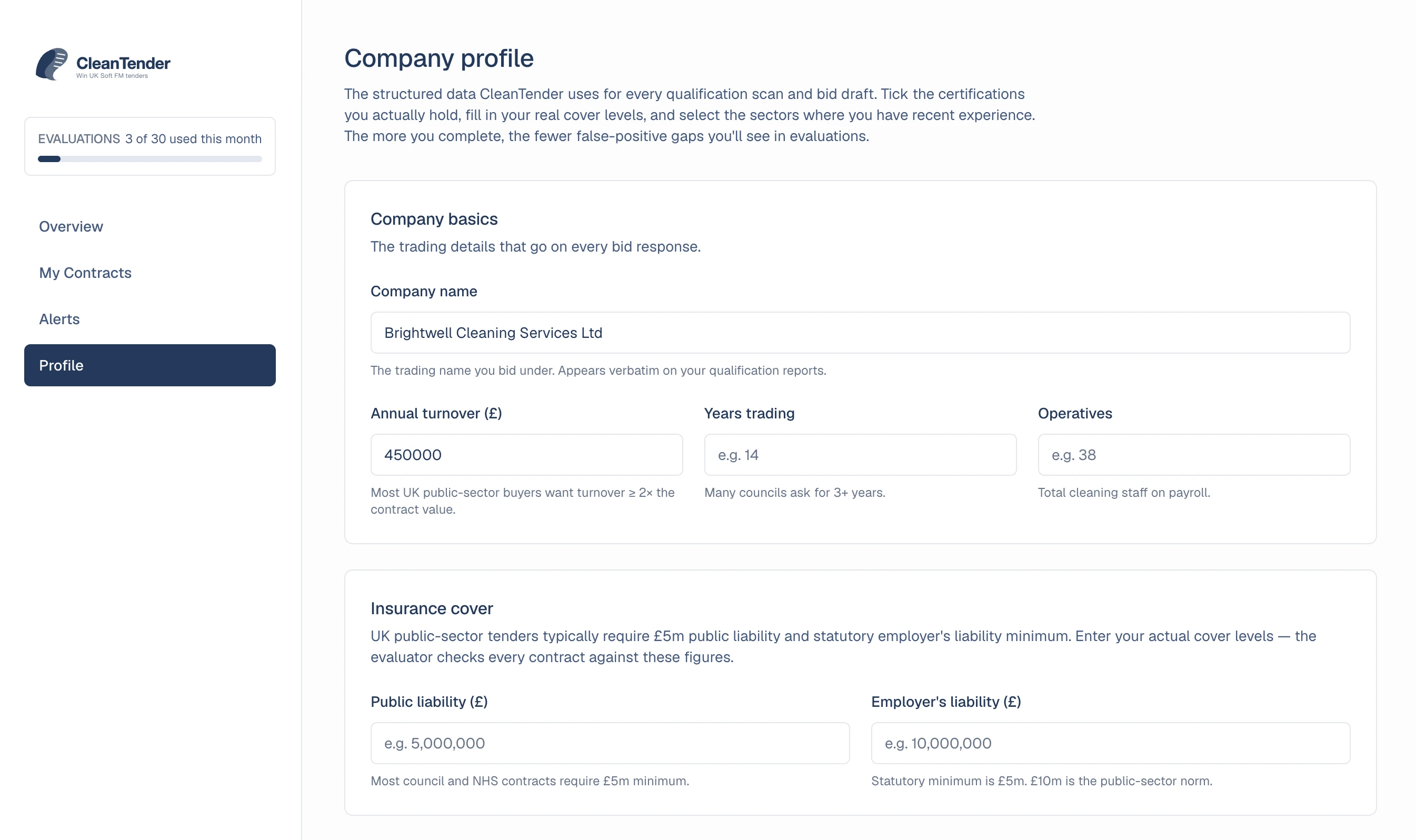
Profile setup defines what you are bid-ready for Step 2· 5 minutes daily
Open the live security-tender feed
Every UK NHS Trust, council, school, university, court (MoJ), HMPPS, MoD, and central government security tender, in one feed. Pre-filtered to your sector and geography. No false positives, no manual portal-trawling across FTS, Contracts Finder, and dozens of buyer e-procurement portals.
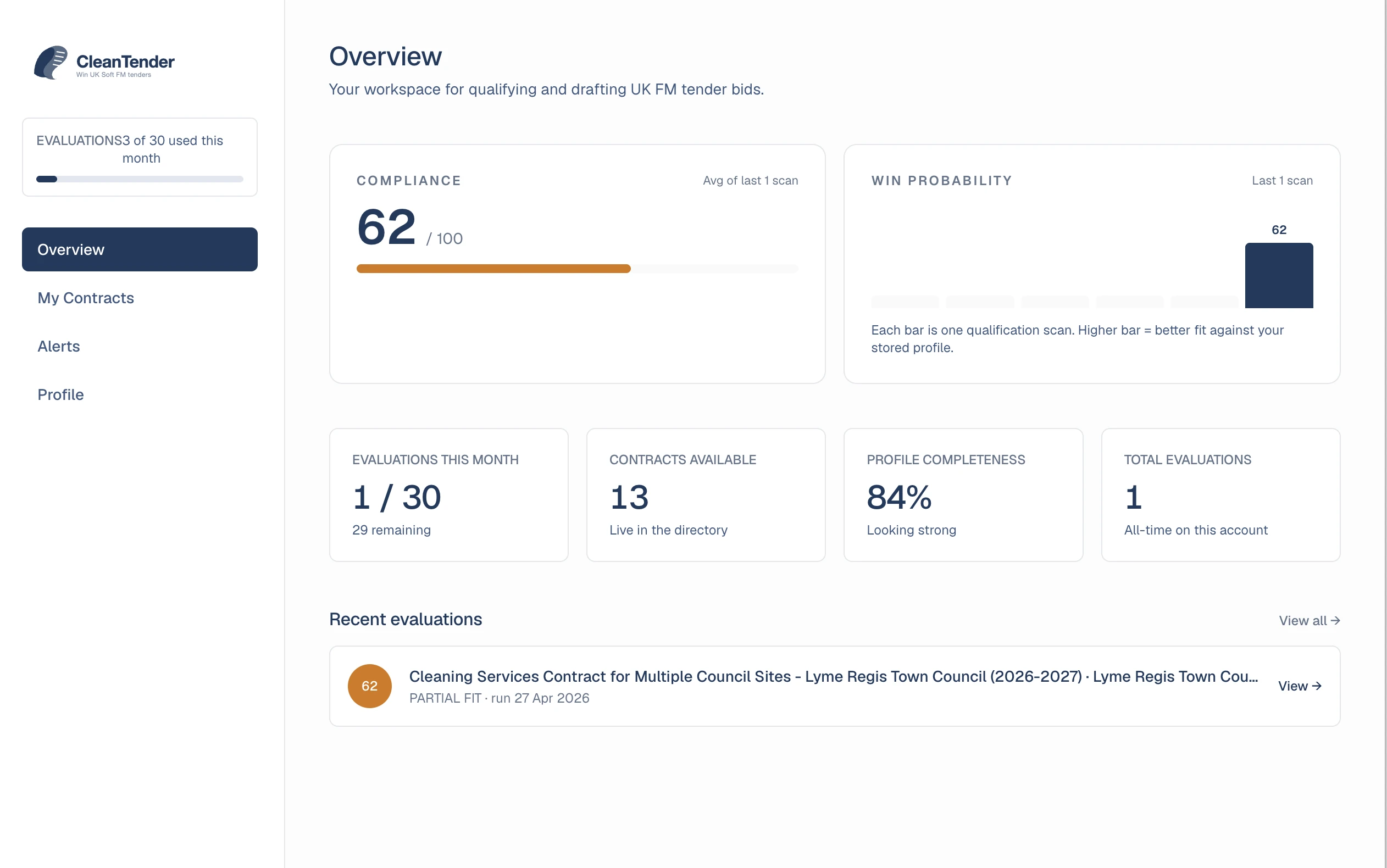
Live feed of in-scope security tenders, fit-scored Step 3· Daily digest
Get email alerts for new in-scope tenders
New security tenders matching your profile land in your inbox the day they publish. CleanTender batches them into a daily digest so you do not get notification fatigue, and links straight back to the in-app fit score.
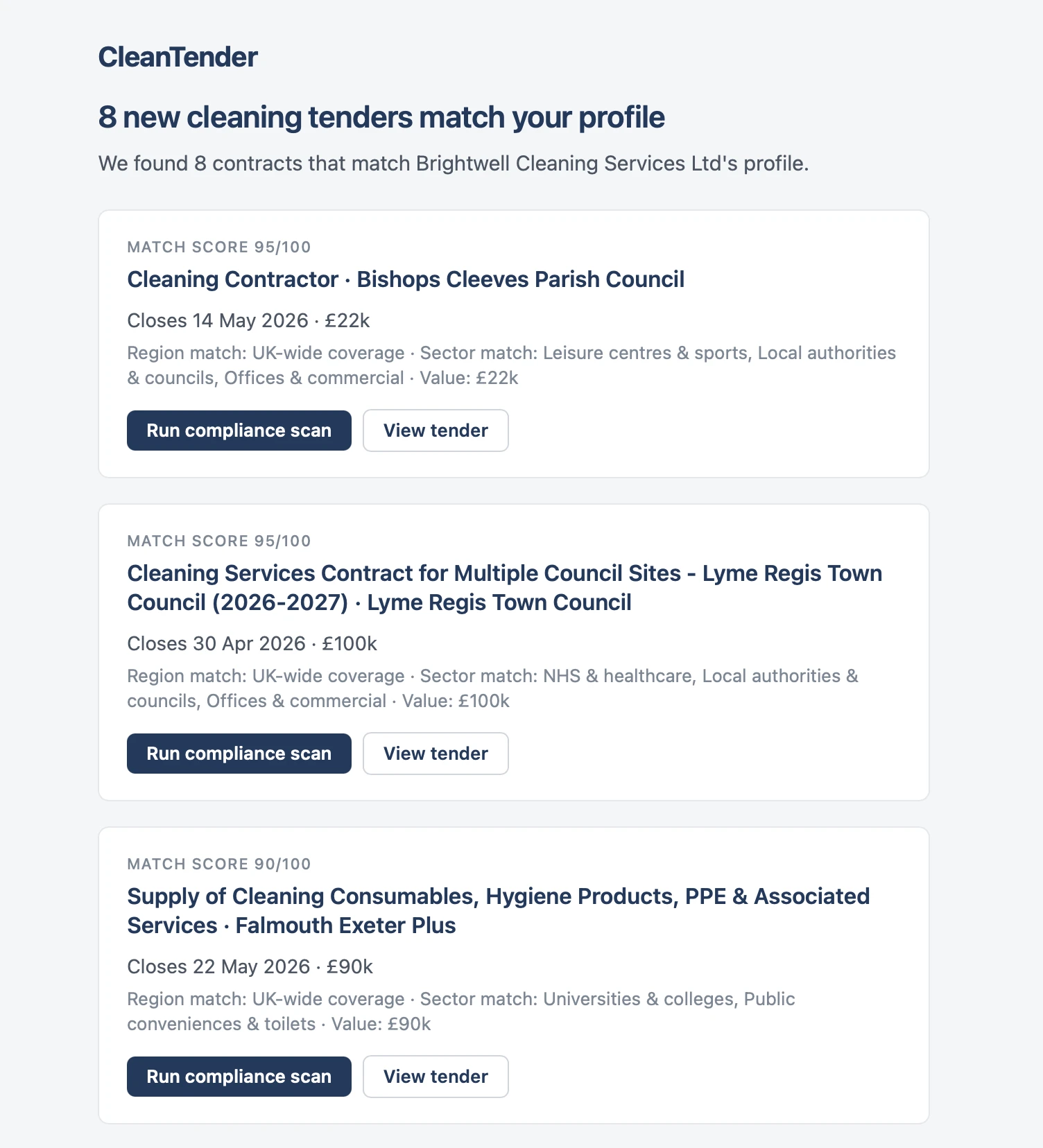
Daily alerts for new in-scope tenders Step 4· 30 seconds
Run a fit-score evaluation on a target tender
One click runs a CleanTender Evaluation against the tender pack: scope match, geography fit, scale fit, compliance gap, and a plain-English win probability. Stops you bidding contracts you were never going to win.
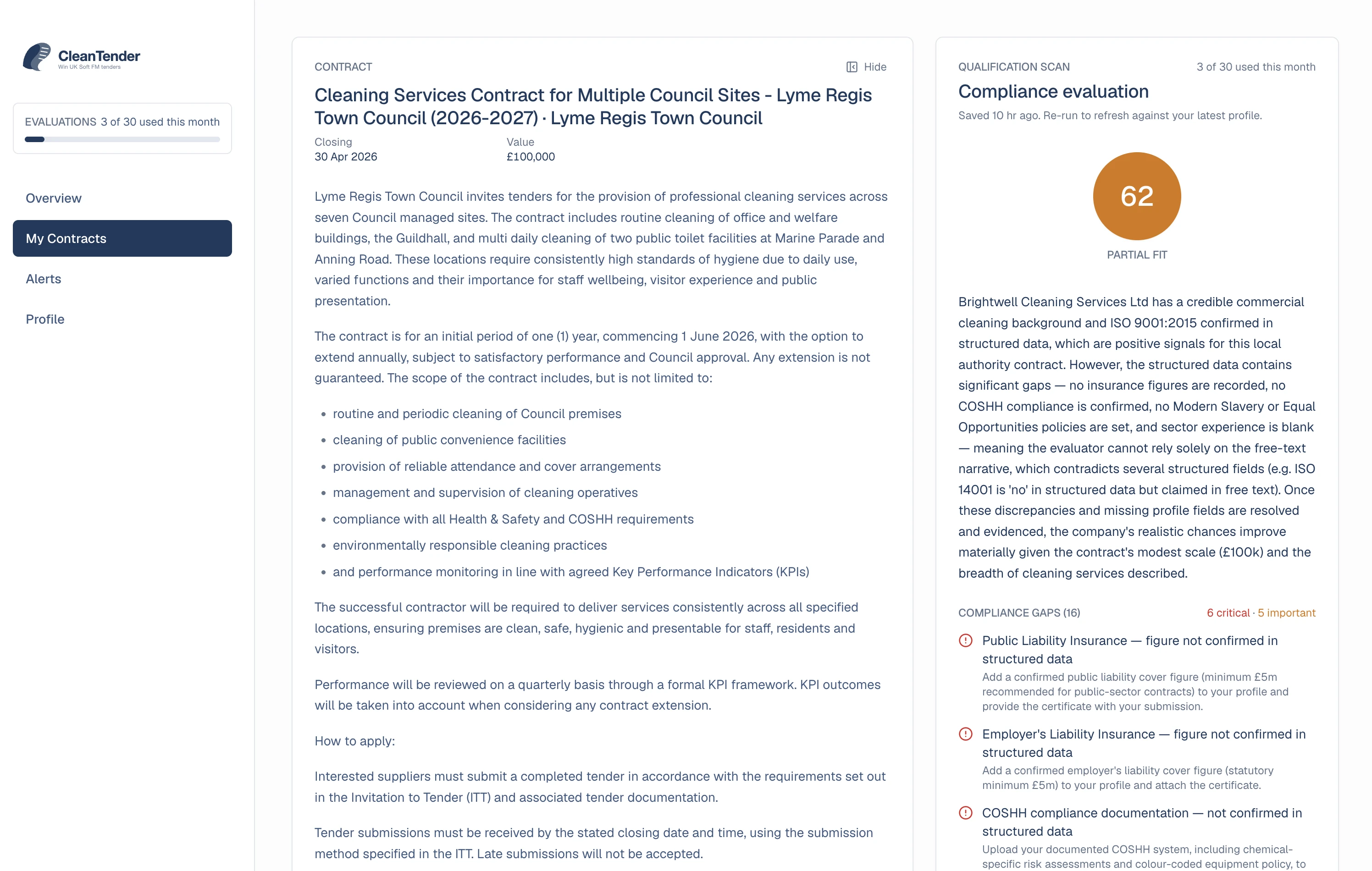
Fit-score and win-probability before you commit a weekend Step 5· 1 minute
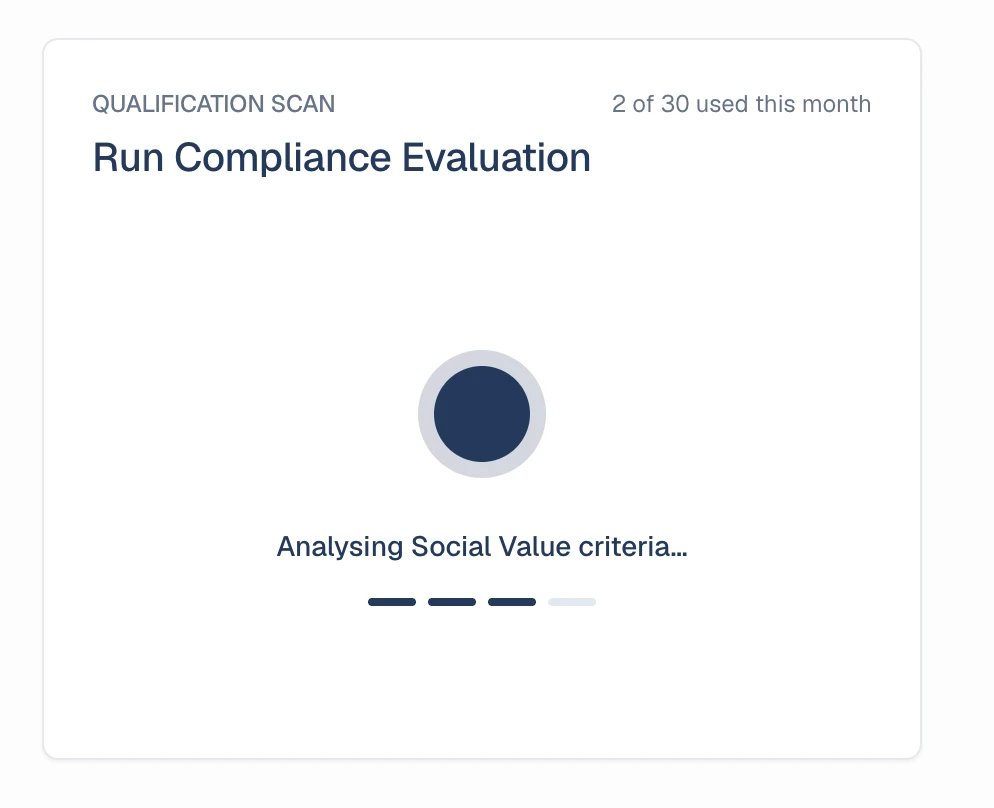
Spot compliance gaps before you start drafting
CleanTender runs a named compliance check against the tender pack: SIA ACS, BS 7858:2019 vetting evidence, ISO 9001 + ISO 14001 + ISO 45001 if held, SSIP, GDPR for CCTV, social value plan, Martyn's Law tier where applicable. Anything missing is flagged before you sink hours into a bid that auto-fails at SQ.
Compliance gaps surfaced before drafting Step 6· 2 minutes generation
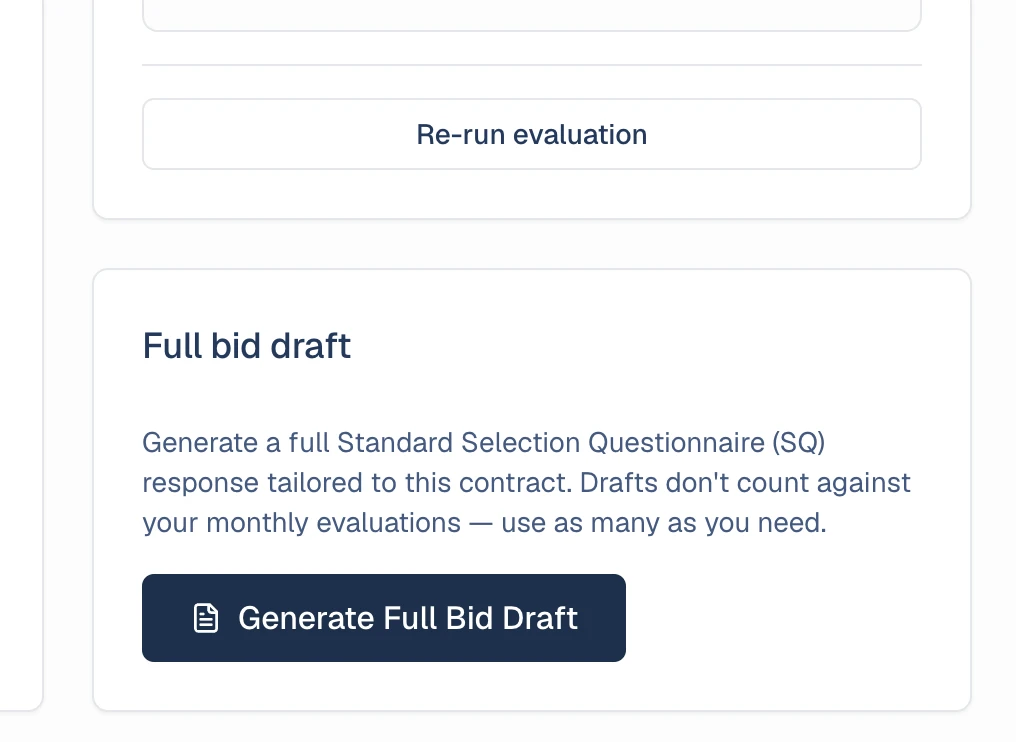
Generate a full SQ + method-statement draft
CleanTender drafts a complete Standard Selection Questionnaire response using your profile data and the tender requirements: declaration block, company overview, contract experience, quality, training, COSHH, social value, H&S, insurance schedule. All ten sections, in one pass.
Full SQ draft generated in minutes, not days Step 7· Half a day
Refine, add evidence, and submit
Tune the draft, drop in named referees and certificate numbers, layer your quantified social value commitments, and submit through the buyer's portal. Most users compress a 30-60 hour first bid to 8-12 hours of focused review.
Step 8· Ongoing
Track outcomes and improve
Every bid logs in CleanTender with status, score, and (after standstill) the buyer's feedback. Use the standstill data to tune your next bid. Win rate compounds; first-bid completion is the only thing standing between you and a public-sector revenue line.
The 5 regulatory frameworks that govern UK security tenders
| Framework | Applies to | What it requires |
|---|---|---|
| SIA Approved Contractor Scheme (ACS) | Voluntary in law, de-facto mandatory on UK public-sector security tenders | Annual independent audit by Security Industry Authority. 89-point management assessment covering staff vetting, training, supervision, customer focus, financial standing. |
| Private Security Industry Act 2001 (SIA licensing) | All front-line officers in licensable roles | Individual SIA licence per officer for: security guarding, door supervision, CCTV operating, key-holding, vehicle immobilising, close protection. Three-year licence cycle, criminal record check at renewal. |
| BS 7858:2019 Security screening of individuals | All officers, control-room staff, and admin handling sensitive data | Five-year history check, two written references covering five years, criminal record check, identity verification, gap-history accounted for. Audit-ready file per officer. |
| Martyn's Law (Terrorism (Protection of Premises) Act 2025) | Standard tier: 200-799 capacity premises and events. Enhanced tier: 800+ capacity and qualifying public events. | Standard duty: assessment, simple plan, reasonable mitigations. Enhanced duty: documented security plan, designated responsible person, training, regular drills. Implementation transition period after Royal Assent. |
| BS 7499 / BS 7984 / BS 8593 sector codes | Static guarding (BS 7499), key-holding and response (BS 7984), CCTV deployment (BS 8593) | Sector-keyed code-of-practice compliance: shift patterns, supervision ratios, response times, documented SOPs, technology integration standards. |
Major UK security frameworks evaluators reference in scoring matrices.
If your method statement does not name all five with documented compliance evidence, you are leaving evaluator marks on the table. Generic "fully accredited and compliant" copy scores 4 out of 10. Named accreditation references with audit dates and certificate numbers score 8-9.
What buyers score on (the marking matrix patterns)
| Criterion | Typical weighting | What scores 8-9/10 |
|---|---|---|
| Price (officer rate, mobile patrol, technology, management overhead) | 30-40% | Transparent rate-card by officer grade, mobile-patrol cost broken from static, named technology cost line, no hidden uplift on bank holiday or sickness cover |
| Method / technical capability | 25-35% | Named shift patterns, supervision ratios with named supervisor, mobile-patrol contingency cover, named incident management platform, integration with site CCTV and access control |
| Vetting and training | 10-20% | BS 7858:2019 file evidence per officer, SIA licence verification log, named training programme (induction, on-site, refresher), Mental Health First Aid certification, conflict-resolution training |
| Social value (PPN 002) | 10-20% minimum | Quantified ex-forces and ex-offender hires, mental health first-aiders deployed, community safety partnerships with local police, apprenticeships, Real Living Wage commitment |
| Health, safety, and compliance | 5-10% | ISO 9001 + ISO 14001 + ISO 45001, SSIP-recognised certificate (CHAS or SafeContractor), lone-worker compliance under Health and Safety at Work Act 1974, GDPR-compliant CCTV operations |
Typical scoring breakdown on UK public-sector security tenders in 2026.
Pricing factors for UK security tenders
Security pricing is layered. A council parks contract, an NHS Trust mental health unit, and a court estate contract have completely different cost structures. The contractor's margin sits on the gap between the headline officer rate and the true loaded cost of vetting, training, supervision, mobile patrol, technology, sickness and holiday cover, and management overhead.
| Component | Rough range (2026) | Notes |
|---|---|---|
| Officer hourly cost (SIA-licensed static guard) | £12.50-£15.00 per hour at the door | Loaded with NI, holiday, training, sickness cover, supervision; sustainable charge-out is materially higher than the National Living Wage |
| Officer hourly cost (Door Supervisor or Mental Health-trained) | £14.50-£18.50 per hour at the door | Required at NHS mental health, A and E, court front-of-house, late-night venues |
| Mobile patrol officer | £35-£60 per visit (single site) or £55-£85 per hour blended | Includes vehicle, fuel, response capability; typically priced per visit on routine patrols, per hour on dedicated mobile |
| Control room and incident management technology | £80-£250 per officer per month | Lone-worker device, incident reporting platform, body-worn camera, control-room support; pass-through or absorbed |
| Vetting and training overhead | £300-£700 per officer per year | BS 7858 vetting refresh, SIA licence renewal cycle, mandatory training hours, refresher modules |
| Holiday, sickness, and supervisor cover | 12-18% of officer cost | Sustainable contracts price for 12-15% absence + supervisor uplift; bids that ignore this collapse mid-contract |
| Management overhead and ACS audit cost | 8-15% of contract value | Account manager time, ACS annual audit, ISO surveillance, training-records system, SLA reporting |
Cost components in a typical UK public-sector security contract.
The 6 main UK public-sector security markets
| Sector | Key standards | Typical contract shape |
|---|---|---|
| NHS Trusts (acute, mental health, A and E, community) | SIA ACS, BS 7858, NHS Conflict Resolution Training (CRT), Mental Health First Aid, GBV-aware training, lone-worker policy | Manned guarding plus mobile patrol, A and E permanent presence, mental health-trained officers. £1m-£15m per Trust, 5-7 year terms. |
| Local authority estates and parks | SIA ACS, BS 7858, BS 7984 keyholding code, GDPR for CCTV monitoring, Anti-Social Behaviour Act tooling familiarity | Mobile patrol, keyholding, alarm response, parks late-shift cover, civic-event stewarding. Frameworks via YPO, ESPO, NEPO. |
| State schools and academy trusts | SIA ACS, enhanced DBS, BS 7858, safeguarding training, lockdown protocol familiarity | Reception cover, gate stewarding, mobile patrol overnight, lockdown drill support. Often part of integrated FM. |
| Universities and FE colleges | SIA ACS, BS 7858, BS 7960 door supervision (campus venues), GDPR for CCTV | Campus security, residential hall cover, exam-room invigilation support, event security. TUCO-style consortia frameworks common. |
| Central government (MoJ courts, HMPPS, MoD, civil estate) | SIA ACS, BS 7858, security clearance (CTC, SC, DV depending), Cabinet Office HMG Security Policy Framework | Court estate, prison perimeter (HMPPS direct), MoD bases, government civil estate. Specialist clearances required. |
| Transport, retail, and event security | SIA ACS, BS 7960, Martyn's Law Standard or Enhanced tier, crowd-management qualifications, NaCTSO ACT training | Stations, ports, shopping centres, sports venues, festivals. Crossing into Martyn's Law Enhanced tier requires documented security plan and drills. |
UK public-sector security markets and the standards each requires.
Most SME security contractors cluster around local authority work and lower-tier school and university contracts. NHS mental health and A and E security require named training and the right officer profile. Court and prison work needs HMG security clearance pathways. Transport and major venues now sit firmly inside Martyn's Law Enhanced tier and require documented security planning. Match your bid scope honestly to your operational base.
If your target is the bidding mechanics rather than the regulatory and scoring framing, pair this guide with the security contracts bidding guide. For the SIA ACS deep dive, see the SIA ACS guide for UK security tenders. For common bid failure modes, see why security tender bids fail. For where UK security tenders are posted across every free portal, see the UK security tenders hub.
Method statement structure for security tenders
- Scope confirmation: site list with shift patterns (day, night, weekend, bank holiday), total weekly hours, post types (gate, reception, mobile patrol, control room), and access-control responsibilities. Reference page numbers in the tender spec.
- Mobilisation plan: 4-week mobilisation timeline covering vetting completion, site induction, key handover, technology deployment, supervisor introduction. TUPE planning if relevant.
- Officer profile and vetting: BS 7858:2019 file structure (five-year history, two written references, criminal record check, identity verification), SIA licence verification process, gap-history evidence, audit cycle.
- Training programme: induction (corporate, site-named, role-named), refresher cycle (annual minimum), mandatory modules (conflict resolution, mental health awareness, first aid, fire safety, lone working, GDPR for CCTV), enhanced modules where relevant (safeguarding for schools, NHS CRT, court etiquette).
- Operational delivery: shift handover process, supervisor visits, mobile patrol routes and frequencies, key-holding response time, alarm response procedure, integration with site CCTV and access control.
- Incident management: named platform (e.g. ProGuard, Spotnik, Time Gateway, Vipre, OneSafe; name the one you use), incident classification, escalation matrix, customer reporting cadence, audit trail.
- Compliance evidence: SIA ACS certificate with audit date, ISO 9001 + ISO 14001 + ISO 45001 if held, SSIP-recognised certificate, BSIA or NSI Gold membership, GDPR registration with ICO, public liability insurance level (£10m typical), employer's liability level.
- KPIs and reporting: response times, patrol completion rates, incident closure rate, customer satisfaction, vetting compliance percentage, training completion percentage, monthly review meeting cadence.
- Escalation: out-of-hours emergency response, named on-call manager, response time, deputy cover, escalation up to operations director, business continuity plan for major site failure or pandemic.
If your method statement still reads as brochure copy at this stage, the eight-section scoring structure in the cleaning method statement guide applies the same logic for security, with shift patterns and incident response swapped in. Marking matrices reward density of relevant evidence, not prose length.
Social value commitments that score in security
PPN 002 (live 1 October 2025) sets a 10% minimum social value weighting on UK central government tenders, and most local authorities and NHS Trusts now match or exceed that. Security contracts have natural social value angles that score well when quantified.
- Ex-forces and reservist hiring: "Year-one recruitment commitment of 20% from ex-forces or reservist backgrounds. Active partnership with the Career Transition Partnership and SaluteMyJob."
- Ex-offender pathways: "Year-one commitment of 5% workforce drawn from people with criminal records, with appropriate role-matching and supervision. Active partnership with Recruit With Conviction or local equivalent."
- Mental Health First Aiders deployed: "100% of officers trained to MHFA Lite standard within six months. Two designated MHFA-qualified responders on every contract."
- Real Living Wage commitment: "All officers paid at or above the Living Wage Foundation Real Living Wage for the contract life, accredited employer status maintained."
- Community safety partnership: "Quarterly liaison with local police community safety officer, contribution to community safety partnership data, support for Safer Streets initiatives in the contract area."
When NOT to bid
- No SIA ACS membership. The annual ACS audit is now the gating credential on UK public-sector security work. If you do not hold it, apply now (12 weeks typical assessment cycle) before chasing tenders.
- Pricing below sustainable. Officer rate at or below the National Living Wage with no on-cost stack collapses on holiday, sickness, and training. Some buyers reject obviously-unsustainable bids under Procurement Act 2023 "abnormally low tender" rules.
- Geography mismatch. Mobile patrol economics break beyond a 20-mile patrol radius. Bidding 60+ miles from your operational base usually means relying on an unprofitable subcontract.
- Sector mismatch. Bidding NHS mental health security when your team has only delivered retail and event work. The conflict resolution training, GBV awareness, and Mental Health First Aid evidence catch out generalists.
- No BS 7858:2019 vetting evidence. If your only evidence is "we vet our staff", you fail the technical section. A documented file structure with audit-ready evidence per officer is the price of entry.
- Martyn's Law mismatch on venue and event work. If you cannot demonstrate familiarity with Standard and Enhanced tier duties under the Terrorism (Protection of Premises) Act 2025, do not bid stadium, theatre, festival, or large-venue work.
What to do this week
- Audit your SIA ACS status. If you are not a member, schedule the assessment now. Without it, most public-sector contracts auto-fail at SQ.
- Audit your BS 7858:2019 vetting files. Ensure each officer file has five-year history, two written references, criminal record check, identity verification, and gap-history evidence.
- Document your incident management technology stack: lone-worker device, incident reporting platform, body-worn camera, control-room support. Get supplier letters for evidence.
- Build a master security method statement covering scope, mobilisation, vetting, training, operations, incident management, compliance, KPIs, escalation. Reuse on every bid.
- Set a saved search on Find a Tender Service for "manned guarding", "security services", "keyholding", "mobile patrol", "event stewarding" plus your geography. Review weekly.
Sources
- SIA Approved Contractor Scheme (Security Industry Authority) · Voluntary in law, de-facto mandatory on UK public-sector security tenders; annual independent audit
- Private Security Industry Act 2001 (legislation.gov.uk) · Establishes SIA licensing for front-line officers in licensable roles
- BS 7858:2019 Security Screening (BSI) · Five-year history, two written references, criminal record check, identity verification per officer
- Terrorism (Protection of Premises) Act 2025 (Martyn's Law) · Standard tier 200-799 capacity, Enhanced tier 800+ and qualifying public events; implementation transition after Royal Assent
- BS 7499 Static Guarding Code of Practice (BSI) · Sector code for static guarding services
- BS 7984 Keyholding and Response Services (BSI) · Sector code for keyholding and alarm response
- PPN 002: Social Value Model (Cabinet Office) · Mandatory from 1 October 2025; 10% minimum social value weighting on central government tenders
- NSI National Security Inspectorate · NSI Gold and Silver schemes referenced on most UK public-sector security tenders
- Living Wage Foundation · Real Living Wage accreditation increasingly listed as a scoring criterion on social value sections
- Procurement Act 2023 (legislation.gov.uk) · Live since 24 February 2025; reshapes SQ structure and award criteria
FAQs
Frequently asked questions
- Three big shifts. First, the Terrorism (Protection of Premises) Act 2025 (Martyn's Law) introduced a tiered duty on premises (Standard tier 200-799 capacity, Enhanced tier 800+ and qualifying public events), with documented security plans, designated responsible persons, and drills required at the Enhanced tier. Second, the Procurement Act 2023 went live on 24 February 2025, restructuring SQ documents and introducing "abnormally low tender" rejection mechanics that catch unsustainable hourly rates. Third, PPN 002 (Social Value Model) became mandatory on central government tenders from 1 October 2025, with a 10% minimum weighting that most NHS Trusts and councils now match or exceed. SIA Approved Contractor Scheme membership and BS 7858:2019 vetting remain the technical backbone everywhere.
- In law, SIA ACS is voluntary. In practice, it is the de-facto floor on UK public-sector security tenders. Most NHS Trusts, local authorities, schools, universities, and central government departments list ACS as a hard or near-hard requirement at SQ. If you do not hold it, the SIA assessment cycle takes around 12 weeks for a first audit, with a £1,500-£2,500 application fee plus your own preparation cost. The 89-point assessment covers staff vetting, training, supervision, customer focus, financial standing, and management systems. Some larger buyers add NSI Gold or BSIA membership as an evaluation differentiator. Plan ACS membership before your next target tender window.
- The Terrorism (Protection of Premises) Act 2025 (Martyn's Law) places duties on premises and event spaces by capacity. Standard tier covers premises and events with a capacity between 200 and 799: a written assessment, simple plan, and reasonable mitigations. Enhanced tier covers premises and events with capacity of 800 or above, plus qualifying public events: a documented security plan, a designated responsible person, training records, and regular drills. For security tender bids on stadia, theatres, large events, festivals, and major public venues, your method statement must demonstrate familiarity with both tiers, your role in supporting the venue's responsible person, and a credible drill and review cycle. Implementation transitions after Royal Assent, so live duty timing depends on the regulator's commencement schedule. Monitor NaCTSO and Home Office updates.
- Hourly rate is more layered than the headline number suggests. SIA-licensed static guard rate is typically £12.50-£15.00 per hour at the door, loaded with NI, holiday, training, sickness cover, and supervision; sustainable charge-out is materially higher than the National Living Wage. Door Supervisor or Mental Health-trained officer rates run £14.50-£18.50 per hour, required at NHS mental health, A and E, court front-of-house, and late-night venues. Mobile patrol officer cost is typically £35-£60 per visit on routine patrols or £55-£85 per hour blended on dedicated mobile. On top, vetting and training overhead is £300-£700 per officer per year (BS 7858 vetting refresh, SIA licence renewal, mandatory training). Holiday, sickness, and supervisor cover adds 12-18% of officer cost. Management overhead and ACS audit cost adds 8-15% of contract value. Build the rate stack transparently in your bid; opaque flat rates lose to transparent stacks under the Procurement Act 2023 most-advantageous-tender rules.
- Quantified, local, measurable commitments aligned to PPN 002 themes (jobs, growth, wellbeing, environment, equal opportunity). Strong examples: "Year-one recruitment commitment of 20% from ex-forces or reservist backgrounds, active CTP and SaluteMyJob partnership". "Year-one commitment of 5% workforce drawn from people with criminal records via Recruit With Conviction". "100% of officers trained to MHFA Lite within six months, two MHFA-qualified responders on every contract". "All officers paid at or above the Living Wage Foundation Real Living Wage for the contract life, accredited employer status maintained". "Quarterly liaison with local police community safety officer, contribution to community safety partnership data". The five themes give you a structure. Quantify each commitment with a number and a date. Generic "we support local communities" copy scores 4/10. Five quantified commitments score 8-9/10 on a 10% category.