
A winning method statement on a UK public-sector grounds maintenance tender has eight named sections: scope, frequencies, equipment, chemicals and pesticides, staffing and qualifications, biodiversity and environmental commitments, quality monitoring, and escalation. Each one maps to a scoring criterion in the buyer's marking matrix. Brochure copy fails every time.
Two regulatory shifts have changed what scores in 2026. Biodiversity Net Gain (BNG) became mandatory in February 2024 and councils now expect grounds contractors to demonstrate habitat-enhancement capability. Glyphosate restrictions are tightening across UK local authorities; many councils now require pesticide-free alternatives in tender method statements. Zero-emission machinery is increasingly specified. Generic answers about "environmentally responsible practices" score 4 out of 10. Named techniques and equipment score 8-9.
If your method statement could be copy-pasted into a competitor's bid by changing the firm name, you wrote brochure copy. Evaluators are not scoring your firm. They are scoring your understanding of this site.
What's in this guide
- How to write a winning grounds maintenance method statement, step by step (CleanTender walkthrough)
- What evaluators are scoring against
- The eight-section structure that scores
- A worked example: a 14-hectare council parks contract
- A worked example: a 6-hectare secondary school estate
- Phrasing that loses points (and what to write instead)
- How to map your statement to the marking matrix
- FAQs on BNG, glyphosate, qualifications
How to win a UK grounds maintenance method statement tender, step by step
The complete end-to-end flow inside CleanTender. From sector setup to a submitted grounds maintenance method statement bid in the time it used to take to read a single tender pack.
Eight steps from "never bid public sector" to a complete SQ response on the buyer's portal. First scan is free.
Step 1· 10 minutes
Build your grounds maintenance method statement company profile
Set your sector to grounds maintenance method statement, your service regions, BS 7370 capability, NPTC ticket inventory (PA1/PA6, CS30/CS31, CS38), ISO 14001 status, fleet inventory, biodiversity approach, insurance levels, turnover, and operative count. CleanTender uses this to fit-score every live tender against your real capability so you only see the ones you can win.
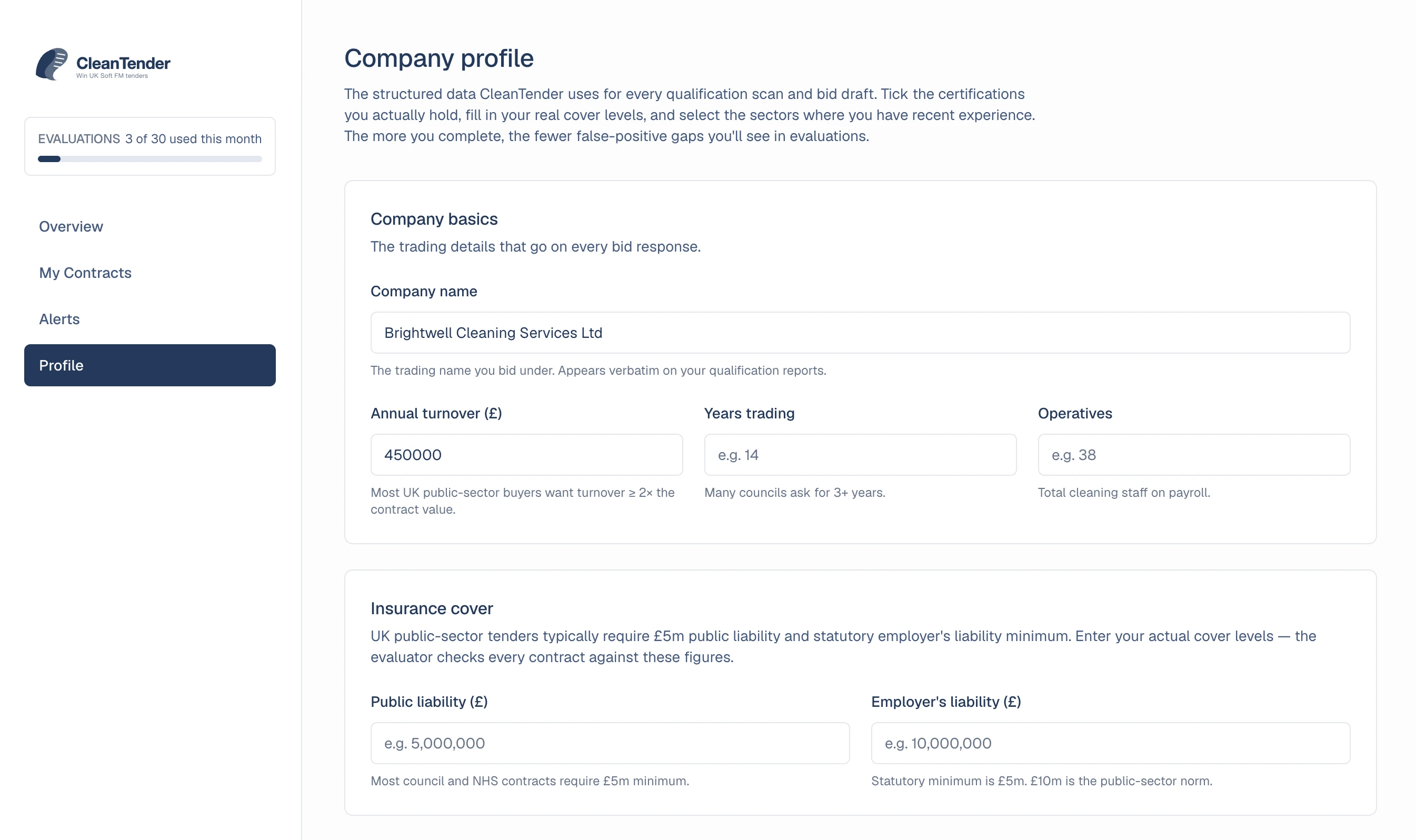
Profile setup defines what you are bid-ready for Step 2· 5 minutes daily
Open the live grounds-tender feed
Every UK council, NHS Trust, school, MoD, university, and housing-association grounds maintenance tender, in one feed. Pre-filtered to your sector and geography. No false positives, no manual portal-trawling across FTS, Contracts Finder, and dozens of buyer e-procurement portals.
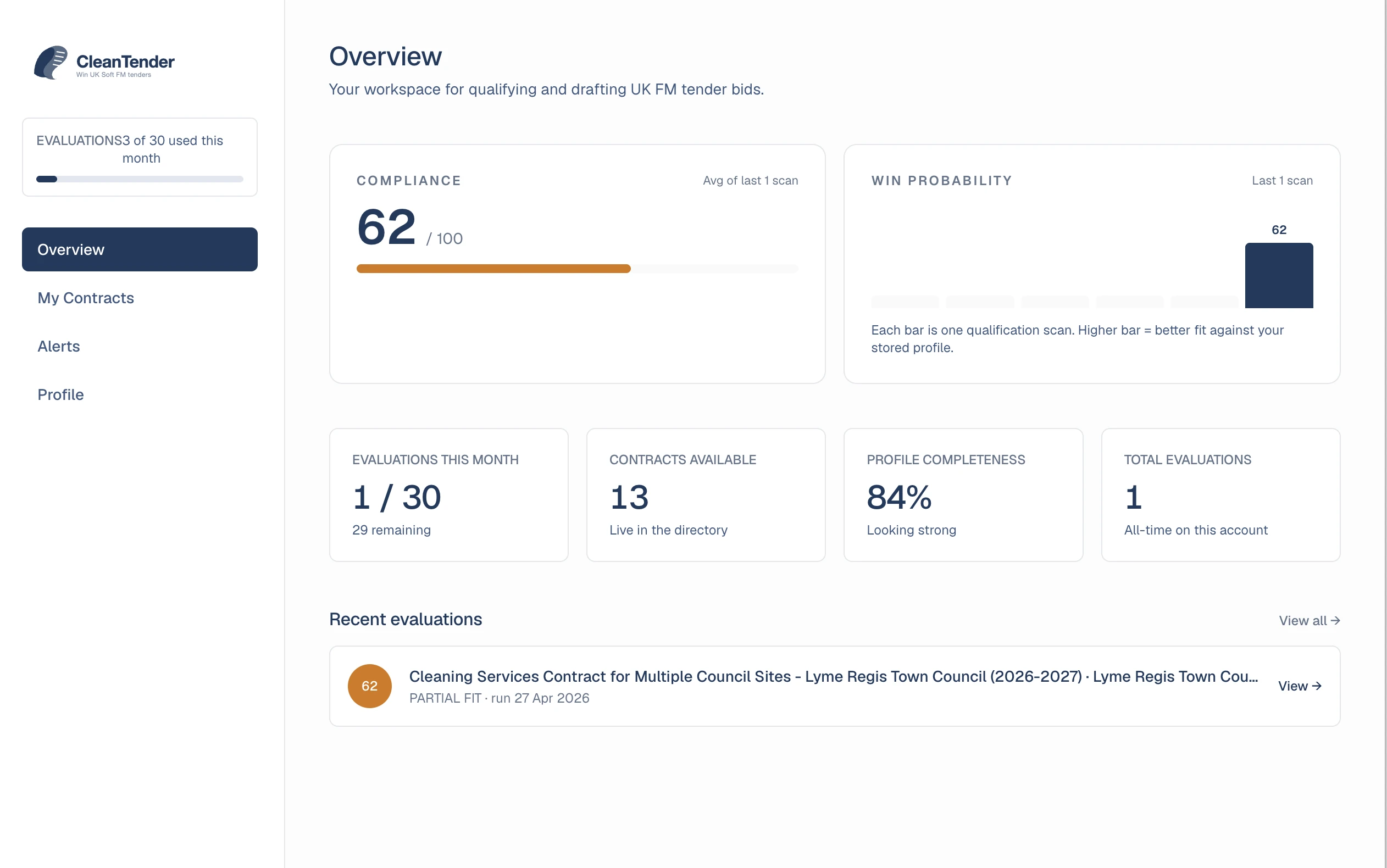
Live feed of in-scope grounds tenders, fit-scored Step 3· Daily digest
Get email alerts for new in-scope tenders
New grounds maintenance method statement tenders matching your profile land in your inbox the day they publish. CleanTender batches them into a daily digest so you do not get notification fatigue, and links straight back to the in-app fit score.
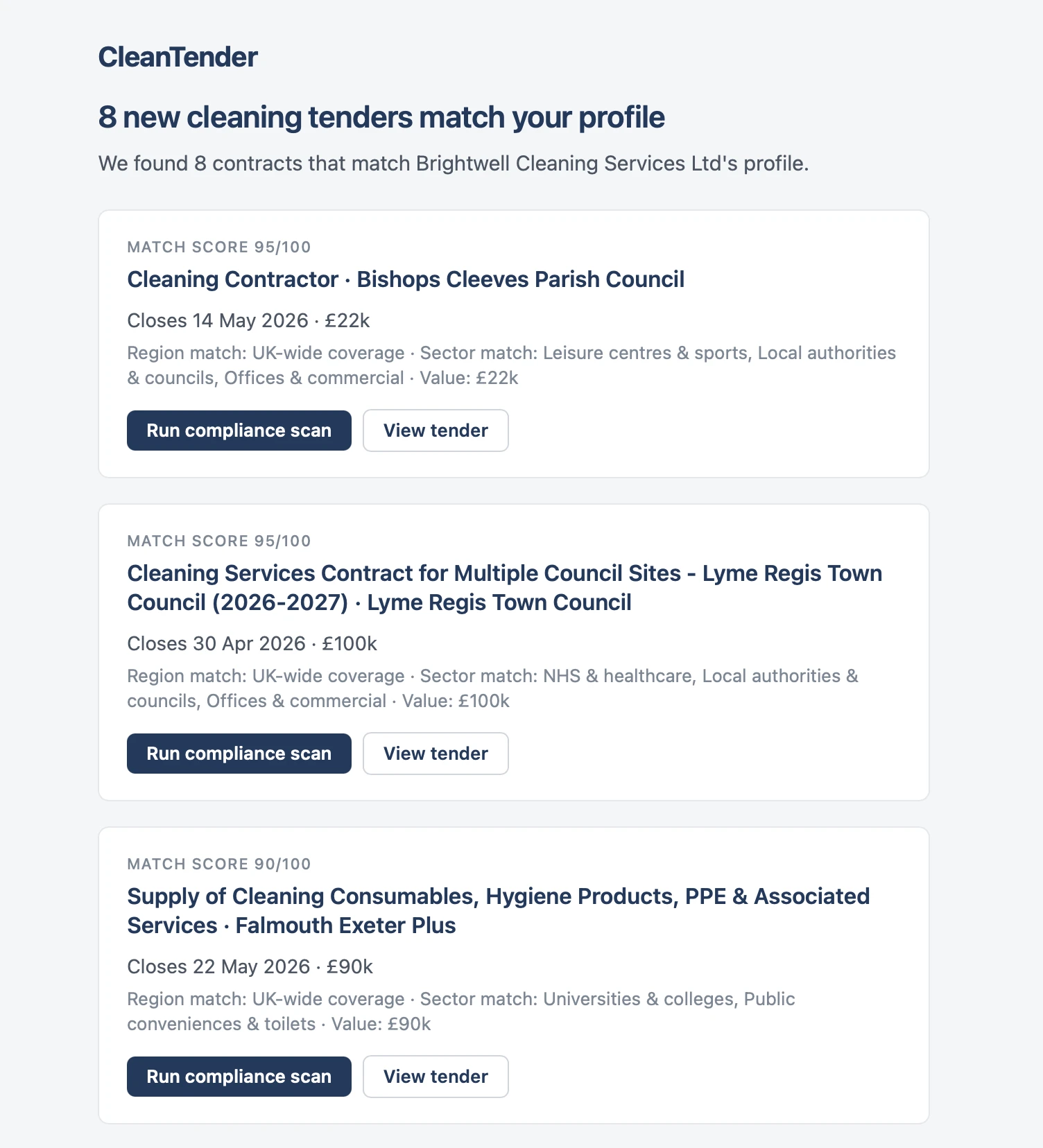
Daily alerts for new in-scope tenders Step 4· 30 seconds
Run a fit-score evaluation on a target tender
One click runs a CleanTender Evaluation against the tender pack: scope match, geography fit, scale fit, compliance gap, and a plain-English win probability. Stops you bidding contracts you were never going to win.
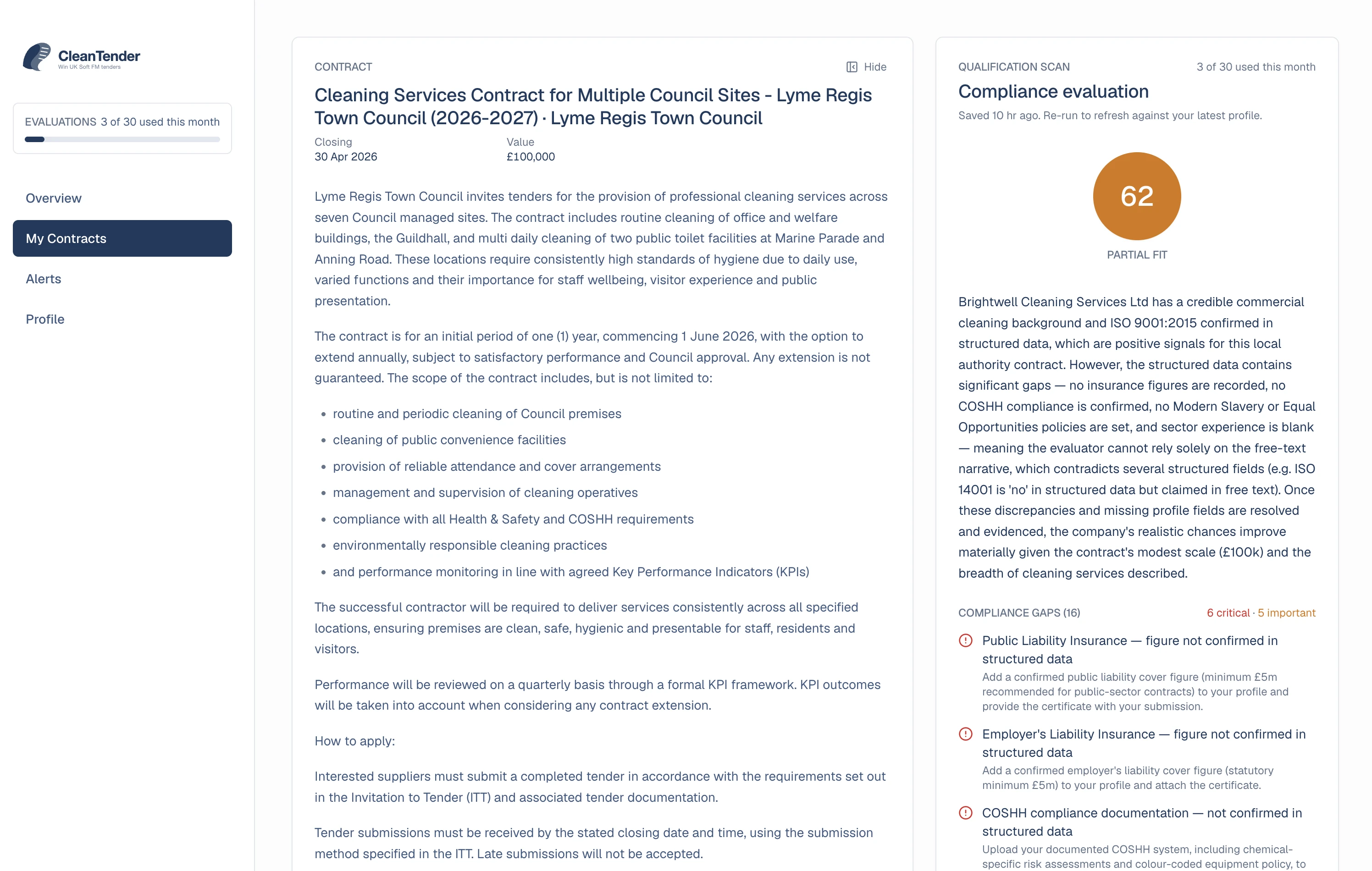
Fit-score and win-probability before you commit a weekend Step 5· 1 minute
Spot compliance gaps before you start drafting
CleanTender runs a named compliance check against the tender pack: ISO 14001, NPTC PA1/PA6, CS30/CS31, LOLER 1998 inspection records, SSIP, social value plan, biodiversity approach, method statement structure. Anything missing is flagged before you sink hours into a bid that auto-fails at SQ.

Compliance gaps surfaced before drafting Step 6· 2 minutes generation
Generate a full SQ + method-statement draft
CleanTender drafts a complete Standard Selection Questionnaire response using your profile data and the tender requirements: declaration block, company overview, contract experience, quality, training, COSHH, social value, H&S, insurance schedule. All ten sections, in one pass.
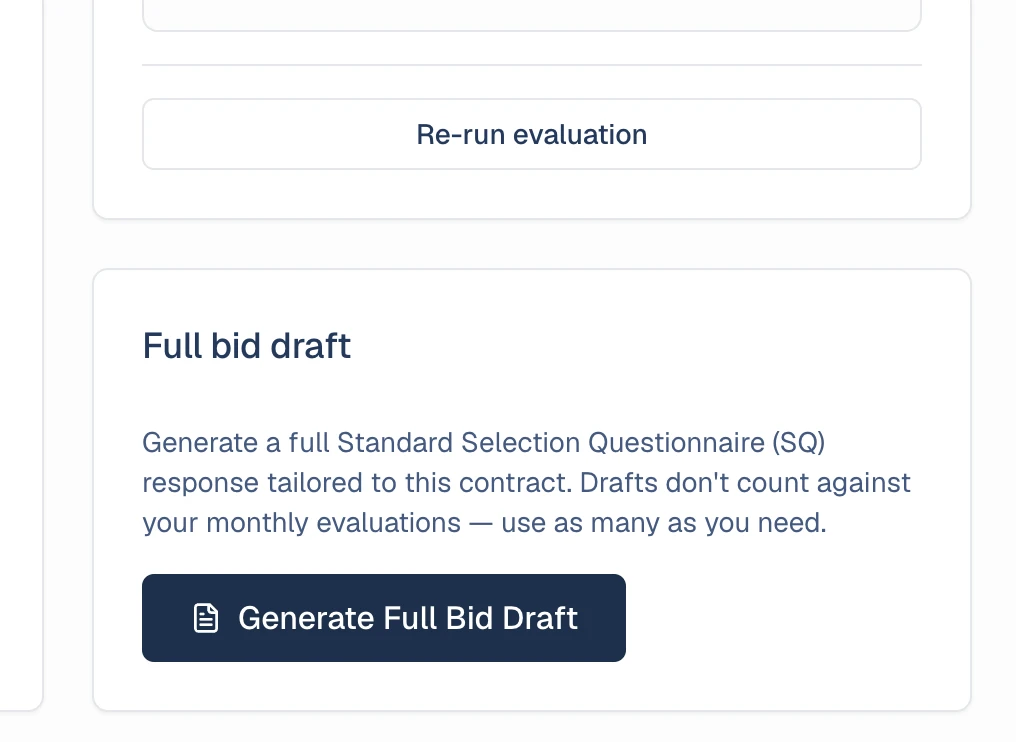
Full SQ draft generated in minutes, not days Step 7· Half a day
Refine, add evidence, and submit
Tune the draft, drop in named referees and certificate numbers, layer your quantified social value commitments, and submit through the buyer's portal. Most users compress a 30-60 hour first bid to 8-12 hours of focused review.
Step 8· Ongoing
Track outcomes and improve
Every bid logs in CleanTender with status, score, and (after standstill) the buyer's feedback. Use the standstill data to tune your next bid. Win rate compounds; first-bid completion is the only thing standing between you and a public-sector revenue line.
What evaluators are scoring against
UK public-sector grounds maintenance tenders use a marking matrix. The buyer wrote it before the tender went live. It tells you what scores 0, 3, 5, 7, and 10 on each quality question. Most matrices are now published in the tender pack itself or released on request under the Procurement Act 2023's transparency rules.
| Score | What it looks like |
|---|---|
| 10/10 | Site-by-site detail. Named equipment with model numbers. Frequency tables by area type. Glyphosate alternatives named. BNG commitments quantified. Named supervisor with NPTC + horticulture qualifications. Zero-emission machinery quote. |
| 7/10 | Mostly site-relevant. Some named equipment. Frequencies broken into seasonal categories. BNG mentioned as principle. Supervisor role identified but not person. |
| 5/10 | Generic but coherent. "Industry best practice". Frequencies referenced but not tabled. No named equipment. Generic environmental statement. |
| 3/10 | Marketing copy. "We pride ourselves on environmental responsibility." No frequencies, no equipment, no BNG reference. |
| 0/10 | Off-topic, missing, or copy-pasted from a different sector. |
Typical 10-point marking matrix for a UK council grounds maintenance method statement.
The eight-section structure that scores
- Scope confirmation: hectarage, named features (sports pitches, ornamental beds, hedges, woodland edges, hard landscaping). Reference the page numbers in the spec.
- Frequency table: weekly, fortnightly, monthly, seasonal tasks broken out by area type (amenity grass, sports pitch, ornamental bed, hedge, woodland edge).
- Equipment: named machinery with capacity, model numbers, fuel type. Cylinder mowers for sports pitches, rotary for amenity, brushcutters for edges, hedge cutters for boundaries. Highlight battery / electric / hybrid inventory.
- Chemicals and pesticides: full list with HSE registration numbers. State your default position on glyphosate (replaced where possible). Name acetic-acid or mechanical-control alternatives. Attach COSHH data sheets as appendix.
- Staffing model: number of operatives per site, supervisor ratio, named site supervisor with NPTC PA1+PA6 (chemical handling), Lantra grounds maintenance qualification, City & Guilds Level 2 in Horticulture or equivalent.
- Biodiversity and environmental commitments: BNG-aligned habitat work, wildflower margins, bird-box installation, no-mow areas, peat-free compost commitment. Quantify wherever possible ("3 hectares of no-mow May, 12 bird boxes installed in year one").
- Quality monitoring: how you check the work. Lantra-aligned audits, monthly photographic reports, customer satisfaction surveys, monthly KPI reports to the contract manager.
- Escalation: what happens when something goes wrong on a Sunday in storm conditions. Named on-call number, response time, deputy supervisor cover, public liability cover for fallen tree work.
Worked example: 14-hectare council parks contract
Tender pack says: 14 hectares across three council parks. Mix of amenity grass (8ha), formal beds (1.5ha), sports pitches (3 cricket squares + 2 football pitches), hedges (3km), and woodland edge (1ha). Year-round maintenance. 5-year base term plus two 1-year extensions.
Here is what scores 8-9 out of 10 on a typical council marking matrix.
| Area | Apr-Oct | Nov-Mar | Annual |
|---|---|---|---|
| Amenity grass (8ha) | Cut every 7-10 days, edge weekly. Box-collected on first cut, rotary mulched thereafter. | Cut every 4-6 weeks until growth ceases. Final autumn cut + leaf collection. | Spring scarification on damage areas |
| Formal beds (1.5ha) | Weekly weed control (mechanical first, acetic-acid spot treatment if required), fortnightly deadheading, monthly mulch top-up | Bi-monthly weeding, annual cut-back of perennials in February | Spring planting cycle (peat-free compost), autumn bulb planting |
| Cricket squares (3) | Specialist cylinder mowing 3x/week April-September. End-of-season renovation: scarification, hollow tine aeration, top dressing, overseeding. | Light maintenance, frost cover days | Pre-season rolling, fertiliser applications per IOG schedule |
| Football pitches (2) | Cylinder mow 2x/week match season, line-marking weekly, divot repair after each match | End-of-season renovation, rest period through deep frost | Pre-season decompaction, slit-tine aeration, overseeding, fertiliser |
| Hedges (3km) | Two cuts: late June (after bird-nesting season under WCA 1981) and September. Edge trimming monthly during growth. | Dormant period work only on management plan exceptions | Annual structural reduction on declining sections |
| Woodland edge (1ha) | Path edges trimmed monthly. No-mow buffer left for invertebrates per BNG plan. | Coppicing on rotation per management plan | Annual deadwood survey, hazard tree assessment |
Frequency table extract for a 14-hectare council parks grounds maintenance contract.
Now the staffing model. Two operatives 5 days a week April-October (10 staff days/week), one operative 3 days a week November-March (3 staff days/week). Site supervisor (NPTC PA1+PA6, Lantra Grounds Maintenance Award, City & Guilds Level 2 Horticulture) on site three days a week and on call the other two. Annual contract value supports approximately 1,400 staff days.
The biodiversity section names: 1.5 hectares of no-mow May areas across the three parks (mapped on submission), 24 bird boxes (12 great tit, 8 blue tit, 4 sparrow terraces) installed and maintained, peat-free compost across all formal beds and seasonal planting, hedgerow gap planting (200 native hedge plants in year one), and a wildflower meadow trial of 0.5 hectares using a native UK seed mix from Emorsgate. All quantified, all credible for a 14-hectare site.
Notice what is in there. Real numbers. Real qualifications. Real product references (Emorsgate, IOG schedule, WCA 1981). Real time windows. An evaluator scoring against the matrix has six things to tick: scope confirmed, frequencies tabled, equipment described, supervisor qualifications named, BNG commitments quantified, and chemical-use position stated. That is an 8-9 out of 10.
Worked example: 6-hectare secondary school estate
School grounds maintenance has different priorities. Term-time vs holiday cycles. Safeguarding rules on staff. Anti-bullying maintenance of clear sight-lines. Hard-wearing pitch surfaces for daily PE use. The method statement should reflect these.
| Period | Cycle | Notes |
|---|---|---|
| Term-time (Sept-July) | Out-of-hours work only (before 07:30 or after 16:30). Weekly mow, monthly hedge edge. | All operatives DBS-checked under safeguarding rules. Visible PPE. No power tool work during PE lessons. |
| Half-term and holidays | Full access. Major works scheduled here: pitch renovation, hedge laying, tree surgery, hard-landscape repairs. | Coordinate with site manager on caretaker availability |
| Summer holiday (6 weeks) | Annual deep-clean. End-of-season pitch renovation, scarification, overseeding, fertiliser. Hedge re-shaping. | Critical window: skip it and the pitches will not recover for September |
| Christmas / Easter (2-3 weeks each) | Hedge cutting outside bird-nesting season. Tree work. Hard-surface repair. | Weather-dependent |
Term-time vs holiday cycle planning for a 6-hectare secondary school grounds contract.
Safeguarding evidence in the staffing section: all operatives Enhanced DBS-checked under the Safeguarding Vulnerable Groups Act 2006, regulated activity confirmed for any operatives working unsupervised in term-time, supervisor designated as safeguarding lead, and visitor-management protocol agreed with the school. Schools score safeguarding evidence highly because the Ofsted framework requires them to.
Phrasing that loses points (and what to write instead)
| Loses points | Scores points |
|---|---|
| We use industry best practice | Cylinder mowing for sports pitches per IOG (Institute of Groundsmanship) standards, rotary mulching for amenity grass, hedge cutting outside bird-nesting season under the Wildlife and Countryside Act 1981 |
| Our staff are fully trained | All chemical applicators hold NPTC PA1+PA6. Site supervisor holds City & Guilds Level 2 in Horticulture and Lantra Grounds Maintenance Award. CSCS card on every operative. |
| We are environmentally responsible | Glyphosate replaced with acetic-acid (Katoun Gold) on all amenity work where mechanical control is not feasible. Peat-free compost only. 25% of fleet now battery-powered (Stihl AP-system), targeting 60% by year three. |
| We have a strong quality management system | ISO 9001:2015 certified by NQA (UKAS-accredited). Monthly internal audits aligned to Lantra Grounds Maintenance Specification. BS 7370 grounds maintenance standards referenced in all task instructions. |
| We promote biodiversity | BNG plan delivers 12% net gain over baseline (mapped, audited annually). 1.5 hectares of no-mow May. 24 bird boxes. Native hedge gap-planting (Emorsgate seed mix). Wildflower meadow trial of 0.5 hectares. |
| We use modern equipment | Stihl AP-system battery brushcutters (15 units), John Deere R54RKB cordless rotary mowers (8 units), Allett Buffalo 28 cylinder mowers (3 units, sports pitches), Echo gas-blower fleet replaced with battery alternatives by Q3 2026. |
Common grounds maintenance method-statement phrases that lose points, and what to write instead.
Map your statement to the marking matrix
Once you have written the eight sections, do one final pass. Open the marking matrix from the tender pack. Read the 10/10 description for each scoring criterion. Highlight the words that show up: "frequency", "BNG", "named supervisor", "qualifications", "glyphosate alternatives", "battery / electric", "audit", "escalation".
Now Ctrl-F your draft for each of those words. If they do not appear, add them. The evaluator's eye is trained to look for those terms. Make her work easy. Score points.
If your draft is still scoring under 7 after that pass, the upstream problem is usually bid selection, not writing. The seven mistakes cleaning companies make in public tenders (the principles apply to grounds maintenance equally) covers the qualification gates that filter wrong-fit bids before you waste a method statement on them.
What to do this week
- Pull a method statement from a recently lost grounds bid. Score it yourself against the eight-section structure. The gaps will be obvious.
- Build a master document of named equipment with model numbers, fuel type, age, and any battery / electric inventory. One page. Reuse on every bid.
- Pull your chemical register. Document your default glyphosate-replacement position (mechanical first, then acetic-acid). Attach COSHH data sheets per product.
- Check supervisor qualifications. NPTC PA1+PA6 is the chemical-handling baseline. Lantra Grounds Maintenance Award and City & Guilds Level 2 Horticulture are the most-cited supervisor credentials on UK public-sector grounds tenders.
- Map the eight sections to your last five bids. If three are missing the same section, that is the biggest single fix you can make this month.
- On the next bid, read the marking matrix before you write the answer. Write to the 10/10 description, not to a template.
Sources
- Biodiversity Net Gain (Defra guidance) · Mandatory from 12 February 2024 for major developments; council grounds tenders increasingly require BNG-aligned habitat work
- BS 7370 Grounds maintenance Code of Practice (BSI) · British Standard for grounds maintenance specification and frequency planning
- NPTC PA1 / PA6 (City & Guilds) · Mandatory chemical-handling qualifications for grounds maintenance operatives applying pesticides
- Wildlife and Countryside Act 1981 (legislation.gov.uk) · Bird-nesting season restrictions on hedge cutting (typically 1 March to 31 August)
- Institute of Groundsmanship (IOG) standards · Industry standards for sports pitch maintenance referenced in council and education tenders
- Procurement Act 2023 (legislation.gov.uk) · Transparency rules for marking matrix publication
- Safeguarding Vulnerable Groups Act 2006 · DBS check requirements for grounds maintenance staff working on school estates
FAQs
Frequently asked questions
- Eight sections in this order: scope confirmation (with hectarage and page references to the tender spec), frequency table broken out by area type (amenity grass, sports pitch, ornamental bed, hedge, woodland edge), equipment list with named machinery and battery / electric inventory, chemicals and pesticides (with HSE registration numbers and glyphosate-alternative position), staffing model with named supervisor and qualifications (NPTC PA1+PA6, Lantra, City & Guilds), biodiversity and BNG-aligned environmental commitments (quantified), quality monitoring (Lantra-aligned audits, photographic reports, KPI reports), and escalation procedures with named on-call cover. Each section maps to a scoring criterion in the buyer's marking matrix.
- Not nationally banned, but increasingly specified out by individual council policies. Many UK councils now require pesticide-free alternatives in tender method statements as part of their environmental commitments. The strongest scoring position is to default to mechanical control first (hand-weeding, hot foam, hot water), then acetic-acid herbicides (e.g. Katoun Gold, registered under HSE) where mechanical is not feasible, with glyphosate held in reserve only for severe invasive weed problems and only with specific written approval from the contract manager. Your method statement should state this hierarchy explicitly. Generic "environmentally responsible" language scores 4/10. A named hierarchy with named alternatives scores 8-9.
- Biodiversity Net Gain (BNG) is a mandatory planning requirement from 12 February 2024 for most major developments in England under the Environment Act 2021. Public-sector grounds maintenance tenders increasingly require contractors to demonstrate BNG-aligned habitat work as part of the contract delivery. Practical commitments that score well: no-mow May areas (quantified in hectares), wildflower meadow trials (named UK native seed supplier like Emorsgate), bird-box and bat-box installation programmes, hedgerow gap-planting with native species, peat-free compost across all planting, and a documented annual BNG audit on the contract baseline. Quantify everything: "3 hectares of no-mow May" beats "we promote biodiversity".
- The most commonly cited combination on UK council and education tenders is: NPTC PA1 (Foundation Module on Safe Use of Pesticides) plus NPTC PA6 (Knapsack and Handheld Application) for any operative applying pesticides, the Lantra Grounds Maintenance Award (or equivalent industry training certificate), and City & Guilds Level 2 in Horticulture or Land-based Operations for the supervisor. CSCS cards are usually required for site-based work. School and NHS contracts add Enhanced DBS checks under the Safeguarding Vulnerable Groups Act 2006. Higher-spec supervisor roles also hold the BIAGRE Tree Survey qualification or LANTRA chainsaw tickets.
- Most council grounds tenders cap method statements at 4-8 sides of A4 per quality question, with 12pt font and standard margins. Larger contracts (NHS estates, university campuses, MoD sites) often go higher (8-15 sides). Word counts of 1,500-3,500 words per question are typical. Fill the space with named equipment, frequency tables, BNG commitments, and site-by-site detail rather than padding. Tables count toward the page limit. Marking matrices reward density of relevant evidence, not prose length. The best 4-page answer beats a generic 8-page answer every time.