
A UK public-sector cleaning bid takes 30-60 hours of writing time on the first attempt and £2,700-£5,700 in real cost (staff time + freelance writer fees). Most small firms lose their first three. The reason is rarely the writing. It is the bid selection: pricing for TUPE, the Standard Selection Questionnaire, the marking matrix, and the social value commitment. Get those four right and your hit rate triples.
Below: which contracts are worth your weekend, the SQ evidence to gather once and reuse, the price you can defend without losing money on TUPE, and the structure that wins on quality.
If the word "tender" itself is new to you, the plain-English meaning of a tender for UK service businesses is a 5-minute primer, and our cleaning tenders overview maps the whole market in one place. Then come back here for the cleaning-bid mechanics.

What's in this guide
- How to bid for a UK cleaning contract, step by step (CleanTender walkthrough)
- The bid-it-or-bin-it gut check
- Where UK cleaning tenders actually live
- Get the boring paperwork right once
- The Standard Selection Questionnaire (post-PAS 91)
- Pricing without racing to the bottom
- Social value answers that score
- Why your first three bids will lose, and that's fine
How to win a UK commercial cleaning tender, step by step
The complete end-to-end flow inside CleanTender. From sector setup to a submitted commercial cleaning bid in the time it used to take to read a single tender pack.
Eight steps from "never bid public sector" to a complete SQ response on the buyer's portal. First scan is free.
Step 1· 10 minutes
Build your commercial cleaning company profile
Set your sector to commercial cleaning, your service regions, BICSc accreditation, COSHH compliance, ISO 9001 status, TUPE experience, colour-coded equipment system, sector experience (NHS / schools / offices), insurance levels, turnover, and operative count. CleanTender uses this to fit-score every live tender against your real capability so you only see the ones you can win.
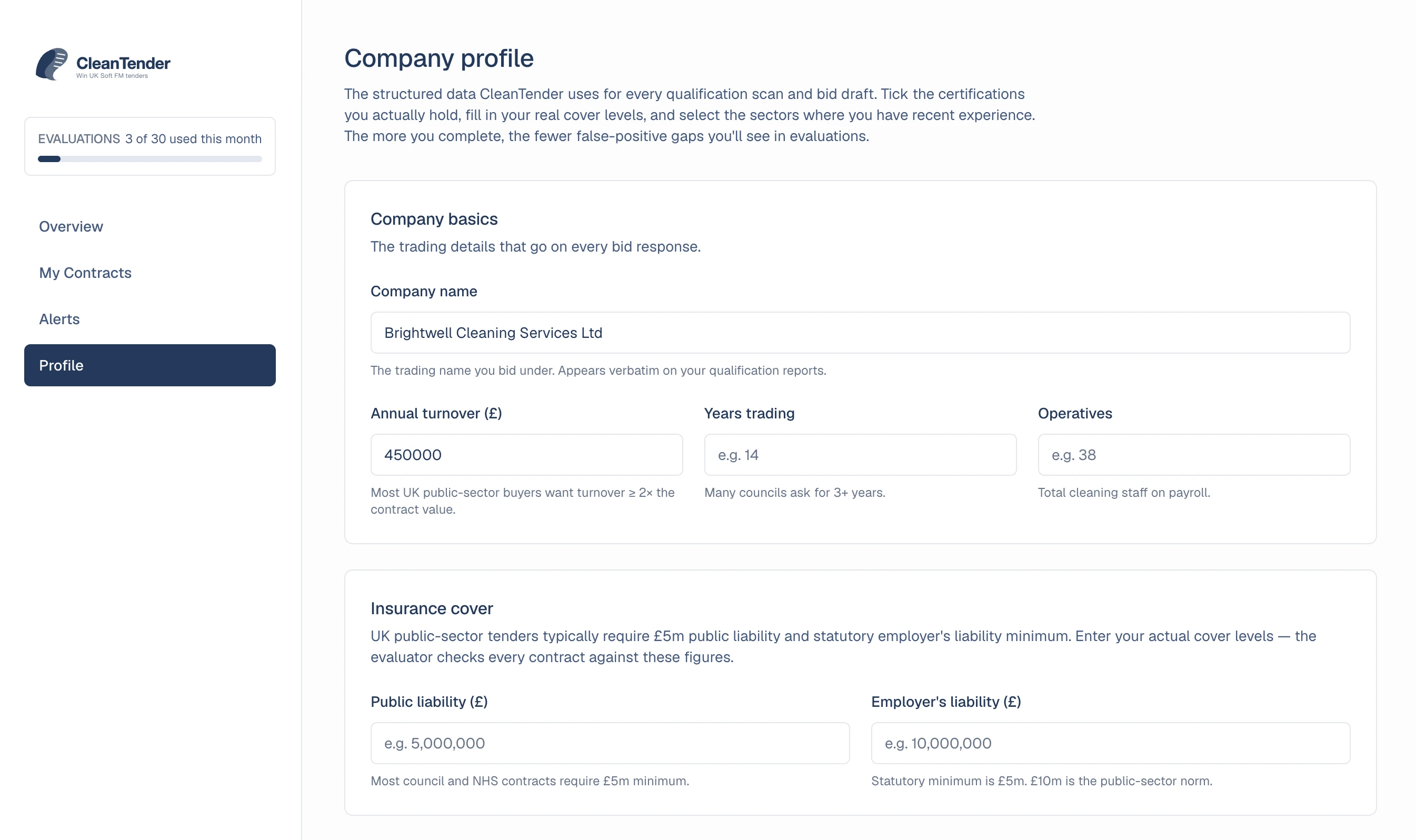
Profile setup defines what you are bid-ready for Step 2· 5 minutes daily
Open the live cleaning-tender feed
Every UK council, NHS Trust, school, university, MoD, and central government cleaning tender, in one feed. Pre-filtered to your sector and geography. No false positives, no manual portal-trawling across FTS, Contracts Finder, and dozens of buyer e-procurement portals.
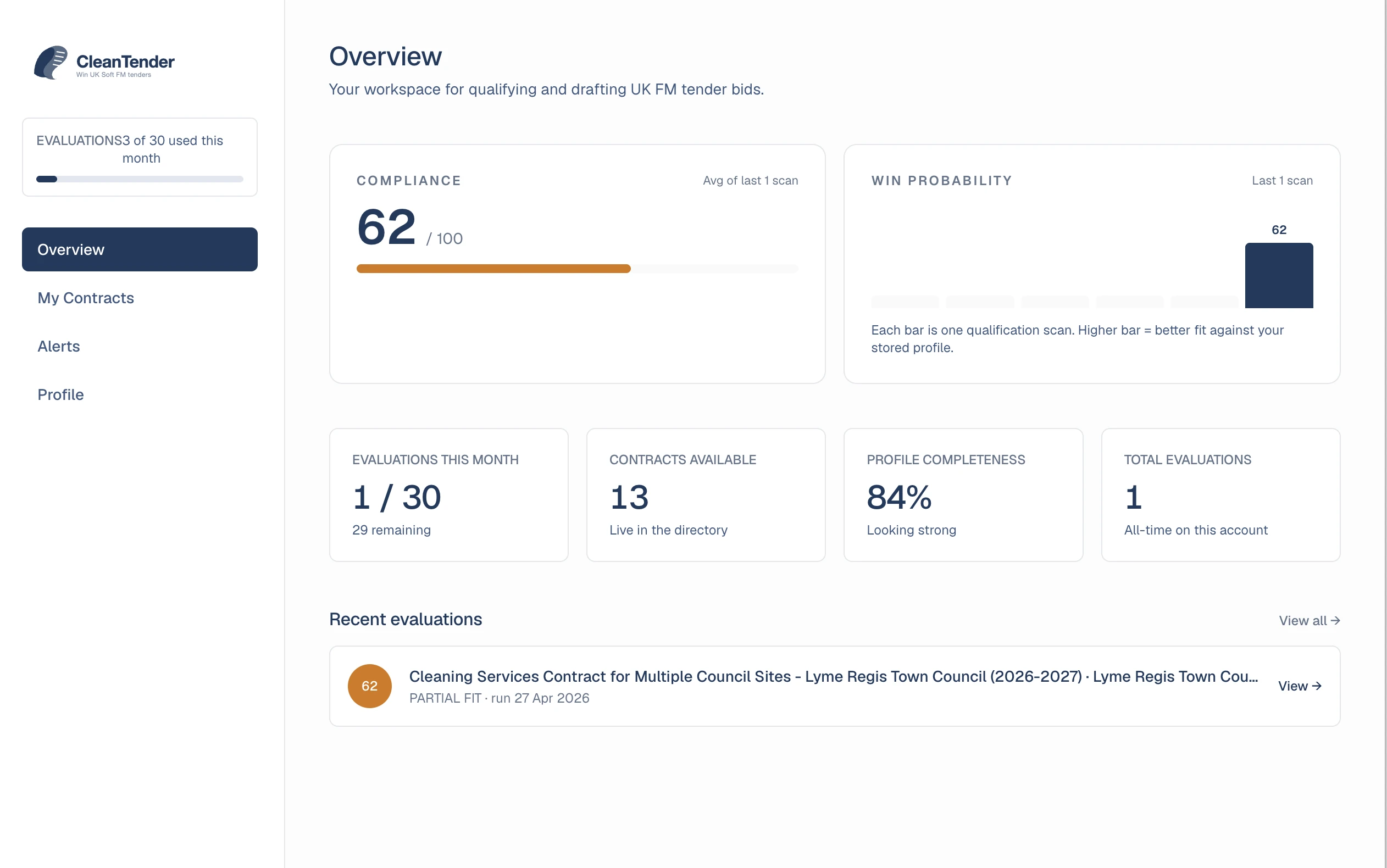
Live feed of in-scope cleaning tenders, fit-scored Step 3· Daily digest
Get email alerts for new in-scope tenders
New commercial cleaning tenders matching your profile land in your inbox the day they publish. CleanTender batches them into a daily digest so you do not get notification fatigue, and links straight back to the in-app fit score.
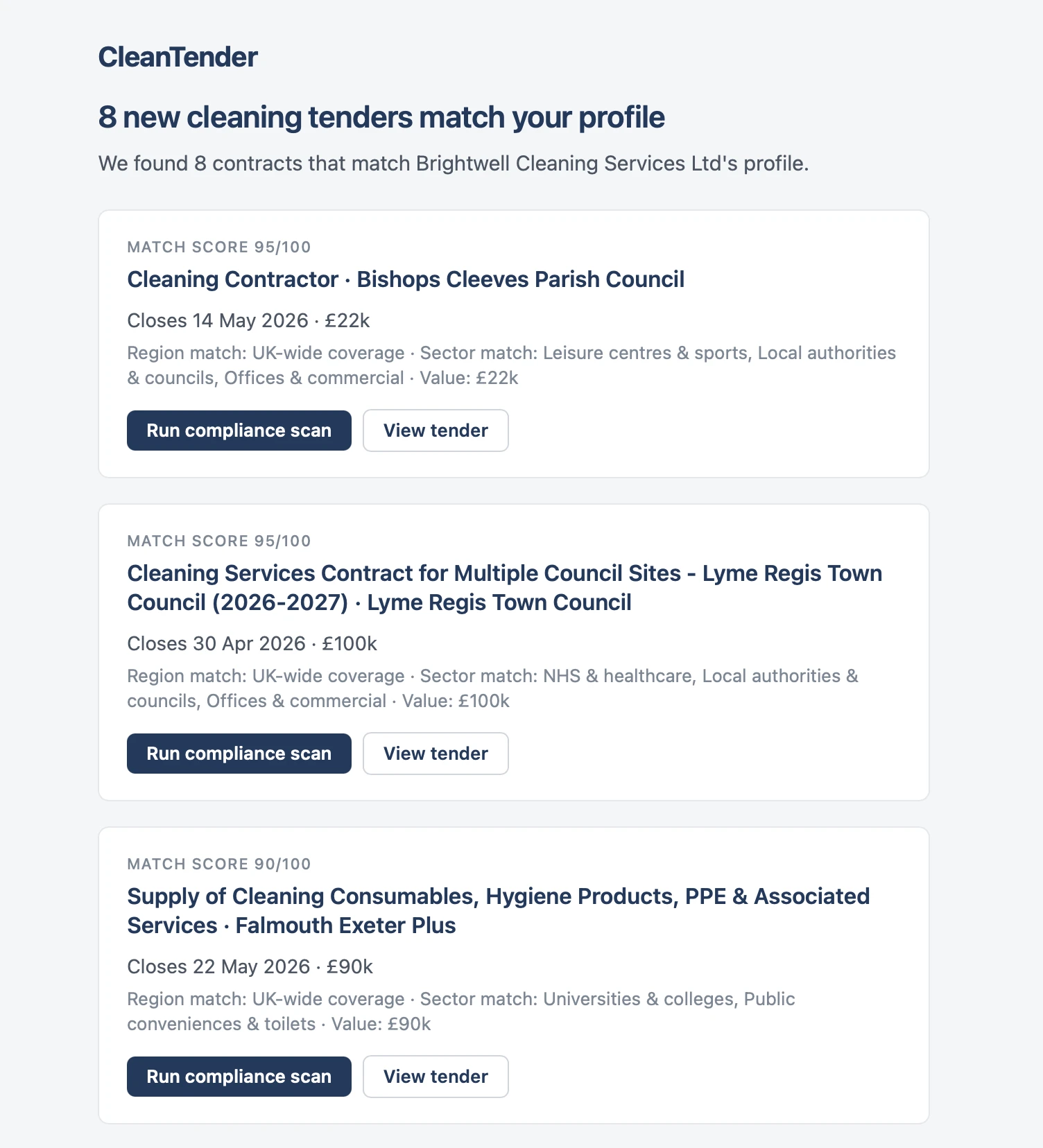
Daily alerts for new in-scope tenders Step 4· 30 seconds
Run a fit-score evaluation on a target tender
One click runs a CleanTender Evaluation against the tender pack: scope match, geography fit, scale fit, compliance gap, and a plain-English win probability. Stops you bidding contracts you were never going to win.
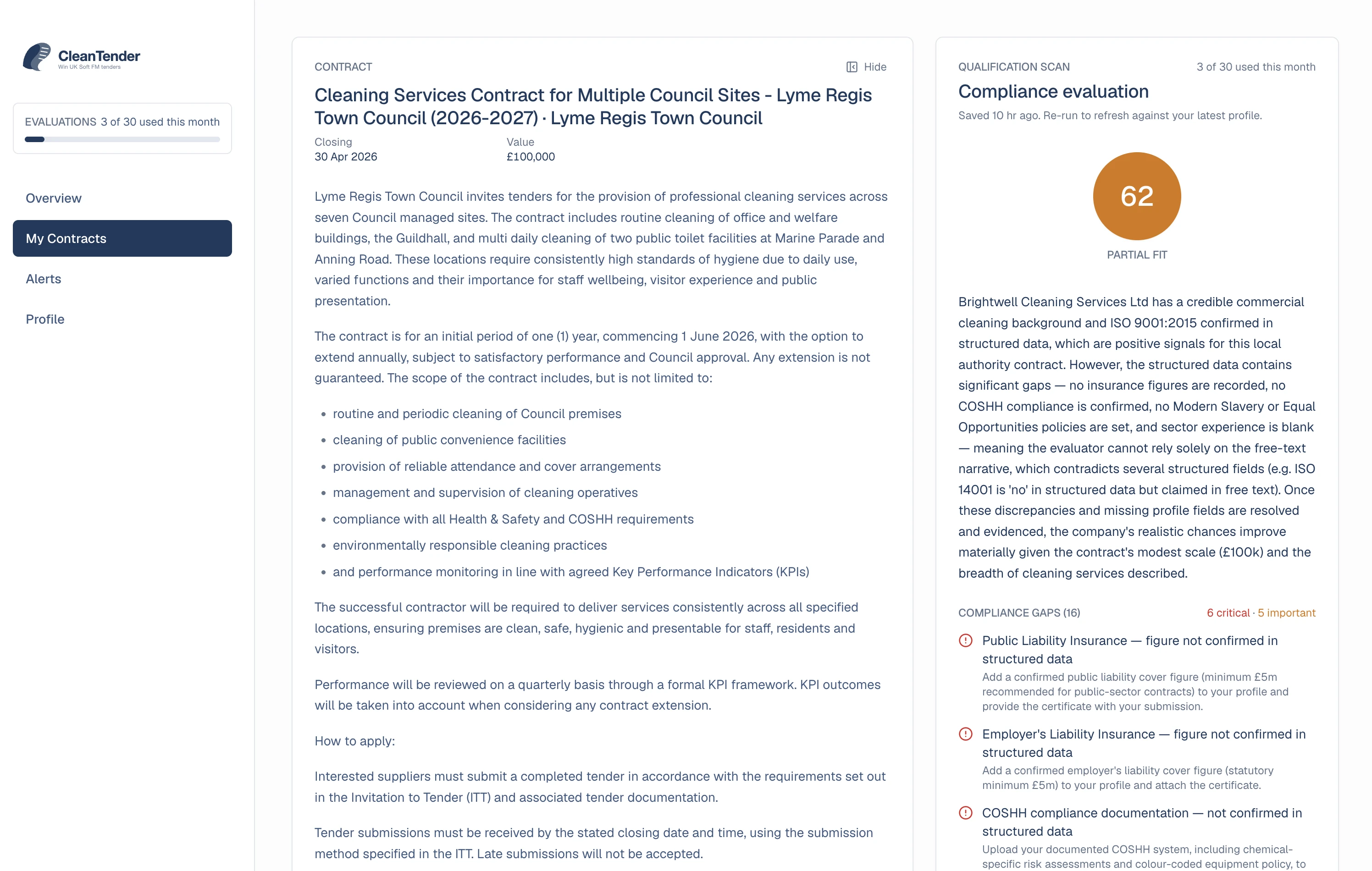
Fit-score and win-probability before you commit a weekend Step 5· 1 minute
Spot compliance gaps before you start drafting
CleanTender runs a named compliance check against the tender pack: BICSc, COSHH, ISO 9001, ISO 14001 if held, SSIP (CHAS or SafeContractor), TUPE pack, social value plan, DBS policy. Anything missing is flagged before you sink hours into a bid that auto-fails at SQ.
Compliance gaps surfaced before drafting Step 6· 2 minutes generation
Generate a full SQ + method-statement draft
CleanTender drafts a complete Standard Selection Questionnaire response using your profile data and the tender requirements: declaration block, company overview, contract experience, quality, training, COSHH, social value, H&S, insurance schedule. All ten sections, in one pass.
Full SQ draft generated in minutes, not days Step 7· Half a day
Refine, add evidence, and submit
Tune the draft, drop in named referees and certificate numbers, layer your quantified social value commitments, and submit through the buyer's portal. Most users compress a 30-60 hour first bid to 8-12 hours of focused review.
Step 8· Ongoing
Track outcomes and improve
Every bid logs in CleanTender with status, score, and (after standstill) the buyer's feedback. Use the standstill data to tune your next bid. Win rate compounds; first-bid completion is the only thing standing between you and a public-sector revenue line.
The bid-it-or-bin-it gut check
Before you read the spec, ask three questions. If any answer is no, bin it.
- Can I actually deliver this contract? Geography, hours, headcount.
- Can I afford to start it? Public buyers pay 30 days from invoice at best. Some pay later. You front the wages until then.
- Have I worked anything like this before? If the buyer wants three NHS references and you've only done offices, walk.
If you can't answer those in two minutes from the cover sheet, the buyer hasn't given you enough to bid on yet. Submit a clarification question and wait.
| Bid it | Bin it |
|---|---|
| Within an hour's drive of your existing patch | More than two hours away with no local hub |
| Annual value sits below 30% of your current turnover | Value would more than double your turnover overnight |
| Scope is straight cleaning, your strongest category | Scope is a bundled FM package needing security and grounds |
| Quality and price weighting is published in the notice | Buyer hides the weighting until ITT stage |
| TUPE list is realistic for your team size | TUPE list has 40 staff and you employ 8 |
A blunt fit check before you spend a weekend on the bid.
The fit check matters more than the answers. A perfect bid on the wrong contract still loses.
Where UK cleaning tenders actually live
Two free portals carry the bulk of public-sector cleaning work in England.
- Contracts Finder. Only older English procurements that started before 24 February 2025. New school and council cleaning from £30,000 inc VAT (£12,000 for central government) goes on Find a Tender instead.
- Find a Tender Service. The high-value portal. Anything over £135,018 including VAT. NHS trust cleaning, large multi-site council estates, central government office contracts.
If you cover Scotland, Wales or Northern Ireland you also need the devolved portals. Public Contracts Scotland for Scottish councils and NHS Scotland. Sell2Wales for Welsh public bodies. eTendersNI for Northern Ireland departments and trusts. None of these duplicate to Contracts Finder. If you only watch one site, you miss the other three nations.
Skip the paid aggregators. Trustpilot reviews of Supply2Gov and Constructionline are full of complaints about steep annual price hikes, recurring subscription traps, and pedantic verification that takes 10 to 12 working days. Every public-sector cleaning notice has to appear on the free portals by law. Save the £2,500.
If you want a single feed of every live cleaning tender across all UK portals, browse our directory of public cleaning contracts.
Get the boring paperwork right once
Build a compliance pack once, then re-use it for every bid. Almost every public buyer asks for the same documents in slightly different boxes.
- Employer's liability insurance. £10m is standard, and is the legal minimum if you employ anyone.
- Public liability insurance. £5m is a common floor on cleaning tenders. Some NHS and large council contracts ask for £10m.
- One SSIP accreditation. CHAS, SMAS, SafeContractor or Constructionline. You only need one. The Deem to Satisfy rule lets you passport into another scheme if a buyer asks for a different badge.
- Last two years of audited accounts (or your last full year if you're new).
- Health and safety policy, environmental policy, equality and diversity policy. One page each is fine for sub-£100k work.
- Two or three reference contacts who'll answer the phone when a council rings.
PPN 03/24, in force from June 2024, says public buyers should require the Common Assessment Standard for projects over £5 million. That maps to CHAS Elite or Worksafe Pro. For everything below that, an entry-level SSIP membership like CHAS Standard or Worksafe SSIP gets you through the door.
ISO 9001 is nice to have. It's not a deal-breaker on most council cleaning under £100k. NHS work is stricter and BS EN 1276 (bactericidal) and EN 14476 (virucidal) disinfectant evidence is often asked for in product schedules.
The Standard Selection Questionnaire (post-PAS 91)
PAS 91 used to be the standard pre-qualification form for FM and cleaning. BSI withdrew it in April 2023.
The replacement for most public-sector cleaning tenders is the Standard Selection Questionnaire (SQ) under PPN 03/23. Same idea, same rough sections: exclusion grounds, financial standing, technical capacity, health and safety, equality, environment. Buyers cannot ask for evidence beyond what the SQ allows at this stage.
Some councils still attach old PAS 91 forms to their tender packs. Buyers are allowed to use it because PAS 91 stays consistent with the procurement regulations. Read the cover sheet. Answer the version they actually ask for, not the one your competitor used last year.
Whatever the form is called, the trick is the same. Answer it once. Save the answers in a single doc, dated. Copy-paste into each new tender and edit only the paragraphs that change per contract. The first SQ takes a weekend. The fifth takes an hour.
If a tender pack still attaches an old PAS 91 form, the form looks the same to fill in but the rules around it have changed. Read our PAS 91 explainer for what BSI's 2023 withdrawal actually changed and how to handle a buyer who hasn't updated their templates.
Pricing without racing to the bottom
Most small cleaning firms underprice. They want the win. They cut their margin to nothing. They win, and then they cannot deliver, and the contract ends ugly.
Public buyers run a Most Economically Advantageous Tender model. Quality and price are scored separately. On council cleaning the quality weighting often sits between 40 and 60 percent. The cheapest bid does not always win. It often doesn't.
Three rules for pricing a public-sector cleaning bid:
- Price what the contract takes, not what you think the cheapest bidder will quote. Cheap and rough loses on quality and never recovers it.
- Build a real cost stack. Wages at the real living wage minimum, holiday cover, materials, supervisor time, mobilisation, insurance, profit. Show it if the buyer asks.
- Write your walk-away rate down before you read the spec. Stick to it. The spec will try to talk you out of it.
If you can't deliver the contract at your walk-away rate, you can't deliver the contract. The bid is over before you start it.
Social value answers that score
Under PPN 002, in-scope central government cleaning tenders carry a minimum 10% social value weighting. Councils and NHS trusts routinely run it at 20% or higher. Some run it at 30%. Ten marks of waffle costs you the contract.
Most small cleaners write nothing. Or they write three paragraphs of community-engagement boilerplate. Buyers see twenty of those a tender. They mark them down.
Pick two or three TOMs measures you can deliver and put a number on each. Numbers beat slogans every time.
- Hire one person who has been long-term unemployed onto this contract within three months of mobilisation.
- Pay the real Living Wage Foundation rate to every cleaner working on this site, including agency cover.
- Donate one supervisor hour a week to a named local food bank or community group for the contract length.
- Spend at least 30% of consumables budget with SME suppliers within 20 miles of the site.
If you can't put a number on it, don't write it. Buyers score commitments, not intentions.
Why your first three bids will lose
Public buyers reward incumbents. Your first bid is up against firms that already work for the council, know the evaluator, and can quote previous contract numbers in their answers. You can't.
Treat the first three bids as paid training. Submit them on time. Get the feedback. Fix the worst answer for next time. The same evaluator will read the next bid you write to that same buyer.
When the buyer offers a debrief, ask for one. Most contractors don't. The debrief tells you which sections lost you marks and exactly how the winning bid framed them. It is the cheapest cleaning-tender education you'll ever buy.
What to actually do this week
You don't need a bid writer. You need to bid less and bid better.
Pick one council inside an hour's drive. Set up email alerts on Find a Tender for cleaning notices in that authority. Watch them for six months. Bid the third or fourth one that matches your scope. That's the formula.
The same bid process applies to smaller trade lots too. Our guide to window cleaning tenders shows it on a single-trade contract, and the piece on cleaning contracts for sale covers the other way to add revenue.
Stuck on the quality questions? These bid writing examples show weak and strong answers for every soft FM sector, scored.
Stuck on whether an answer is good enough? Our free AI bid answer grader scores any tender answer 0 to 5 and tells you the three things to fix first.
Bidding for a school or academy? The school cleaning tenders guide covers safeguarding answers and term-time working.
Sources
- Procurement Act 2023 (full text on legislation.gov.uk) · Live since 24 February 2025
- Procurement Policy Notes (Cabinet Office collection) · PPN 03/23 (SQ), PPN 03/24 (CAS), PPN 002 (Social Value)
- Contracts Finder · Free portal for English public-sector tenders over £12,000
- Find a Tender Service · High-value portal for tenders over £135,018 incl. VAT
- Safety Schemes in Procurement (SSIP) · Member schemes and the Deem to Satisfy passport rule
FAQs
Frequently asked questions
- No. BSI withdrew PAS 91 in April 2023. Most public buyers now use the Standard Selection Questionnaire (SQ) under PPN 03/23 instead. You'll still see PAS 91 attached to some older council tender packs because buyers are allowed to keep using it. Read the buyer's cover instructions and answer the version they actually ask for, not the one a competitor sent last year.
- A safe floor is £10m employer's liability and £5m public liability. Some larger NHS or local-authority contracts ask for £10m public liability. Your employer's liability minimum is set by law if you employ anyone. Always check the Instructions to Bidders document for the exact figure on the contract you're chasing before you upgrade your cover.
- Not always, but you usually need at least one SSIP accreditation. CHAS, SMAS, SafeContractor and Constructionline all sit under the SSIP umbrella and recognise each other through Deem to Satisfy. Hold one and you can passport into another for a small fee if a buyer demands that scheme. The Common Assessment Standard (CHAS Elite or Worksafe Pro) is only formally required for public-sector projects above £5m.
- A weekend if your compliance pack is ready. Three weeks if it isn't. Most of the time isn't writing answers. It's hunting for old insurance certificates, rewriting your H&S policy, and chasing referees. Build the pack once and the second bid takes a fraction of the time.
- Probably not. Every public-sector cleaning notice over the notice thresholds has to appear on Find a Tender (or Public Contracts Scotland) by law. Trustpilot reviews of paid aggregators flag steep price hikes, recurring monthly subscription traps, and slow verification cycles measured in working days. For a small UK cleaner the free portals plus saved-search email alerts are usually enough.
- TUPE protects staff who already clean a building when the contract changes hands. The new contractor inherits them on existing pay and terms. On almost every council and NHS cleaning re-tender, TUPE applies. Ask for the TUPE list early. If the list shows 40 staff and you employ 8, the contract probably isn't a fit even if the value looks right.