
UK public-sector catering buyers are no longer scoring the cheapest cost-per-head. The Hospital Food Review (Phil Shelley, 2020) reset NHS standards. Government Buying Standards for Food and Catering Services (GBSF) bind every central government department and the prison service. School Food Standards govern every maintained school in England. Natasha's Law made full ingredient and allergen labelling mandatory on pre-packed for direct sale (PPDS) food from 1 October 2021. The Procurement Act 2023 (live 24 February 2025) tightened SQ scoring, and PPN 002 sets a 10% minimum social value weighting on central government catering contracts from 1 October 2025.
The catering contractor that wins in 2026 brings a documented HACCP plan, Food Hygiene Rating Scheme score of 4 or 5, ISO 9001 (and increasingly ISO 22000 or FSSC 22000), traceable supply chain evidence, and a credible plan for the named regulatory standards that apply to the buyer's sector. The one that loses still leads with "competitive cost-per-head" and a generic menu deck.
All hospitals must serve patients freshly prepared meals, available seven days a week, that are nutritionally balanced and meet the dietary, cultural, and religious needs of every patient.
NHS England, Hospital Food Standards (post-Hospital Food Review)
What's in this guide
- How to win a UK catering tender, step by step (CleanTender walkthrough)
- The 5 regulatory frameworks that govern UK public-sector catering tenders
- What buyers score on (the marking matrix patterns)
- Pricing factors: ingredients, labour, kitchen overhead, allergen risk
- The 6 main public-sector catering sectors
- Method statement structure tuned for catering tenders
- Social value commitments that score in catering
- When NOT to bid
How to win a UK catering tender, step by step
The complete end-to-end flow inside CleanTender. From sector setup to a submitted catering bid in the time it used to take to read a single tender pack.
Eight steps from "never bid public sector" to a complete SQ response on the buyer's portal. First scan is free.
Step 1· 10 minutes
Build your catering company profile
Set your sector to catering, your service regions, FHRS rating per kitchen, HACCP plan status, ISO 9001 + ISO 22000 if held, supplier accreditations (Red Tractor, MSC, LEAF, Soil Association), allergen-management software, EHO inspection history, insurance levels, turnover, and operative count. CleanTender uses this to fit-score every live tender against your real capability so you only see the ones you can win.
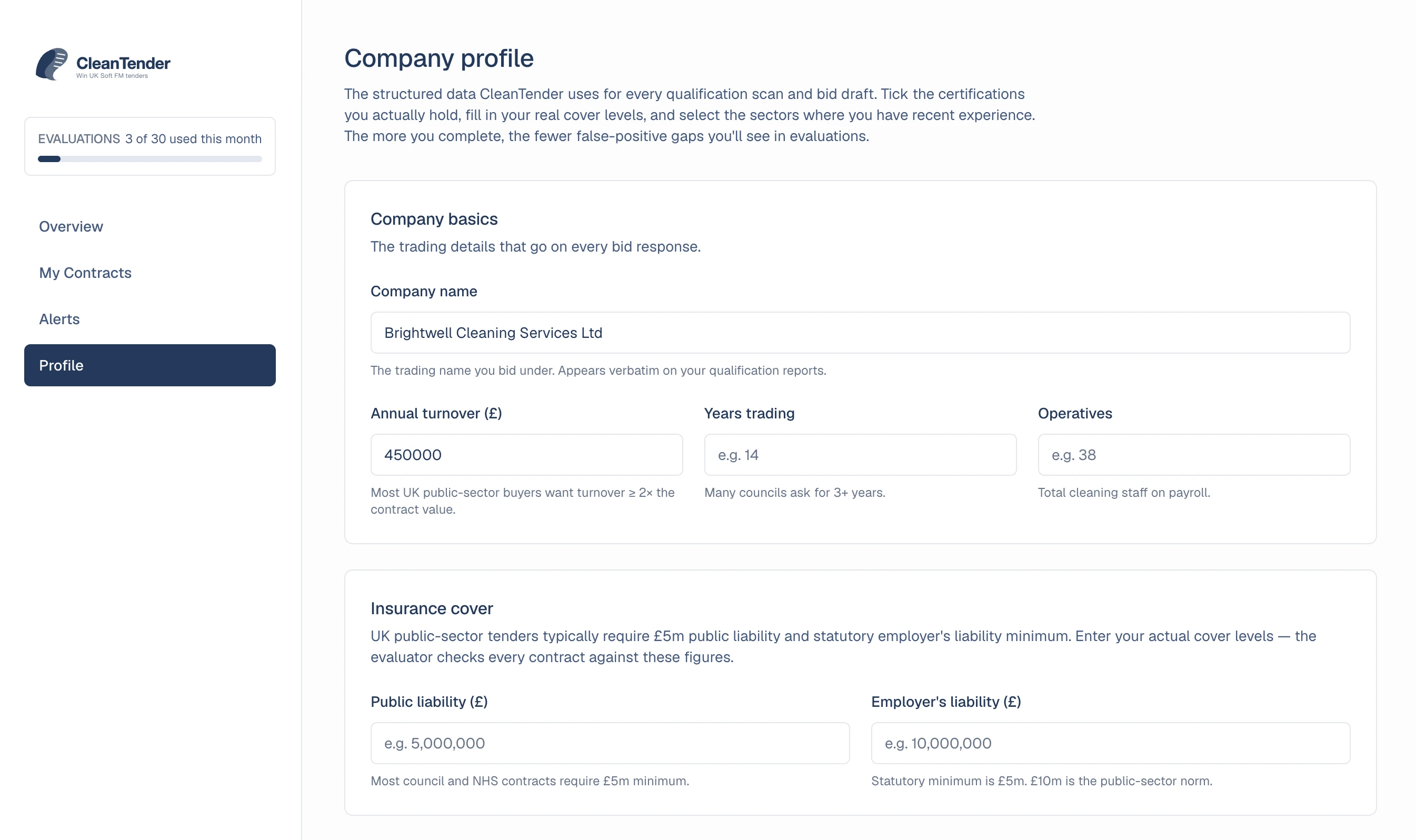
Profile setup defines what you are bid-ready for Step 2· 5 minutes daily
Open the live catering-tender feed
Every UK NHS Trust, state school, academy trust, university, council civic, prison (HMPPS), and MoD catering tender, in one feed. Pre-filtered to your sector and geography. No false positives, no manual portal-trawling across FTS, Contracts Finder, and dozens of buyer e-procurement portals.
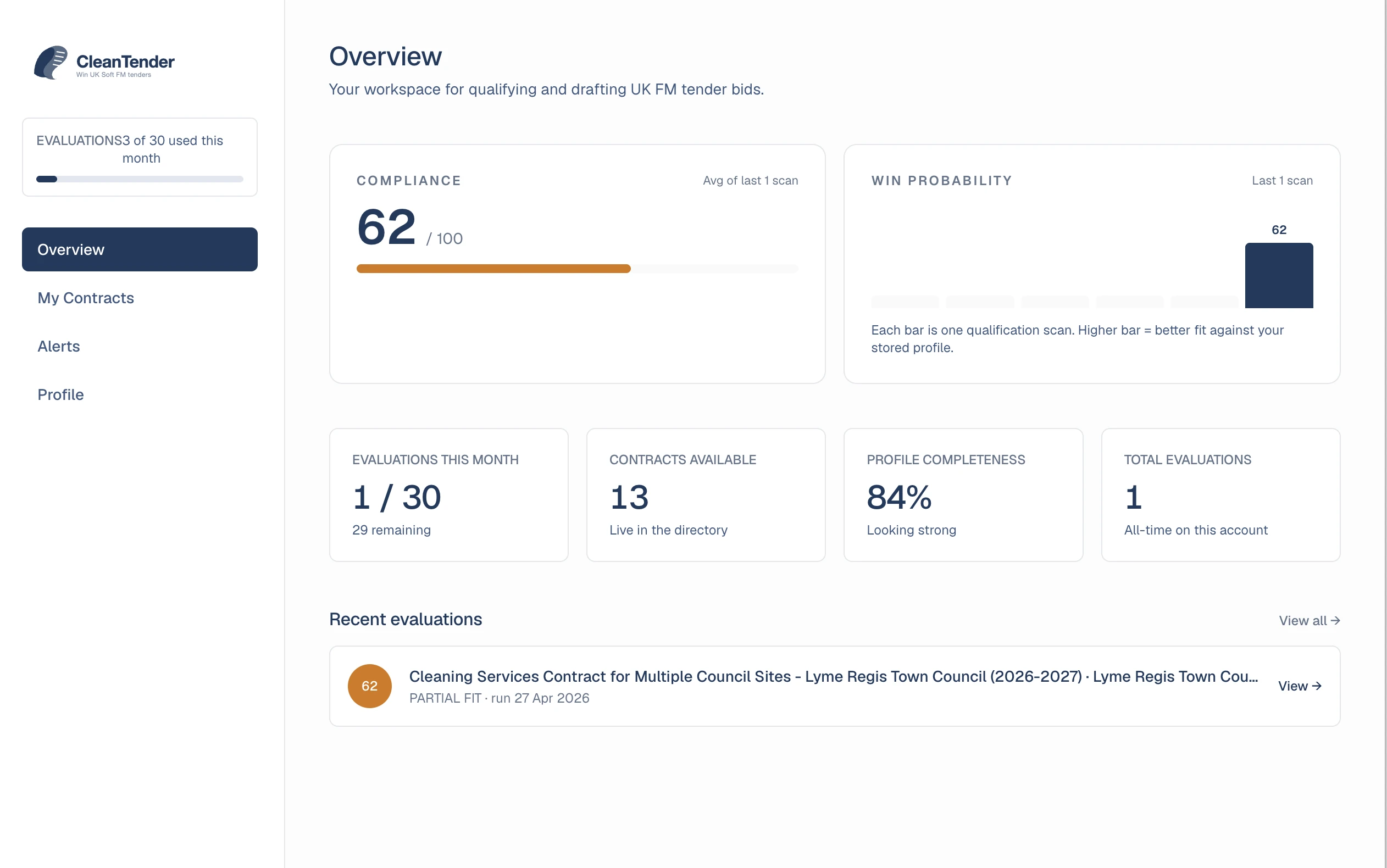
Live feed of in-scope catering tenders, fit-scored Step 3· Daily digest
Get email alerts for new in-scope tenders
New catering tenders matching your profile land in your inbox the day they publish. CleanTender batches them into a daily digest so you do not get notification fatigue, and links straight back to the in-app fit score.
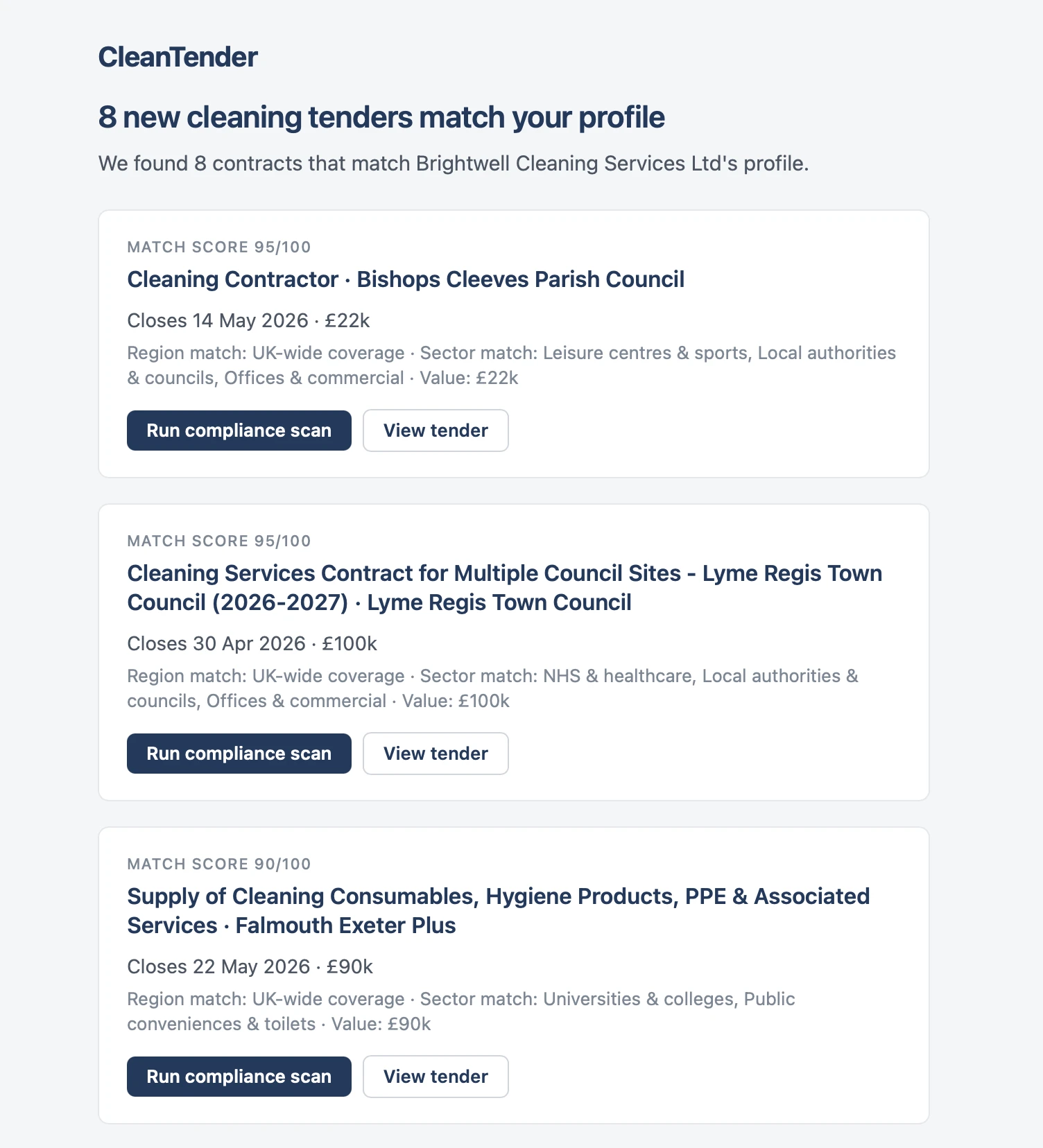
Daily alerts for new in-scope tenders Step 4· 30 seconds
Run a fit-score evaluation on a target tender
One click runs a CleanTender Evaluation against the tender pack: scope match, geography fit, scale fit, compliance gap, and a plain-English win probability. Stops you bidding contracts you were never going to win.
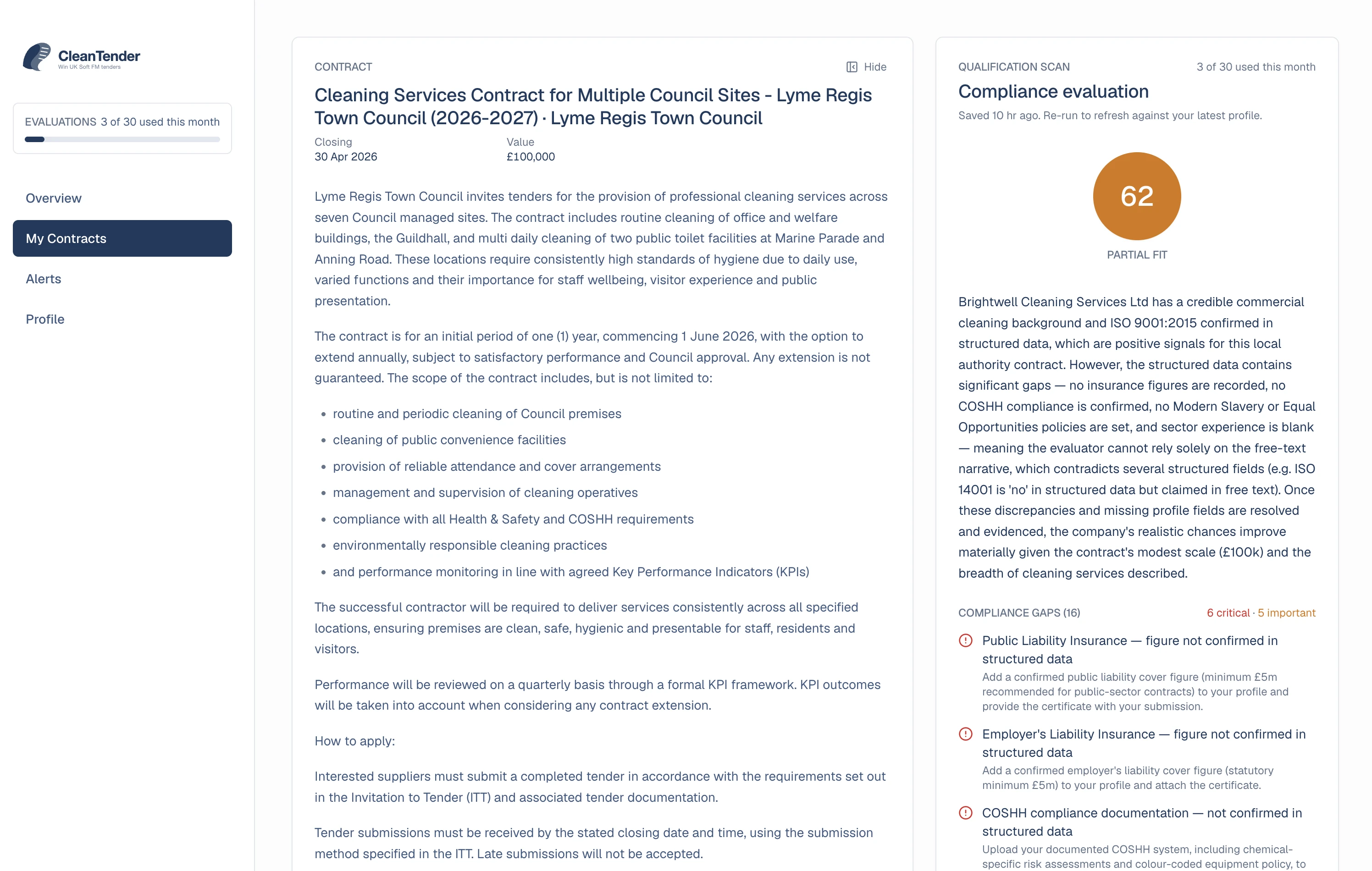
Fit-score and win-probability before you commit a weekend Step 5· 1 minute
Spot compliance gaps before you start drafting
CleanTender runs a named compliance check against the tender pack: FHRS 4-5, HACCP plan, ISO 9001, ISO 22000 if applicable, GBSF sourcing evidence, Natasha's Law PPDS workflow, allergen training records, social value plan. Anything missing is flagged before you sink hours into a bid that auto-fails at SQ.
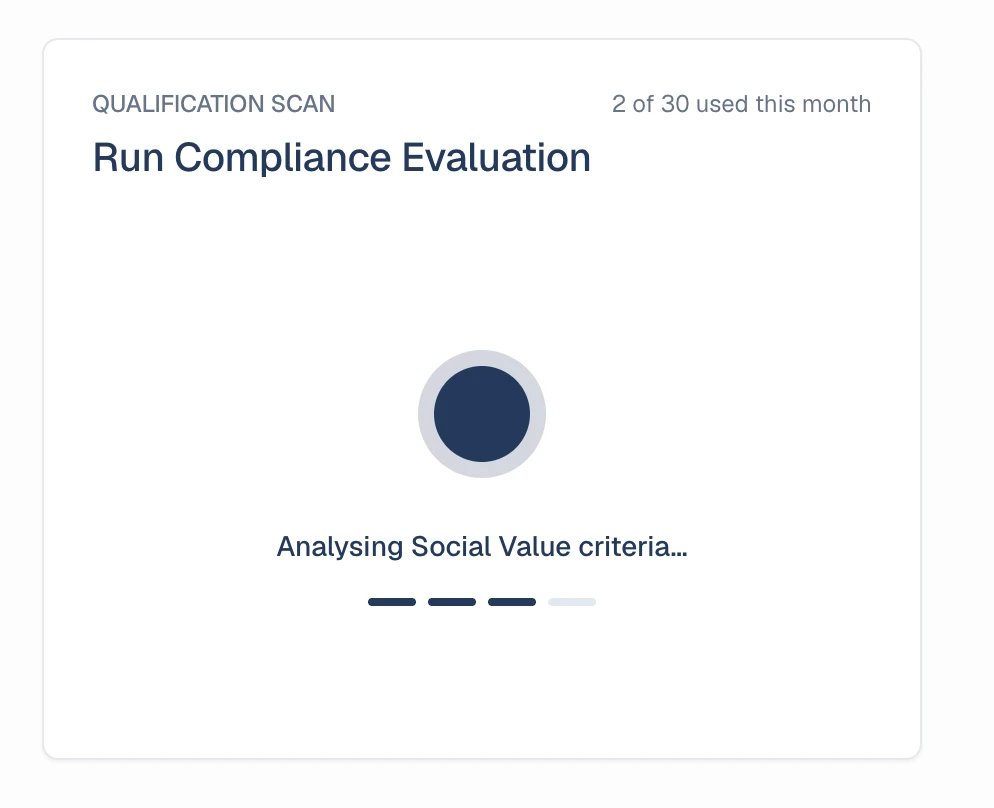
Compliance gaps surfaced before drafting Step 6· 2 minutes generation
Generate a full SQ + method-statement draft
CleanTender drafts a complete Standard Selection Questionnaire response using your profile data and the tender requirements: declaration block, company overview, contract experience, quality, training, COSHH, social value, H&S, insurance schedule. All ten sections, in one pass.
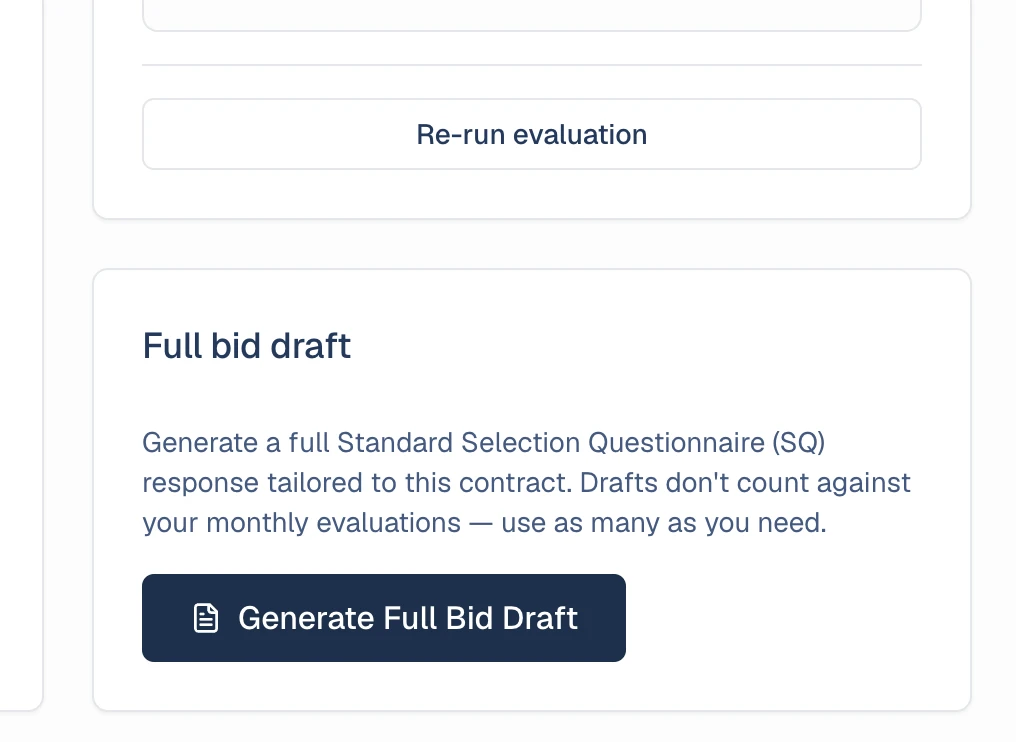
Full SQ draft generated in minutes, not days Step 7· Half a day
Refine, add evidence, and submit
Tune the draft, drop in named referees and certificate numbers, layer your quantified social value commitments, and submit through the buyer's portal. Most users compress a 30-60 hour first bid to 8-12 hours of focused review.
Step 8· Ongoing
Track outcomes and improve
Every bid logs in CleanTender with status, score, and (after standstill) the buyer's feedback. Use the standstill data to tune your next bid. Win rate compounds; first-bid completion is the only thing standing between you and a public-sector revenue line.
The 5 regulatory frameworks that govern UK catering tenders
| Framework | Applies to | What it requires |
|---|---|---|
| Government Buying Standards for Food and Catering Services (GBSF) | Mandatory: central government departments, prison service. Recommended: NHS, MoD, wider public sector. | Sustainable sourcing thresholds (fish from MSC or equivalent, eggs cage-free, named welfare standards), salt and sugar reformulation targets, fruit and vegetable portions, transparent supply chain reporting. |
| Hospital Food Standards (NHS England, post-Hospital Food Review 2020) | All NHS Trusts (acute, mental health, community) | Hot meals seven days a week, named nutritional analysis per menu cycle, full allergen disclosure, dietary and cultural diversity, breastfeeding-friendly catering, 24/7 access for staff. |
| School Food Standards (Department for Education, 2014, ongoing guidance) | Maintained schools in England (also referenced in academy funding agreements) | Daily fruit and vegetables, oily fish weekly, no confectionery or savoury snacks except whole-grain crackers, water freely available, no fried food more than twice a week, bread without added fat or oil daily. |
| Natasha's Law (Food Information Amendment Regulations 2019, in force 1 October 2021) | All food sold pre-packed for direct sale (PPDS) | Full ingredient list and the 14 mandatory allergens listed on every PPDS item, with allergens emphasised. Front-of-pack visible at point of selection. |
| HACCP and Food Hygiene Rating Scheme (Food Standards Agency) | All food businesses; FHRS scoring published in England, Wales, Northern Ireland | Documented HACCP plan covering biological, chemical, physical, and allergen hazards. FHRS rating 4 or 5 typically required for public sector. Local Authority Environmental Health audits feed FHRS. |
Major UK catering frameworks evaluators reference in scoring matrices.
If your method statement does not name all five by sector with documented compliance evidence, you are leaving evaluator marks on the table. Generic "high quality fresh food" copy scores 4 out of 10. Named regulatory references with named menus and documented audit history score 8-9.
What buyers score on (the marking matrix patterns)
| Criterion | Typical weighting | What scores 8-9/10 |
|---|---|---|
| Price (cost-per-head, kitchen rental, capex contribution) | 30-40% | Transparent cost-per-head broken by meal type, ingredient cost-pass-through clauses with cap, named CPI uplift mechanism, no hidden surcharges |
| Method / technical capability | 25-35% | Sample 4-week menu cycle with nutritional analysis, named HACCP critical control points, allergen management protocol, kitchen workflow diagrams, contingency for equipment failure |
| Food quality and sustainability | 10-20% | GBSF-compliant sourcing evidence, named Red Tractor / MSC / LEAF / Soil Association suppliers, locally sourced percentage with definition (radius), Plate-Up for the Planet or equivalent climate-conscious menu evidence |
| Social value (PPN 002) | 10-20% minimum | Local SME supplier targets with quarterly reporting, food waste donation partnerships (FareShare, Olio, local food banks), school nutrition education sessions, apprentice chef commitments |
| Health, safety, and compliance | 5-10% | ISO 9001 + FHRS 4-5 + ISO 22000 or FSSC 22000 if held, SSIP-recognised certificate, allergen training records, EHO inspection history |
Typical scoring breakdown on UK public-sector catering tenders in 2026.
Pricing factors for UK catering tenders
Catering pricing is layered. A school food contract, a hospital patient meals contract, and a council civic-events contract have completely different cost structures. The contractor's margin sits on the gap between the cost-per-head presented and the true loaded cost of ingredients, labour, kitchen overhead, allergen-management risk, and waste.
| Component | Rough range (2026) | Notes |
|---|---|---|
| Ingredient cost (school primary lunch, GBSF-compliant) | £0.85-£1.30 per head | Higher with locally sourced and organic; lower with bulk frozen. School Food Standards constrain savings. |
| Ingredient cost (NHS patient meal, full menu cycle) | £3.50-£6.50 per head per day | Three meals plus snacks. Allergen-free and texture-modified diets cost 20-40% more. |
| Labour (kitchen brigade per shift) | £14-£22 per hour blended | Higher in London. Shortage of trained chefs since 2022 has pushed rates up materially. |
| Kitchen overhead (utilities, depreciation, cleaning) | £0.40-£0.90 per meal | Higher in older NHS kitchens. Energy costs volatile; cap clauses essential. |
| Allergen management overhead | 5-12% of ingredient cost | Separate prep areas, dedicated utensils, training time, software for allergen matrix maintenance |
| Food waste | 8-15% of ingredient cost | Hospital and school catering target reduction below 10% via portion-control and donation partnerships |
| Compliance and audit (HACCP, EHO, FHRS, ISO surveillance) | £3,000-£12,000 per kitchen per year | Standalone standing cost; spread across all meals served from that kitchen |
Cost components in a typical UK public-sector catering contract.
The 6 main UK public-sector catering markets
| Sector | Key standards | Typical contract shape |
|---|---|---|
| NHS hospitals (acute, mental health, community) | Hospital Food Standards, GBSF, Natasha's Law, HACCP, FHRS 4-5, BDA texture descriptors (IDDSI), allergen matrix | Patient catering contracts run 5-7 years, often £4m-£20m. Retail (staff and visitor) often separate. NHS Supply Chain framework or trust-direct. |
| State schools (primary and secondary) | School Food Standards (DfE), Free School Meals eligibility, Universal Infant Free School Meals, Natasha's Law, allergen protocol | Local authority frameworks or academy trust contracts. Term-time delivery, holiday gaps. Cost-per-head usually £2.30-£3.20. |
| Universities and FE colleges | FHRS 4-5, Natasha's Law, sustainable sourcing for student preferences, vegan and halal menu lines | Single-tender or framework via consortia (e.g. The Energy Consortium for utilities, TUCO for catering supplies). Commercial-leaning but increasing sustainability scrutiny. |
| Prisons (HMPPS) | GBSF mandatory, Prison Service Order 5000 compliance, security clearance for kitchen staff | HMPPS national catering framework. £3m-£40m per lot. Long-term, low-margin, security-screened workforce. Specialist sector. |
| MoD (defence catering) | GBSF widely applied, defence-sector dietary and operational requirements, security clearance (BPSS, SC) often required | DEFCON-bound contracts. Living-in messes, training establishments, deployable catering. ESS, Sodexo Defence, Aramark, Compass dominate. |
| Local authority civic and community catering | GBSF often required, FHRS 4-5, allergen labelling, council-set sustainability policies | Civic events, council canteens, day centres, lunch clubs. Lower volume per contract, more relational. Frameworks via YPO, ESPO, NEPO. |
UK public-sector catering markets and the standards each requires.
Most SME caterers cluster around schools and local-authority work. NHS patient catering is harder to enter as an SME (capital investment in kitchen plant, IDDSI-compliant texture-modified meals, 24/7 ward service). Prisons are a specialist sector with sustained low margin. MoD requires security clearance and DEFCON contract familiarity. Match your bid scope honestly to your operational base.
If your target is school catering only, pair this guide with the school catering bid playbook which goes deeper on School Food Standards, Free School Meals revenue mechanics, and term-time gap planning. For broader central-government catering, see the government catering contracts guide.
Method statement structure for catering tenders
- Scope confirmation: site list with daily meal volumes by category (breakfast, lunch, dinner, snacks, special diets), service hours, dining capacity, kitchen lease or shared use. Reference page numbers in the tender spec.
- Menu development: sample 4-week cycle with nutritional analysis (per portion: kcal, protein, carbohydrate, sugar, salt, saturated fat, fibre), allergen matrix per dish, alignment to GBSF / School Food Standards / Hospital Food Standards as applicable.
- Procurement and supply chain: named suppliers with accreditations (Red Tractor, MSC, LEAF, Soil Association, RSPCA Assured), local sourcing percentage with radius definition, traceability protocol, contingency suppliers per category.
- HACCP plan: critical control points by process (delivery, storage, prep, cook, hold, serve, clean), monitoring frequency, corrective actions, verification records, periodic review schedule.
- Allergen management (Natasha's Law compliance): allergen matrix maintenance, training records, separate prep area protocol, customer communication script, cross-contamination prevention, full PPDS labelling workflow.
- Staffing and qualifications: head chef qualifications (City and Guilds 706, NVQ Level 3 or equivalent), Level 2 Food Safety for all kitchen staff, allergen training certified, supervisor with Level 3 Food Safety, named relief cover.
- Compliance evidence: ISO 9001 certificate, ISO 22000 / FSSC 22000 if held, FHRS rating per kitchen with date, EHO inspection history, SSIP-recognised certificate, public liability insurance level, employer's liability level.
- Reporting and KPIs: daily covers per service, food waste percentage, customer satisfaction surveys, allergen incident log, EHO score trend, FHRS score, monthly nutritional adherence per menu cycle.
- Escalation: out-of-hours kitchen failure response (e.g. refrigeration breakdown, sudden allergen incident), named on-call manager, response time, deputy cover, escalation up to operations director.
If your method statement still reads as brochure copy at this stage, the eight-section scoring structure in the cleaning method statement guide applies the same logic for catering, with HACCP critical control points and allergen workflow swapped in. Marking matrices reward density of relevant evidence, not prose length.
Social value commitments that score in catering
PPN 002 (live 1 October 2025) sets a 10% minimum social value weighting on UK central government tenders, and most local authorities and NHS Trusts now match or exceed that. Catering contracts have natural social value angles that score well when quantified.
- Local SME supplier hires: "Year-one supply chain spend with local farms and food producers within 50 miles to reach 40% of ingredient spend, reported quarterly."
- Food waste donation partnerships: "Active partnerships with FareShare and Olio. Year-one target of 4 tonnes of edible surplus diverted from waste to community organisations."
- Apprentice chef and kitchen porter pathway: "Three apprentice chef roles in year one, drawn from local FE colleges. Two kitchen porter roles ringfenced for long-term unemployed candidates."
- School and community nutrition education: "Six schools per year on a healthy-eating curriculum delivered by our team. NHS Trust contract: monthly diabetes-friendly cooking sessions with patient groups."
- Decarbonisation: "Plant-forward menu lines covering 25% of meals served by year three. Energy-efficient kitchen equipment refresh aligned to net zero by 2040. Refrigerant phase-down per F-Gas regulations."
When NOT to bid
- Geography mismatch. Catering is intensely local. The kitchen-to-service distance and your supplier network determine cost-per-head viability. Bidding 90+ minutes from your operational base is usually unprofitable for school and council work.
- Sector mismatch. Bidding NHS patient catering when you have only ever delivered school lunches. The IDDSI texture descriptors, ward service logistics, and 24/7 patient catering needs catch out generalists.
- Scale mismatch. Total contract value above 2x your turnover. Buyers worry about supplier-collapse risk and kitchen capacity at peak.
- No FHRS 4 or 5 across your sites. The audited rating is now an SQ gate on most public-sector catering work. If a site is on a 3, fix it before the next bid window or do not bid.
- No HACCP plan in writing. If your only HACCP evidence is "we follow safe food practices", you will fail the technical section. A documented plan with critical control points and corrective actions is the price of entry.
- No allergen protocol post-Natasha's Law. If you cannot show the PPDS labelling workflow and allergen matrix maintenance, evaluators on schools and NHS contracts will mark this section heavily.
What to do this week
- Audit your current FHRS scores by site. If any site is below 4, scope an EHO-friendly improvement plan now. Most public-sector contracts auto-fail at SQ without 4 or 5.
- Document your HACCP plan if it is not already on paper. Critical control points by process, monitoring frequency, corrective actions, verification records.
- Build a supplier accreditation matrix: Red Tractor, MSC, LEAF, RSPCA Assured, Soil Association. Calculate your locally-sourced percentage with a defined radius.
- Build a sample 4-week menu cycle with full nutritional analysis and an allergen matrix. Reuse on every bid.
- Set a saved search on Find a Tender Service for "catering services", "patient catering", "school food", "food and beverage services" plus your geography. Review weekly.
Sources
- Government Buying Standards for Food and Catering Services (DEFRA) · Mandatory for central government and prison service; widely adopted by NHS, MoD, wider public sector
- Hospital Food Standards (NHS England) · Post-Hospital Food Review (Phil Shelley, 2020) standards: hot meals seven days a week, allergen disclosure, nutritional analysis
- School Food Standards (Department for Education) · Mandatory in maintained schools in England; daily fruit and veg, no confectionery, restricted fried food
- Natasha's Law / Food Information (Amendment) (England) Regulations 2019 · In force 1 October 2021. Mandates ingredient list and 14 allergens on all PPDS food.
- Food Hygiene Rating Scheme (Food Standards Agency) · 0-5 rating in England, Wales, Northern Ireland; FHRS 4 or 5 typically required for public sector
- HACCP guidance (Food Standards Agency) · Documented HACCP plan with critical control points required by retained EU Regulation 852/2004
- ISO 22000 Food Safety Management (BSI) · Food safety management standard often referenced on NHS and prison catering contracts
- PPN 002: Social Value Model (Cabinet Office) · Mandatory from 1 October 2025; 10% minimum social value weighting on central government tenders
- Procurement Act 2023 (legislation.gov.uk) · Live since 24 February 2025; reshapes SQ structure and award criteria
FAQs
Frequently asked questions
- Three big shifts. First, the Hospital Food Review recommendations (Phil Shelley, 2020) are embedded in NHS Hospital Food Standards: hot meals seven days a week, mandatory allergen disclosure, named nutritional analysis per menu cycle, dietary and cultural diversity, breastfeeding-friendly catering. Second, the Procurement Act 2023 went live on 24 February 2025, restructuring SQ documents and award criteria. Third, PPN 002 (Social Value Model) became mandatory on central government tenders from 1 October 2025, with a 10% minimum weighting that most NHS Trusts and councils now match. Layered on top: Natasha's Law (in force October 2021) and Government Buying Standards for Food still drive day-to-day technical scoring.
- Not yet a hard SQ gate everywhere, but increasingly listed as an evaluation differentiator on NHS and prison catering contracts. ISO 9001 (general quality management) is more universally requested. ISO 22000 (Food Safety Management) and FSSC 22000 are scoring uplifts on NHS patient catering, prison HMPPS contracts, and large-scale university work. First-year cost for ISO 22000 is £5,000-£12,000 with surveillance audits at £2,000-£4,000 in years 2-3. The minimum bar everywhere remains FHRS 4 or 5 plus a documented HACCP plan and Level 2 Food Safety training for all kitchen staff. Plan for ISO 22000 when chasing NHS or prison work above £2m annual value.
- Natasha's Law (Food Information Amendment Regulations 2019, in force 1 October 2021) requires every pre-packed for direct sale (PPDS) item to display the full ingredient list and the 14 mandatory allergens, with allergens emphasised. For public-sector catering bids, your method statement must show the PPDS labelling workflow: who labels what, when, and how the allergen matrix is maintained as recipes change. Schools, NHS Trusts, and councils now expect named software (Nutritics, Saffron, Calcmenu, Apetito or equivalent) for allergen-matrix maintenance, customer-facing allergen disclosure scripts at point of selection, training records for all kitchen and front-of-house staff, and a documented PPDS-vs-non-PPDS classification per menu line. Bids that treat allergen management as boilerplate score 4-5/10 in the technical section. Bids that name the workflow and software score 8-9.
- NHS patient catering cost-per-head is more layered than school catering. Ingredient cost is typically £3.50-£6.50 per patient per day for a standard menu, covering breakfast, lunch, dinner, and snacks. Texture-modified diets (under IDDSI, the International Dysphagia Diet Standardisation Initiative) cost 20-40% more because of the labour and ingredients required for safe pureed and minced-and-moist textures. Allergen-free meals, halal, kosher, and other religious or cultural diets add further cost. Labour for a hospital kitchen brigade runs £14-£22 per hour blended. Kitchen overhead (utilities, depreciation, cleaning) is typically £0.40-£0.90 per meal. Allergen management overhead adds another 5-12% on top of ingredients. Build the cost-per-head stack transparently in your bid with cost-pass-through clauses and a CPI uplift mechanism with cap; opaque flat rates lose to transparent stacks under the Procurement Act 2023 most-advantageous-tender rules.
- Quantified, local, measurable commitments aligned to PPN 002 themes (jobs, growth, wellbeing, environment, equal opportunity). Strong examples: "Year-one supply chain spend with local farms and producers within 50 miles to reach 40% of ingredient spend, reported quarterly". "Active FareShare and Olio partnerships, year-one target of 4 tonnes of edible surplus diverted to community organisations". "Three apprentice chef roles in year one drawn from local FE colleges, two kitchen porter roles ringfenced for long-term unemployed candidates". "Six schools per year on a healthy-eating curriculum delivered by our team". "Plant-forward menu lines covering 25% of meals served by year three; net zero direct kitchen emissions by 2040". The five themes give you a structure. Quantify each commitment with a number and a date. Generic "we promote sustainability" copy scores 4/10. Five quantified commitments score 8-9/10 on a 10% category.