
UK public-sector waste management buyers are no longer scoring the cheapest collection price. From 31 March 2025, Simpler Recycling rules require all businesses with 10 or more employees to separate dry recyclables (paper, card, plastic, metal, glass) and food waste at source. From 31 March 2026, household collections by local authorities must do the same. From October 2025, Extended Producer Responsibility (EPR) for packaging shifts the cost of disposal onto the producers. Landfill Tax is at £103.70 per tonne (standard rate, from April 2025). Buyers now score waste contractors on segregation capability, recycling rates, hazardous-waste handling competence, and net-zero commitments, with price typically 30-40% of the marking matrix.
The waste contractor that wins in 2026 brings a documented separation system, ISO 14001 certification, real recycling data on existing contracts, and a credible decarbonisation plan. The one that loses still leads with "competitive pricing" and a fleet of diesel skip trucks.
All businesses, including offices, hospitals, and educational establishments, with 10 or more employees, will need to separate the following waste streams: dry recyclable materials (plastic, metal, glass, paper and card) and food waste.
DEFRA, Simpler Recycling guidance (effective 31 March 2025)
What's in this guide
- How to win a UK waste management tender, step by step (CleanTender walkthrough)
- The 4 regulatory shifts that reshaped UK waste tenders for 2026
- What buyers actually score on (and the marking matrix patterns)
- Pricing factors: gate fees, transport, segregation, EPR offsets
- The 5 main waste streams in public-sector contracts
- Method statement structure tuned for waste tenders
- Social value commitments that score in waste
- When NOT to bid
How to win a UK waste management tender, step by step
The complete end-to-end flow inside CleanTender. From sector setup to a submitted waste management bid in the time it used to take to read a single tender pack.
Eight steps from "never bid public sector" to a complete SQ response on the buyer's portal. First scan is free.
Step 1· 10 minutes
Build your waste management company profile
Set your sector to waste management, your service regions, ISO 14001 status, hazardous waste carrier registration, vehicle inventory (HGV + RCV + skip lorries), MRF/AD/WtE destination contracts, WAMITAB COTC supervisor, insurance levels, turnover, and operative count. CleanTender uses this to fit-score every live tender against your real capability so you only see the ones you can win.
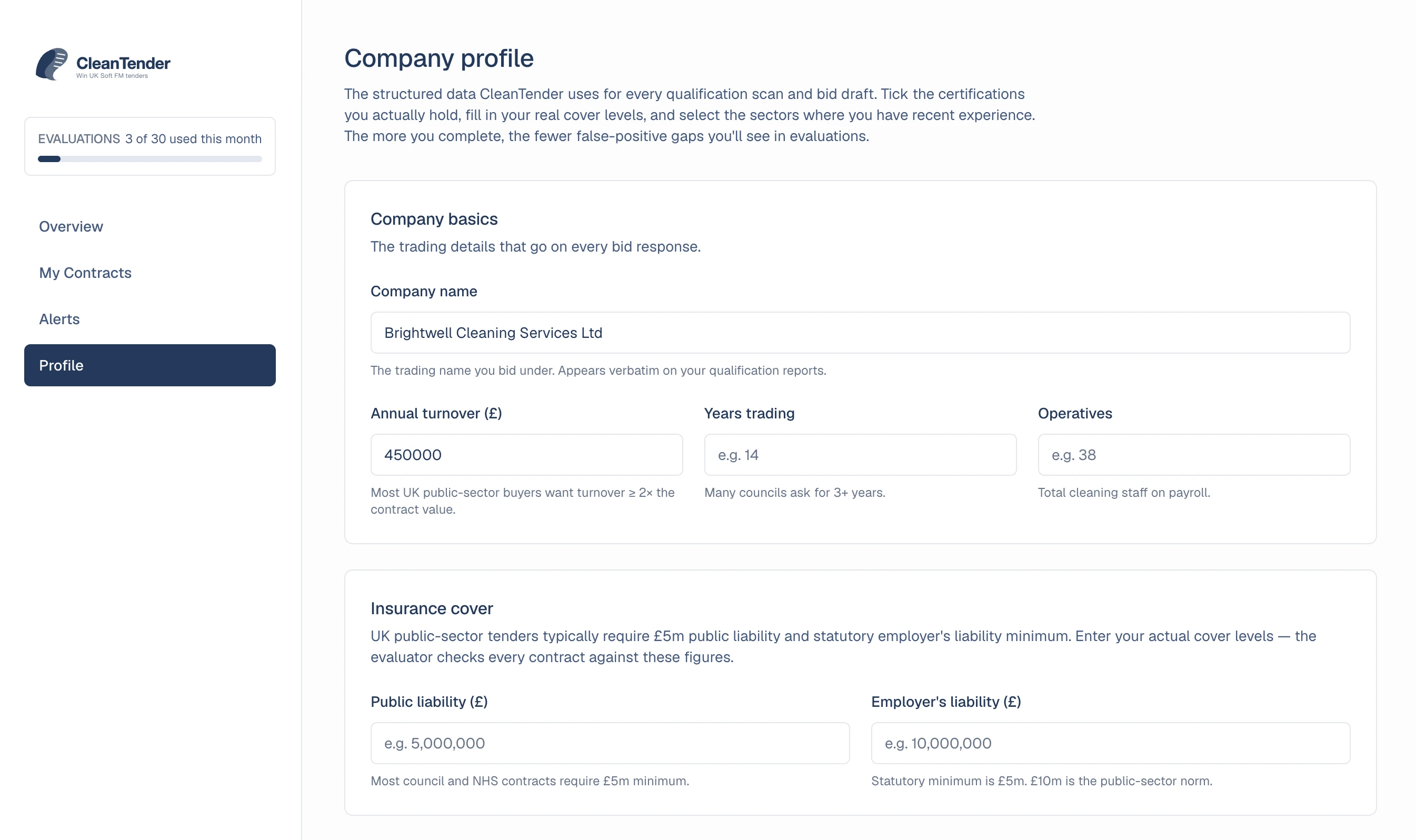
Profile setup defines what you are bid-ready for Step 2· 5 minutes daily
Open the live waste-tender feed
Every UK council, NHS Trust, school, MoD, and central government waste collection and recycling tender, in one feed. Pre-filtered to your sector and geography. No false positives, no manual portal-trawling across FTS, Contracts Finder, and dozens of buyer e-procurement portals.
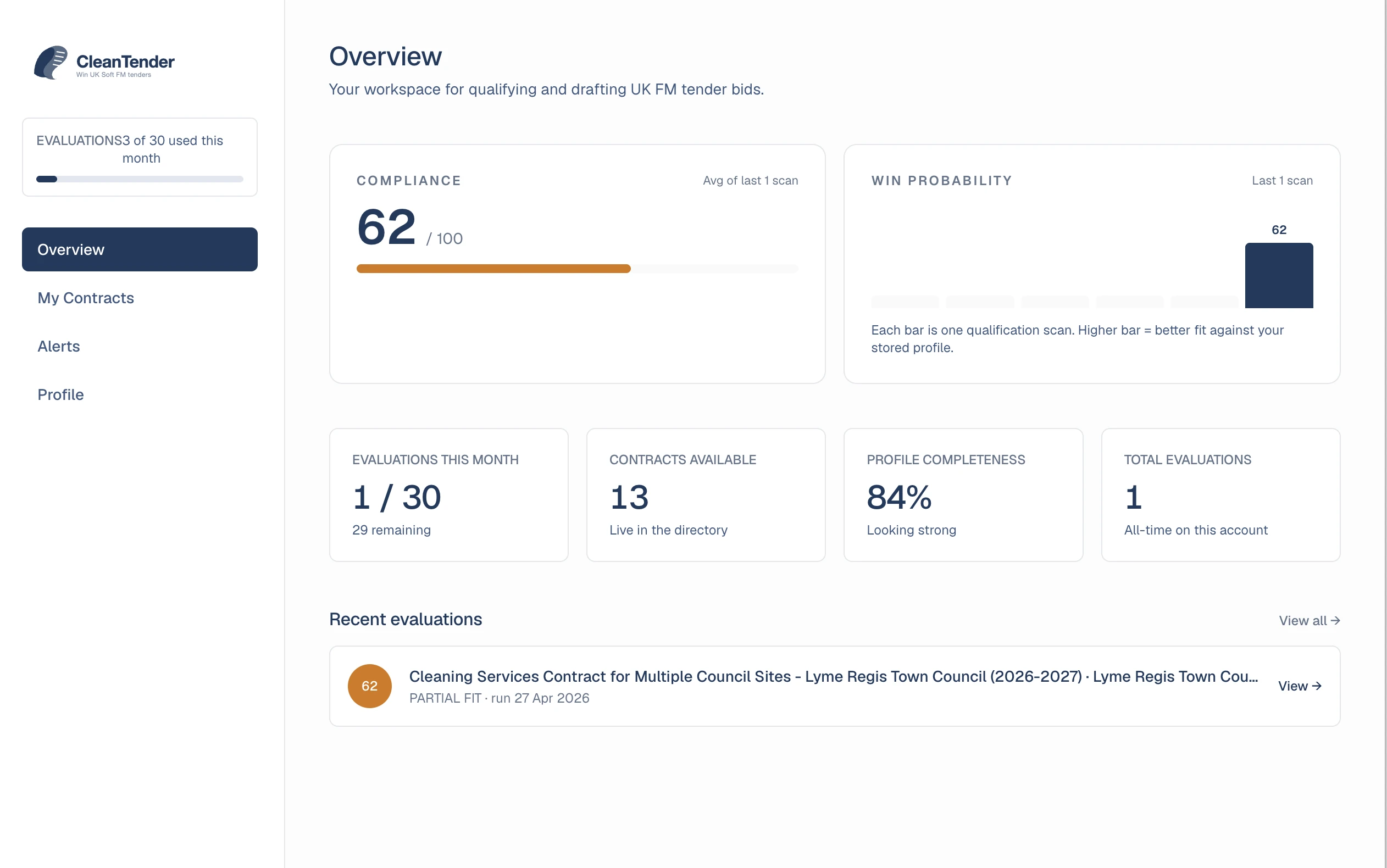
Live feed of in-scope waste tenders, fit-scored Step 3· Daily digest
Get email alerts for new in-scope tenders
New waste management tenders matching your profile land in your inbox the day they publish. CleanTender batches them into a daily digest so you do not get notification fatigue, and links straight back to the in-app fit score.
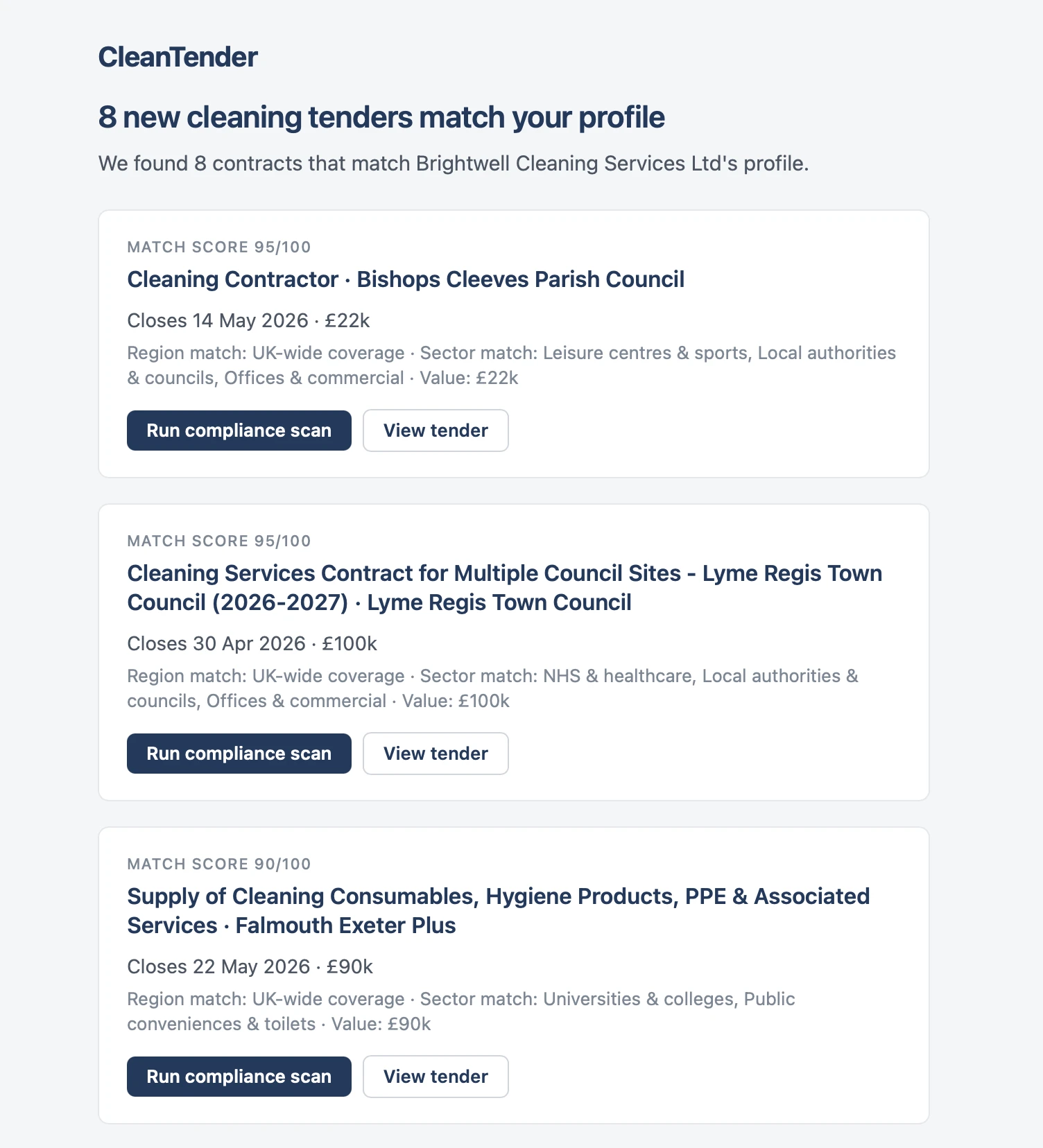
Daily alerts for new in-scope tenders Step 4· 30 seconds
Run a fit-score evaluation on a target tender
One click runs a CleanTender Evaluation against the tender pack: scope match, geography fit, scale fit, compliance gap, and a plain-English win probability. Stops you bidding contracts you were never going to win.
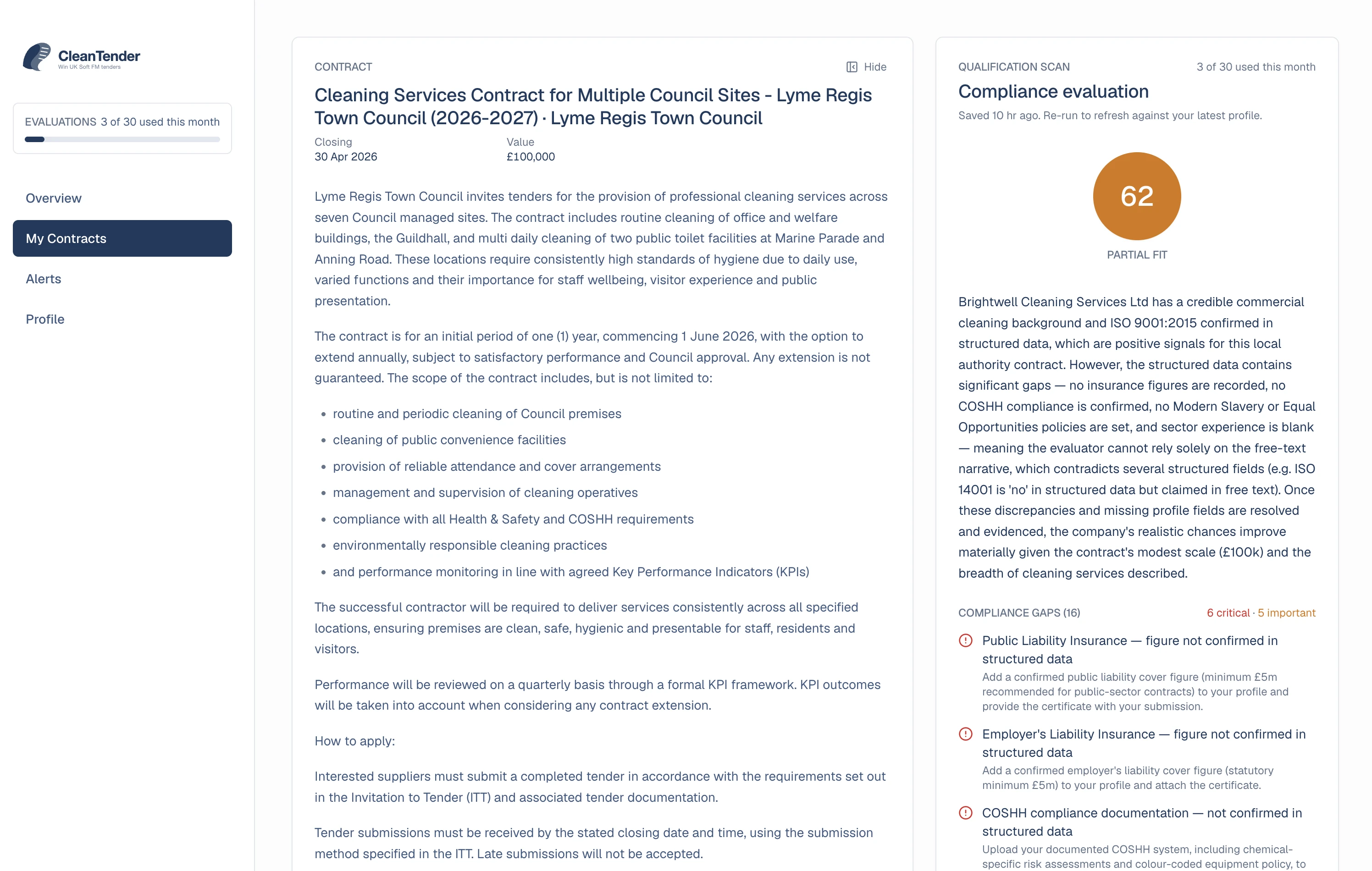
Fit-score and win-probability before you commit a weekend Step 5· 1 minute
Spot compliance gaps before you start drafting
CleanTender runs a named compliance check against the tender pack: ISO 14001, hazardous waste carrier registration, Driver CPC, WAMITAB COTC, SSIP, social value plan, decarbonisation pathway. Anything missing is flagged before you sink hours into a bid that auto-fails at SQ.
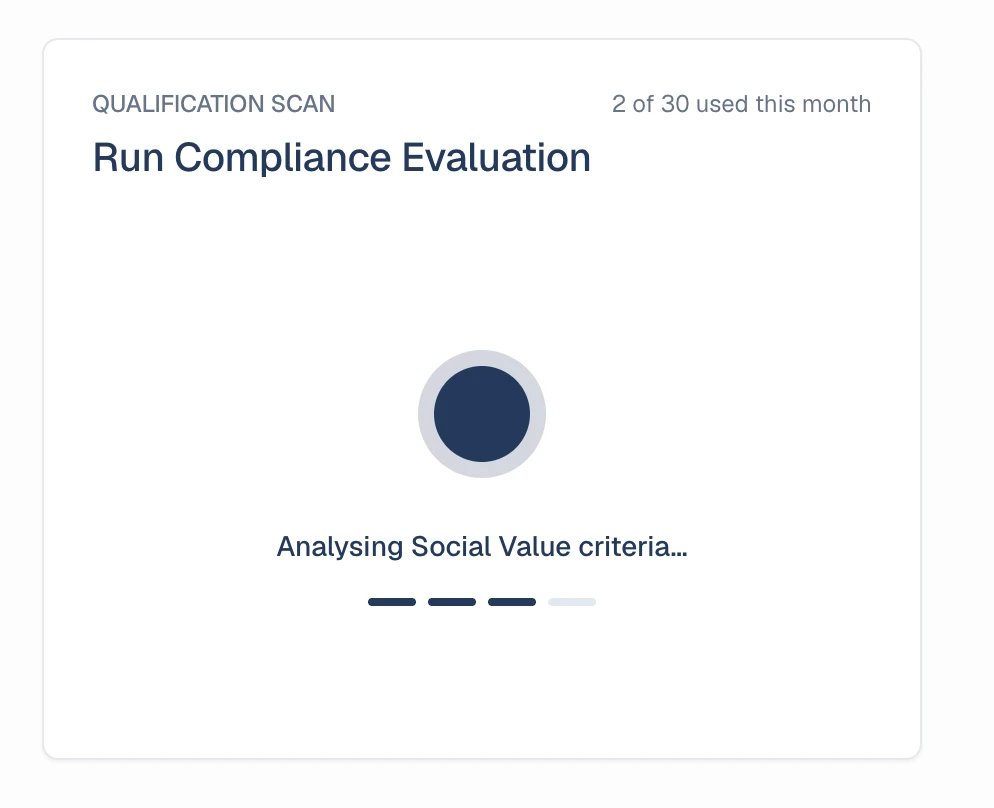
Compliance gaps surfaced before drafting Step 6· 2 minutes generation
Generate a full SQ + method-statement draft
CleanTender drafts a complete Standard Selection Questionnaire response using your profile data and the tender requirements: declaration block, company overview, contract experience, quality, training, COSHH, social value, H&S, insurance schedule. All ten sections, in one pass.
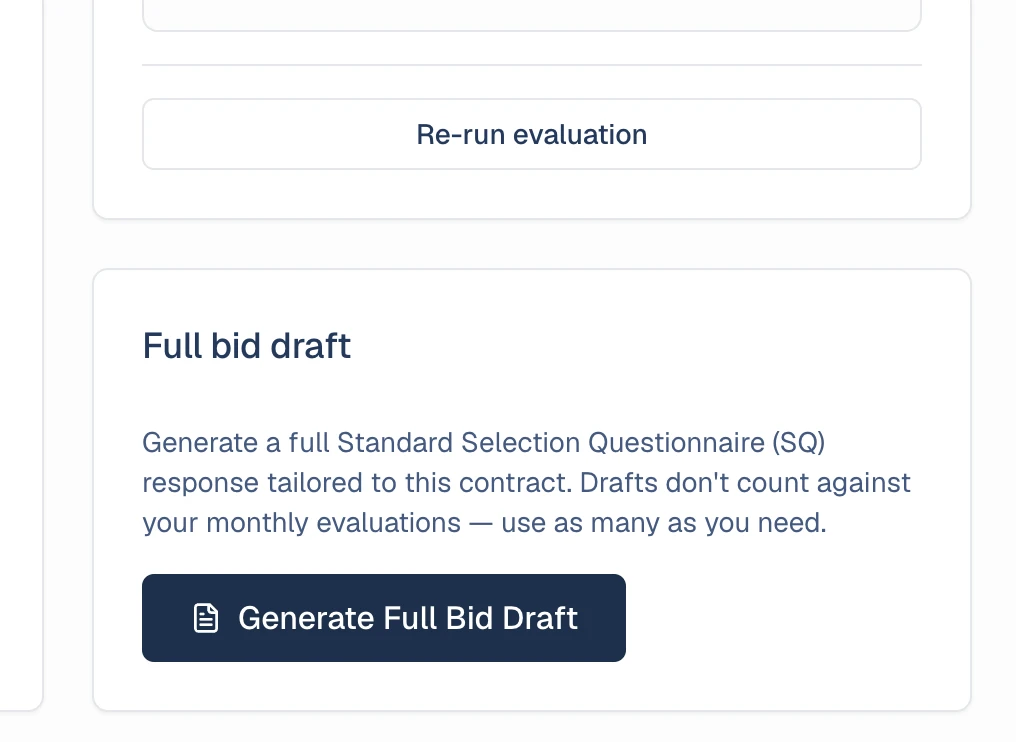
Full SQ draft generated in minutes, not days Step 7· Half a day
Refine, add evidence, and submit
Tune the draft, drop in named referees and certificate numbers, layer your quantified social value commitments, and submit through the buyer's portal. Most users compress a 30-60 hour first bid to 8-12 hours of focused review.
Step 8· Ongoing
Track outcomes and improve
Every bid logs in CleanTender with status, score, and (after standstill) the buyer's feedback. Use the standstill data to tune your next bid. Win rate compounds; first-bid completion is the only thing standing between you and a public-sector revenue line.
The 4 regulatory shifts that reshaped UK waste tenders
| Regulation | Effective | What it requires |
|---|---|---|
| Simpler Recycling (DEFRA) | 31 March 2025 (10+ employee businesses); 31 March 2026 (local authority household collections); 31 March 2027 (micro-businesses under 10 employees) | Mandatory separate collection of dry recyclables (paper/card, plastic/metal, glass) and food waste. Co-mingled paper + plastic/metal allowed; everything else separate. |
| Extended Producer Responsibility (EPR) for packaging | Reporting obligations from 2023; first fee payments 1 October 2025 | Producers pay the cost of council collection and disposal. Council budgets shift; some collection streams gain a cross-subsidy. |
| Landfill Tax | Standard rate £103.70 per tonne from 1 April 2025; lower rate £4.05 | Material cost pressure on any waste destined for landfill. Buyers want contractors who divert reliably above 60-70% on general waste streams. |
| Hazardous Waste Regulations 2005 + Environmental Permitting | Live; periodic enforcement updates | Consigner Duty on producers, full audit trail per consignment, registered carriers only, T11 / S2 transport documentation. Buyers verify carrier registration before award. |
Major UK waste regulation changes effective 2024-2026 that contractors must address in tender responses.
If your method statement does not reference all four of these by name with your documented compliance approach, you are leaving evaluator marks on the table. Generic "environmentally responsible" copy scores 4 out of 10. Named regulatory references with a documented contractor response score 8-9.
What buyers score on (the marking matrix patterns)
| Criterion | Typical weighting | What scores 8-9/10 |
|---|---|---|
| Price | 30-40% | Transparent gate-fee + transport pricing, EPR offsets stated, no hidden surcharges, mileage-based fuel adjustment with cap |
| Method / technical capability | 30-40% | Named MRF and WtE destinations, segregation process diagrams, recycling-rate KPIs with baseline, contingency for breakdowns |
| Environmental and recycling performance | 10-20% | ISO 14001 certified, current contract recycling rates with evidence (not aspirations), zero-emission vehicle plan with a year-three target |
| Social value (PPN 002) | 10-20% minimum | Local recycling-sector hires, circular-economy partnerships with local schools/charities, community recycling-education sessions, decarbonisation pathway aligned to net zero |
| Health and safety / compliance | 5-10% | ISO 9001 + ISO 14001 + ISO 45001 (or evidence of equivalent OHSAS practice), SSIP-recognised certificate, registered hazardous waste carrier, COSHH and CDM coverage |
Typical scoring breakdown on UK public-sector waste management tenders in 2026.
Pricing factors for UK waste tenders
Waste pricing is layered. A council tender for general waste collection rolls up multiple cost components and the contractor's margin sits on the gap between the gate fee and the disposal route.
| Component | Rough range (2026) | Notes |
|---|---|---|
| Gate fee at MRF (mixed dry recyclables) | £40-£90 per tonne | Varies by quality of separation. Higher contamination = higher gate fee or rejection. |
| Gate fee at Energy from Waste (residual waste) | £90-£140 per tonne | Cheaper than landfill. Most general waste destined for incineration with energy recovery. |
| Landfill (lower rate, inert) | £20-£40 per tonne + £4.05 Landfill Tax | For genuinely inert material only. Most waste no longer eligible. |
| Landfill (standard rate) | £40-£70 per tonne + £103.70 Landfill Tax | Last-resort destination. Buyers look for diversion rate evidence. |
| Hazardous waste disposal | £200-£800+ per tonne (varies wildly by waste type) | Separate consignment notes, registered carrier required, T11 / S2 documentation |
| Transport | £3-£6 per mile (HGV) + £20-£40 per hour driver cost | Distance to MRF / WtE matters. Local destinations score on social value. |
| Container hire | £8-£15 per week (eurobin) to £30-£60 per week (1100L wheeled bin) | Standing charge separate from collection cost |
Cost components in a typical UK council waste collection contract.
The 5 main waste streams in public-sector contracts
| Stream | Typical sources | Documentation |
|---|---|---|
| General waste | Council depots, school grounds, civic offices, NHS administrative areas | Waste Transfer Notes; carrier registration; destination evidence (MRF, WtE, landfill); SIC and EWC codes |
| Mixed dry recyclables | All sites with 10+ employees from 31 March 2025 | MRF gate-fee evidence, segregation method, contamination thresholds, monthly recycling-rate reporting |
| Food waste | Mandatory separate collection from 31 March 2025 for businesses | Anaerobic digestion (AD) destination, in-vessel composting evidence, no co-collection with general waste |
| Hazardous waste | NHS clinical waste, asbestos, chemical waste, electrical / WEEE | Hazardous Waste Regulations 2005 consignment notes; registered hazardous waste carrier; T11 / S2 transport documentation; specialist disposal facility |
| Clinical waste (NHS) | Hospitals, GP surgeries, dental practices, pharmacies | HTM 07-01 compliance; orange-bag (anatomical) and yellow-bag (sharps / infectious) segregation; licensed treatment facility (incineration or alternative treatment) |
Common waste streams in UK public-sector contracts and the documentation each requires.
Most general waste contracts cover streams 1, 2, and 3 (general, recycling, food). NHS estates contracts add streams 4 and 5. School estates often add hazardous (chemistry-lab waste, fluorescent tubes under WEEE). Match your bid scope honestly to your operational capability.
Method statement structure for waste tenders
- Scope confirmation: stream-by-stream coverage (general, dry recyclables, food, hazardous if in scope), site list with collection frequency, container types and quantities. Reference page numbers in the tender spec.
- Collection schedule: routes, frequencies, collection windows. Reference Simpler Recycling separation requirements explicitly.
- Segregation and processing: where dry recyclables go (MRF name and location), where food waste goes (AD or in-vessel composting facility), where general waste goes (WtE plant name, energy recovery rates), and where hazardous waste goes (specialist facility name with licence number).
- Vehicle inventory: HGV count, refuse collection vehicle (RCV) types, side-loaders, skip lorries, recycling pods. Highlight zero-emission and Euro 6+ vehicles. State your year-three decarbonisation target.
- Staffing and qualifications: HGV drivers with current Driver CPC (Certificate of Professional Competence), supervisor with WAMITAB Certificate of Technical Competence (COTC), recycling operatives with CSCS cards, hazardous-waste handler with appropriate WAMITAB ticket. Include shift patterns and relief cover.
- Compliance: ISO 14001 certificate number and UKAS accreditation, ISO 9001 and ISO 45001 if held, SSIP-recognised health and safety certificate, registered hazardous waste carrier number (if applicable), Environment Agency permits.
- Reporting: monthly recycling-rate KPI reports, quarterly contamination-trend analysis, annual carbon footprint reporting (Scope 1+2+3), customer satisfaction surveys.
- Escalation: out-of-hours emergency response (e.g. burst bin liner, vehicle breakdown mid-route), named on-call manager, response time, deputy cover, and escalation up to operations director.
If your method statement still reads as brochure copy at this stage, the eight-section scoring structure in the cleaning method statement guide applies the same logic for waste, with the streams and qualifications swapped. Marking matrices reward density of relevant evidence, not prose length.
Social value commitments that score in waste
PPN 002 (live 1 October 2025) sets a 10% minimum social value weighting on UK central government tenders, and most local authorities now match or exceed that. Waste contracts have natural social value angles that score well when quantified.
- Local recycling sector hiring: "We will create three full-time roles at our local MRF in year one, drawn from the council area. Apprenticeships for two of them."
- Circular economy partnerships: "Year-one partnership with [local charity] to divert reusable items from skip routes. Forecast 8 tonnes of furniture and bicycles diverted annually."
- Community recycling education: "Six schools per year on a recycling-education programme delivered by our team. Curriculum-aligned with KS2 and KS3 environment modules."
- Decarbonisation pathway: "30% zero-emission RCV fleet by year three, 60% by year five. Path to net zero direct emissions by 2040."
- Local supply chain: "Year-one spend with SME suppliers within 50 miles to reach 35% of contract supply chain spend. Reported quarterly."
When NOT to bid
- Geography mismatch. Council waste contracts are intensely local. The MRF and WtE plants you have relationships with determine your gate fees and your margin. Bidding 90+ minutes from your operational base is usually unprofitable.
- Stream mismatch. Bidding an NHS contract with hazardous and clinical streams when you only handle general and recycling. The clinical waste regs (HTM 07-01) catch out generalists at evaluation.
- Scale mismatch. Total contract value above 2x your turnover. Buyers worry about vehicle availability, depot capacity, and supplier collapse risk.
- No ISO 14001. The certification gate is increasingly hard. UKAS-accredited ISO 14001 takes 6-12 months and £4,000-£8,000 first year. If you're starting today, get the application moving before the next bid window.
- No registered hazardous waste carrier. If hazardous waste is in scope and you are not registered as a Hazardous Waste Carrier with the Environment Agency, the bid is auto-failed at SQ. Application takes weeks not days.
Sources
- Simpler Recycling (DEFRA) · Policy statement covering separation requirements; effective 31 March 2025 for 10+ employee businesses
- Extended Producer Responsibility for packaging (DEFRA) · Reporting obligations and fee payments; producers pay disposal costs from October 2025
- Landfill Tax rates (HMRC) · Standard rate £103.70 per tonne from 1 April 2025; lower rate £4.05
- Hazardous Waste Regulations 2005 (legislation.gov.uk) · Consigner Duty, registered carriers, T11 / S2 documentation requirements
- HTM 07-01 Safe and sustainable management of healthcare waste (NHS England) · NHS clinical waste segregation, packaging, transport, and disposal standards
- ISO 14001 (BSI) · Environmental management standard now a hard SQ gate on most council and NHS waste tenders
- WAMITAB · Operator competence certifications referenced on most UK waste tenders
- Driver CPC · Certificate of Professional Competence required for HGV drivers in waste collection
- PPN 002: Social Value Model (Cabinet Office) · Mandatory from 1 October 2025; 10% minimum social value weighting on central government tenders
FAQs
Frequently asked questions
- Three big shifts. First, Simpler Recycling went live on 31 March 2025 for businesses with 10 or more employees, requiring mandatory separate collection of dry recyclables (paper/card, plastic/metal, glass) and food waste. Local authority household collections must do the same from 31 March 2026. Second, Extended Producer Responsibility (EPR) for packaging started its first fee-payment cycle in October 2025, shifting council waste-budget pressure. Third, Landfill Tax rose to £103.70 per tonne (standard rate) from 1 April 2025, making landfill the most expensive disposal route by a wide margin. Public-sector buyers now score waste contractors on segregation capability, recycling rate evidence, and decarbonisation pathway, not just collection price.
- Increasingly, yes. UKAS-accredited ISO 14001 is now listed as a hard SQ gate on most council and NHS waste tenders, especially anything above £100,000. Some local authorities specifically require it on all general waste, recycling, and food waste contracts. ISO 9001 (quality) is usually paired with it. ISO 45001 (occupational health and safety) increasingly required on hazardous and clinical waste contracts. First-year cost for ISO 14001 is £4,000-£8,000 with surveillance audits at £1,500-£3,000 in years 2-3. If you do not hold it and you are bidding council waste contracts, start the application before your next target tender window.
- Five common streams. General waste (depots, offices, civic centres) goes mostly to Energy from Waste (WtE) plants. Mixed dry recyclables (paper/card, plastic/metal, glass) go to Materials Recovery Facilities (MRFs) for separation. Food waste (mandatory separate from 31 March 2025 for 10+ employee businesses) goes to anaerobic digestion (AD) or in-vessel composting facilities. Hazardous waste (NHS chemicals, asbestos, electrical, WEEE) requires registered hazardous waste carrier registration with the Environment Agency and consignment notes per Hazardous Waste Regulations 2005. Clinical waste (NHS) follows HTM 07-01 with orange-bag and yellow-bag segregation, licensed treatment facility, and audit trail. Most general contracts cover streams 1-3; NHS contracts add streams 4-5; school estates often add specialist hazardous handling for science-lab waste and WEEE.
- Significantly. Standard rate Landfill Tax is £103.70 per tonne from 1 April 2025, on top of the gate fee at the landfill site (£40-£70 per tonne for standard rate material). That makes landfill the most expensive disposal route, costing roughly £140-£175 per tonne all-in. Energy from Waste plants are typically £90-£140 per tonne with no Landfill Tax. MRFs for recyclables are £40-£90 per tonne depending on contamination. The price pressure pushes contractors toward higher diversion rates and segregated streams. Public-sector buyers now expect 60-70%+ diversion from landfill on general waste streams, with evidence. A bid that lands on "competitive pricing" without showing the diversion strategy will lose to one with named MRF and WtE destinations and current diversion-rate data.
- Quantified, local, measurable commitments aligned to PPN 002 themes (jobs, growth, wellbeing, environment, equal opportunity). Strong examples: "Three FTE local hires at our MRF in year one with two apprenticeships". "Year-one partnership with [local reuse charity] forecast to divert 8 tonnes of furniture and bicycles annually". "Six schools per year on curriculum-aligned recycling education sessions". "30% zero-emission RCV fleet by year three, 60% by year five, path to net zero direct emissions by 2040". "Year-one supply chain spend with SMEs within 50 miles of contract area at 35%+, reported quarterly". The five themes give you a structure. Quantify each commitment with a number and a date. Generic "we promote sustainability" copy scores 4/10. Five quantified commitments score 8-9/10 on a 10% category.