
A tender pack is the full set of documents a UK public buyer publishes when they want bids. Under the Procurement Act 2023 (live from 24 February 2025), every document has to be available at the moment the tender notice goes up. So you can read the entire pack on day one and decide whether to bid. Six core documents do most of the work.
What's in this guide
- The standard contents of a UK public tender pack
- Each document, explained in plain English
- What changed under the Procurement Act 2023
- Which documents to read first
- Common mistakes that disqualify your bid
Standard contents of a UK tender pack
| Document | What it is | Read it for |
|---|---|---|
| Tender Notice | The short public advert. Posted on Find a Tender, above and below threshold, since 24 February 2025. | Title, value, deadline, CPV code, link to the full pack. |
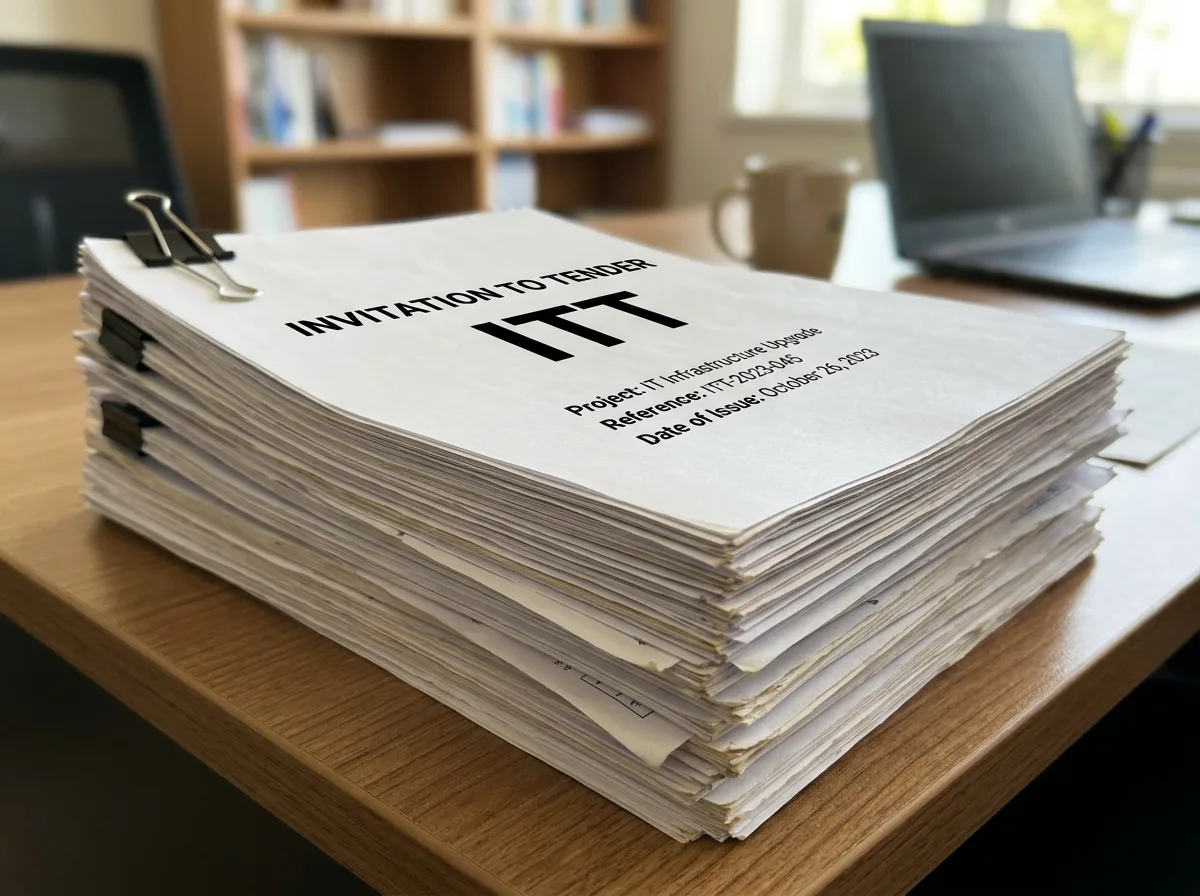
| Invitation to Tender (ITT) | The cover document inviting you to bid. Sets the rules of the procedure. | Timetable, evaluation criteria, scoring weights, submission rules. |
| Specification | What the buyer actually wants delivered. Performance, frequencies, standards, KPIs. | Whether you can actually do the work. Read this first. |
| Pricing Schedule / Bill of Quantities | Templated price form. Often a spreadsheet with line items. | How to format your price. Where unit rates apply. |
| Draft Contract | Terms and conditions you sign if you win. Often NEC or JCT, sometimes bespoke. | Liability caps, payment terms, KPIs, exit clauses. |
| Selection Questionnaire (SQ) | Pre-qualification questionnaire. Replaced PQQ under PA 2023. | Insurance, accounts, accreditations, modern slavery, GDPR. |
| TUPE Schedule | List of staff transferring with the contract. Pay, hours, terms. | Pricing the labour cost. Spotting hidden TUPE liabilities. |
| Social Value Schedule | Buyer's social value model. PPN 002 or National TOMs. | What commitments you must make and how they're scored. |
| KPI Schedule | Performance metrics the contract is judged on. | What you'll be measured on once you win. |
| Asset Register | List of equipment, vehicles, materials in scope (where relevant). | Whether equipment transfers, whether you need to invest, lease costs. |
What you'll find in a typical UK public-sector soft FM tender pack.
Tender Notice
The Tender Notice is the short public advert for the procurement. Above the threshold (£207,720 inc. VAT for services for sub-central authorities) it goes on Find a Tender. Below threshold, but above £12,000 for central government or £30,000 for sub-central (both inc VAT), it also goes on Find a Tender. Contracts Finder only holds older procurements started before 24 February 2025. Scottish buyers use Public Contracts Scotland, and Sell2Wales and eTendersNI run alongside Find a Tender in Wales and Northern Ireland.
What the Notice tells you. The buyer's name. The contract title. The estimated value. The CPV code (so you can spot whether it's actually in your sector). The submission deadline. And a link to the full tender pack.
Invitation to Tender (ITT)
The ITT is the cover document that pulls the rest of the pack together. It is the rules of the bid. Read it carefully because if you miss a rule, you can be disqualified.
What the ITT covers. The procurement procedure (Open, Competitive Flexible, etc.). The bid timetable. The evaluation criteria and weightings. Word counts. File formats. Where to submit. How to ask clarification questions. Standstill period rules. Confidentiality.
If procedure names are unfamiliar, the Procurement Act 2023 guide for FM suppliers covers each one. The procurement acronyms cheat sheet has the rest.
Specification
The Specification (or 'spec') is what the buyer wants done. It is the most important document in the pack for deciding whether to bid. If you cannot deliver what the spec describes, no amount of clever writing will save your bid.
What a soft FM spec covers. Site list with sizes and frequencies. Service standards (BICSc cleaning levels, SIA security shifts, grounds maintenance schedules). KPIs. Reporting cadence. Holiday cover. Working patterns. Any restricted hours. Equipment requirements.
Under PA 2023, technical specifications must be performance or functional, not descriptive. So a buyer should describe the outcome (a clinical area cleaned to NHS National Standards of Cleanliness) rather than dictating brand names or methods. This is helpful for innovative SMEs because you can propose better methods.
Pricing Schedule
The Pricing Schedule is the price form. It is usually a templated spreadsheet with one line per service, site or activity. The buyer often defines line items so they can compare bids on a fair basis.
Watch for three things. First, whether prices are fixed for the contract life or indexed to inflation. Second, whether the National Living Wage rise is recoverable through annual review (it should be, since NLW rises every April). Third, whether you have to break out social value costs separately. Many soft FM bidders lose by under-pricing the management overhead and back-office cost.
Draft Contract
The Draft Contract is the legal agreement you sign if you win. Most public buyers use one of three forms.
| Form | When you'll see it | Watch for |
|---|---|---|
| NEC4 Term Service Contract | Default for most local authority and NHS soft FM. Performance-based. | Compensation events, programme requirements, X clauses. |
| JCT Measured Term Contract | Older. Some councils still use it for grounds and building maintenance. | Liquidated damages, defects period, payment cycles. |
| Bespoke Service Agreement | Some buyers (housing associations, MATs) use their own form. | Termination clauses, exit cooperation, indemnities. |
Common UK public-sector contract forms.
Read the contract before you bid, not after. The risk allocation in the contract is non-negotiable on most public tenders. If the indemnity cap is uninsurable for an SME, you bin the bid before writing a word.
Selection Questionnaire (SQ)
The Selection Questionnaire is the pre-qualification questionnaire that sits in front of the bid. It checks whether you are a viable supplier at all. Under PA 2023 it replaced the old PQQ. The format is now standardised, so you can re-use answers across bids.
What the SQ covers. Company information. Last 2-3 years of audited accounts. Insurance certificates (Employers Liability minimum £5m, Public Liability minimum £5m). H&S policy signed within 12 months. ISO certifications (UKAS-accredited). Modern Slavery Statement (if you have 50+ staff). GDPR / data protection policy. Equality and diversity policy. Environmental policy.
Most public tenders fail at SQ stage, not at bid stage. The most common reason. Expired insurance. The second most common. Missing modern slavery statement on a 50-staff firm. Both are avoidable.
For the deeper SQ explainer including the standard SQ template under PA 2023, see what is PAS 91 and what replaced it for FM contracts.
Schedules: TUPE, KPI, Social Value, Asset Register
Schedules are the supporting documents that turn the spec and contract into pricable detail. Each one matters for a soft FM bid.
- TUPE Schedule. Names, hours, hourly rates, holiday entitlement, length of service, pension status of every transferring employee. Price your labour against this, not against your own existing rates.
- KPI Schedule. Performance metrics the contract is judged on. Often weighted. Affects payment under NEC4 if you fall short.
- Social Value Schedule. The buyer's social value model. Either National TOMs or PPN 002 Social Value Model. Lists the commitments and the proxy values.
- Asset Register. Equipment in scope. Whether items transfer to you, whether you must replace them, lease costs and condition.
- Site List. Address, square metreage, opening hours, accessibility. Critical for cleaning and grounds work where unit rates depend on site characteristics.
What changed under the Procurement Act 2023
Two big changes for tender documents under PA 2023.
- All documents must be published at notice stage. Under PCR 2015, some buyers drip-fed the spec or only released the contract late. Now everything is on the table on day one. Use it.
- Specifications must be performance-based, not prescriptive. Buyers must describe what they want delivered, not how. So you can propose innovative methods (zero-emission machinery, pesticide-free grounds care, route optimisation tech) and get scored for them.
Which documents to read first
When a tender pack lands, do not start at page one. Read in this order to decide whether to bid before you write a word.
| Order | Document | What you're checking |
|---|---|---|
| 1 | Tender Notice | Value, deadline, CPV code, location. Bin if any of these are wrong for you. |
| 2 | Specification | Can you actually deliver this? Frequencies, sites, hours, standards. |
| 3 | TUPE Schedule | Hidden labour cost. How many staff, on what rates, with what protected terms. |
| 4 | Draft Contract | Liability cap, indemnities, KPIs that trigger penalties. Insurable for an SME? |
| 5 | Pricing Schedule | How they want it priced. Are line items sensible. Are NLW rises recoverable. |
| 6 | Evaluation criteria (in ITT) | Quality vs price weighting. Social value weighting. Strengths to lean on. |
| 7 | Selection Questionnaire (SQ) | Have you got the docs ready. Bin if a missing accreditation is a hard requirement. |
The 30-minute first-pass reading order for a UK soft FM tender pack.
For the order to actually write your bid response in, the step-by-step UK government contracts guide walks through the mechanics. For sector-specific bid plays, see the cleaning, security and school catering guides.
Common mistakes that disqualify your bid
- Word-count breach: most public buyers auto-disqualify any answer over the word limit. Treat the limit as a hard cap, not a guideline.
- Missing or expired insurance certificates: SQ is checked against named figures. £5m EL/£5m PL is the floor for most tenders. Have certificates dated within the validity window.
- Pricing below NLW: buyers must reject 'abnormally low' bids. From April 2026 the NLW is £12.71/hr. Add employer NI, pension, holiday pay, supervision. The all-in floor is well above £12.71.
- Missing modern slavery statement: required if you have 50+ staff or £36m turnover. Even smaller firms should have one for tender purposes.
- Unsigned declarations: SQ contains several declarations. Each must be signed by the named director. Type a name in if a wet signature isn't possible.
- Wrong contract form assumed: do not assume NEC4 if the pack uses JCT, or vice versa. The compensation event language is materially different.
One last thing
Tender packs are designed to make buyers safe, not to make bidders' lives easy. They are dense by design. The good news is they are dense in predictable ways. Read in the right order. Bin tenders that fail your first three filters before you write a word. Save your weekends for the bids you can actually win.
Once you know what the documents ask, the bid writing examples show how to answer the quality questions.
Two free tools help here. The SQ readiness checker shows which policies and certificates you still need for the selection stage, and the free AI bid answer grader scores your written answers 0 to 5 before you submit.
Sources
- Procurement Act 2023 (legislation.gov.uk) · Tender document publication requirements under PA 2023.
- Transforming Public Procurement (Cabinet Office) · Standard SQ template and supplier guidance.
- Find a Tender Service · UK above-threshold tender notices and full document packs.
- Contracts Finder · Below-threshold UK contracts. Full packs published from notice stage.
- NEC Contracts · NEC4 Term Service Contract is the default form for most public sector soft FM.
FAQs
Frequently asked questions
- ITT stands for Invitation to Tender. It is the cover document in a UK public-sector tender pack that pulls the rest together. The ITT sets the procedure, the timetable, the evaluation criteria and weightings, the word counts, the submission rules and the standstill period. Read the ITT carefully because if you miss a rule (like a word limit or a file-format requirement), you can be auto-disqualified.
- An ITT is the rules of the bid. A specification is the description of what the buyer wants delivered. The ITT covers procedure, scoring and timetable. The specification covers sites, frequencies, service standards, KPIs and equipment. Most soft FM tenders publish them as separate documents in the same pack. You read the ITT to know how to bid. You read the specification to know whether you can deliver.
- Yes, under the Procurement Act 2023. The Act requires buyers to publish all tender documents at notice stage. So when a tender appears on Find a Tender or Contracts Finder, the full pack is available the same day. This is a change from the old PCR 2015 rules, where some buyers drip-fed the spec or contract terms during the bid window.
- A TUPE schedule is a list of all the staff who currently deliver the contract that is being re-tendered. Their names (or staff IDs), hours, hourly rates, holiday entitlement, length of service and pension status. If you win, those staff transfer to you on the same terms under TUPE. The schedule lets you price the labour cost accurately. Pricing your bid against your own current pay rates instead of the TUPE schedule is one of the most common reasons soft FM bids lose money on day one.
- Rarely. PAS 91 was withdrawn by BSI in April 2023. For construction and hard FM, it has been replaced by the Common Assessment Standard (CAS). For soft FM, the Selection Questionnaire (SQ) covers most of the same ground. Some legacy tender packs still mention PAS 91 by habit, but if a soft FM tender asks for it, your standard SQ data is usually accepted.
- The SQ is the pre-qualification questionnaire under the Procurement Act 2023. It replaced the old PQQ. The SQ checks whether you are a viable supplier at all before scoring your actual bid. It covers company information, accounts, insurance (typically £5m Employers Liability and £5m Public Liability), ISO certifications, health and safety policy, modern slavery statement, GDPR policy and equal opportunities policy. Most failed bids fail at SQ stage, not at evaluation stage.
- For UK public-sector soft FM, the most common form is the NEC4 Term Service Contract. It is the default for most local authority and NHS work. Some councils still use the older JCT Measured Term Contract for grounds and building maintenance. Housing associations and Multi-Academy Trusts often use bespoke service agreements. Read the contract form before you bid. Liability caps, payment terms and KPI penalty mechanisms are non-negotiable on most public tenders.
- Yes. Every UK public-sector tender has a clarification questions process described in the ITT. You submit questions in writing through the buyer's portal. The buyer must publish answers to all bidders, anonymising the questioner. Use this process. If something in the spec or pricing schedule is unclear, asking is free. Bidding on a misunderstanding is not.