
B2G (business-to-government) is the sale of goods or services by private companies to public-sector buyers: local councils, NHS Trusts, state schools, universities, the MoD and central government departments. The UK government values this market at around £400 billion a year. Since 24 February 2025 it runs under the Procurement Act 2023, with contracts published on Find a Tender.
For a UK SME that matters for one reason: predictability. Public buyers must pay within 30 days, contracts typically run 3 to 5 years, and every bid is scored against published criteria. Lose, and the buyer has to tell you why.
What does B2G stand for?
B2G stands for business-to-government (sometimes written business2government). It sits alongside B2B (selling to other businesses) and B2C (selling to consumers). Same company, different buyer, very different sales process.
UK B2G market at a glance
Six numbers and frameworks every SME should know before deciding whether to chase public-sector revenue.
Market size
UK public procurement spend
~£400bn
Government's own figure at the Procurement Act go-live: £400 billion spent on public procurement every year, across central government, councils, NHS, schools, MoD, and arms-length bodies.
gov.uk press release, Feb 2025Measured spend
FY24/25, excluding capital spending
£249bn
Tussell's independent 2025 analysis of what the UK public sector actually spent on procurement, capital spending excluded. The precise number behind the headline figure.
Tussell Strategic Suppliers 2025Procurement Act 2023
Replaces 2015 PCR + UCR + CCR + DSPCR
Live
New SQ structure, "most-advantageous-tender" framework, transparency obligations, and abnormally-low-tender rejection mechanics.
legislation.gov.uk30-day payment terms
Through public supply chains
Mandatory
The Act mandates 30-day payment terms for all public sector contracts, flowing down to subcontractors. No collection-letter relationship management.
gov.uk press release, Feb 2025PPN 002
Social Value Model
10% weighting
Mandatory minimum on central government tenders. Most councils and NHS Trusts now match or exceed.
gov.uk publicationFind a Tender
The central digital platform
One register
Every UK contracting authority publishes procurement notices here. Suppliers register their commonly used company information once and reuse it across bids.
find-tender.service.gov.ukIf you already know B2B and want a side-by-side breakdown, see B2B vs B2G: what changes when you sell to government. To see exactly what kinds of contracts UK SMEs win every day, see 5 real-world examples of UK B2G contracts.
What's in this guide
- What B2G actually means (and what it is not)
- Why SMEs should care (4 structural advantages)
- How UK public procurement actually works (the SQ → ITT → award flow)
- What is a B2G event? (Meet the Buyer days, webinars, open days)
- The 6-step playbook to break into B2G
- See it in CleanTender (product walkthrough)
- B2G in soft FM (cleaning, security, grounds, waste, catering)
Why SMEs should care about B2G
Most SME owners write off the public sector because the paperwork looks impossible. It isn't. And the structural advantages, once you have shipped one bid, are hard to find anywhere else.
| Advantage | What it means in practice |
|---|---|
| 30-day payment, by law | The Procurement Act 2023 mandates 30-day payment terms for all public sector contracts, flowing down through the supply chain. No collection-letter relationship management. |
| Long-term stability | Typical contract term is 3-5 years with extension options. One win covers a baseline of recurring revenue. |
| Recession-proof demand | Hospitals, schools, councils, and prisons need cleaning, security, catering, grounds, and waste services through every economic cycle. |
| Transparent feedback on losses | The standstill letter (mandatory under Procurement Act 2023) breaks down exactly how your bid scored against the winner. You learn what to fix next time. |
Four structural advantages of UK B2G revenue versus private-sector contracts.
How UK public procurement actually works
Selling to a private business can be as fast as a single phone call. The Procurement Act 2023 regulates UK B2G procurement, and it runs through a defined sequence of stages, every one of which is auditable.
- Pre-market engagement (optional): the buyer publishes a Pipeline Notice or runs an early-market event so suppliers can flag capacity, ask questions, and shape the spec. Worth attending if you can.
- Tender publication: the buyer publishes the contract on Find a Tender, the central digital platform for UK public procurement. Below-threshold central government contracts (£12k-£139k) also appear on Contracts Finder. The clock starts on submission deadlines.
- Selection Questionnaire (SQ): structured pass/fail evidence on insurance, financial standing, ISO certifications, modern slavery, equal opportunities. Usually graded as suitable / not suitable rather than scored.
- Invitation to Tender (ITT): the scored bid. Method statements, social value, pricing, and any technical questions unique to your sector. Each section has a published weighting.
- Standstill period: a mandatory 8-working-day pause (with limited exceptions) between award decision and contract signature so unsuccessful bidders can challenge. The standstill letter explains your scores.
- Award and contract: the winning supplier signs and starts mobilisation. KPI reporting begins from day one of contract delivery.
What is a B2G event?
A B2G event is any session where public-sector buyers meet potential suppliers outside a live tender: Meet the Buyer days, procurement open days, and framework launch webinars. They are free, and they are one of the few legitimate ways to talk to a buyer before the formal process starts. Expect church-hall coffee and lanyard queues, not sales theatre.
Three worth knowing. Crown Commercial Service runs regional Government Meet the Buyer events in cities including Cambridge, York, London, Bristol, Manchester and Cardiff, plus a rolling programme of free framework launch and market engagement webinars. In Scotland, the Supplier Development Programme organises the country's largest free Meet the Buyer event every year, alongside single-council roadshows. And construction-adjacent trades get Constructionline's regional Marketplace Live days, where members meet main contractors and public buyers face to face. Turn up with two or three sharp questions about upcoming pipeline, not a brochure.
The 6-step playbook to break into B2G
Run this in order before chasing your first UK public-sector tender. Each step closes a hole that loses bids at SQ or wastes a bid-week on a contract you were never going to win. Tool-agnostic; works whether you use CleanTender or do it manually.
Step 1· Day 1
Pick your sector lane and stick to it
Decide whether you bid cleaning, security, grounds, waste, catering, or another vertical. Buyers score sector experience heavily; bids that read like "we do anything" lose to ones that read like "we do this and only this".
Step 2· Week 1
Build the SQ evidence pack once
Insurances at the right level (PL £5-10m, EL £10m), latest accounts, ISO 9001 if held, ISO 14001 increasingly required, equality + modern slavery + environmental policies, SSIP-recognised certificate (CHAS or SafeContractor). Reuse on every bid.
Step 3· Week 1
Register on Find a Tender and Contracts Finder
Find a Tender is the central digital platform where every UK contracting authority publishes; register your company details once. Contracts Finder still lists below-threshold contracts (from £12k central government / £25k local authorities and other sub-central bodies). Set saved searches with sector keywords and your geography. Review weekly, flag fit candidates inside 48 hours.
Step 4· Week 2
Decide on a fit-scoring approach
You will see far more tenders than you can bid. Score each on sector match, geography, scale, and compliance gap. Bid only the 8/10 fits. Bidding everything kills win rate and morale.
Step 5· Week 3
Quantify your social value commitments
PPN 002 sets a 10% minimum social value weighting on central government tenders. Build a library of dated, numerical commitments aligned to the five themes (jobs, growth, wellbeing, environment, equal opportunity). Reuse and tune.
Step 6· Week 4-6
Bid your first contract in your local geography
Aim for a contract value of £100k-£300k and a buyer within 30 minutes of your operational base. Local council frameworks are the most forgiving entry point. First-bid completion is the win, even if you do not place.
See it in CleanTender (product walkthrough)
The same six-step playbook above, automated end-to-end inside CleanTender. Each step takes seconds to minutes instead of days.
From sector setup to a submitted bid in the time it used to take to read a single tender pack.
Step 1· 10 minutes
Build your soft FM company profile
Set your sector (cleaning, security, grounds, waste, or catering), your service regions, ISO certifications, accreditations (CHAS, SafeContractor, SIA ACS, BICSc, NPTC, FHRS), insurance levels, turnover, and operative count. CleanTender uses this to fit-score every live tender against your real capability so you only see the ones you can win.
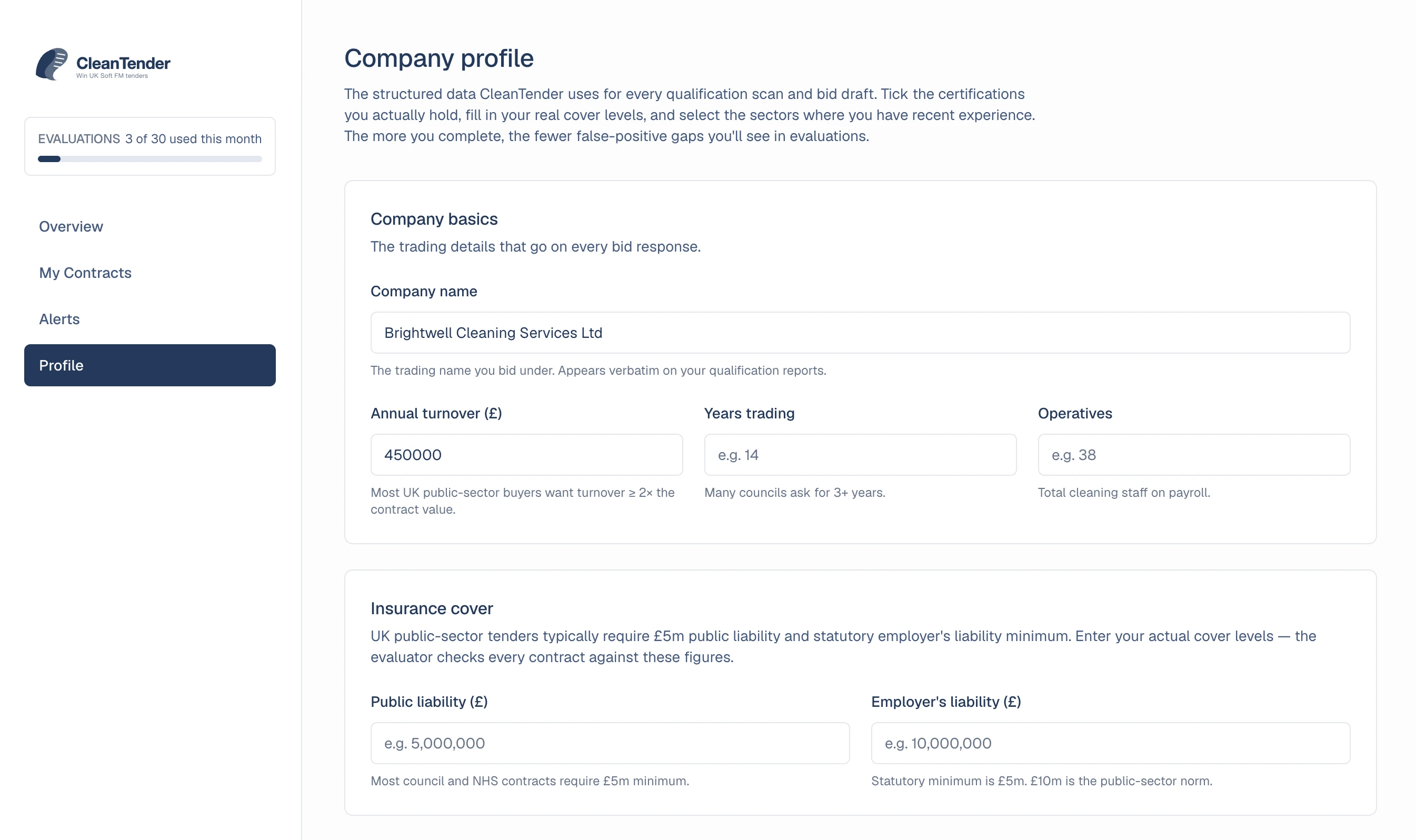
Profile setup defines what you are bid-ready for Step 2· 5 minutes daily
Open the live UK public-sector feed
Every UK council, NHS Trust, school, MoD, university, and housing-association soft-FM tender, in one feed. Pre-filtered to your sector and geography. No false positives, no manual portal-trawling across FTS, Contracts Finder, and dozens of council e-procurement portals.
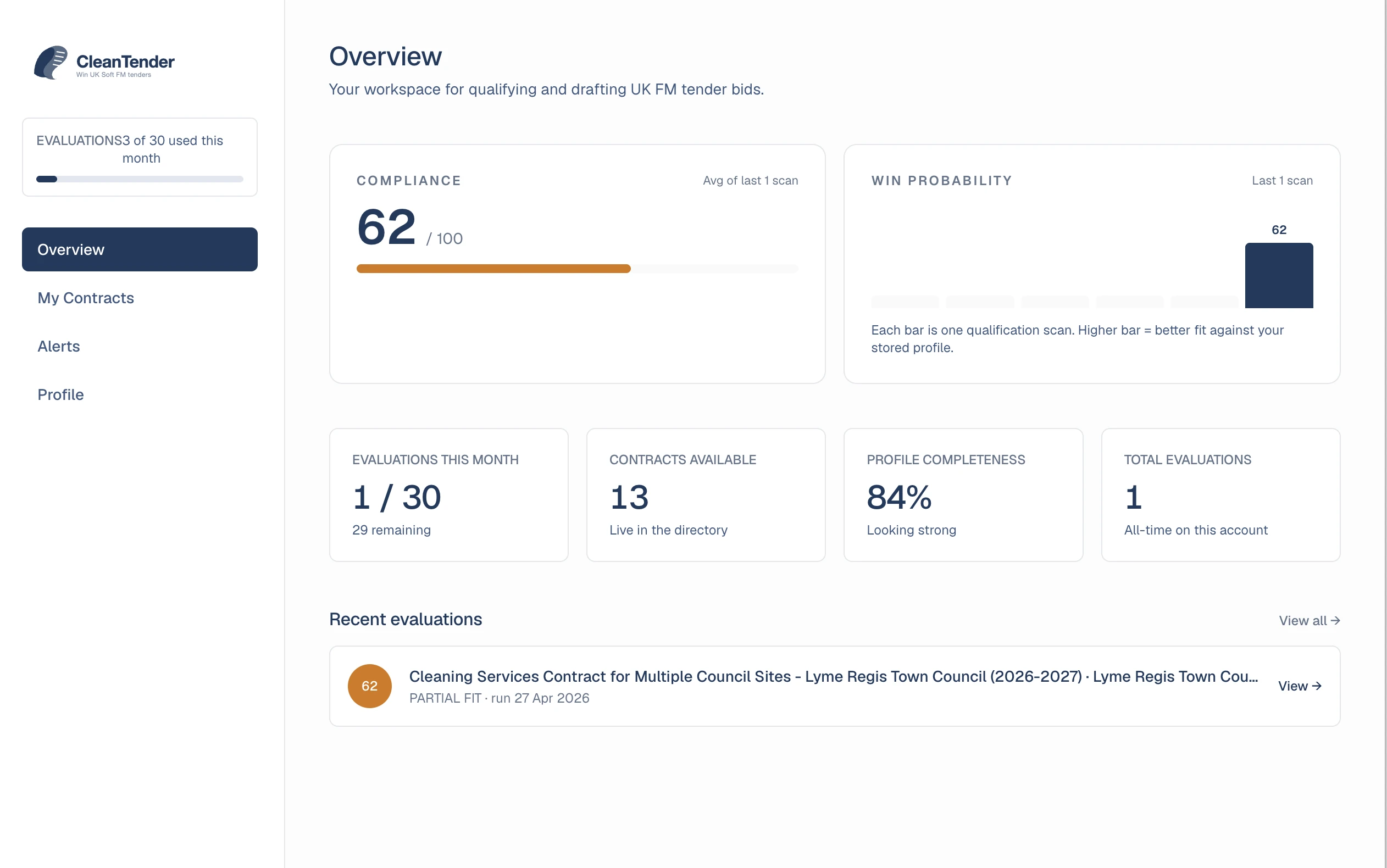
Live feed of in-scope tenders, fit-scored Step 3· Daily digest
Get email alerts for new in-scope tenders
New tenders matching your profile land in your inbox the day they publish. CleanTender batches them into a daily digest so you do not get notification fatigue, and links straight back to the in-app fit score.
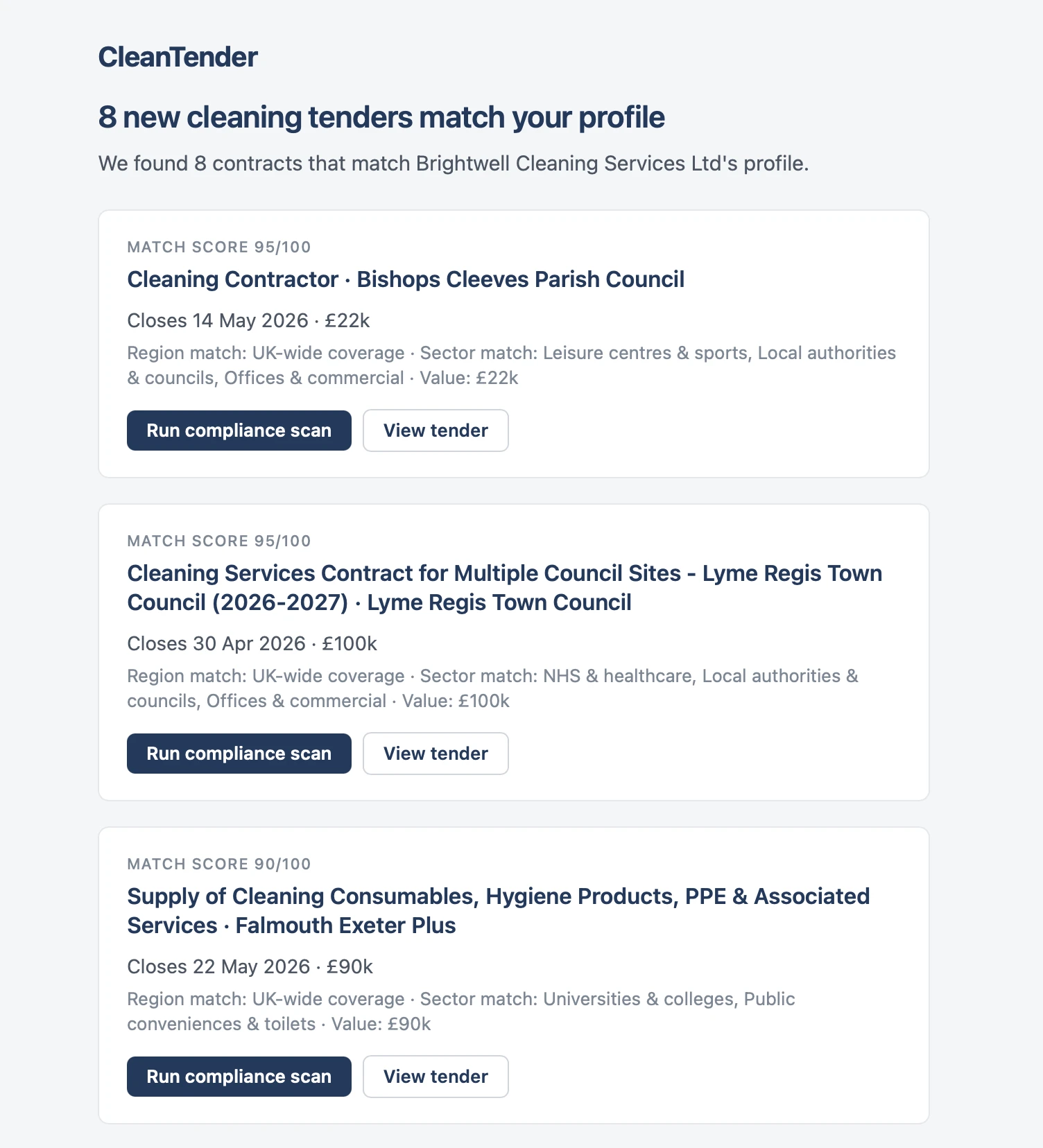
Daily alerts for new in-scope tenders Step 4· 30 seconds
Run a fit-score evaluation on a target tender
One click runs a CleanTender Evaluation against the tender pack: scope match, geography fit, scale fit, compliance gap, and a plain-English win probability. Stops you bidding contracts you were never going to win.
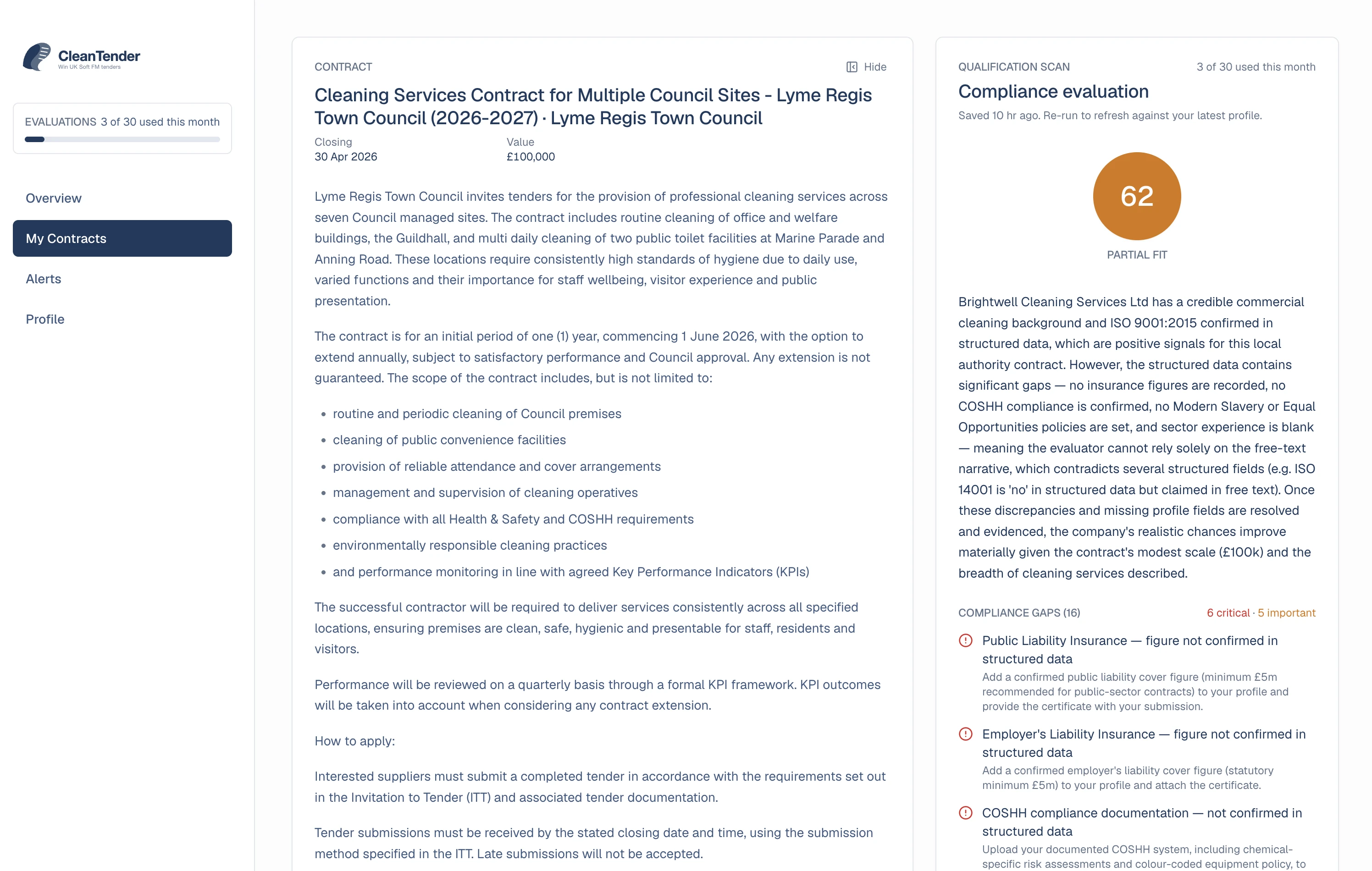
Fit-score and win-probability before you commit a weekend Step 5· 1 minute
Spot compliance gaps before you start drafting
CleanTender runs a named compliance check against the tender pack: ISO 9001, ISO 14001, sector accreditations, SSIP, social value plan, and any requirements unique to your sector (BICSc, SIA ACS, FHRS, NPTC, etc). Anything missing is flagged before you sink hours into a bid that auto-fails at SQ.
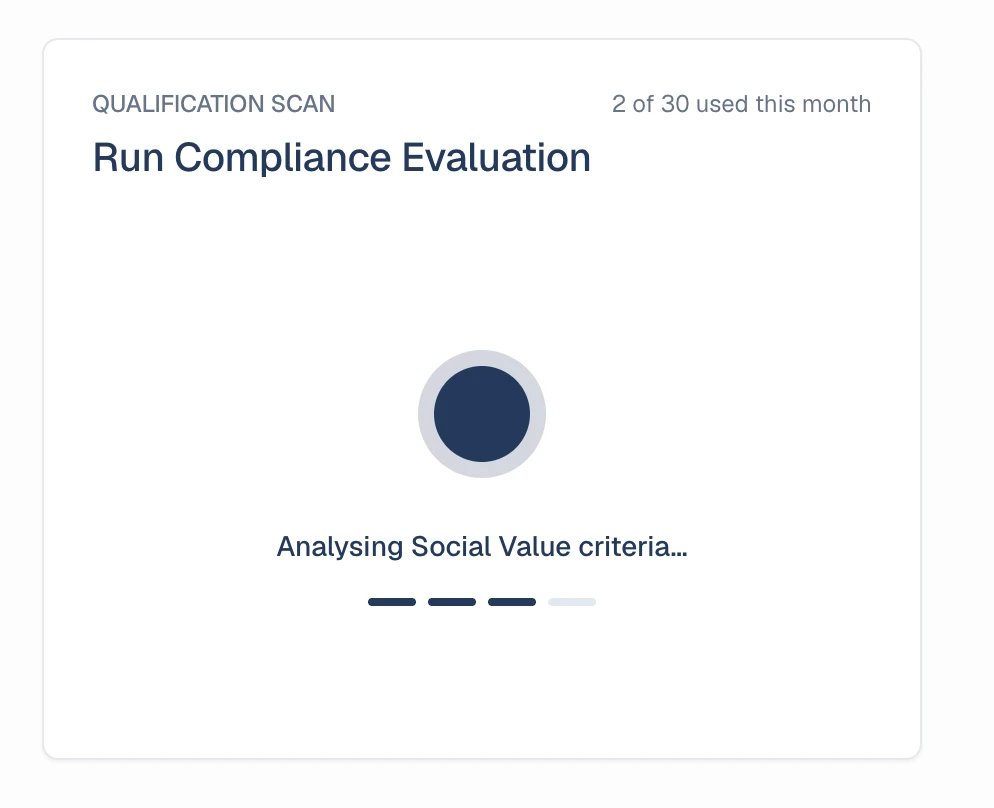
Compliance gaps surfaced before drafting Step 6· 2 minutes generation
Generate a full SQ + method-statement draft
CleanTender drafts a complete Standard Selection Questionnaire response using your profile data and the tender requirements: declaration block, company overview, contract experience, quality, training, COSHH, social value, H&S, insurance schedule. All ten sections, in one pass.
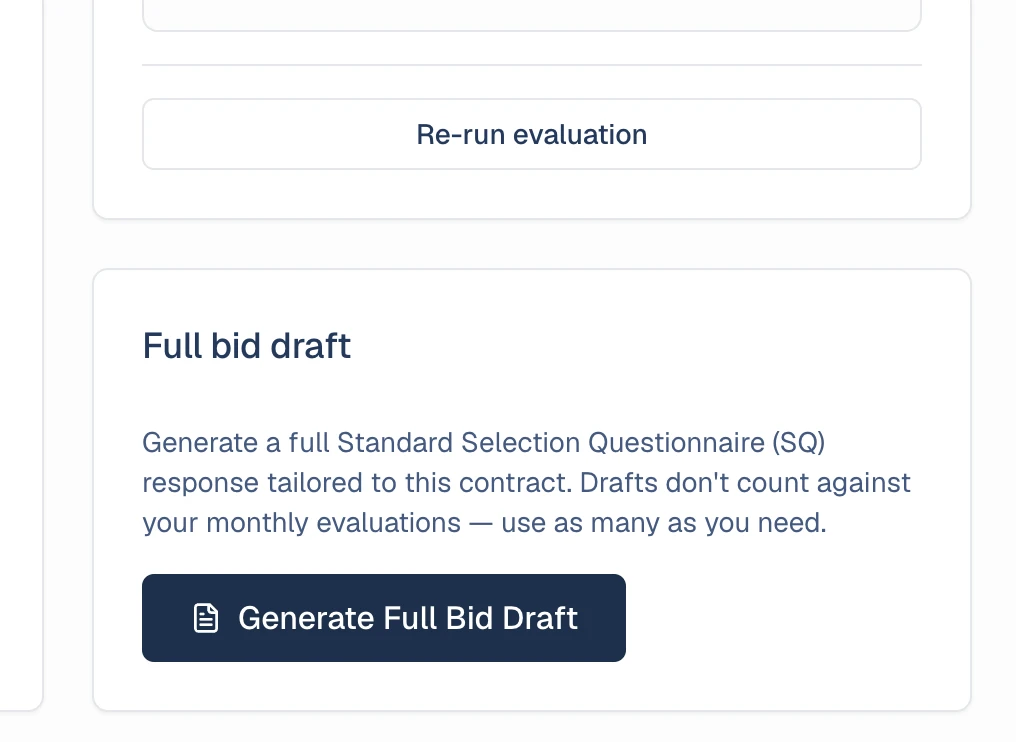
Full SQ draft generated in minutes, not days Step 7· Half a day
Refine, add evidence, and submit
Tune the draft, drop in named referees and certificate numbers, layer your quantified social value commitments, and submit through the buyer's portal. Most users compress a 30-60 hour first bid to 8-12 hours of focused review.
Step 8· Ongoing
Track outcomes and improve
Every bid logs in CleanTender with status, score, and (after standstill) the buyer's feedback. Use the standstill data to tune your next bid. Win rate compounds; first-bid completion is the only thing standing between you and a public-sector revenue line.
B2G in soft FM (the most accessible entry point)
Soft FM (cleaning, security, grounds maintenance, waste management, catering) is one of the most accessible B2G entry points for UK SMEs. The scope is recurring, the contracts are sized for SMEs, and the compliance gates are clearer than in IT or construction.
If your business sits in one of these sectors, the win-focused playbooks here give you the regulatory, scoring, and pricing detail you need: cleaning, security, grounds maintenance, waste management, and catering. For the universal new-business reality check, see can a new business win a UK government tender.
Sources
- Gov.uk: New public procurement rules to drive growth (Feb 2025) · £400 billion annual procurement spend; 30-day payment mandate for all public sector contracts
- Tussell: 2025 Strategic Suppliers analysis · £249 billion FY24/25 UK public procurement spend, excluding capital spending
- Procurement Act 2023 (legislation.gov.uk) · Live since 24 February 2025; replaces PCR 2015 and other regimes
- Gov.uk: Central Digital Platform factsheet · Enhanced Find a Tender launched 24 February 2025 as the central digital platform for public procurement
- Gov.uk: Procurement Act 2023, a short guide for suppliers · Supplier-facing summary of the rule change from 24 February 2025
- PPN 002 Social Value Model (Cabinet Office) · 10% minimum social value weighting on central government tenders
- Find a Tender (the central digital platform) · Where every UK contracting authority publishes procurement notices
- Contracts Finder · Below-threshold contracts (from £12k central government / £25k local authorities, up to the FTS thresholds); often the SME entry point
- CCS SME Action Plan 2025 · Regional Government Meet the Buyer events: Cambridge, York, London, Bristol, Manchester, Cardiff
- Supplier Development Programme: Meet the Buyer events · Scotland's largest free annual Meet the Buyer event, plus council roadshows
- Procurement Policy Notes (gov.uk) · Live PPN library covering social value, SME engagement, climate, modern slavery, and more
FAQs
Frequently asked questions
- B2G stands for business-to-government: private companies selling goods or services to public-sector buyers such as local councils, NHS Trusts, state schools, universities, central government departments, MoD, prisons, and arms-length bodies. In the UK, the government's own figure for the market is around £400 billion a year, and the Procurement Act 2023 has set the rules since 24 February 2025. Compare that with B2B (business-to-business, selling to private companies) and B2C (business-to-consumer, selling to individuals).
- The government's headline figure, published at the Procurement Act go-live in February 2025, is £400 billion spent on public procurement every year. Independent data firm Tussell measured £249 billion of UK public procurement spend in FY24/25 with capital spending excluded, which is the more precise operational number. Either way, the public sector is the largest single buyer of goods and services in the country. Every above-threshold contract publishes on Find a Tender, the central digital platform, and below-threshold central government contracts (£12k-£139k) publish on Contracts Finder.
- Start with Find a Tender (find-tender.service.gov.uk), the central digital platform where every UK contracting authority publishes procurement notices; you register your company details once and reuse them. Contracts Finder (contractsfinder.service.gov.uk) still carries central government below-threshold contracts (£12k-£139k). Councils, NHS Trusts, and consortia also use sector portals (YPO, ESPO, NEPO, CCS, NHS Supply Chain, TUCO for catering). Set saved searches with sector keywords (e.g. "manned guarding", "grounds maintenance", "cleaning services") plus your geography and review weekly. CleanTender consolidates the soft FM cuts of these feeds into one daily view.
- A B2G event is a session where public-sector buyers meet potential suppliers outside a live tender: Meet the Buyer days, procurement open days, and framework launch webinars. Crown Commercial Service runs regional Government Meet the Buyer events in cities including Cambridge, York, London, Bristol, Manchester and Cardiff, plus a rolling programme of free webinars on its events page. In Scotland, the Supplier Development Programme organises the country's largest free Meet the Buyer event every year, alongside single-council roadshows. Constructionline runs regional Marketplace Live days where members meet main contractors and public buyers face to face. They are free, and they are one of the few legitimate ways to talk to a buyer before a tender goes live. Turn up with two or three sharp questions about upcoming pipeline, not a brochure.
- Two stages of a typical UK public-sector procurement. The Selection Questionnaire (SQ) is a pass/fail gate: do you have the required insurance levels, the right ISO certifications, modern slavery and equal opportunities policies, the financial standing to deliver, no relevant convictions? The SQ is usually graded as suitable / not suitable rather than scored. The Invitation to Tender (ITT) is the scored bid for SQ-approved suppliers: method statements, technical capability, social value, and pricing, each section with a published weighting. Build the SQ evidence pack once and reuse on every bid; tune the ITT response to each contract's scope and scoring matrix.
- Social value is the extra economic, social, and environmental benefit a supplier delivers above and beyond the contract scope itself: local jobs created, apprenticeships, carbon emissions reduced, support for disadvantaged groups, community partnerships. Under the Public Services (Social Value) Act 2012 and PPN 002 (Social Value Model), a minimum of 10% of the bid score on UK central government tenders must be allocated to social value, with most councils and NHS Trusts now matching or exceeding that. The five themes are jobs, growth, wellbeing, environment, and equal opportunity. Quantified, dated commitments score 8-9/10. Generic "we support local communities" copy scores 4/10.
- Yes, and the structural barriers are lower than most SMEs assume. The Procurement Act 2023 was explicitly pitched by government as opening up the £400 billion market to small businesses, and it mandates 30-day payment terms through public-sector supply chains. Below-threshold contracts on Contracts Finder (£12k-£139k) are explicitly SME-friendly entry points. Local council frameworks for soft FM (cleaning, security, grounds, waste, catering) regularly award lots to firms with turnover under £1m. The skills you need are: an SQ evidence pack lined up once and reused, ISO 9001 (and increasingly ISO 14001) in motion, a documented social value plan, and the discipline to bid only the contracts you genuinely fit. The bid-completion rate for first-time SME bidders is what trips most people up; aim to ship one bid per month and refine until you place.