
Most UK cleaning SMEs lose three bids in a row before they win one. Some lose ten. The ones who quit at three blame the procurement system. The ones who keep going learn one rule that flips their hit rate.
Qualify before you write. Stop sending Selection Questionnaires for contracts you can't win. Pick the ones you can. Write fewer bids, win more of them.
Here's the strategy. Not bid mechanics (we have a separate guide for that). Strategy. Which contracts to chase. What scores well at SQ stage. How to double your win rate inside three months.

What's in this guide
- How to win a UK cleaning tender, step by step (CleanTender walkthrough)
- Why the first three bids lose
- The qualify-before-you-write rule
- Cleaning contracts for small business: where to start
- Which contracts to actually chase
- What scores well at SQ stage
- Frameworks vs single contracts (the SME entry point)
- Pricing as a strategy not a guess
- How win rate compounds (the bid-four-onwards game)
How to win a UK commercial cleaning tender, step by step
The complete end-to-end flow inside CleanTender. From sector setup to a submitted commercial cleaning bid in the time it used to take to read a single tender pack.
Eight steps from "never bid public sector" to a complete SQ response on the buyer's portal. First scan is free.
Step 1· 10 minutes
Build your commercial cleaning company profile
Set your sector to commercial cleaning, your service regions, BICSc accreditation, COSHH compliance, ISO 9001 status, TUPE experience, colour-coded equipment system, sector experience (NHS / schools / offices), insurance levels, turnover, and operative count. CleanTender uses this to fit-score every live tender against your real capability so you only see the ones you can win.
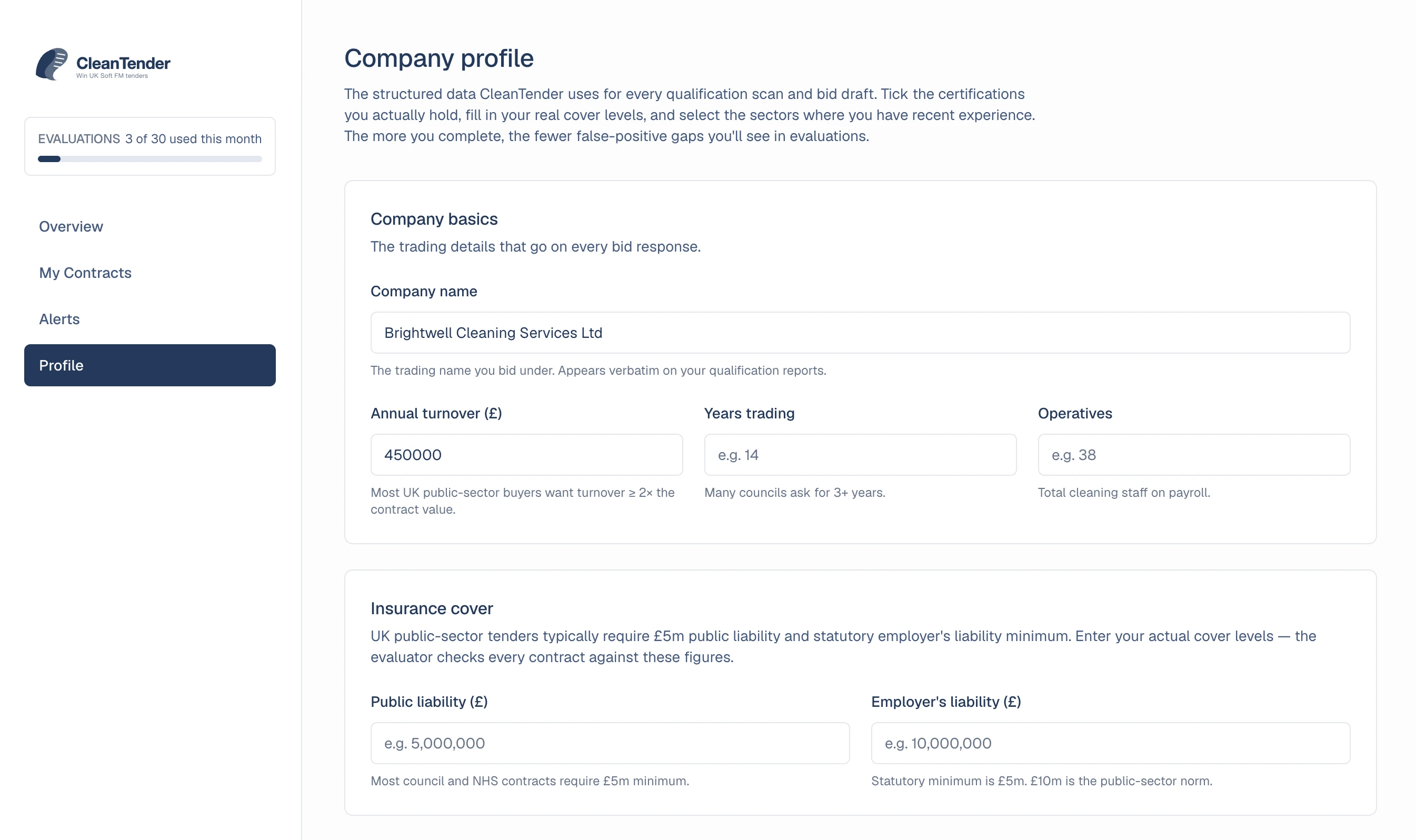
Profile setup defines what you are bid-ready for Step 2· 5 minutes daily
Open the live cleaning-tender feed
Every UK council, NHS Trust, school, university, MoD, and central government cleaning tender, in one feed. Pre-filtered to your sector and geography. No false positives, no manual portal-trawling across FTS, Contracts Finder, and dozens of buyer e-procurement portals.
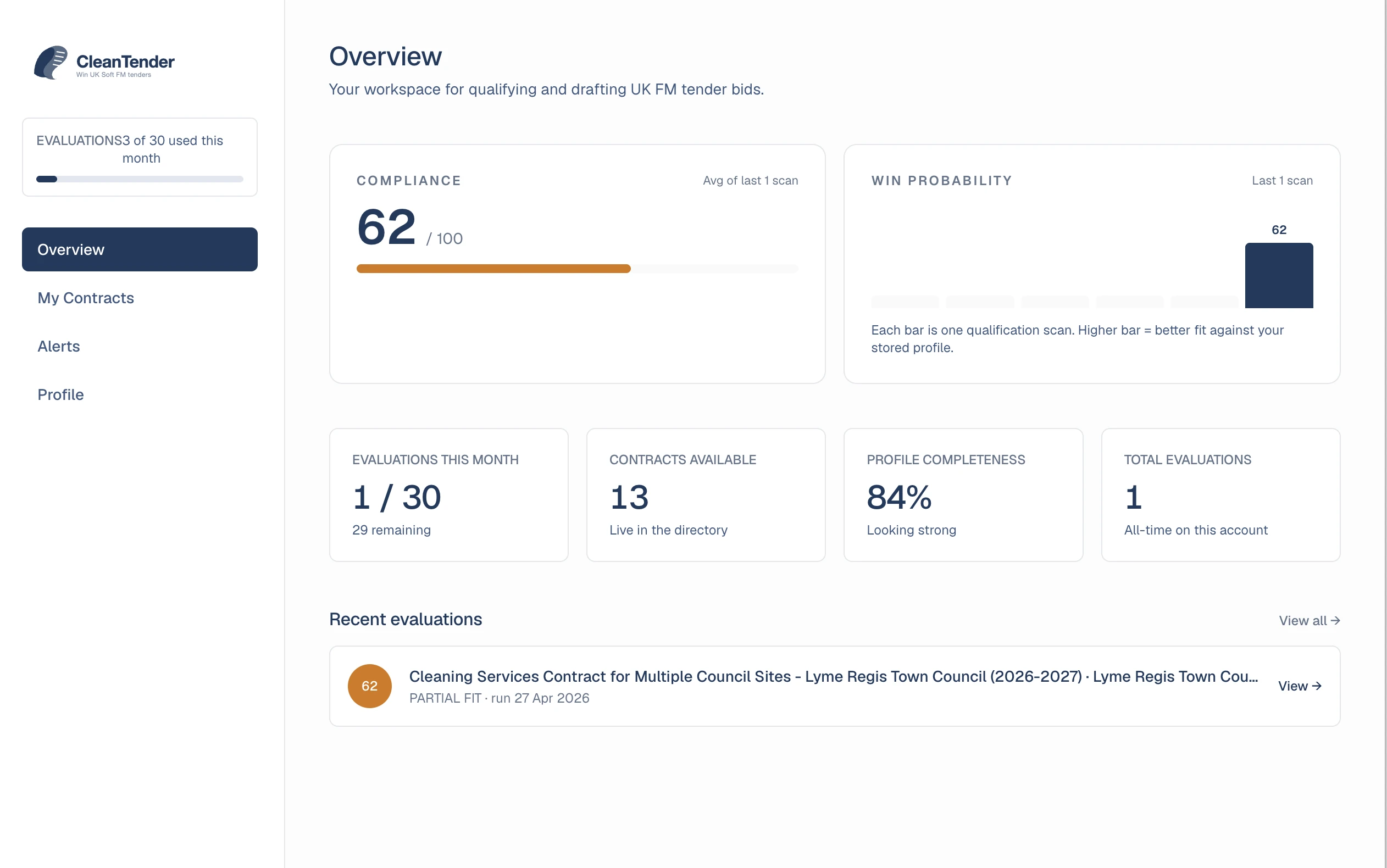
Live feed of in-scope cleaning tenders, fit-scored Step 3· Daily digest
Get email alerts for new in-scope tenders
New commercial cleaning tenders matching your profile land in your inbox the day they publish. CleanTender batches them into a daily digest so you do not get notification fatigue, and links straight back to the in-app fit score.
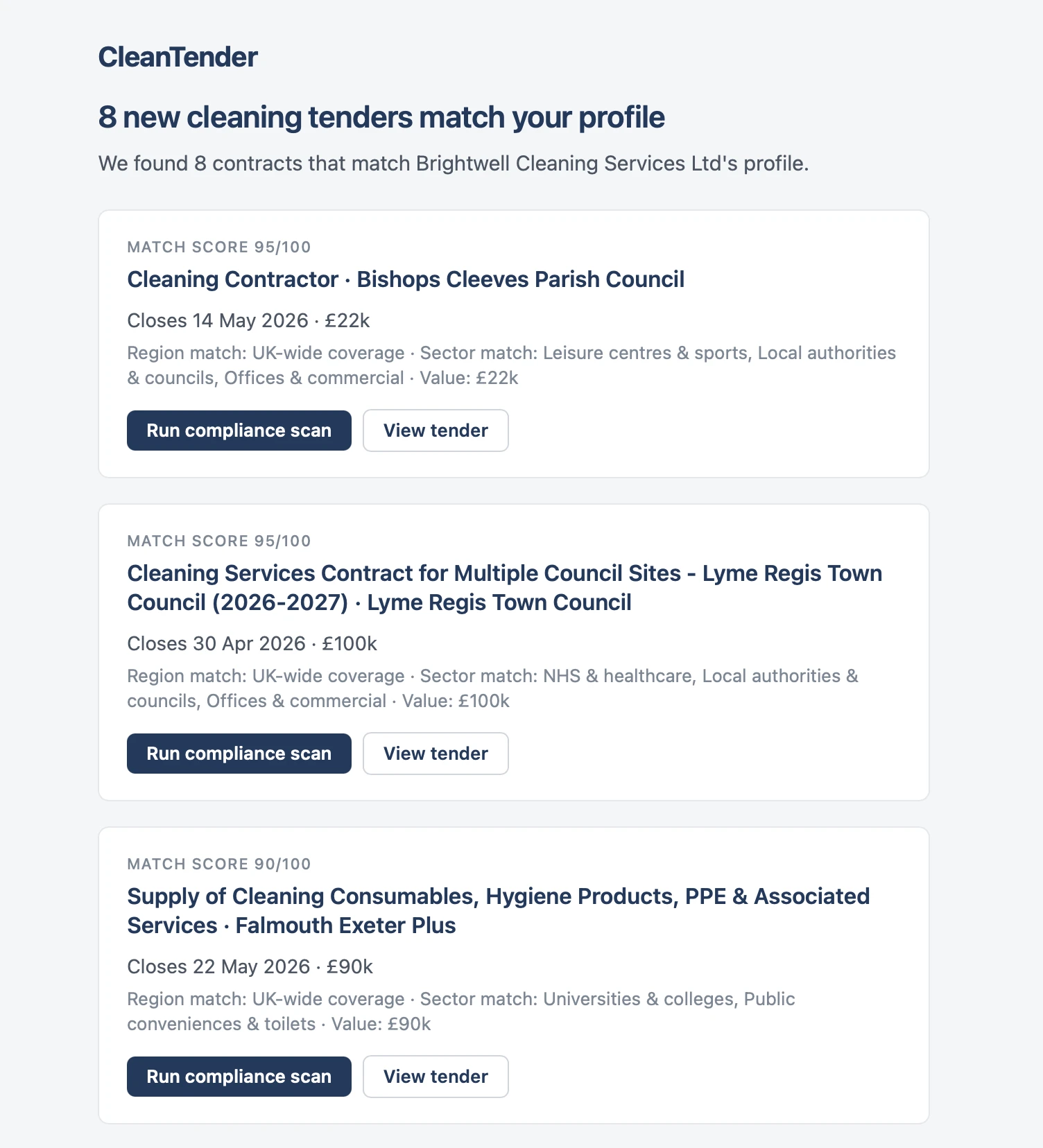
Daily alerts for new in-scope tenders Step 4· 30 seconds
Run a fit-score evaluation on a target tender
One click runs a CleanTender Evaluation against the tender pack: scope match, geography fit, scale fit, compliance gap, and a plain-English win probability. Stops you bidding contracts you were never going to win.
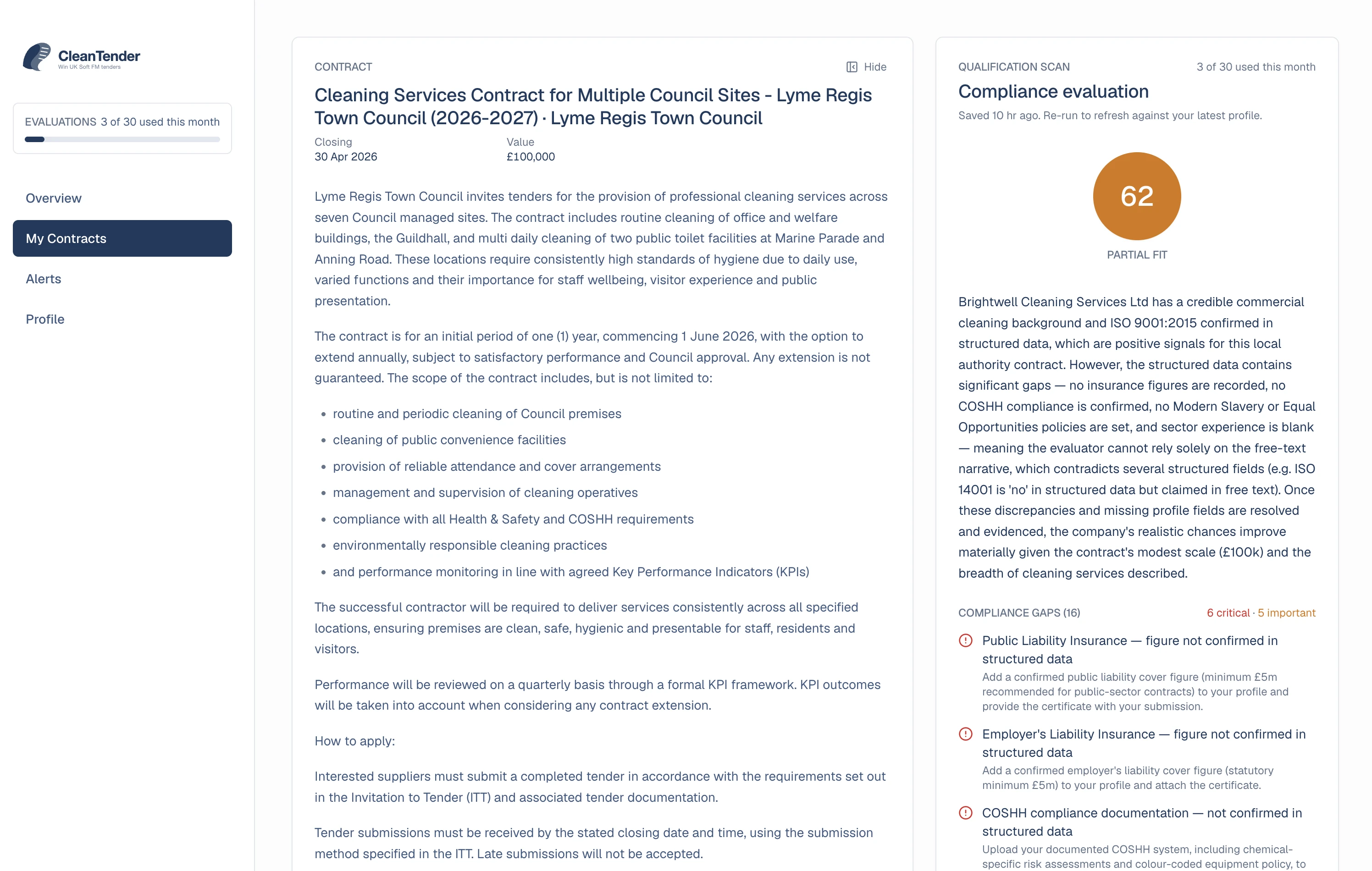
Fit-score and win-probability before you commit a weekend Step 5· 1 minute
Spot compliance gaps before you start drafting
CleanTender runs a named compliance check against the tender pack: BICSc, COSHH, ISO 9001, ISO 14001 if held, SSIP (CHAS or SafeContractor), TUPE pack, social value plan, DBS policy. Anything missing is flagged before you sink hours into a bid that auto-fails at SQ.
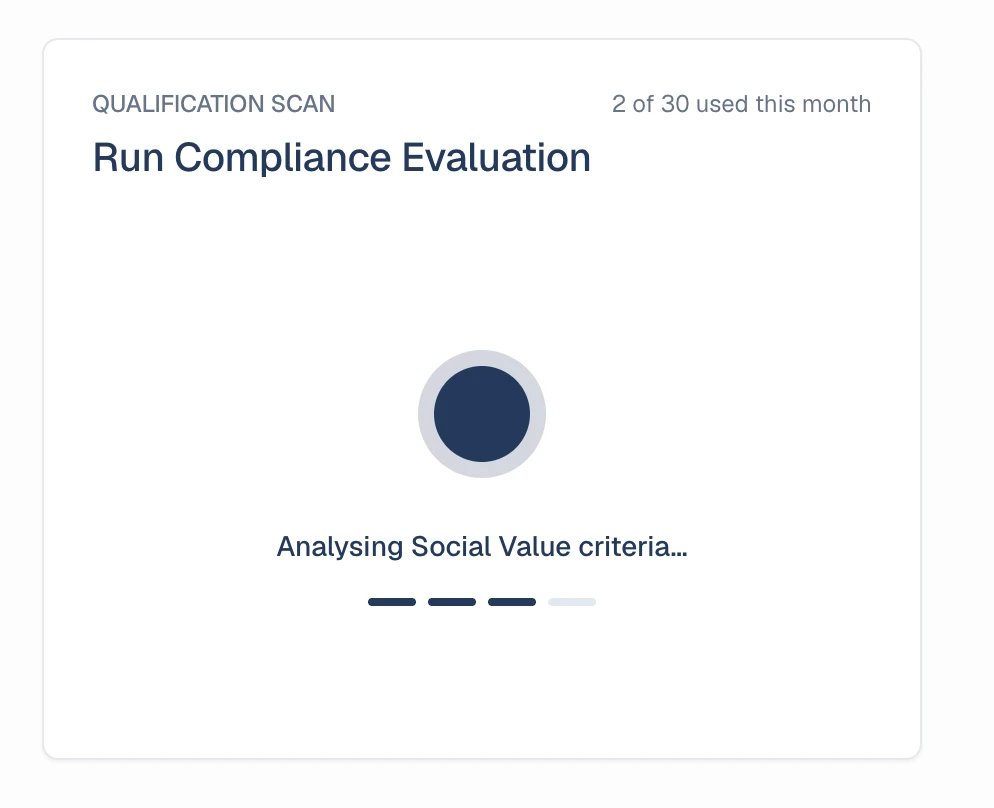
Compliance gaps surfaced before drafting Step 6· 2 minutes generation
Generate a full SQ + method-statement draft
CleanTender drafts a complete Standard Selection Questionnaire response using your profile data and the tender requirements: declaration block, company overview, contract experience, quality, training, COSHH, social value, H&S, insurance schedule. All ten sections, in one pass.
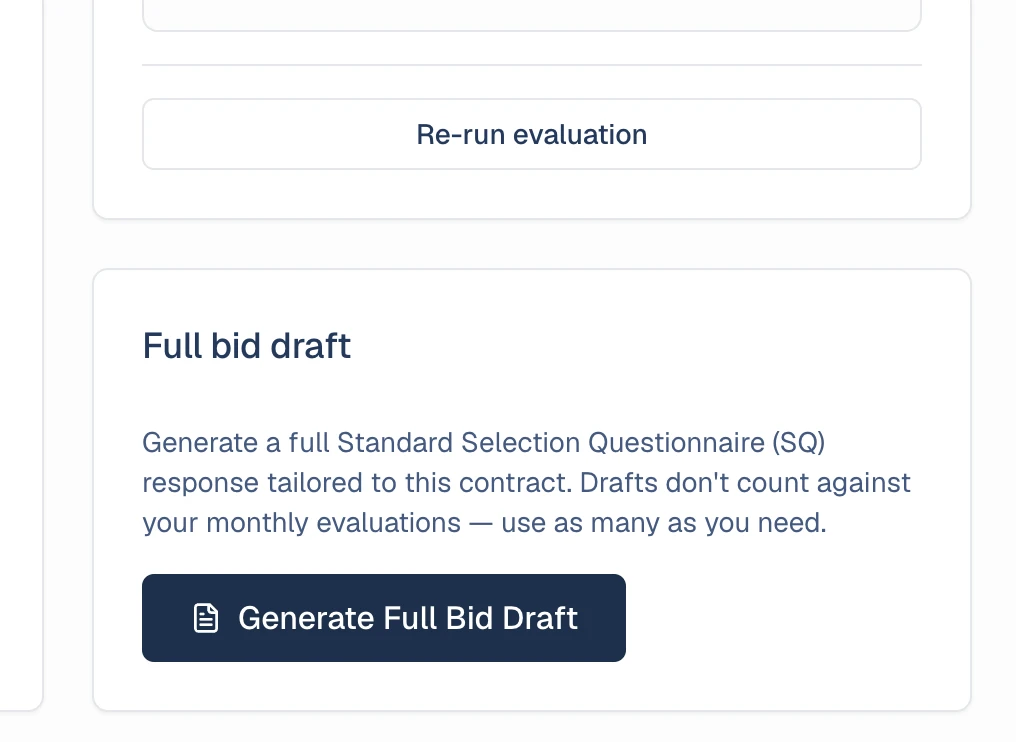
Full SQ draft generated in minutes, not days Step 7· Half a day
Refine, add evidence, and submit
Tune the draft, drop in named referees and certificate numbers, layer your quantified social value commitments, and submit through the buyer's portal. Most users compress a 30-60 hour first bid to 8-12 hours of focused review.
Step 8· Ongoing
Track outcomes and improve
Every bid logs in CleanTender with status, score, and (after standstill) the buyer's feedback. Use the standstill data to tune your next bid. Win rate compounds; first-bid completion is the only thing standing between you and a public-sector revenue line.
Why the first three bids lose
Three usual reasons. None of them are about quality.
- You bid for the wrong contract. The buyer wanted £10m public liability and you have £5m. They wanted three NHS references and you have two council ones. The technical capacity score binned you before the method statement was read.
- Your method statement reads like a brochure. Generic claims. "We provide a high-quality service." The evaluator scored you 2 out of 5 because there's nothing measurable to score.
- Your social value answer is vague. "We support local employment." 1 out of 5. The winner committed 4 full-time-equivalent residents from the postcode area within three months. 4 out of 5.
None of these are talent gaps. They're learning gaps. The good news: every public-sector buyer has to give you feedback under section 50 of the Procurement Act 2023. Read it. Apply it.
If you keep losing on the first reason (wrong contract), the deeper breakdown of how qualification gates kill bids before evaluation lives in the seven mistakes cleaning companies make in public tenders. If you keep losing on the second (brochure method statements), the eight-section structure that scores 8-9 out of 10 with worked examples is in how to write a method statement for a cleaning tender. And if the real problem is a thin pipeline, the UK cleaning tenders hub covers where the live opportunities actually sit.
The qualify-before-you-write rule
Single biggest hit-rate lever. Don't write a bid you can't win.
Score every contract you find against your stored profile before you commit a weekend. The score isn't a guess. It's a checklist. Insurance levels match? Sector experience present? Region covered? Accreditations cited? Value band reasonable? Each gap is a bin reason.
- Below 60 out of 100, walk. The gaps are too big to close inside the bid window.
- Between 60 and 80, read the contract pack carefully. Some gaps are closable (subcontract a security partner, partner with a BICSc training provider). Some aren't (the spec wants ISO 14001 and you don't have it). Decide based on what's closable.
- Above 80, write. You match the buyer's stated requirements. Now compete on the quality answers.
Cleaning contracts for small business: where to start
Start with one public contract you can service from where you already work, plus one private client you can walk to. That's it. A two-van firm doesn't need a pipeline of forty tenders. It needs one win it can reference in every bid after.
- Pick a radius. Twenty to thirty miles from your base, no further, because buyers score mobilisation and cover.
- Set free alerts for cleaning tenders in that radius, then shortlist only single-site work under £80,000 a year.
- Get the paperwork done once: insurance levels, a COSHH register, a DBS policy, and an SSIP such as CHAS if the buyers near you ask for it.
- Bid on two or three small contracts in a row. Expect the first ones to lose.
- In parallel, win private offices, surgeries and shops directly. Those references count in public bids too.
The live list of cleaning tenders shows what's open near you today. For the private side, the guide to getting office cleaning contracts covers direct approaches and managing agents.
Which contracts to actually chase
Three categories of cleaning contract are usually winnable for an SME bidding in 2026. Three are usually not.
Winnable
- Single-school, single-academy-trust contracts (£25,000 to £80,000 a year). Tight enough that national contractors don't bother bidding.
- Council civic-centre and library cleaning (£40,000 to £150,000). Often a single-site spec, manageable from a regional base.
- Framework call-offs you've already qualified for. Smaller volumes, established relationship, no full SQ each time.
- Public conveniences and seasonal-tourism cleaning (£15,000 to £80,000). Local councils prefer local providers who can mobilise quickly.
Usually not winnable for an SME
- Multi-academy trust frameworks covering 30+ sites (£500k+/year). National contractors with regional supervision teams will out-mobilise you.
- Crown Commercial Service framework RM6248 (FM Services). Built for ISS, Mitie, OCS, Sodexo. SMEs almost never make the lot.
- NHS Trust acute-hospital cleaning. Specialist (BICSc-trained, BS EN 1276 + EN 14476 evidence, infection-control protocols, 24/7 mobilisation). Worth bidding only if you have a healthcare-specialist team.
There's no rule against bidding above your weight. There's a rule about not wasting weekends bidding above your weight. Pick your battles.
What scores well at SQ stage
Buyers' evaluation panels score against published criteria. Most cleaning SQs follow a 0-5 scale per question (0 = unanswered, 1 = inadequate, 5 = excellent with full evidence). What separates 4 and 5 from 2 and 3 is specificity.
Method statement (quality criterion)
- Vague (1-2): "We will deliver a high-quality cleaning service to the buyer's satisfaction."
- Concrete (4-5): "Daily clean of all 14 council civic-centre toilets to BICSc Standard, twice-daily during peak May-September footfall. Colour-coded equipment per BS EN 14476-certified disinfectant. Chemical risk assessments per COSHH 2002. KPI report submitted weekly with timestamped completion logs and any non-conformance flagged within 24 hours."
The longer version cites the spec, names the standard, names the chemical certification, defines the cadence, defines the reporting loop. The evaluator can score it 5 out of 5. The vague version is content-free.
Social value (PPN 002 from October 2025)
- Vague (1-2): "We support local employment." "We have an environmental policy."
- Concrete (4-5): "Recruit 4 full-time-equivalent residents from the EX1-EX5 postcode area within 3 months of mobilisation. 2 of these will be NEET 16-24-year-olds via Devon Apprenticeship Service partnership. Switch contract fleet to 100% electric within 12 months, target 2.4 MTCDE annual reduction. Source 70% of consumables from suppliers within 30 miles. Quarterly reporting against National TOMs proxy values."
These commitments cite real postcode areas, named partner organisations, measurable targets, reporting cadence. They convert directly into the National TOMs framework's proxy values, which is how local-authority evaluators score. Our government cleaning contracts pillar walks through the full SQ structure including price, quality, and social-value weightings.
Frameworks vs single contracts (the SME entry point)
If you're new to public-sector bidding, the single biggest tactical move is to chase frameworks and Dynamic Markets first, not single high-value tenders.
- Frameworks (Procurement Act 2023, sections 45-48). Pre-approved supplier list. Buyers call off from the framework for individual contracts during its term (usually four years). You compete to get on, then compete or are direct-awarded on call-offs. Lower qualification bar than a single high-value tender.
- Dynamic Markets (sections 34-40). Successor to Dynamic Purchasing Systems. Always-open: you can join at any point during the market's life. The market sets qualification once. Buyers run mini-competitions among qualified suppliers. Even lower bar to entry.
Worth scanning: NHS Shared Business Services frameworks, ESPO (Eastern Shires Purchasing Organisation), YPO (Yorkshire Purchasing Organisation), CPC (Crescent Purchasing Consortium), and your county council's preferred-supplier framework. Cleaning is usually a separable lot.
Pricing as a strategy not a guess
Public-sector cleaning awards run on Most Economically Advantageous Tender (MEAT). Price is one weighted criterion. Almost never the deciding one.
Don't try to win on price alone. The lowest bidder loses surprisingly often. Buyers' evaluation panels know that the lowest bid is usually the one that cuts staff training, equipment quality, or supervision. Score 5/5 on quality and 3/5 on price beats score 5/5 on price and 2/5 on quality.
What to do instead: price competitively (within 5-10% of the median bid the buyer historically receives), then compete hard on quality and social value answers. The win rate at +5% is consistently better than at -10% in the published award data.
How win rate compounds
Win rate isn't a constant. It compounds across bids. By bid five, you've usually:
- Built a stable Selection Questionnaire base. Most SQ questions ask the same thing in slightly different orders. The TUPE answer doesn't change. The COSHH plan doesn't change. The ISO 9001 evidence doesn't change. By bid five you have the routine 70% of any new SQ pre-written.
- Got a real reference contact who'll answer the phone. Buyers ring. Two strong references beat ten weak ones.
- Read three rounds of section 50 feedback. You know which words score, which words don't, what the local council's evaluation panel actually weights.
- Joined a framework or two. Mini-competitions are easier to win than open competition.
So bid four wins more than bid one because the inputs are better. Bid eight wins more than bid four. The hardest period is the first three. Push through them.
Most cleaning SMEs quit at bid three. The ones who keep going to bid five usually have a council framework win by bid eight.
Hard-won lesson
If you want the bid mechanics (Selection Questionnaire structure, what each section asks, how to write the answers), our how to bid for cleaning contracts guide covers them. If you want a faster route from notice to qualified shortlist, register on CleanTender and run a free fit check on the next live tender that catches your eye.
Two side doors are open as well: window cleaning tenders often go to small local firms, and buying existing cleaning contracts for sale can speed up private-sector growth.
Quality marks win cleaning contracts more often than price. Grade your tender answer with our free tool and fix the weak spots before submission.
A single school is often the easiest first public contract. See how school cleaning tenders get scored before you bid.
Sources
- Procurement Act 2023 · Section 50 feedback rights, Sections 45-48 frameworks, Sections 34-40 Dynamic Markets
- PPN 002: Social Value Model · Mandatory from 1 October 2025, 10% minimum weighting on central government
- National TOMs framework · Local-authority social value measurement framework with proxy values
- BICSc · British Institute of Cleaning Science, COPC training standard
FAQs
Frequently asked questions
- Pick a 20 to 30 mile radius and go after two things at once: small public contracts and private clients you can reach directly. On the public side, set free alerts on Find a Tender and Contracts Finder, shortlist single-site work under about £80,000 a year (a school, a library, a council office), and get your insurance, COSHH register and DBS policy ready once so every bid reuses them. On the private side, approach offices, GP surgeries and managing agents near your base. The first public bids usually lose, so bid on two or three in a row and ask for feedback each time. One win gives you the reference that makes the next bid stronger.
- By chasing the right contracts, not all contracts. Focus on frameworks and Dynamic Markets first (lower qualification bar per call-off), then sub-£100k single-site work like council civic centres and individual schools where national contractors don't bother bidding. Win on local presence (real postcode-level social value commitments), not on price. Use section 50 feedback after every loss and apply the lesson to the next bid. Most SMEs win their first call-off contract on bid four to seven.
- Realistically nine to eighteen months from first submission to first award. The first three bids are usually paid training. Submit on time, request the section 50 feedback you're entitled to, apply the lessons to bid four. Hit rate compounds: bid four wins more than bid one because the inputs are better, bid eight more than bid four. Frameworks and Dynamic Markets are the gentle entry point because the qualification bar per call-off is lower than for single high-value tenders.
- Vague answers. "We support local employment" scores 1 out of 5. "Recruit 4 FTE residents from the EX1-EX5 postcode area within 3 months, partnering with Devon Apprenticeship Service for 2 NEET placements" scores 4 or 5. The same applies to the method statement, KPI proposal, and environmental commitments. Buyers' evaluation panels reward specificity (named partners, real postcode areas, measurable targets, reporting cadence) and reject brochure language.
- No. Public-sector cleaning awards run on Most Economically Advantageous Tender. Price is one weighted criterion (usually 30-60%), but the lowest bidder loses surprisingly often because evaluation panels know the absolute cheapest bid usually cuts training, equipment, or supervision. Bid within 5-10% of the buyer's historical median bid, then compete hard on quality and social value answers. Score 5/5 on quality and 3/5 on price beats 5/5 on price and 2/5 on quality.
- How to bid is the mechanics. Selection Questionnaire structure, what each section asks, how to write a method statement, how to format the response. How to win is the strategy. Which contracts to chase, what scores well, frameworks vs single contracts, the qualify-before-you-write rule, how win rate compounds across bids. The bid mechanics get you to a submission. The strategy gets you to a win.
- Stop bidding for contracts you can't win. The single biggest hit-rate lever is qualifying every contract against your stored profile before you commit a weekend. Below 60 out of 100, walk. Above 80, write. The qualification scan reads the contract pack against your insurance levels, accreditations, sector experience, regions, and value band. Skipping the bids you can't win frees the time for the bids you can. Most SMEs double their hit rate inside three months of adopting the rule.