
If your business currently sells to other private companies (B2B), you already know how to build relationships, negotiate deals, and close contracts. When you try to sell those exact same services to a UK council or NHS Trust, your standard playbook stops working. The buyer will not meet you for lunch, the budget is fixed, and you are forced to fill out a 60-page document just to be considered.
Welcome to the difference between B2B and B2G. The pivot is not about sales muscle. It is about a completely different decision-making model, governed by the Procurement Act 2023 (live since 24 February 2025) and scored against published evaluation matrices.
B2B vs B2G at a glance
Six dimensions where B2B and B2G operate by different rules. Bring B2B muscle to a B2G fight and you lose the bid.
Sales cycle
B2B vs B2G
Days vs Months
B2B can close in a single phone call. UK B2G runs through pre-market engagement, SQ, ITT, standstill — typically 3-12 months.
Decision basis
How they pick the winner
Pitch vs Math
B2B: pitch deck + relationship + ROI. B2G: pre-published scoring matrix, evaluators score your written bid out of 100.
Social value
Mandatory weighting
0% vs 10%+
B2B: CSR is a nice-to-have. B2G: PPN 002 sets a 10% minimum, most councils run 15-30%. Five themes, quantified commitments required.
PPN 002 (gov.uk)Feedback on losses
Transparency obligations
None vs Full
B2B: "we went in another direction". B2G: standstill letter mandatory under Procurement Act 2023, breaks down your scores against the winner.
Payment terms
Cash flow
45-60d vs 30d
B2B average payment 45-60 days with active chasing. B2G: Prompt Payment Code + 30-day terms paid through the supply chain.
Compliance burden
Up-front evidence
Light vs Heavy
B2B: an MSA and an NDA. B2G: ISO certifications, sector accreditations, modern slavery + equal opportunities + environmental policies, SSIP, vetting evidence — all proven at SQ stage.
If you are new to the term B2G itself, start with what is B2G — a plain-English guide for UK SMEs. For real-world examples of the contracts UK SMEs win every day, see 5 real-world UK B2G contracts and how SMEs win them.
What's in this guide
- The sales cycle and buyer behaviour (fast vs regulated)
- How the decision is made (pitch deck vs evaluation matrix)
- The role of social value (nice-to-have vs legal requirement)
- Transparency and feedback (closed door vs standstill letter)
- Cash flow and payment protection
- How to pivot your sales strategy from B2B to B2G
- How to actually start, step by step (CleanTender walkthrough)
1. The sales cycle and buyer behaviour
B2B is fast and flexible. A B2B sales cycle can be as short as a single phone call. If the CEO likes your product and has the budget, they can sign a contract today. The buyer's primary motivation is usually efficiency, innovation, or profit.
B2G is long and regulated. A procurement officer cannot just decide to buy your service. Taxpayer money must be spent transparently. The sales cycle is governed by the Procurement Act 2023. Buying decisions can take 3 to 12 months, moving rigidly from pre-market engagement to SQ (Selection Questionnaire), ITT (Invitation to Tender), and final award. The buyer's primary motivation is compliance, risk reduction, and public welfare.
2. How the decision is made
B2B: the pitch deck wins. A strong pitch deck, a persuasive sales rep, a demonstration of how your service will increase the client's bottom line. Relationship-building (lunches, networking, personalised emails) is highly effective.
B2G: the evaluation matrix wins. Charm does not win contracts; math does. Every tender is judged against a strict, pre-published scoring matrix. Evaluators score your written bid out of 100 based on price, quality, and social value. If you write an incredible proposal but forget to attach your ISO 9001 certificate, you will be disqualified immediately. There is no room for negotiation or special deals at the contract stage.
3. The role of social value
B2B: a nice-to-have. In B2B, Corporate Social Responsibility (CSR) is a bonus. A private company might appreciate that you donate to charity, but they will ultimately choose the supplier with the best price and service.
B2G: a legal requirement. In the UK B2G market, social value is legally mandated. Under PPN 002 (Social Value Model, mandatory from 1 October 2025), a minimum of 10% (and often up to 30%) of your total bid score is based on how your contract will benefit the local community. You must prove exactly how many local jobs you will create, how much carbon you will save, and how you will support disadvantaged groups. Fail the social value section and you lose the bid, even if your price is the cheapest.
4. Transparency and feedback
B2B: a closed door. Lose a B2B deal and the company does not owe you an explanation. You might get a polite "we went in another direction", but you will rarely find out who beat you or what they charged.
B2G: total transparency. Public-sector procurement is legally required to be transparent. Lose a B2G bid and the buyer must provide you with a standstill letter under the Procurement Act 2023. This document breaks down exactly how your bid scored against the winning bidder. Furthermore, winning contract values and supplier names are published publicly on Find a Tender Service and Contracts Finder.
5. Cash flow and payment protection
B2B: 45-60 days with chasing. Average B2B payment in the UK runs 45-60 days from invoice, frequently with active credit-control chasing required. Late payment is endemic in some sectors.
B2G: 30 days, statutory. UK government is bound by the Prompt Payment Code; major contracts require 30-day terms paid through the supply chain down to subcontractors. The Procurement Act 2023 added enforcement teeth: contracting authorities now publish payment performance data quarterly, and consistent late-payment can lead to debarment from future tenders.
How to pivot your sales strategy from B2B to B2G
Adding B2G revenue to a B2B business requires a transition from a sales-led approach to a compliance-led approach. The pivot is not about better selling. It is about meeting evidence requirements you never had to meet in B2B.
- Get accredited. B2G buyers require proof. Make sure you have your baseline policies (Health & Safety, Cyber Essentials, Equal Opportunities, Modern Slavery, Environmental) and relevant industry accreditations (ISO 9001, ISO 14001, sector-specific like SIA ACS for security, BICSc for cleaning, NPTC for grounds).
- Learn to write bids. Stop sending sales brochures. Learn to dissect an ITT, write directly to the evaluator's scoring matrix, and answer the exact question asked without marketing fluff.
- Master social value. Understand the PPN 002 themes (jobs, growth, wellbeing, environment, equal opportunity) and the National TOMs financial proxies. Quantify each commitment with a number and a date — generic CSR copy scores 4/10.
- Set up monitoring. Find a Tender Service for above-threshold (>£139k) contracts; Contracts Finder for below-threshold (£12k-£139k). Saved searches with sector keywords. Review weekly, flag fits inside 48 hours.
- Build the SQ evidence pack once. Insurance, accounts, ISOs, policies, certifications. Reuse on every bid. The pack is 80% of the work for any first bid; the bid-specific writing is the remaining 20%.
- Pick winnable opening targets. First bid value £100k-£300k, buyer within 30 minutes of your operational base, sector you actually deliver in B2B already. Local council frameworks are the most forgiving entry point.
The B2G shortcut for soft FM SMEs (CleanTender walkthrough)
If you operate in soft FM (cleaning, security, grounds, waste, catering), CleanTender takes the friction out of the B2B-to-B2G pivot. Live tenders fit-scored against your profile, compliance gaps surfaced before you draft, and AI-generated SQ responses tailored to public-sector scoring matrices.
Eight steps from "never bid public sector" to a complete SQ response on the buyer's portal. First scan is free.
Step 1· 10 minutes
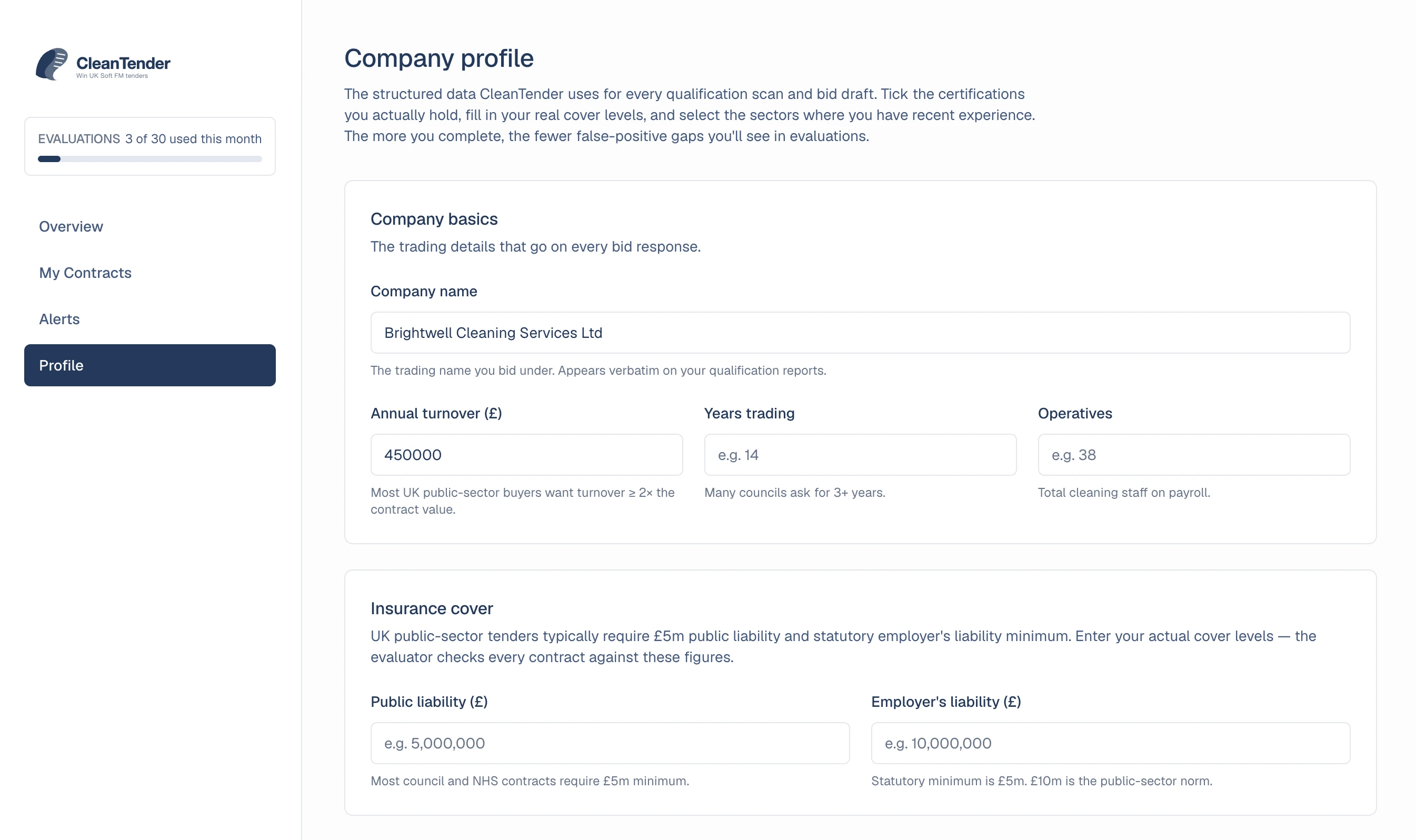
Build your soft FM company profile
Set your sector to soft FM, your service regions, sector specialism (cleaning / security / grounds / waste / catering), ISO certifications, sector accreditations (CHAS / SafeContractor / SIA ACS / BICSc / NPTC / FHRS), insurance levels, turnover, operative count, insurance levels, turnover, and operative count. CleanTender uses this to fit-score every live tender against your real capability so you only see the ones you can win.
Profile setup defines what you are bid-ready for Step 2· 5 minutes daily
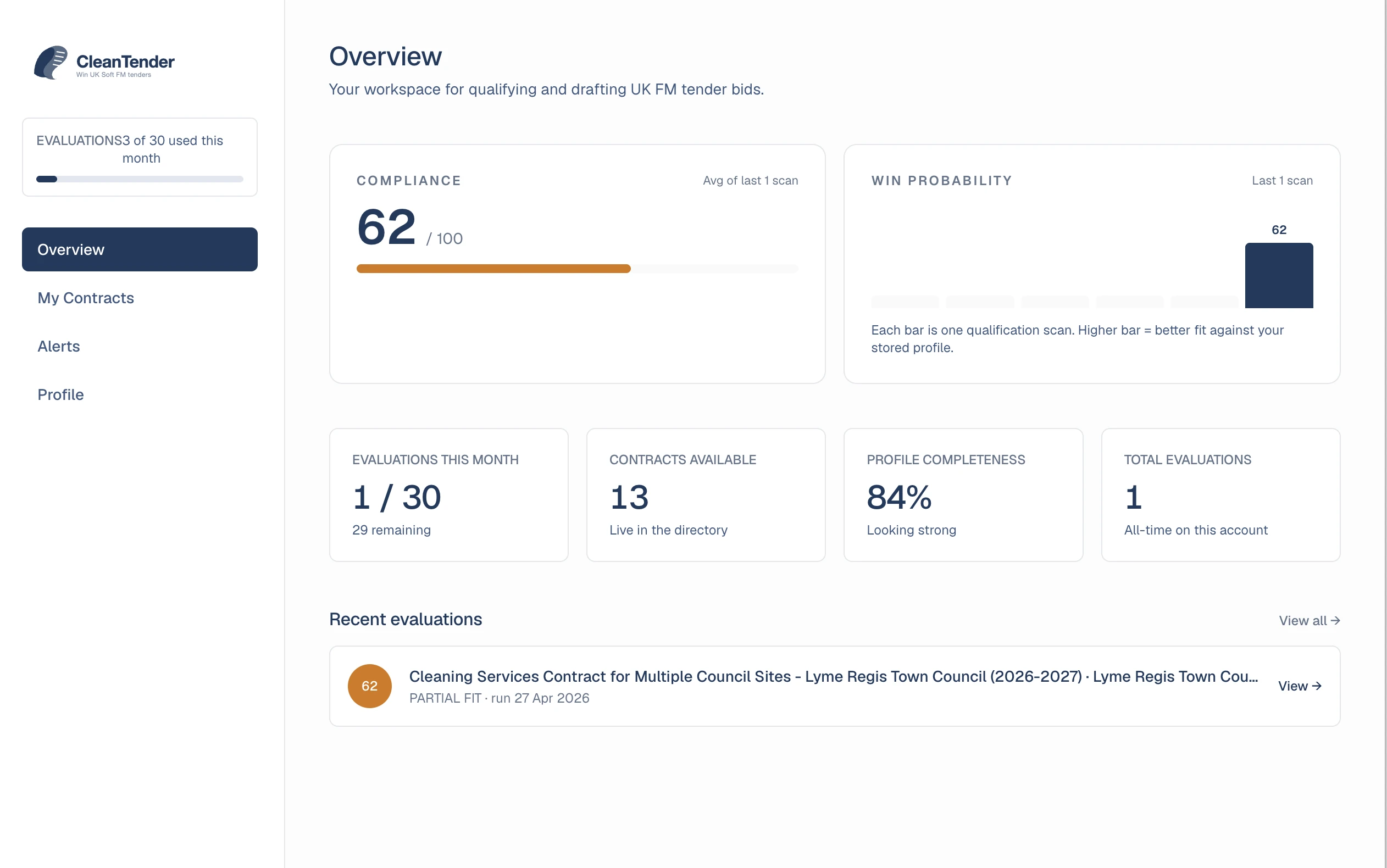
Open the live soft FM-tender feed
Every UK council, NHS Trust, school, university, MoD, and central government soft FM tender, in one feed. Pre-filtered to your sector and geography. No false positives, no manual portal-trawling across FTS, Contracts Finder, and dozens of buyer e-procurement portals.
Live feed of in-scope soft FM tenders, fit-scored Step 3· Daily digest
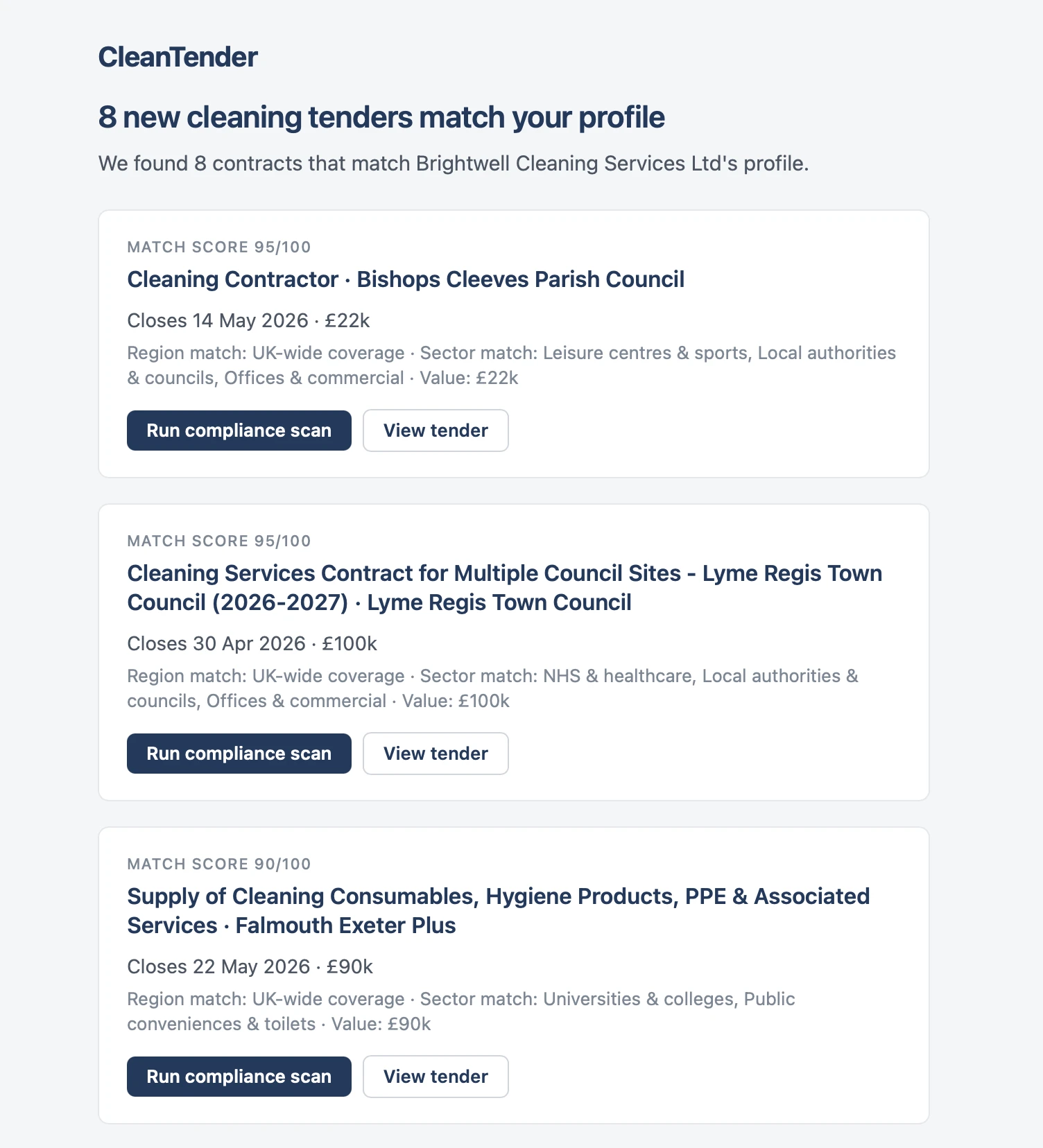
Get email alerts for new in-scope tenders
New soft FM tenders matching your profile land in your inbox the day they publish. CleanTender batches them into a daily digest so you do not get notification fatigue, and links straight back to the in-app fit score.
Daily alerts for new in-scope tenders Step 4· 30 seconds
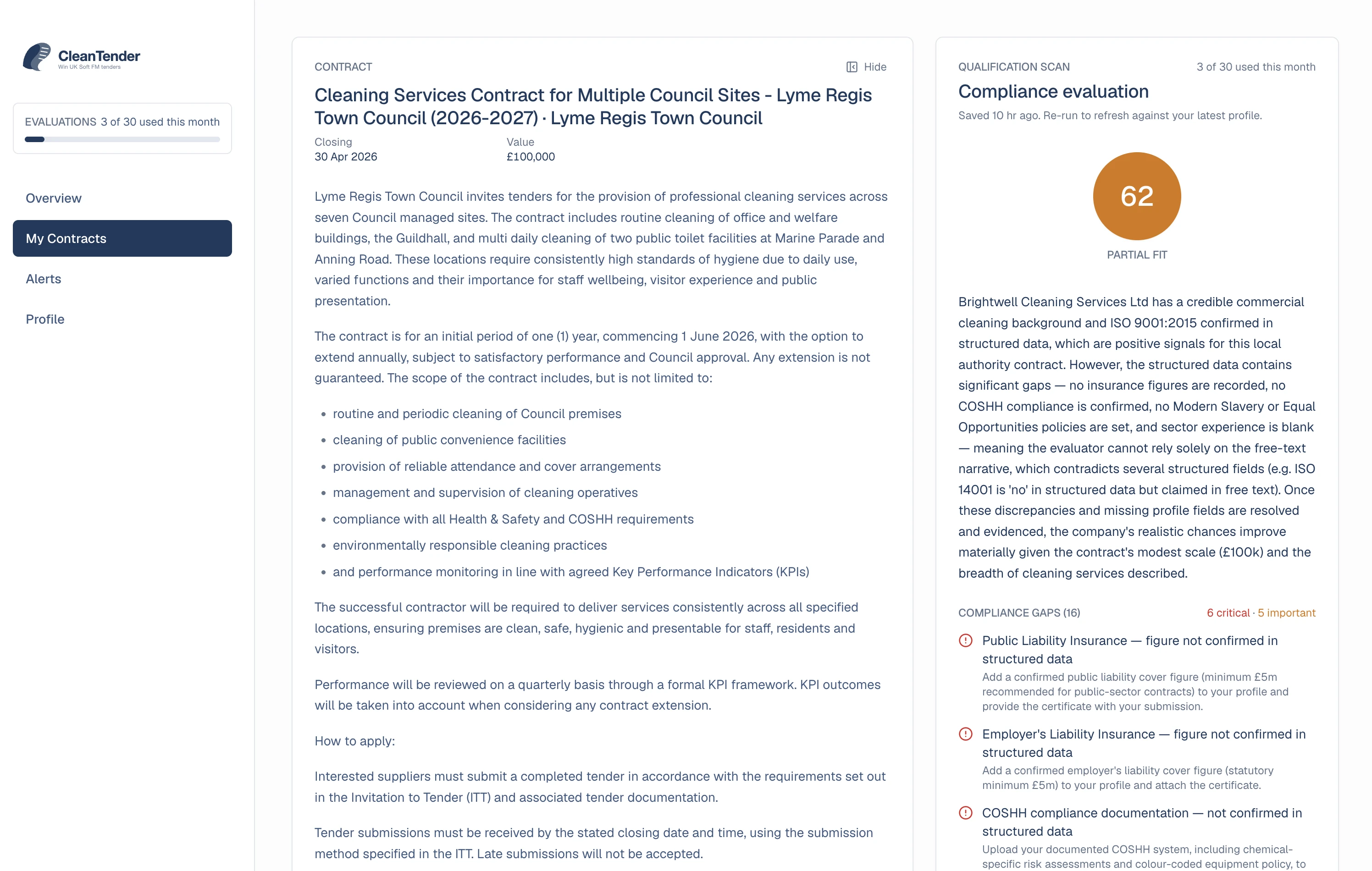
Run a fit-score evaluation on a target tender
One click runs a CleanTender Evaluation against the tender pack: scope match, geography fit, scale fit, compliance gap, and a plain-English win probability. Stops you bidding contracts you were never going to win.
Fit-score and win-probability before you commit a weekend Step 5· 1 minute
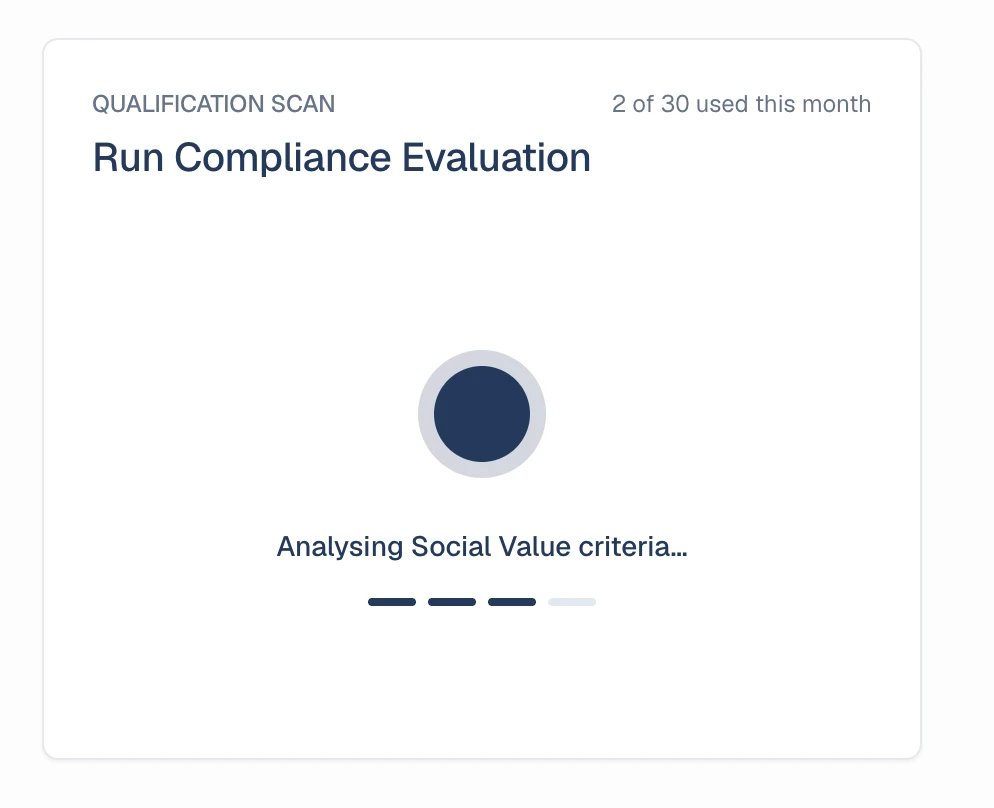
Spot compliance gaps before you start drafting
CleanTender runs a named compliance check against the tender pack: sector accreditations, ISO 9001, ISO 14001 increasingly required, SSIP, social value plan, modern slavery policy, equal opportunities policy. Anything missing is flagged before you sink hours into a bid that auto-fails at SQ.
Compliance gaps surfaced before drafting Step 6· 2 minutes generation
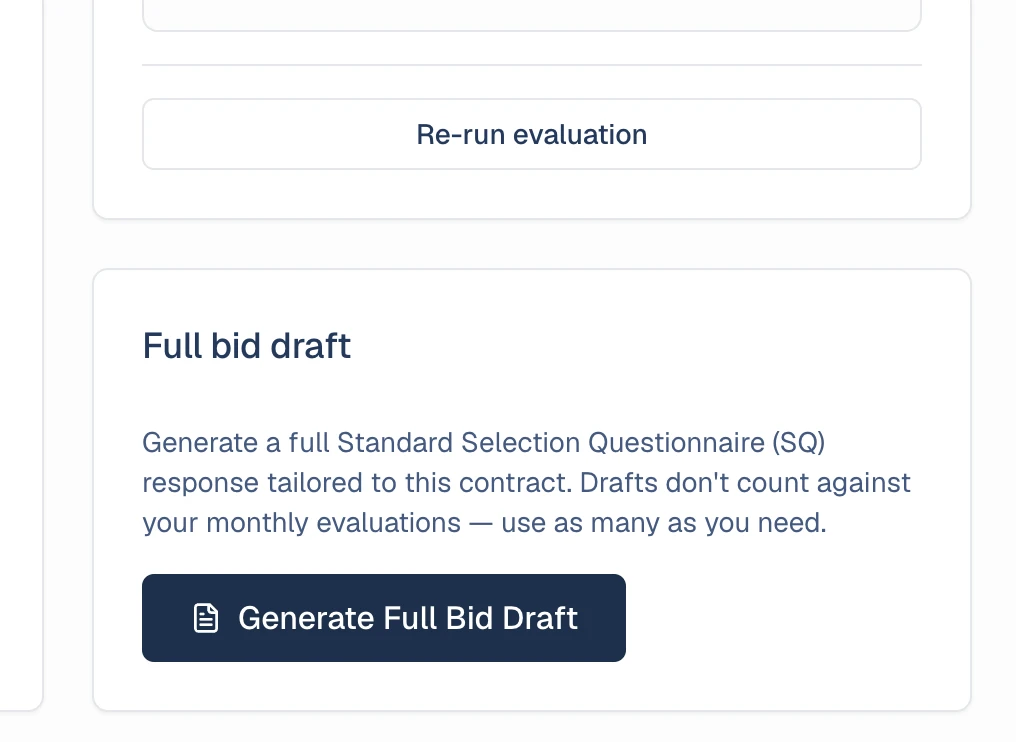
Generate a full SQ + method-statement draft
CleanTender drafts a complete Standard Selection Questionnaire response using your profile data and the tender requirements: declaration block, company overview, contract experience, quality, training, COSHH, social value, H&S, insurance schedule. All ten sections, in one pass.
Full SQ draft generated in minutes, not days Step 7· Half a day
Refine, add evidence, and submit
Tune the draft, drop in named referees and certificate numbers, layer your quantified social value commitments, and submit through the buyer's portal. Most users compress a 30-60 hour first bid to 8-12 hours of focused review.
Step 8· Ongoing
Track outcomes and improve
Every bid logs in CleanTender with status, score, and (after standstill) the buyer's feedback. Use the standstill data to tune your next bid. Win rate compounds; first-bid completion is the only thing standing between you and a public-sector revenue line.
Sources
- Procurement Act 2023 (legislation.gov.uk) · Live since 24 February 2025; reshapes SQ structure, award criteria, and standstill obligations
- PPN 002 Social Value Model (Cabinet Office) · Mandatory from 1 October 2025; 10% minimum social value weighting on central government tenders
- Find a Tender Service · All UK above-threshold (>£139k) public-sector contracts publish here
- Contracts Finder · Below-threshold UK Government contracts (£12k-£139k); SME entry point
- Prompt Payment Code (Small Business Commissioner) · Code obliging signatories (including major government contractors) to pay 95% of invoices within 60 days, 30 days for SMEs
- Social Value Portal (National TOMs) · Maintains the National TOMs framework; ~46 measures across 5 themes with annually-updated financial proxies
FAQs
Frequently asked questions
- B2B (Business-to-Business) is sales between private companies. B2G (Business-to-Government) is sales from a private company to a public-sector buyer (council, NHS Trust, school, central government). The differences are structural, not just about audience: B2B is won on relationships and pitch decks with a fast sales cycle; B2G is won on a pre-published scoring matrix with a 3-12 month regulated cycle under the Procurement Act 2023. B2G also legally mandates social value (10% minimum on central government tenders from 1 October 2025) and total transparency on losses (standstill letter), neither of which exist in B2B.
- Public-sector buyers cannot just decide to buy your service. They are spending taxpayer money and are legally required under the Procurement Act 2023 (live 24 February 2025) to follow a transparent, auditable process: optional pre-market engagement, formal tender publication on Find a Tender Service or Contracts Finder, Selection Questionnaire (pass/fail evidence on insurance and accreditations), Invitation to Tender (the scored bid), 8-day standstill period, and award. The whole cycle typically runs 3-12 months. In B2B, the same decision can be made on a single phone call.
- In B2B, Corporate Social Responsibility (CSR) is a nice-to-have differentiator. A private buyer might appreciate that you donate to charity but will ultimately pick on price and service. In UK B2G, social value is legally mandated. PPN 002 (Social Value Model, mandatory from 1 October 2025) sets a 10% minimum weighting on central government tenders, and most councils and NHS Trusts run 15-30%. The five PPN 002 themes are jobs, growth, wellbeing, environment, and equal opportunity. You must quantify commitments with a number and a date (e.g. "3 local FTE hires year one, drawn from contract postcode area"). Generic CSR copy scores 4/10; quantified, dated commitments score 8-9/10 on a 10-30% category. Fail the social value section and you lose the bid, even with the cheapest price.
- Under the Procurement Act 2023, after a UK public-sector buyer announces a contract award, there is a mandatory 8-day standstill period before the contract can be signed. During this window, every unsuccessful bidder is entitled to a standstill letter that breaks down exactly how their bid scored against the winning bidder, section by section. This is genuinely valuable feedback that B2B sellers never get — losing a B2B deal usually produces "we went in another direction" with no insight. In B2G, you learn what to fix on the next bid. Bidders use the standstill letter to identify the section that lost them the bid (often method statement quality or social value scoring) and refine for the next opportunity.
- The compliance pack takes the longest. Plan 6-12 months from "never bid public sector" to "submitted first bid". Time-critical items: ISO 9001 certification (3-6 months from application), ISO 14001 if needed (6-12 months), sector accreditations (4-12 weeks for SIA ACS or CHAS Standard or SafeContractor), and an SSIP-recognised certificate. Once the SQ evidence pack is built, individual bid-writing time drops to 8-12 hours per bid (versus 30-60 hours on a first attempt). The structural changes to your sales muscle (writing to a scoring matrix, quantifying social value, abandoning the pitch-deck reflex) take 3-5 bids to internalise. Most SMEs lose their first 3 bids before they place; that is normal and the standstill letters are how you compress the learning curve.
- Different, not better. B2G strengths: long contract terms (3-7 years typical), prompt-payment-protected cash flow (30-day terms, statutory), transparent feedback on losses, recession-resilient demand (hospitals and schools always need cleaning, security, catering, grounds, waste). B2G weaknesses: long sales cycle, heavy compliance burden, low margin on the largest framework lots, exposure to political budget cuts, and 70-80% chance you lose the first 3 bids while you learn the rules. B2B strengths: fast cycle, relationship leverage, higher margin on niche services, agility on contract terms. The right answer for most UK SMEs in soft FM is to add B2G as a baseline of recurring revenue underneath a faster-moving B2B operation, not to replace one with the other.