
When people hear "B2G" (Business-to-Government), they picture billion-pound defence contracts, massive infrastructure projects like HS2, or national IT rollouts. While those exist, they are a tiny fraction of the actual volume of UK public-sector procurement.
The reality: the UK government spends roughly £300 billion a year with private suppliers, and has a standing target of directing £1 in every £3 to SMEs. Local councils, schools, NHS Trusts, and universities award thousands of contracts every year to SMEs for everyday services. Below: five real-world UK B2G contract types soft-FM SMEs win every day, with values, named compliance gates, and what scores at SQ stage.
5 UK B2G contracts at a glance
Each card is a real contract type SMEs win. Click through to the named winning compliance below.
Council office cleaning
Local authority framework
£150k–£500k/yr
Civic centres, libraries, community hubs, social services. Won on BICSc, COSHH, Real Living Wage, local hires.
NHS Trust security
Manned guarding + CCTV monitoring
£500k–£3m/yr
24/7 hospitals, mental health units, A&E. Often split into lots so SMEs can bid. Won on SIA ACS + BS 7858 vetting + GDPR for CCTV.
University grounds maintenance
Campus + sports facilities
£200k–£800k/yr
Lawns, sports pitches, walkways, biodiversity. Won on NPTC PA1/PA6, electric mower plan, biodiversity baselines.
Primary school catering (UIFSM)
MAT or local authority framework
£300k–£1.5m/yr
UIFSM for Reception–Year 2, paid meals above. Won on FHRS 4-5, HACCP, Natasha's Law, local food sourcing.
Confidential waste + recycling
Police, council, housing association
£100k–£600k/yr
General + recycling + secure shredding. Won on Upper Tier Waste Carrier, ISO 27001 chain of custody, recycling rates.
All 5 share one rule
How SMEs win in B2G
Compliance > pitch
Every example is won on named accreditations and quantified social value — not on relationships, pitch decks, or undercutting on price.
If you are new to the term B2G itself, start with what is B2G — a plain-English guide for UK SMEs. For the side-by-side breakdown of how B2G differs from B2B, see B2B vs B2G: what changes when you sell to government.
What's in this guide
- Example 1: The local council office cleaning contract
- Example 2: The NHS Trust security guarding contract
- Example 3: University campus grounds maintenance
- Example 4: Primary school catering (UIFSM)
- Example 5: Confidential waste and recycling
- How to actually find your first one (CleanTender walkthrough)
Example 1: The local council office cleaning contract
A typical local authority operates dozens of buildings — civic centre, libraries, community hubs, social services offices, leisure centres. These buildings need daily commercial cleaning, window cleaning, and washroom restocking.
The B2G opportunity: councils group buildings into a Cleaning Services Framework or single contract lasting 3 to 5 years, typically valued at £150,000 to £500,000 annually depending on building count and frequencies. Often awarded with social value at 15-25% weighting.
How the SME wins it: not by having the slickest website. They win by proving they pay the Real Living Wage, hold BICSc accreditation for the team, have robust COSHH documentation per chemical, and commit to hiring long-term unemployed residents from the local borough to satisfy the council's social value requirements. A signed Living Wage Foundation accreditation in the bid pack typically lifts the social value score from 5/10 to 8/10 by itself.
Full playbook in how to win UK cleaning contracts.
Example 2: The NHS Trust security guarding contract
NHS hospitals and clinics are complex, 24/7 environments that require specialised security personnel: manned guarding, CCTV monitoring, key holding, mobile patrol response.
The B2G opportunity: an NHS Trust will tender for a Manned Guarding and Security Services contract typically valued at £500,000 to £3 million annually. Because of the critical nature of the site, these contracts are often split into lots (Lot 1: Main Hospital, Lot 2: Outpatient Clinics, Lot 3: Mental Health Unit), allowing smaller firms to bid on manageable chunks of the work without competing against the national primes for the whole estate.
How the SME wins it: the winning security firm must prove absolute compliance. They demonstrate SIA Approved Contractor Scheme (ACS) membership, rigorous BS 7858:2019 staff vetting procedures, GDPR compliance for CCTV operations, and the ability to rapidly deploy relief guards when an officer calls in sick. NHS contracts also score Mental Health First Aid certification heavily — a 100% MHFA-trained workforce often lifts the technical score by 1-2 points.
Full playbook in how to win UK public-sector security tenders.
Example 3: University campus grounds maintenance
Universities are essentially small towns. They have extensive lawns, sports pitches, ornamental beds, car parks, and pedestrian walkways that require year-round upkeep, including grass cutting, hedge work, tree surgery, and winter gritting.
The B2G opportunity: a university typically releases a tender for Grounds Maintenance and Landscaping on a 3-year term with an option to extend for another 2 years, valued at £200,000 to £800,000 annually. Sustainability and biodiversity scoring is usually heavy under BREEAM and SKA-rating obligations.
How the SME wins it: by proving operational capacity and environmental responsibility. Staff must hold NPTC PA1 + PA6 pesticide-application tickets. The bid must outline a clear plan for transitioning to electric mowers with a year-three percentage target. Evaluators look closely at biodiversity commitments — pollinator-meadow conversion, peat-free policy, named monitoring partnership with a local biodiversity trust. Bids without biodiversity quantification cap out at 5/10 in the environmental section.
Full playbook in how to win UK grounds maintenance tenders.
Example 4: Primary school catering (UIFSM)
The UK government mandates that all children in Reception, Year 1, and Year 2 in state-funded schools receive a free school meal under Universal Infant Free School Meals (UIFSM). Many schools do not employ their own kitchen staff and outsource the entire operation.
The B2G opportunity: a Multi-Academy Trust (MAT) or a local authority will tender for school meals provision across a group of primary schools, valued at £300,000 to £1.5 million annually. These contracts are high-volume and heavily regulated by the School Food Standards (DfE).
How the SME wins it: by proving they can deliver nutritious, cost-effective meals while adhering to Natasha's Law allergen labelling (in force October 2021), maintaining Food Hygiene Rating Scheme (FHRS) 4 or 5 across every kitchen, and operating a documented HACCP plan. A major winning factor is food miles — proving that the company sources ingredients from local farmers within a defined radius (often 50 miles) reduces carbon emissions and supports the local agricultural economy. Quantified local sourcing percentages with quarterly reporting commitments lift social value scores from 4/10 to 8/10.
Full playbook in how to win UK school catering contracts.
Example 5: Confidential waste and recycling
Every public-sector organisation, from the police to local housing associations, generates massive volumes of sensitive paperwork and general waste that must be disposed of securely and sustainably.
The B2G opportunity: a public body will tender for Waste Management and Confidential Shredding typically valued at £100,000 to £600,000 annually. Scope includes scheduled collection of general waste, mixed recycling, and the secure, certificated destruction of confidential documents.
How the SME wins it: by demonstrating a watertight chain of custody for confidential materials (often requiring ISO 27001 information security accreditation), holding the correct Upper Tier Waste Carrier licences with the Environment Agency, and providing detailed monthly reporting on recycling rates. Buyers increasingly want diversion-from-landfill rates above 70% and a credible decarbonisation plan for the collection fleet. Generic "environmentally responsible" copy scores 4/10; quantified diversion rates and named MRF/AD/WtE destinations score 8-9.
Full playbook in how to win UK waste management tenders.
What every B2G winner has in common
Five different sectors, five different sets of named compliance, but one common thread: the SME that wins is the one that brings the named accreditation and quantified social value to the bid. Not the one that pitches flexibility, undercuts on price, or offers "a personal service". Compliance is the entry ticket; quantified social value is the differentiator.
How to find your first UK B2G contract (CleanTender walkthrough)
If you operate in soft FM (cleaning, security, grounds, waste, catering), CleanTender pulls every relevant UK B2G contract into one daily feed and shows you which ones you can credibly win before you commit a weekend.
Eight steps from "never bid public sector" to a complete SQ response on the buyer's portal. First scan is free.
Step 1· 10 minutes
Build your soft FM company profile
Set your sector to soft FM, your service regions, sector specialism (cleaning / security / grounds / waste / catering), ISO certifications, sector accreditations (BICSc / SIA ACS / NPTC / FHRS / Upper Tier Waste Carrier), insurance levels, turnover, operative count, insurance levels, turnover, and operative count. CleanTender uses this to fit-score every live tender against your real capability so you only see the ones you can win.
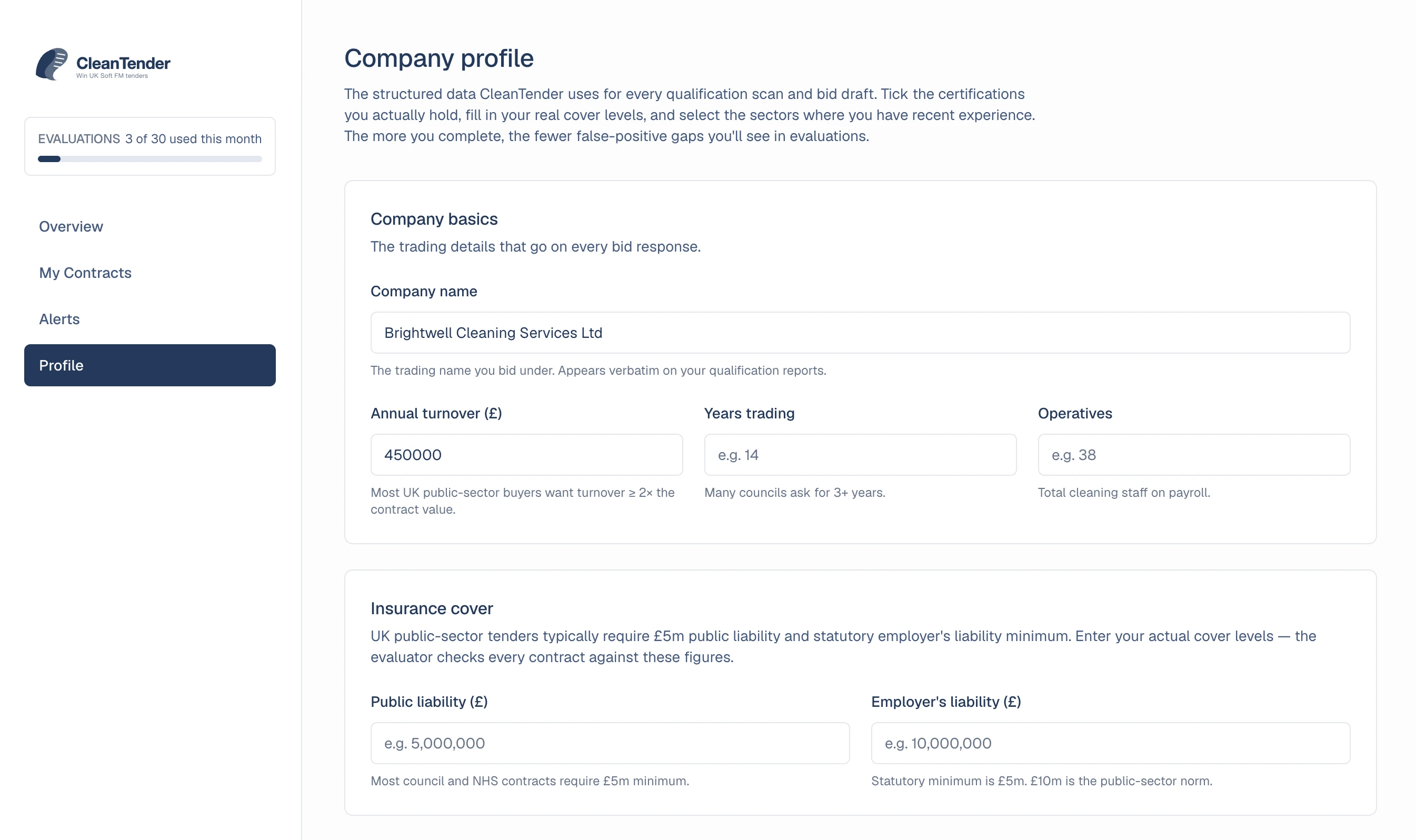
Profile setup defines what you are bid-ready for Step 2· 5 minutes daily
Open the live soft FM-tender feed
Every UK council, NHS Trust, school, university, MoD, and central government soft FM tender, in one feed. Pre-filtered to your sector and geography. No false positives, no manual portal-trawling across FTS, Contracts Finder, and dozens of buyer e-procurement portals.
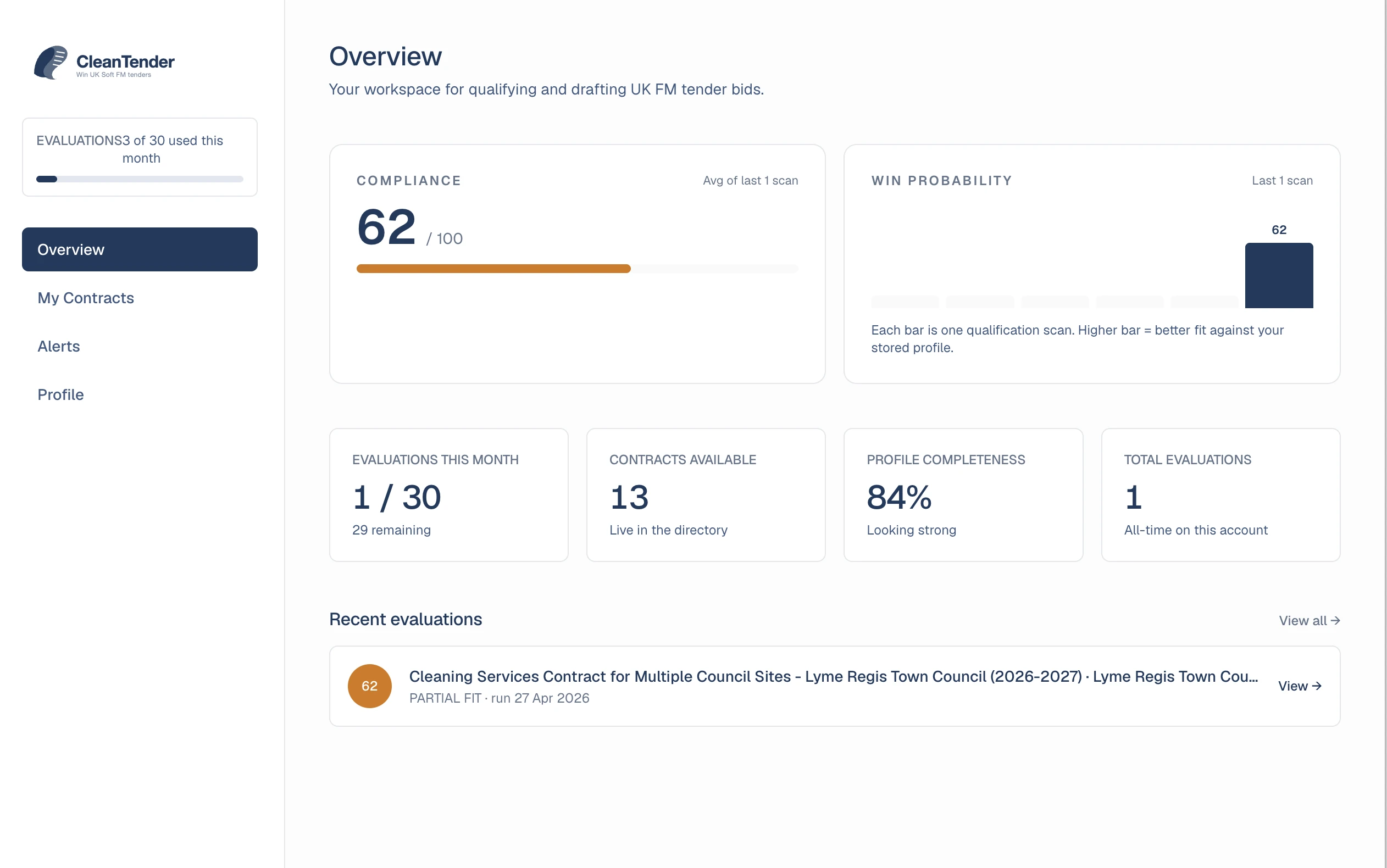
Live feed of in-scope soft FM tenders, fit-scored Step 3· Daily digest
Get email alerts for new in-scope tenders
New soft FM tenders matching your profile land in your inbox the day they publish. CleanTender batches them into a daily digest so you do not get notification fatigue, and links straight back to the in-app fit score.
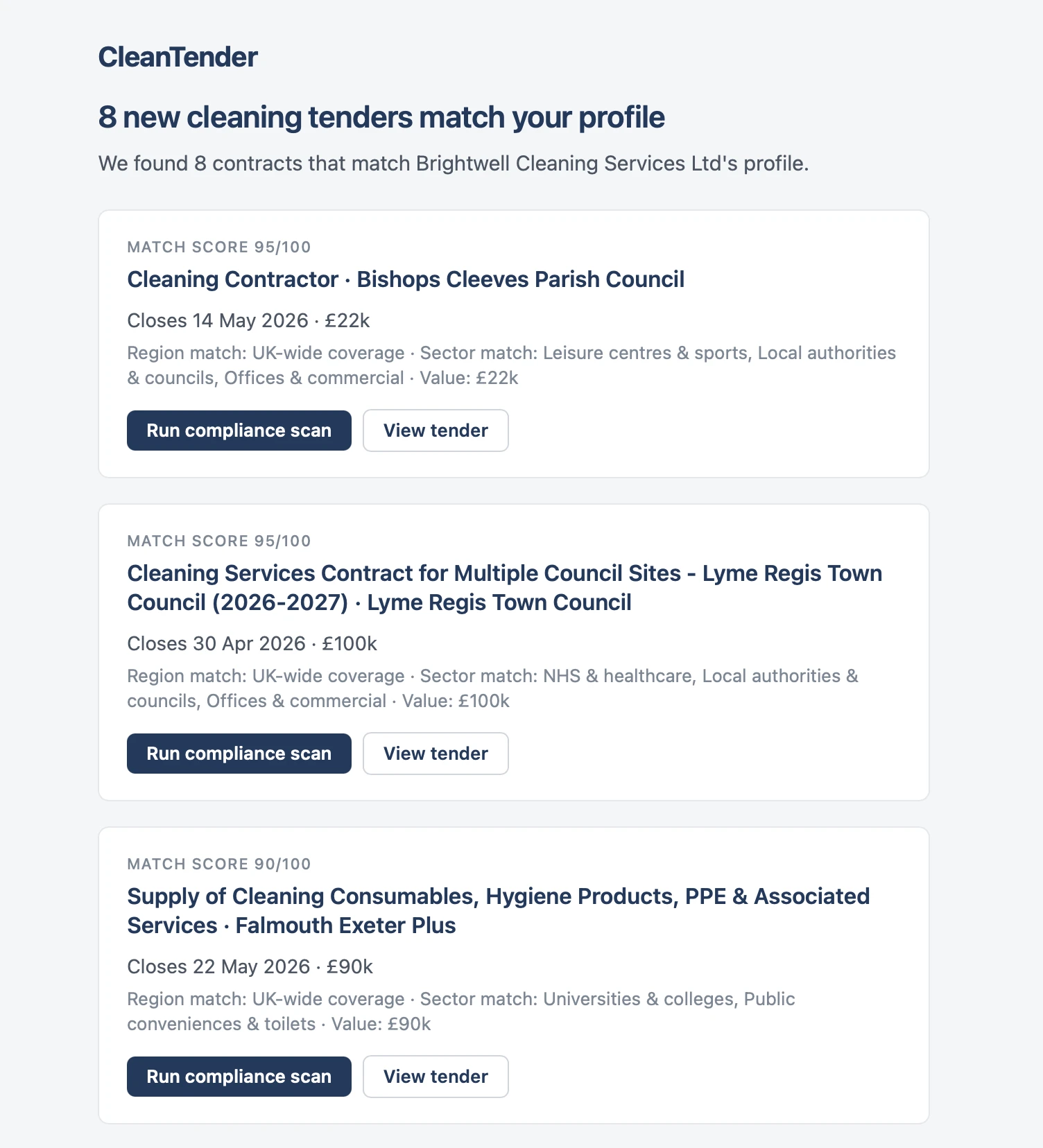
Daily alerts for new in-scope tenders Step 4· 30 seconds
Run a fit-score evaluation on a target tender
One click runs a CleanTender Evaluation against the tender pack: scope match, geography fit, scale fit, compliance gap, and a plain-English win probability. Stops you bidding contracts you were never going to win.
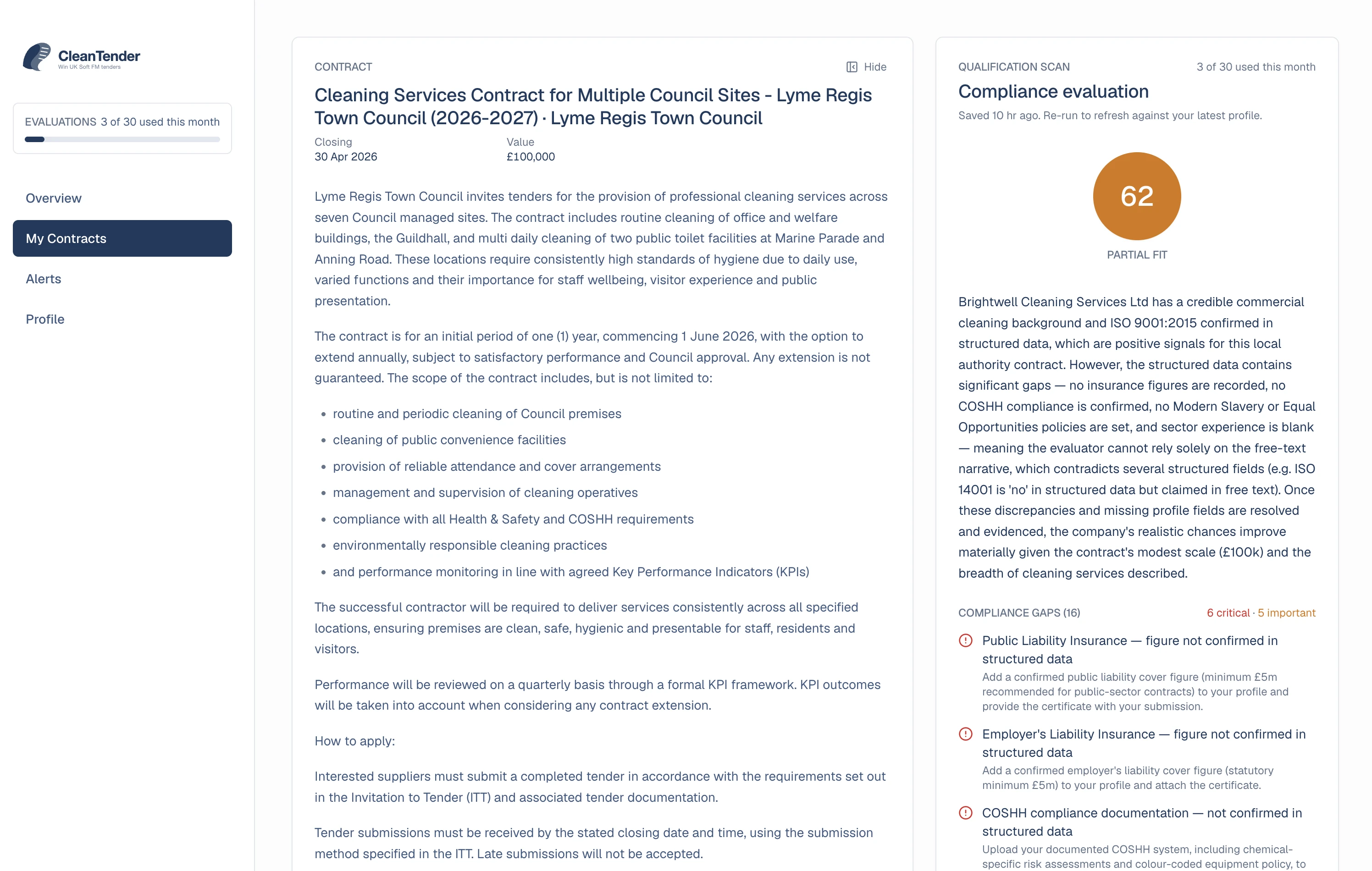
Fit-score and win-probability before you commit a weekend Step 5· 1 minute
Spot compliance gaps before you start drafting
CleanTender runs a named compliance check against the tender pack: sector accreditations, ISO 9001, ISO 14001 increasingly required, SSIP, social value plan, Real Living Wage Foundation accreditation, modern slavery policy. Anything missing is flagged before you sink hours into a bid that auto-fails at SQ.
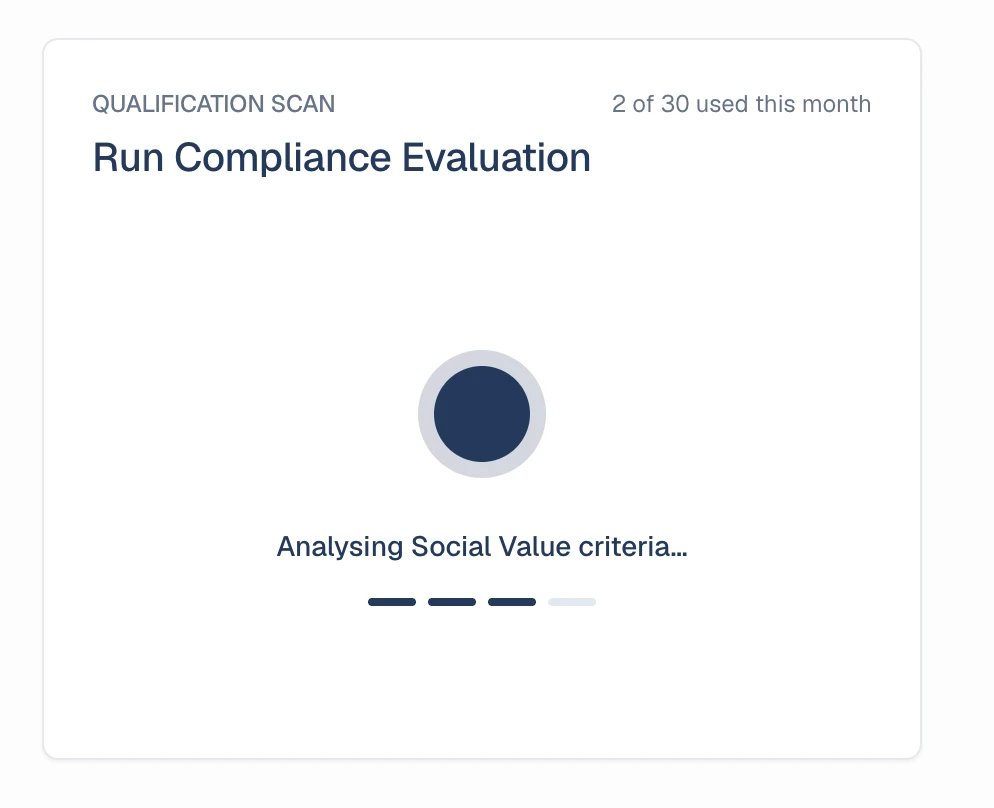
Compliance gaps surfaced before drafting Step 6· 2 minutes generation
Generate a full SQ + method-statement draft
CleanTender drafts a complete Standard Selection Questionnaire response using your profile data and the tender requirements: declaration block, company overview, contract experience, quality, training, COSHH, social value, H&S, insurance schedule. All ten sections, in one pass.
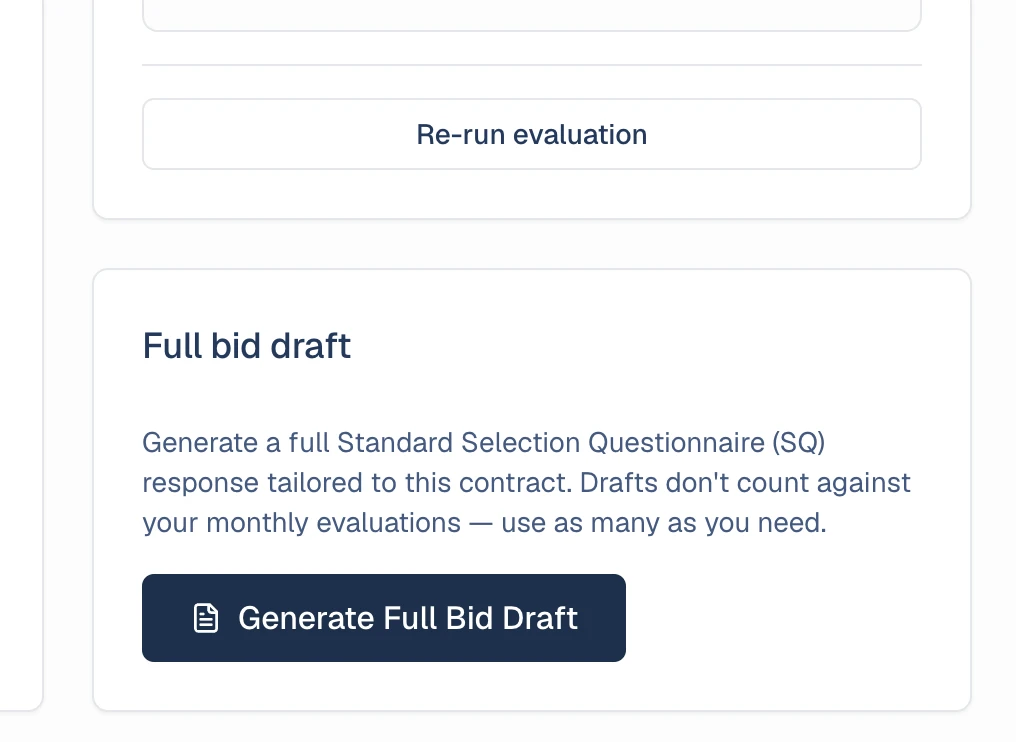
Full SQ draft generated in minutes, not days Step 7· Half a day
Refine, add evidence, and submit
Tune the draft, drop in named referees and certificate numbers, layer your quantified social value commitments, and submit through the buyer's portal. Most users compress a 30-60 hour first bid to 8-12 hours of focused review.
Step 8· Ongoing
Track outcomes and improve
Every bid logs in CleanTender with status, score, and (after standstill) the buyer's feedback. Use the standstill data to tune your next bid. Win rate compounds; first-bid completion is the only thing standing between you and a public-sector revenue line.
Sources
- Find a Tender Service · All UK above-threshold (>£139k) public-sector contracts publish here daily
- Contracts Finder · Below-threshold UK Government contracts (£12k-£139k); SME entry point
- PPN 002 Social Value Model (Cabinet Office) · 10% minimum social value weighting on central government tenders from 1 October 2025
- Procurement Act 2023 (legislation.gov.uk) · Live since 24 February 2025; SQ structure, scoring, standstill, transparency
- Living Wage Foundation · Real Living Wage accreditation regularly listed in council social value scoring
- School Food Standards (DfE) · Mandatory standards in maintained schools; UIFSM eligibility framework
FAQs
Frequently asked questions
- Five common types UK SMEs win every day: (1) Local council office cleaning contracts at £150k-£500k/year on 3-5 year terms; (2) NHS Trust security guarding contracts at £500k-£3m/year, often split into lots so SMEs can bid for one site rather than the whole estate; (3) University campus grounds maintenance at £200k-£800k/year on 3+2 year terms; (4) Primary school catering under UIFSM at £300k-£1.5m/year via Multi-Academy Trust frameworks; (5) Confidential waste and recycling for police, councils, and housing associations at £100k-£600k/year. Each has its own named compliance gates (BICSc, SIA ACS, NPTC, FHRS, ISO 27001) and the SME that brings them wins.
- Below-threshold UK Government contracts on Contracts Finder run £12k-£139k and are explicitly designed as SME entry points. Above-threshold contracts on Find a Tender Service are >£139k and trend much larger. For soft FM, typical SME wins sit in the £100k-£3m/year range: council cleaning frameworks £150k-£500k/year, NHS security lots £500k-£3m/year, university grounds £200k-£800k/year, primary school catering £300k-£1.5m/year, confidential waste £100k-£600k/year. Contract terms are typically 3-5 years with extension options; the win provides a baseline of recurring revenue. The largest framework call-offs (national NHS Supply Chain lots, Crown Commercial Service frameworks) trend higher and are usually contested by primes, but local-authority and trust-direct contracts are very SME-accessible.
- By targeting lots. NHS Trusts increasingly split large contracts into manageable lots so SMEs can bid for one site or one service line rather than the entire estate. Common patterns: a manned-guarding contract split into Lot 1 (Main Hospital), Lot 2 (Outpatient Clinics), Lot 3 (Mental Health Unit). A cleaning contract split by site, by clinical-versus-non-clinical area, or by day-versus-night. SMEs bid the lot they can credibly serve. Once you've won one lot and built the audit trail, the next NHS Trust contract is much easier — past performance evidence on an NHS site is heavily weighted on subsequent bids. The compliance pack is the same regardless of lot size: SIA ACS for security, BICSc for cleaning, FHRS 4-5 for catering, ISO 9001/14001/45001 typically required.
- UIFSM stands for Universal Infant Free School Meals. The UK government mandates that all children in Reception, Year 1, and Year 2 in state-funded schools receive a free school meal, paid via central government funding to schools. Many schools do not employ their own kitchen staff and outsource the entire operation, including UIFSM provision plus paid meals for older year groups. For an SME catering business, this is one of the most accessible B2G opportunities: contracts are typically £300k-£1.5m/year, awarded by Multi-Academy Trusts (MATs) or local authorities, and reward operators who can demonstrate FHRS 4-5 across kitchens, a documented HACCP plan, full Natasha's Law allergen labelling on every PPDS item, and local-sourced ingredient percentages. The scoring usually runs 60% quality, 40% price, with social value at 15-25% of the quality block — quantified local-supplier commitments routinely score 8-9/10.
- Confidential waste contracts (police, councils, housing associations, NHS administrative offices) typically value £100k-£600k/year on 3-5 year terms. Three named compliance gates separate winners from also-rans: (1) Upper Tier Waste Carrier licence with the Environment Agency for the collection fleet; (2) ISO 27001 information security accreditation for chain-of-custody on confidential materials; (3) certificated secure destruction (often shred-on-site) with audit-trail evidence per consignment. Beyond the gates, scoring rewards quantified diversion-from-landfill rates (above 70% on general waste streams), named MRF/AD/WtE destinations with gate-fee letters in writing, and decarbonisation pathway for the collection fleet (electric vehicles year three target). Generic "environmentally responsible" copy scores 4/10; named destinations and quantified diversion rates score 8-9/10.
- Yes — far more so than most SMEs assume. The UK government has a standing target of spending £1 in every £3 with SMEs, either directly or through prime supply chains. Local council frameworks for cleaning, security, grounds, waste, and catering regularly award lots to firms with turnover under £1m. NHS Trusts increasingly split large contracts into lots specifically to enable SME participation. Multi-Academy Trust catering contracts often go to regional caterers rather than national primes. The compliance bar is real (ISO 9001 increasingly required, sector accreditations like BICSc/SIA ACS/NPTC/FHRS), and the compliance pack typically takes 6-12 months to build for first-time bidders. Once built, it gets reused on every bid. Most SMEs lose their first 3 bids while learning the rules, then start placing as the standstill-letter feedback compounds. First-bid completion is the only thing standing between an SME and a recurring B2G revenue line.