
UK window cleaning tenders are published on six places: Find a Tender, Contracts Finder, Public Contracts Scotland, Sell2Wales, eTendersNI and the buyer's own e-procurement portal. Check all six or you will miss most of them.
The buyers are councils, housing associations, universities, colleges, schools, museums and NHS trusts. The contracts are recurring, local, and winnable for a firm with five vans. Big FM companies often do not want a standalone window round across 40 low-rise blocks. You do.
UK window cleaning tenders: the numbers that decide your bid
Work at Height Regulations 2005
WAHR 2005
Avoid, prevent, then minimise. Your method statement follows this order or it loses marks.
Employers' liability legal minimum
£5m
Most policies carry £10m. Buyers commonly ask for £5m to £10m public liability too. Check the SQ.
Council notice threshold (Find a Tender)
£30k
Since 24 February 2025, councils publish contracts from £30,000 incl. VAT on Find a Tender. Central government from £12,000.
University of Edinburgh window cleaning tender
£560k
Closing 12 October 2026. A single-service window contract at real scale.
University of Strathclyde 2026-30
Up to £1m
Window cleaning, reactive cleaning and associated services, bundled.
Health and safety pre-qualification
SSIP
CHAS, SafeContractor, SMAS Worksafe and others. Mutually recognised. One is enough.
Window cleaning sits inside the wider market for cleaning tenders, so if you also do internal or communal work, read our UK cleaning tenders guide next. If you run pressure washing as a side line, the pressure washing contracts playbook covers the same buyers from the other side of the van.
What's in this guide
- How to win a UK window cleaning tender, step by step
- Where window cleaning tenders are published
- Who buys window cleaning (with live examples)
- How contracts get lotted
- What buyers ask for: height safety, accreditation, insurance
- Pricing a window cleaning tender
- When not to bid
- FAQs
How to win a UK window cleaning tender, step by step
The complete end-to-end flow inside CleanTender. From sector setup to a submitted window cleaning bid in the time it used to take to read a single tender pack.
Eight steps from "never bid public sector" to a complete SQ response on the buyer's portal. First scan is free.
Step 1· 10 minutes
Build your window cleaning company profile
Set your sector to window cleaning, your service regions, SSIP accreditation (CHAS, SafeContractor or SMAS Worksafe), public and employers' liability levels, IPAF and PASMA cardholders, water-fed pole fleet, regions and van radius, insurance levels, turnover, and operative count. CleanTender uses this to fit-score every live tender against your real capability so you only see the ones you can win.
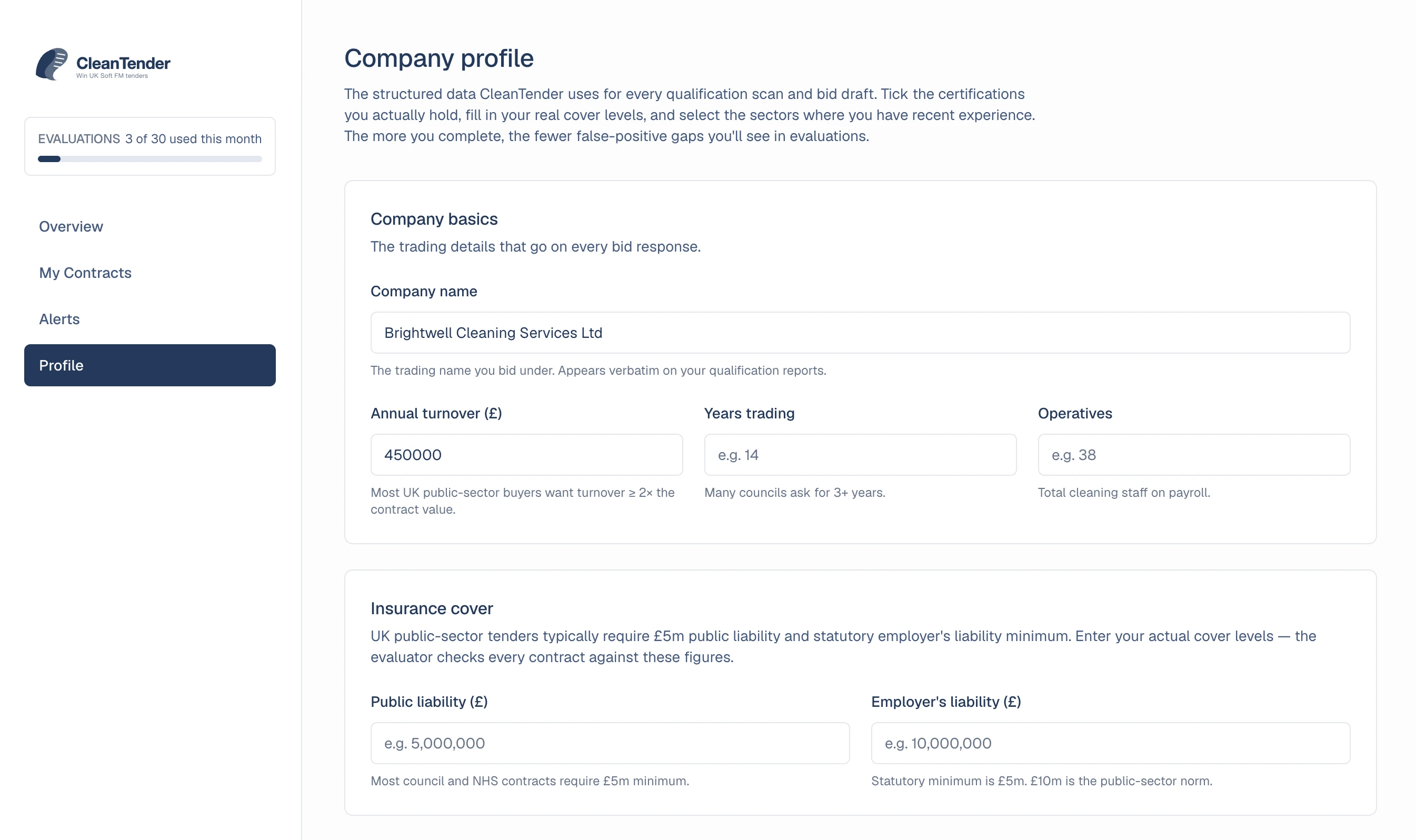
Profile setup defines what you are bid-ready for Step 2· 5 minutes daily
Open the live window cleaning-tender feed
Every UK every UK council, housing association, university, college, school and NHS trust window cleaning, communal cleaning and gutter cleaning tender tender, in one feed. Pre-filtered to your sector and geography. No false positives, no manual portal-trawling across FTS, Contracts Finder, and dozens of buyer e-procurement portals.
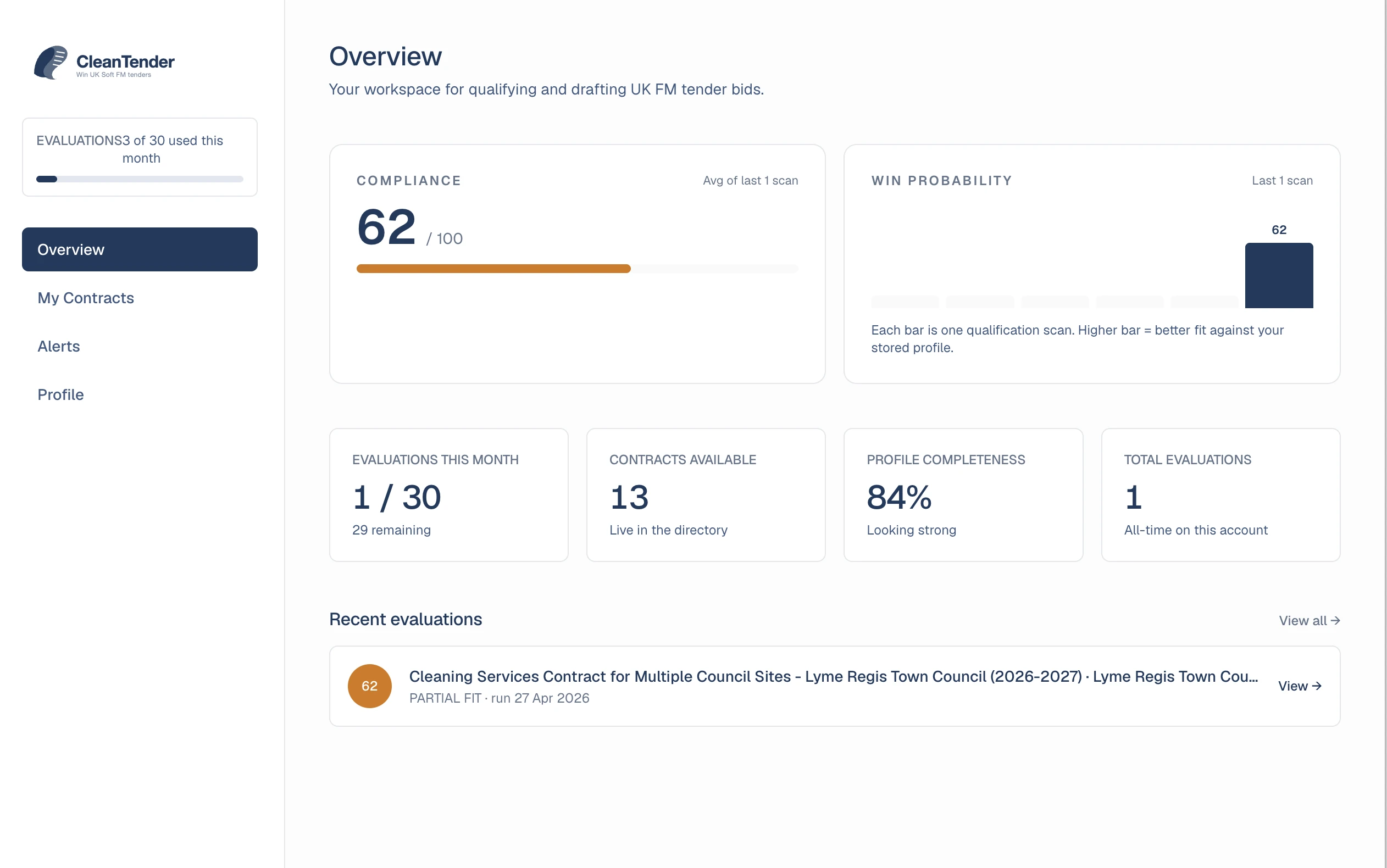
Live feed of in-scope window cleaning tenders, fit-scored Step 3· Daily digest
Get email alerts for new in-scope tenders
New window cleaning tenders matching your profile land in your inbox the day they publish. CleanTender batches them into a daily digest so you do not get notification fatigue, and links straight back to the in-app fit score.
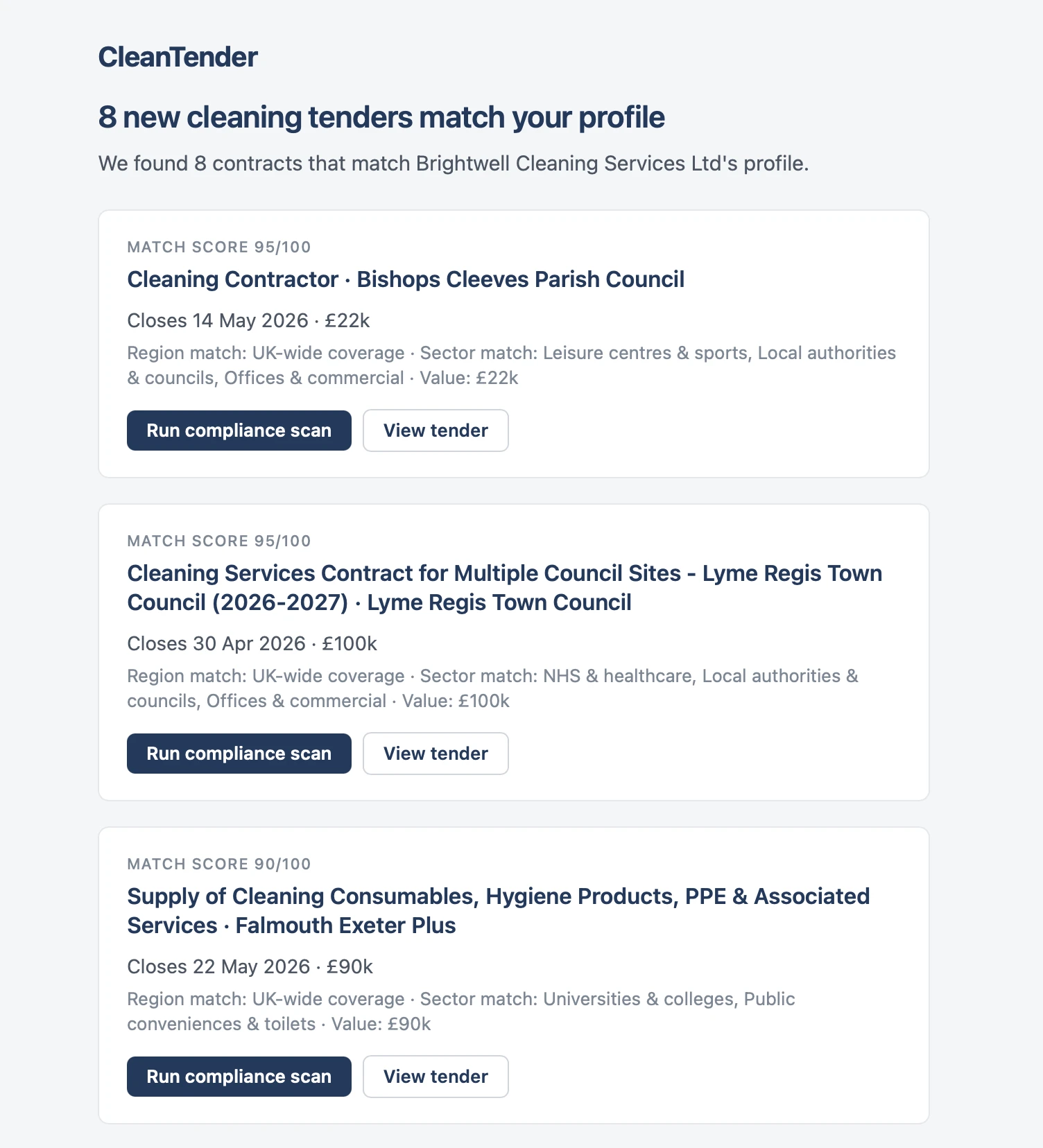
Daily alerts for new in-scope tenders Step 4· 30 seconds
Run a fit-score evaluation on a target tender
One click runs a CleanTender Evaluation against the tender pack: scope match, geography fit, scale fit, compliance gap, and a plain-English win probability. Stops you bidding contracts you were never going to win.
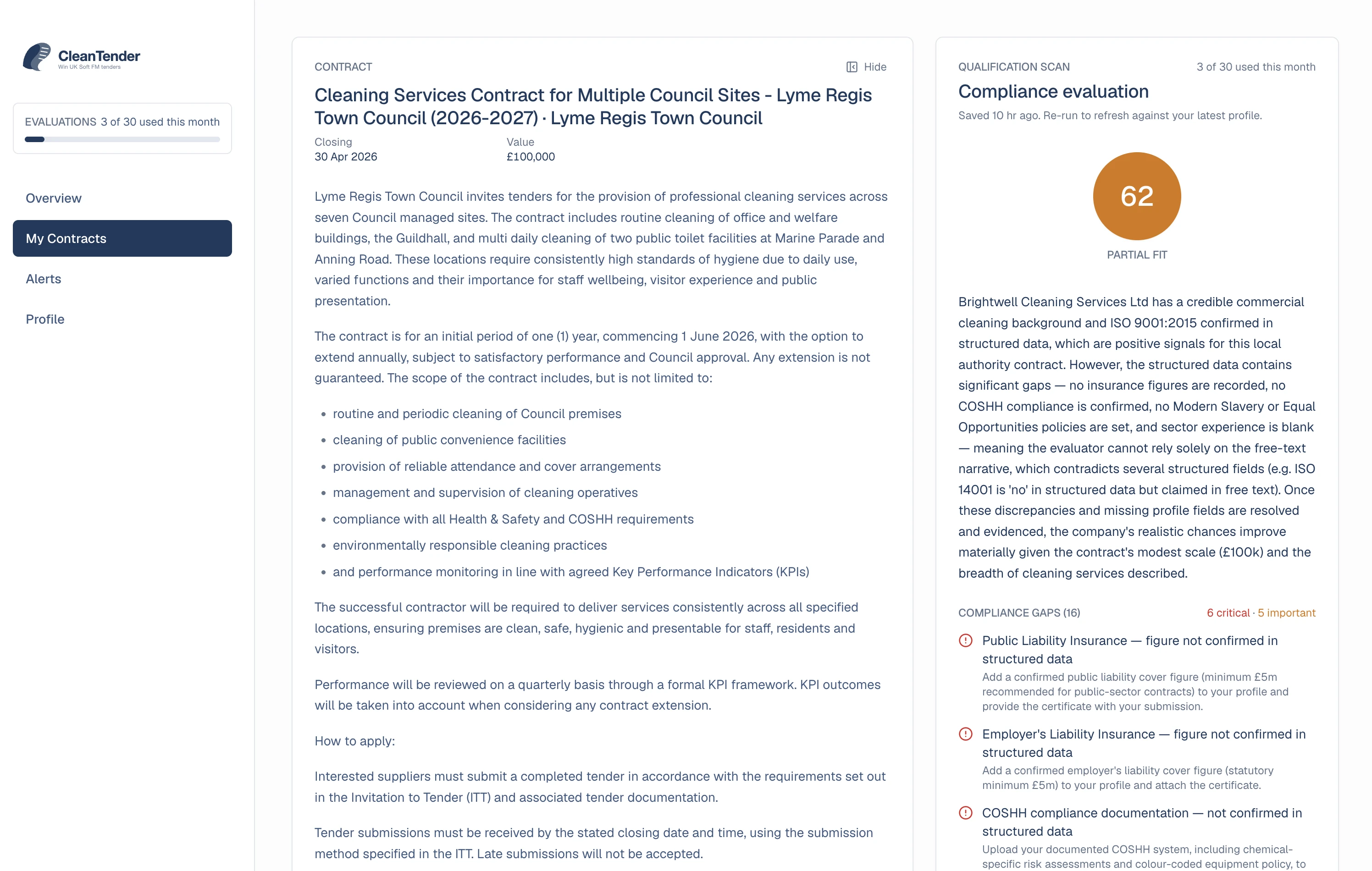
Fit-score and win-probability before you commit a weekend Step 5· 1 minute
Spot compliance gaps before you start drafting
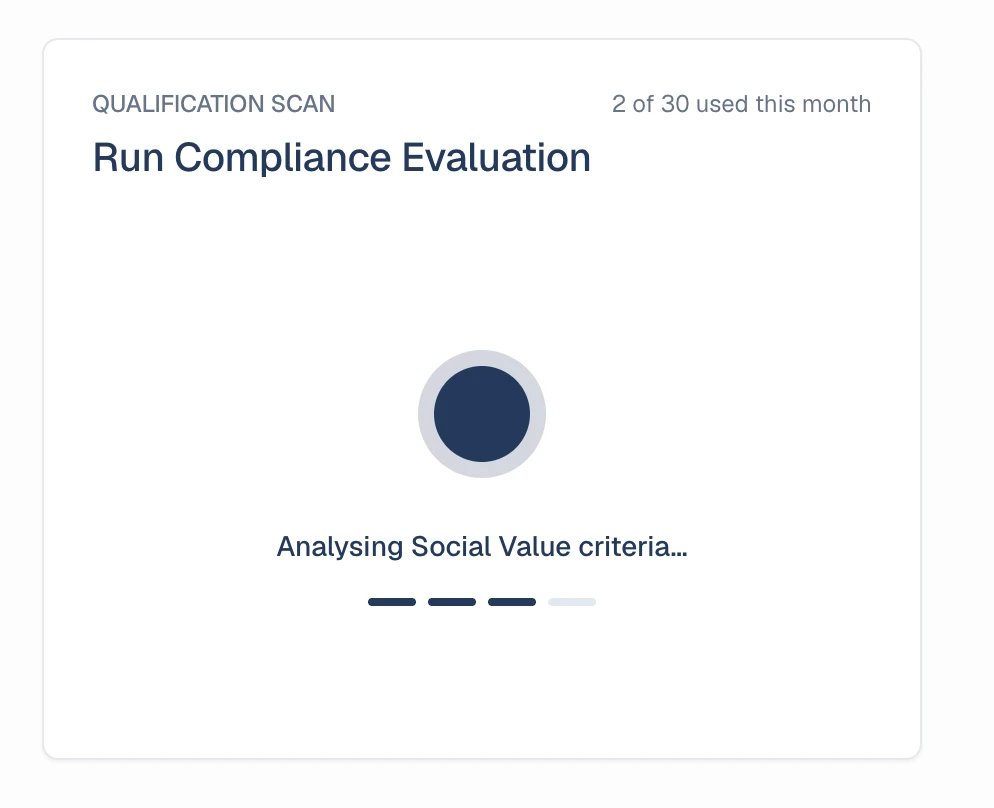
CleanTender runs a named compliance check against the tender pack: Work at Height Regulations 2005, SSIP, IPAF, PASMA, insurance levels, RAMS, social value. Anything missing is flagged before you sink hours into a bid that auto-fails at SQ.
Compliance gaps surfaced before drafting Step 6· 2 minutes generation
Generate a full SQ + method-statement draft
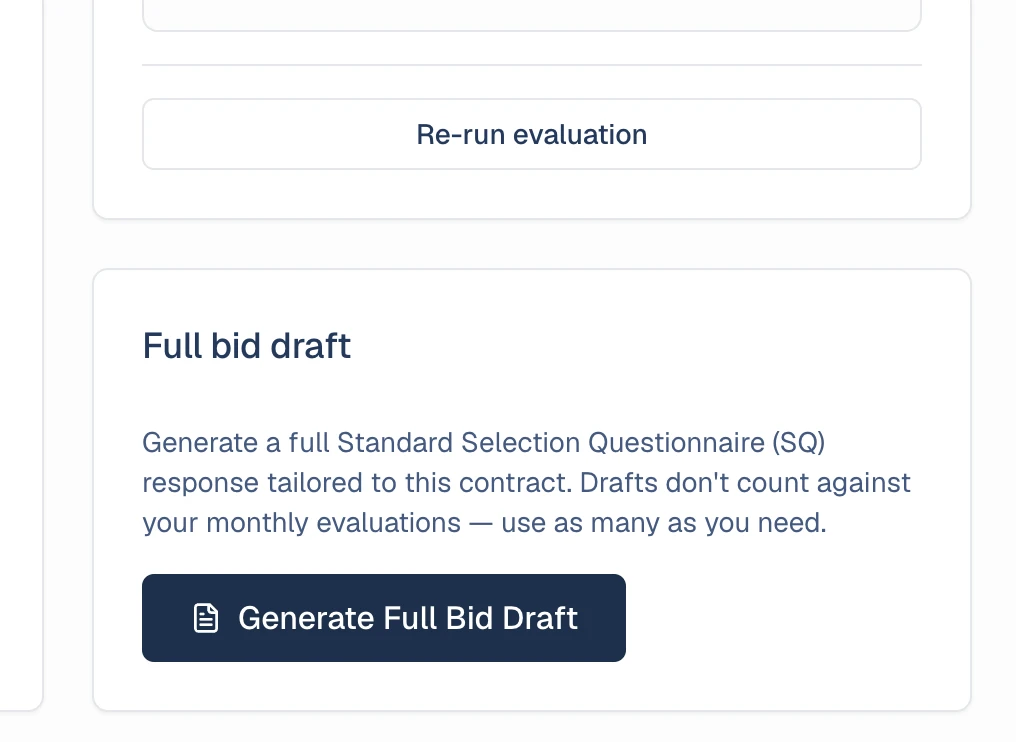
CleanTender drafts a complete Standard Selection Questionnaire response using your profile data and the tender requirements: declaration block, company overview, contract experience, quality, training, COSHH, social value, H&S, insurance schedule. All ten sections, in one pass.
Full SQ draft generated in minutes, not days Step 7· Half a day
Refine, add evidence, and submit
Tune the draft, drop in named referees and certificate numbers, layer your quantified social value commitments, and submit through the buyer's portal. Most users compress a 30-60 hour first bid to 8-12 hours of focused review.
Step 8· Ongoing
Track outcomes and improve
Every bid logs in CleanTender with status, score, and (after standstill) the buyer's feedback. Use the standstill data to tune your next bid. Win rate compounds; first-bid completion is the only thing standing between you and a public-sector revenue line.
Where UK window cleaning tenders are published
Each nation has its own portal. England splits across two. Then every council and housing association has a supplier portal of its own on top.
- Find a Tender. The main one. Since 24 February 2025 it carries new notices from £30,000 including VAT for councils and £12,000 for central government, up to the big university contracts like Edinburgh and Strathclyde.
- Contracts Finder. England. Older procurements started before February 2025 still finish here, so it thins out every month.
- Public Contracts Scotland. Scottish councils, universities, colleges and housing associations. Heriot-Watt University used it.
- Sell2Wales. Welsh councils and housing associations. Caerphilly County Borough Council and Tai Hedyn both published window cleaning notices this year.
- eTendersNI. Northern Ireland.
- Buyer portals. ProContract, In-Tend, Delta, Jaggaer and the rest. Housing associations lean on these hard. Small quotes under the thresholds often never leave them, and some buyers invite three local firms without any public notice at all.
Checking six portals every morning gets old in a week. That is the reason aggregators exist. Our comparison of public-sector tender sites ranks the free and paid options honestly. Or skip the comparison and browse live contracts filtered to window cleaning.
Who buys window cleaning, with live examples
These are real UK window cleaning tenders published in 2026. Values show only where the buyer published one.
| Buyer | Tender | Type | Value / closing |
|---|---|---|---|
| University of Edinburgh | Window Cleaning Services | University | Up to £560k, closes 12 Oct 2026 |
| University of Strathclyde | Window Cleaning, Reactive Cleaning & Associated Services (2026-30) | University | Up to £1m |
| Caerphilly County Borough Council | Window Cleaning and Associated Cleans for Corporate Properties | Council | Closes 27 Oct 2026 |
| Peabody Trust | Estate and Window Cleaning, South London and North East London | Housing association | Not published |
| Clarion Housing Association | Cleaning & Window Cleaning, East | Housing association | Not published |
| Incommunities | Communal Block Cleaning and Window Cleaning | Housing association | Not published |
| The Community Housing Group | Communal Window Cleaning | Housing association | Closed 28 May 2026 |
| Karbon Homes | Window Cleaning | Housing association | Not published |
| Heriot-Watt University | Window Cleaning Services | University | Not published |
| Bedford College | Provision of Window Cleaning Services | College | Not published |
| Royal Armouries Museum | Window Cleaning Services | Museum | Not published |
| Ipswich Borough Council | Grafton House Window Cleaning | Council, single site | Not published |
Look at the mix. Seven of those twelve are housing associations, universities or colleges, not councils. Housing associations are the sweet spot for a small firm: low-rise communal blocks, glass you reach from the ground with a pole, and visit cycles that repeat for years.
Single-site notices like Ipswich's Grafton House are the easiest first win. One building, one access plan, one price. Bid those before you go near a 30-site university estate.
How window cleaning contracts get lotted
Pure window-only contracts exist, but they are the minority. Three patterns come up again and again.
- Window cleaning plus "associated cleans". Gutters, fascias, soffits, cladding, signage. Caerphilly and Strathclyde both word it this way. If you own a gutter vac, you are fine.
- Communal cleaning plus windows. Incommunities, Clarion and Peabody all bundle internal block cleaning with window cleaning. A window-only firm either partners with a communal cleaner or bids as a subcontractor to one.
- Windows as one lot of a bigger cleaning framework. The window lot is usually the smallest and the least contested. Big contractors chase the main cleaning lot and leave the window lot to specialists. Bid the lot you can actually deliver, not the whole framework.
Joint bids with a communal cleaner work well on housing contracts. The mechanics of that, plus how buyers score partnered bids, sit in our guide on how to bid for cleaning contracts.
What buyers ask for in a window cleaning tender
Working at height
This is the section evaluators read hardest. Falls from height kill window cleaners, and every buyer knows it.
The Work at Height Regulations 2005 set a clear order. Avoid working at height where you can. Where you can't, use equipment that prevents a fall. Where you can't do that, minimise the distance and consequences of a fall. Write your method statement in exactly that order.
- Water-fed poles first. They keep operatives on the ground, which is the "avoid" step. Name pole lengths and the storeys you cover.
- MEWPs for glass beyond pole reach, with IPAF-trained operators named.
- Mobile towers for internal atria and awkward courtyards, with PASMA-trained staff.
- Ladders. Short duration, low risk only. Say so.
- Rope access or cradles on high-rise. Most small firms should subcontract this or leave it alone.
Add site-by-site risk assessments, a pure-water supply plan, and how you handle public footpaths and residents' cars under a dripping pole. Our cleaning method statement template shows the structure evaluators expect and how to fill each section.
Accreditation
SSIP accreditation is the pass/fail line on most selection questionnaires. CHAS is the name you will see most, but SafeContractor and SMAS Worksafe count too, because SSIP schemes recognise each other. If you are choosing, read CHAS vs SMAS Worksafe. If you are still deciding whether you need one at all, do I need CHAS for cleaning tenders answers it straight. Short version: for window cleaning, yes. Height work makes buyers stricter than for internal cleaning.
Federation of Window Cleaners membership is not usually required. It still helps in the quality section as evidence of training and safe practice.
Insurance
Employers' liability has a legal minimum of £5m and most policies carry £10m. Public liability asks vary by buyer, commonly £5m to £10m. Read the selection questionnaire before you renew, not after. Upping cover mid-bid costs more and takes longer than you think.
Everything else
- DBS checks for schools, colleges and anywhere near vulnerable residents.
- Key holding and access procedures for housing blocks and corporate buildings.
- Photo-evidence of completed visits. Housing associations love this because it kills "they never came" complaints from residents.
- Social value. Local hires, apprentices, van miles cut by tight routing. Name numbers, not intentions.
Pricing a window cleaning tender
Price per visit, per building. Split each building by elevation or by access method (pole, MEWP, internal). Then multiply by frequency.
An evaluator comparing five bids wants to see why one block costs more than another. "Block 14 needs a MEWP on the rear elevation" is a reason. A lump sum is a guess, and a guess scores badly on value for money even when it is cheap.
- Walk every site you can before pricing. Measure pole reach. Find the blocks with no vehicle access.
- Price MEWP hire as a separate line. It is the number most likely to blow your margin.
- Include a reactive or ad-hoc rate. Buyers use it, and it protects you when they add buildings.
- Build in pure-water costs, route time and parking. Central London parking alone can wreck a Peabody-style estate round.
- Never price below cost to get in. Rates on multi-year housing contracts rarely rise as fast as wages.
Pricing is one of five things that separate winners from losers. The other four are in how to win cleaning contracts, and the private-sector side of the same work sits in our commercial cleaning contracts guide.
When not to bid
Losing a bid costs you two or three days. Winning the wrong one costs you three years.
- The sites sit outside your van radius.
- The spec needs rope access or cradle work you would have to subcontract at a loss.
- It bundles full communal cleaning and you have no partner lined up.
- You lack SSIP accreditation and the deadline is under four weeks away.
- The contract value would be more than half your turnover. Most buyers check financial standing, and a contract that size would own your business anyway.
- The incumbent has held it for years, the spec reads like it was copied from their method statement, and there's no clarification window to ask why.
If you are unsure, run the notice through our bid/no-bid decision tool. It takes about five minutes. For councils and central government buyers in particular, how to get government cleaning contracts covers the selection stage in more detail.
Sources
Sources
- The Work at Height Regulations 2005 (legislation.gov.uk) · The law behind every window cleaning method statement.
- Working at height: HSE guidance · HSE guidance on the avoid, prevent, minimise hierarchy.
- SSIP (Safety Schemes in Procurement) · Umbrella for CHAS, SafeContractor, SMAS Worksafe and other mutually recognised schemes.
- Federation of Window Cleaners · UK trade body for window cleaners.
- Find a Tender Service · UK-wide notices above Procurement Act 2023 thresholds.
- Contracts Finder · England. Procurements started before 24 February 2025.
- Public Contracts Scotland · Scottish public-sector notices.
- Sell2Wales · Welsh public-sector notices.
- eTendersNI · Northern Ireland public-sector notices.
- Procurement Act 2023 guidance (gov.uk) · Thresholds, notices and award rules in force since 24 February 2025.
FAQs
Frequently asked questions
- Register as a supplier on Find a Tender and on the e-procurement portals of the councils and housing associations within your van radius, then set a saved search for "window cleaning". Most public window cleaning contracts go out as short, single-trade lots or bundled with gutter cleaning. Before you bid, have your employers' liability (at least £5m, the legal minimum), public liability at the level the buyer asks for, an SSIP certificate such as CHAS, and written work at height risk assessments ready. Price per block or per visit exactly as the schedule asks, and answer the method statement with your access equipment, frequencies and how you handle complaints. Small local firms win these regularly because buyers value quick response and local cover.
- On six places: Find a Tender, Contracts Finder (England), Public Contracts Scotland, Sell2Wales, eTendersNI, and each buyer's own e-procurement portal. Since February 2025, new council contracts from £30,000 including VAT go on Find a Tender; Contracts Finder only carries older procurements. Housing associations often publish only on their own portals, and smaller quotes may go to three invited local firms with no public notice. Set free email alerts on each national portal using "window cleaning" as a keyword, and register as a supplier with the councils and housing associations inside your van radius. Or use a tender aggregator that pulls every portal into one feed so you only check one inbox.
- Start with single-site notices, register on your local council's supplier portal, and get SSIP accreditation such as CHAS before you bid. Councils publish window cleaning either as a standalone contract (Ipswich Borough Council's Grafton House is a recent single-building example) or as a lot inside a wider cleaning framework. The selection questionnaire checks insurance, health and safety accreditation and financial standing. The quality stage scores your working-at-height method statement, staffing, and how you evidence each visit. Win one small council contract first. It becomes the reference that gets you onto the bigger frameworks.
- For most public-sector window cleaning tenders, yes, or another SSIP scheme such as SafeContractor or SMAS Worksafe. Height work makes buyers stricter than they are for internal cleaning, and SSIP accreditation is the usual pass/fail check on the selection questionnaire. SSIP schemes recognise each other, so you only need one. Apply several weeks before the tender you want to bid on, because an assessment with a missing document can drag on longer than a bid window lasts.
- Employers' liability with at least £5m of cover (the legal minimum if you employ staff, and most policies carry £10m) plus public liability at the level the buyer states, commonly £5m to £10m. Read the selection questionnaire before you renew. Some housing associations and universities also ask for professional indemnity or contract works cover. Keep a current certificate ready to upload, dated inside the bid validity period.
- Rarely by name, but your method statement should lead with them. The Work at Height Regulations 2005 tell you to avoid working at height where you can, and water-fed poles keep operatives on the ground. Evaluators score that approach higher than ladder work. Name your pole lengths, the storeys you can reach, and how you supply pure water. Then explain what you use above pole reach: MEWPs with IPAF-trained operators, towers with PASMA-trained staff, and ladders only for short, low-risk jobs.
- Per visit, per building, split by elevation or access method, then multiplied by frequency. Show MEWP hire as its own line and include a reactive rate for extra visits. Evaluators compare bids line by line, so a clear schedule that explains why one block costs more than another scores better than a single annual figure. Walk the sites before pricing where you can. Access problems you spot on a site visit are cheaper to price in than to absorb for three years.
- Yes. Most window cleaning is local and recurring, and housing associations in particular run low-rise estates a five-van firm can cover well. Bid single-site contracts first, target window-only lots inside bigger cleaning frameworks, and partner with a communal cleaner when the contract bundles both. Stay inside your van radius and skip anything that needs rope access you would have to subcontract. A first win gives you the reference the bigger frameworks ask for.