
UK public bodies spend roughly £1.2 billion a year on cleaning. Council civic centres, NHS Trust offices, primary schools, leisure centres, public toilets. Most of it goes to a handful of national contractors. The rest goes to regional SMEs who learned how to bid.
Government cleaning contracts pay between £25,000 a year (a parish council) and £4 million a year (a county council framework). The terms are usually two to four years with optional extensions. The work is steady. The cash flow is steady because public buyers must pay valid invoices within 30 days under the Procurement Act 2023.
Here's the entire pipeline. Where the contracts live. What to gather before you bid. The three steps that get you to a submitted Selection Questionnaire. And what gets you binned.

What's in this guide
- How to win a UK government cleaning tender, step by step (CleanTender walkthrough)
- What counts as a government cleaning contract in the UK
- Step 1: get ready to bid (paperwork + accreditations)
- Step 2: where to find government cleaning contracts
- Step 3: how to bid on government cleaning contracts
- Pricing without going broke
- Common reasons SMEs lose at SQ stage
- What to do when you lose your first bid
How to win a UK government cleaning tender, step by step
The complete end-to-end flow inside CleanTender. From sector setup to a submitted government cleaning bid in the time it used to take to read a single tender pack.
Eight steps from "never bid public sector" to a complete SQ response on the buyer's portal. First scan is free.
Step 1· 10 minutes
Build your government cleaning company profile
Set your sector to government cleaning, your service regions, BICSc accreditation, COSHH compliance, ISO 9001 status, TUPE experience, sector experience (NHS / schools / offices / MoJ courts), insurance levels, turnover, and operative count. CleanTender uses this to fit-score every live tender against your real capability so you only see the ones you can win.
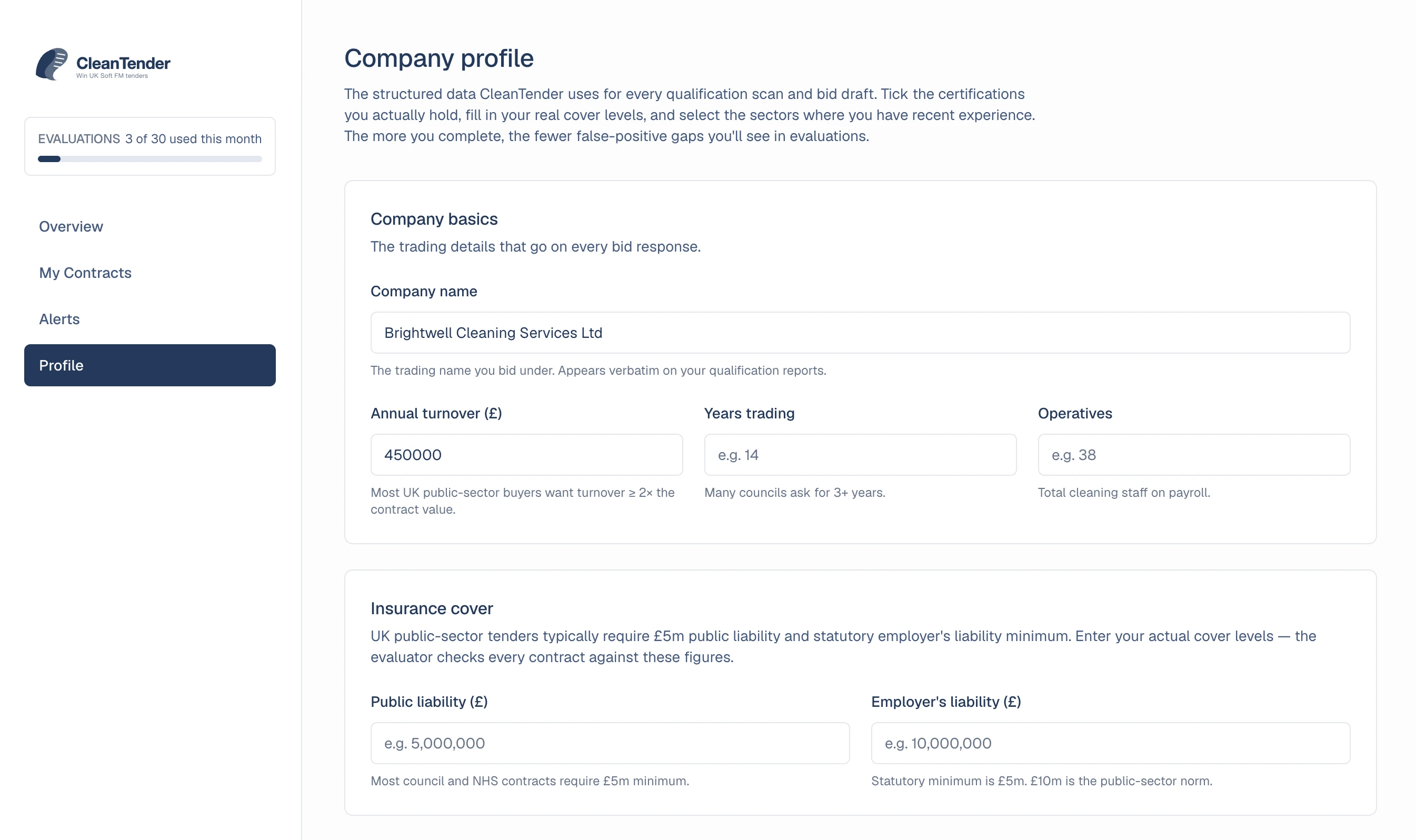
Profile setup defines what you are bid-ready for Step 2· 5 minutes daily
Open the live government cleaning-tender feed
Every UK central government, council, NHS Trust, school, MoD, and Crown Commercial Service framework cleaning tender, in one feed. Pre-filtered to your sector and geography. No false positives, no manual portal-trawling across FTS, Contracts Finder, and dozens of buyer e-procurement portals.
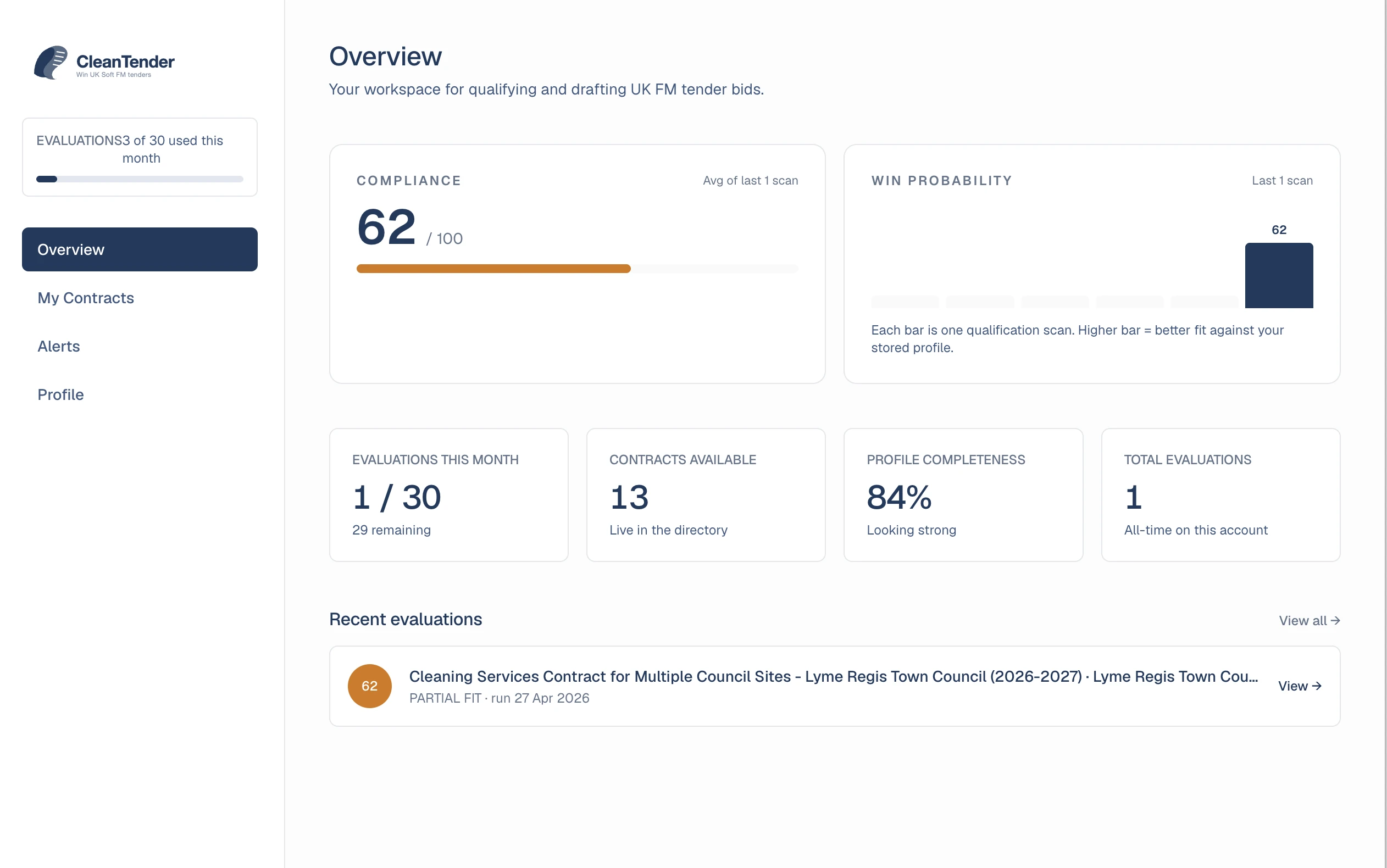
Live feed of in-scope government cleaning tenders, fit-scored Step 3· Daily digest
Get email alerts for new in-scope tenders
New government cleaning tenders matching your profile land in your inbox the day they publish. CleanTender batches them into a daily digest so you do not get notification fatigue, and links straight back to the in-app fit score.
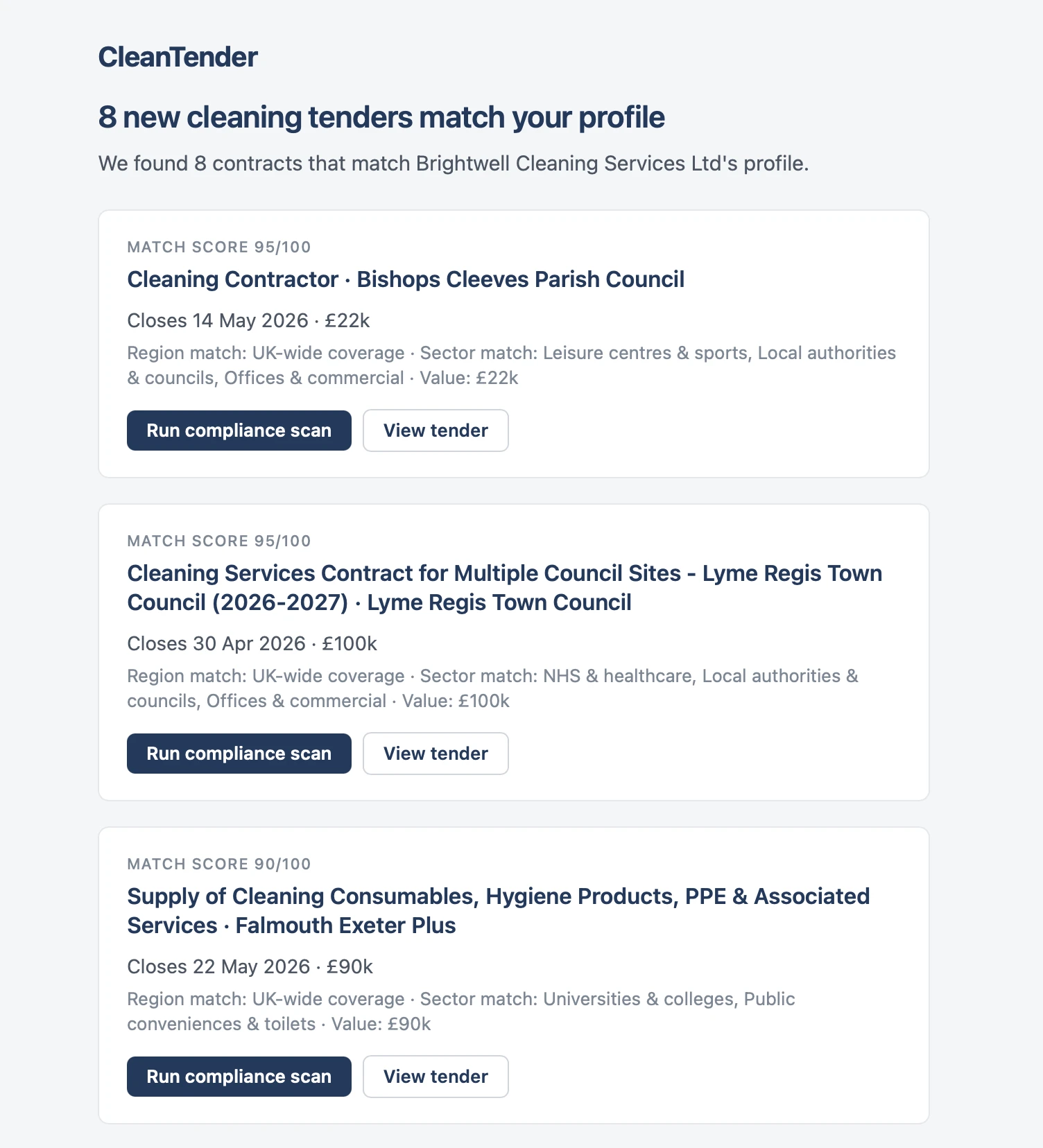
Daily alerts for new in-scope tenders Step 4· 30 seconds
Run a fit-score evaluation on a target tender
One click runs a CleanTender Evaluation against the tender pack: scope match, geography fit, scale fit, compliance gap, and a plain-English win probability. Stops you bidding contracts you were never going to win.
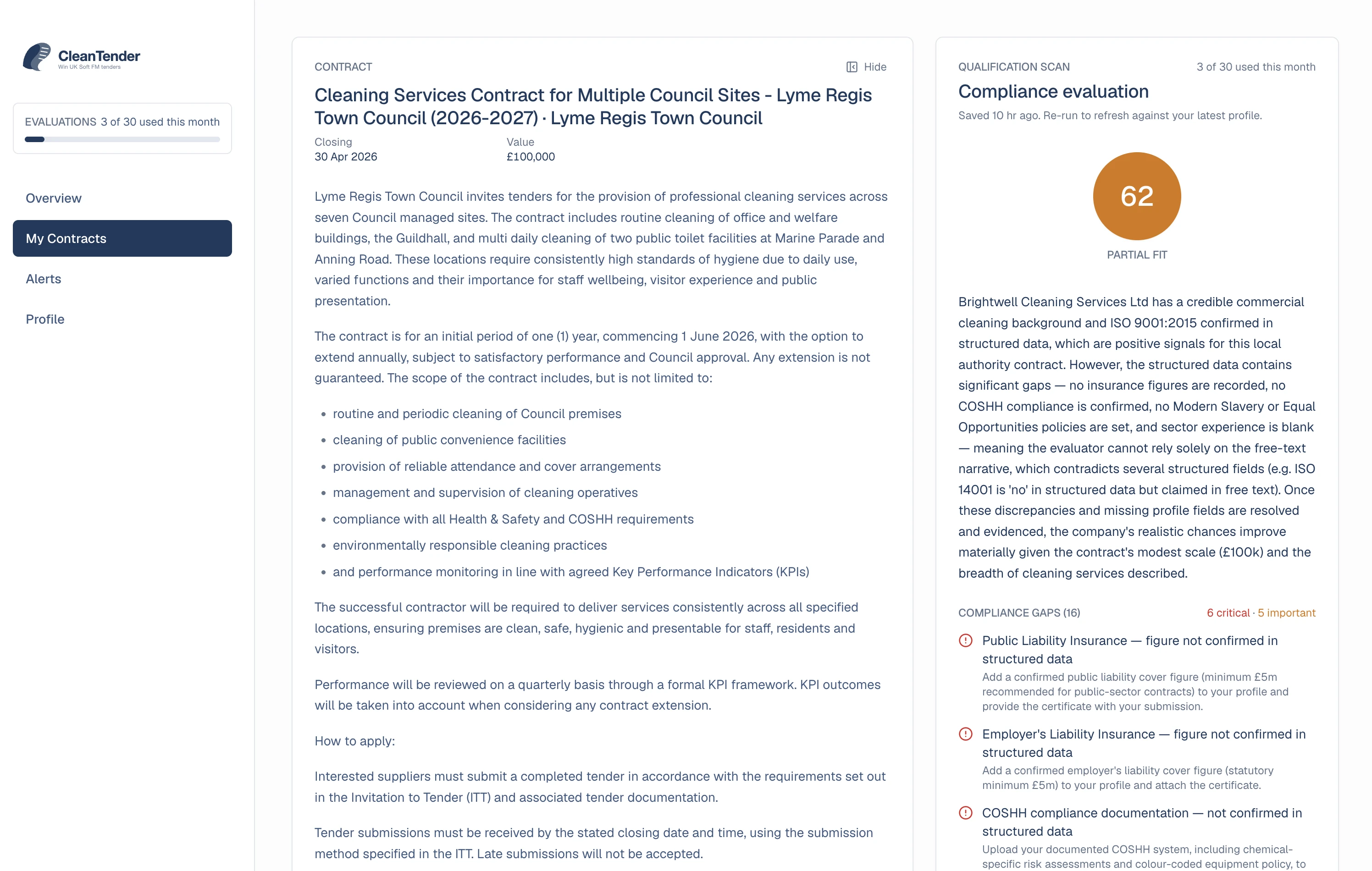
Fit-score and win-probability before you commit a weekend Step 5· 1 minute
Spot compliance gaps before you start drafting
CleanTender runs a named compliance check against the tender pack: BICSc, COSHH, ISO 9001, ISO 14001 if held, SSIP (CHAS or SafeContractor), TUPE pack, social value plan, modern slavery policy. Anything missing is flagged before you sink hours into a bid that auto-fails at SQ.
Compliance gaps surfaced before drafting Step 6· 2 minutes generation
Generate a full SQ + method-statement draft
CleanTender drafts a complete Standard Selection Questionnaire response using your profile data and the tender requirements: declaration block, company overview, contract experience, quality, training, COSHH, social value, H&S, insurance schedule. All ten sections, in one pass.
Full SQ draft generated in minutes, not days Step 7· Half a day
Refine, add evidence, and submit
Tune the draft, drop in named referees and certificate numbers, layer your quantified social value commitments, and submit through the buyer's portal. Most users compress a 30-60 hour first bid to 8-12 hours of focused review.
Step 8· Ongoing
Track outcomes and improve
Every bid logs in CleanTender with status, score, and (after standstill) the buyer's feedback. Use the standstill data to tune your next bid. Win rate compounds; first-bid completion is the only thing standing between you and a public-sector revenue line.
What counts as a government cleaning contract in the UK
"Government cleaning contract" sounds narrow. In practice it covers anything where a UK public body buys cleaning services and is required to follow procurement law.
- NHS Trusts and Integrated Care Boards. Hospital-grade cleaning at acute trusts. Office and reception cleaning at trust HQs. Primary care premises.
- Local authorities. Council civic centres, leisure centres, public conveniences, libraries. Borough, district, county, unitary, parish.
- Schools and academies. Single-school contracts (parish schools), multi-academy trust frameworks (which can cover 30+ sites).
- Universities and FE colleges. Halls of residence, lecture theatres, sports facilities, student unions.
- Central government estates. HMRC, MoJ, DWP, Cabinet Office. Often run via Crown Commercial Service framework RM6248 (FM Services).
- Prisons. Run through the Ministry of Justice. SIA-vetted cleaning, restricted access.
- Police, fire, rescue. Smaller estates than NHS or central gov but consistent annual spend.
- Devolved-government bodies in Scotland, Wales, and Northern Ireland.
Each one buys cleaning slightly differently. Schools want safeguarding evidence and Enhanced DBS on every operative. NHS wants BS EN 1276 and EN 14476 disinfectant evidence and BICSc-trained teams. Prisons want SIA-vetted staff. Match your bid to what the buyer actually scores.
Step 1: get ready to bid
Don't bid until the paperwork is in place. The Selection Questionnaire on every public-sector cleaning contract asks for the same documents in slightly different boxes. Build the pack once, reuse on every bid.
Insurance
- Public liability: £5 million is the typical cleaning floor. £10 million on NHS, larger council estates, and prisons.
- Employer's liability: £10 million. Statutory minimum is £5m, public-sector norm is £10m.
- Crime / fidelity: £100,000 to £250,000 if you're handling keys, alarm codes, or cash.
SSIP accreditation (you only need one)
SSIP is the Safety Schemes In Procurement umbrella. Member schemes mutually recognise each other under the Deem-to-Satisfy rule. You need one. Pick the cheapest that gives you what you need.
- CHAS Standard. £200-£500 a year. Most common for cleaning SMEs. Audits H&S management, RIDDOR, training records.
- SMAS Worksafe. £345-£600 a year. Similar coverage to CHAS, sometimes preferred by councils in the Midlands and North.
- SafeContractor. £400-£800 a year.
- Constructionline. £622-£5,000+ a year depending on tier. Asks for more (financial standing, insurance, equality) and is preferred for higher-value or works-adjacent contracts.
Our best SSIP scheme for small business comparison walks through the four side by side. CHAS vs SMAS Worksafe is the head-to-head if you've already narrowed it down.
Quality and environmental management
- ISO 9001 (Quality Management). Nice to have under £100,000. Effectively mandatory above. £1,200 to £4,500 to certify, £600 to £1,500 annual surveillance.
- ISO 14001 (Environmental). Increasingly expected when the bid carries a sustainability weighting under PPN 06/21.
- ISO 45001 (Occupational H&S). Replaces OHSAS 18001. Asked for on most council frameworks above £250,000.
cleaning accreditations
- BICSc (British Institute of Cleaning Science) team accreditation. The standard public cleaning buyers expect on operative training. Cleaning Operator Proficiency Certificate (COPC) is the entry-level qualification each operative should hold.
- BS EN 1276 (bactericidal) and EN 14476 (virucidal) disinfectant evidence. Asked for on NHS and care-home contracts. Most major cleaning chemical brands carry products certified to both.
- COSHH compliance. Risk assessments for every chemical product, colour-coded equipment to prevent cross-contamination, signed-off training records.
Vetting and policies
- DBS policy and procedure. Enhanced DBS on every operative working in schools, healthcare, or with vulnerable adults.
- TUPE process. Documented transfer methodology. Most public-sector cleaning re-tenders TUPE the incumbent's staff to the winning bidder.
- Modern Slavery Act statement. Mandatory on any contract above £36 million turnover. Best-practice on all public-sector bids.
- Equal Opportunities and Equality and Diversity policies. One page each is fine for sub-£100k work.
- Health and Safety policy. Required, signed by the most senior person in the business, dated within the last 12 months.
Step 2: where to find government cleaning contracts
Five free official portals carry the full UK public-sector notice set. No paid aggregator carries notices the official portals don't already have, by law. Register on every portal that covers a region you can deliver to.
| Portal | Threshold | Buyers |
|---|---|---|
| Find a Tender Service | Over £135,018 incl. VAT | All UK public + utilities sector |
| Contracts Finder | Older procurements started before 24 Feb 2025 only | Central government, English local authorities, schools |
| Public Contracts Scotland | All thresholds | Scottish public sector + NHS Scotland |
| Sell2Wales | All thresholds | Welsh public-sector bodies |
| eTendersNI | All thresholds | NI departments, councils, health trusts |
UK official portals as of 2026. All free. All carry the legally-required notice set under the Procurement Act 2023.
Set saved-search email alerts on each by CPV code. The cleaning family is 90910 (general cleaning), 90911 (accommodation, building, window), 90919 (office and school), 90921 (disinfection), 90923 (rat control / pest), 90924 (sanitation). Add 79993 if you cover total FM bundles.
Our best free tender sites in the UK guide walks through the registration steps for each portal. For the wider government-contracts framework (Procurement Act 2023, Central Digital Platform, exclusion grounds), our how to bid for a government contract guide covers the regime end to end. And if you want a single page on where UK cleaning tenders are posted, the hub pulls it all together.
Paid aggregators (Supply2Gov, Tenders Direct, TenderLedger, Tracker Intelligence) republish what's on the free portals. They sometimes add buyer or award intelligence. They don't add notices the free portals don't carry, and most SMEs don't earn back the subscription at 4-12 bids a year.
Step 3: how to bid on government cleaning contracts
The Selection Questionnaire (SQ) is the standard pre-qualification form for every UK public-sector cleaning contract under the Procurement Act 2023. PPN 03/23 specifies the format. Buyers customise it slightly per contract but the bones are the same.
Standard SQ sections
- Part 1: supplier information. Companies House details, addresses, key contacts. Pull from the Central Digital Platform once you've registered.
- Part 2: exclusion grounds (Schedules 6 and 7 of the Act). Self-declaration. Be honest. Discrepancies caught later are a discretionary exclusion ground.
- Part 3: selection criteria. Financial standing (last two years of accounts), insurance, technical capacity (relevant experience, training, equipment), references, environmental and quality management.
- Part 4: per-project questions. Method statement, mobilisation plan, KPI proposal, social value commitments. This is where you actually compete.
How public buyers actually score the SQ
Most cleaning SQs run on weighted scoring against a published award criteria matrix. Typical breakdown:
- Price: 30 to 60% of the total score, depending on the contract. Lower on NHS and large frameworks (40%), higher on small council civic-centre work (60%).
- Quality / method: 20 to 40%. The technical answer to "how will you deliver this contract?" Cleaning frequency, equipment, supervision, KPI reporting.
- Social value: 10 to 25% under PPN 002. Mandatory at 10% from 1 October 2025 on central government. Most councils run higher.
- Sometimes innovation: 5 to 10% on contracts that genuinely want a new approach.
What buyers reject SMEs for
- Missing accreditation. Tick ISO 9001, attach the certificate. Don't claim it if you don't hold it. Misrepresentation is a Schedule 7 discretionary exclusion ground.
- Insurance levels below the floor. £5m PL on a contract that asks for £10m gets you binned at SQ stage.
- Vague social value. "We will support local employment" scores nil. "We will recruit 4 full-time-equivalent residents from the EX1-EX9 postcode area within 3 months of mobilisation" scores well.
- Method statement that's a copy-paste from a previous bid. Buyers spot it. Match the method to the contract's real specification.
- Missed word counts. SQ word counts are caps not targets. A focused 480-word answer beats a 750-word answer that loops on itself.
- Late submission. Portals slow or break in the final hour. Submit 24 hours before the deadline.
Pricing without going broke
Cleaning is hourly. Build the rate from the ground up. Don't undercut the floor. Public-sector contracts usually run on Most Economically Advantageous Tender (MEAT), which means the cheapest bidder doesn't always win.
- Direct wage. National Living Wage 2026 is £12.21 for over-21s. Public-sector cleaning typically pays NLW or slightly above (£12.50 to £13.50) due to TUPE.
- Holiday accrual. 28 days statutory equals roughly 12% on top.
- Employer's NI. 13.8% above the secondary threshold.
- Pension auto-enrolment. 3% employer minimum.
- Sick pay reserve. 2 to 4%.
- Equipment, consumables, chemicals. £200 to £500 per operative per year on a routine site.
- Supervision and management. 10 to 15% of direct wage cost.
- Insurance, accreditations, software. 4 to 6%.
- Profit margin. 5 to 10% is typical for SME cleaning. Below 5% you're undercutting yourself; above 12% you're losing on price.
Realistic public-sector charge-out in 2026: £14 to £18 per cleaning-operative-hour for standard daytime work. £16 to £21 for out-of-hours or specialist (NHS, food production). Night and weekend uplifts of 10 to 15% are normal.
On the bid-writer-vs-AI economics across different bid volumes, our bid writer vs AI bid tool comparison runs the maths.
What to do when you lose your first bid
The first three bids will probably lose. That's normal. Treat them as paid training.
Section 50 of the Procurement Act 2023 gives you a statutory right to feedback. The buyer publishes an Assessment Summary in the Contract Award Notice that explains the winning bid's relative advantages, usually a comparative scoring breakdown across each award criterion. You can request a more detailed debrief within ten days of the standstill notice.
Use the feedback structurally. If your social value answer scored 2 out of 5 and the winner scored 4, the gap is real money. If your method statement was rated "developing" and the winner's was "strong", spot what the winner did differently. Apply the lesson to the next bid in the same buyer's pipeline.
If you want a faster route from notice to qualified shortlist, register on CleanTender and run a free fit check on the next live tender that catches your eye. The qualification scan reads the contract pack against your stored profile in 30 seconds and tells you whether you can win it before you commit a weekend to writing.
Government contracts can't be bought, only won, which is why the guide to cleaning contracts for sale points readers back to tendering. Window firms should also check the list of window cleaning tenders.
Schools and academy trusts buy a large share of public cleaning. Read the guide to school cleaning contracts for how they buy.
Sources
- Procurement Act 2023 · Royal Assent October 2023, in force 24 February 2025
- Find a Tender Service · Every UK public-sector contract over £135,018 incl. VAT
- Contracts Finder · English central + local-authority work down to £12,000
- Procurement Policy Notes · PPN 002 (Social Value Model), PPN 017 (AI disclosure), PPN 03/23 (SQ format)
- BICSc · British Institute of Cleaning Science. COPC qualification standard for operatives
- SSIP · Safety Schemes In Procurement umbrella. Mutual recognition between member schemes
FAQs
Frequently asked questions
- Three steps. Get the paperwork in place: public liability insurance (£5m floor, £10m for NHS), one SSIP accreditation (CHAS, SMAS, SafeContractor, or Constructionline), ISO 9001 above £100k, BICSc team training. Register on the official free portals (Find a Tender, Contracts Finder, plus the devolved portals if you cover Scotland, Wales, or NI) and set saved-search alerts on cleaning CPV codes 90910, 90911, 90919. When a notice catches your eye, qualify the contract against your profile before you commit a weekend, draft a Selection Questionnaire response in the standard sections, submit 24 hours before the deadline.
- Government cleaning bids run through the Selection Questionnaire format under PPN 03/23 of the Procurement Act 2023. Four parts: supplier info (auto-pulled from your Central Digital Platform profile), exclusion-ground self-declarations, selection criteria (financial standing, insurance, technical capacity, references), per-project questions (method statement, mobilisation, KPIs, social value). Most SQs are weighted: price 30-60%, quality 20-40%, social value 10-25%. Match every claim to evidence, use the buyer's exact vocabulary from the spec, submit 24 hours early.
- Three things. Procurement law: government contracts must follow the Procurement Act 2023, private clients can buy any way they want. Transparency: government contracts publish award notices, performance KPIs, and payment compliance on the public record under sections 53 to 80 of the Act. Payment terms: government contracts get statutory 30-day payment that extends down the supply chain to your subcontractors; private contracts can run 60 to 90 days. Government contracts are usually longer term (2-4 years) with optional extensions; private contracts are often 12-month rolling.
- Yes, and the Procurement Act 2023 was designed to make it easier. SMEs win on local presence (delivering in postcodes the national contractors can't credibly cover), on social value (recruiting locally is more credible from a local SME than a national chain), and on framework call-offs (smaller volumes per call-off, lower qualification bar). Frameworks and Dynamic Markets are usually a better entry point than single high-value tenders. Most cleaning SMEs win their first call-off contract on bid four to seven, having lost the first three as training.
- Two sets of thresholds matter. £12,000 for central government and £30,000 for councils, schools and NHS trusts (incl. VAT) trigger a below-threshold notice on Find a Tender. £135,018 (central) and £207,720 (sub-central) incl. VAT bring in the full above-threshold regime. Below those numbers, public buyers can buy informally without advertising. Above them, the contract must be advertised under the Procurement Act 2023. The Pipeline Notice threshold is £2 million for contracts coming up in the next 18 months.
- Realistically nine to eighteen months from first submission to first award. The first three bids are usually paid training. Use the section 50 feedback you're entitled to, apply the lesson to bid four. Most cleaning SMEs win their first call-off on bid four to seven. Frameworks and Dynamic Markets are the gentler entry point than single high-value tenders, because the qualification bar per call-off is lower and you build the relationship before the work starts.
- Public liability £5 million is the typical cleaning floor. £10 million on NHS, larger council estates, and prisons. Employer's liability £10 million (statutory minimum is £5m, public-sector norm is £10m). Crime / fidelity cover £100,000 to £250,000 if you handle keys, alarm codes, or cash. Get the broker to write a single Insurance Schedule covering all three with current expiry dates, then upload it to your Central Digital Platform profile and reuse on every bid.
- Not always. Sub-£100,000 council cleaning, security or grounds work usually accepts an SSIP accreditation (CHAS Standard, SMAS Worksafe, SafeContractor, or Constructionline) plus public liability insurance. ISO 9001 becomes effectively mandatory above £100,000, especially on NHS and major council frameworks where it's listed as a minimum standard at SQ stage. ISO 14001 is increasingly expected when the bid carries a sustainability weighting under PPN 06/21. Cost is £1,200 to £4,500 to certify with £600-£1,500 annual surveillance.