
UK public-sector pressure washing buyers are not scoring the cheapest cost-per-square-metre.
Six regulatory shifts now sit at the heart of every council, NHS Trust, MAT, university, MoD, and housing-association pressure washing tender. Miss one in your method statement and the technical score caps at 4/10 before the evaluator has even read your pricing schedule.
The 2026 pressure washing tender landscape, by the numbers
Chewing Gum Task Force grant per council, 2026 round
£27,500
Plus a £2,500 discretionary uplift. Applications close 13 March 2026.
Public + employers' liability minimums
£5m / £10m
Public liability £5m. Employers' liability £5m is the legal minimum; most policies carry £10m. Some council frameworks ask for £10m public.
Council notice threshold (Find a Tender)
£30k
Since 24 February 2025, councils publish from £30,000 incl. VAT on Find a Tender. Below this most pressure washing work is awarded direct off three-quote frameworks and never hits a public portal.
High-pressure water jet machine safety standard
BS EN 1829-1
Replaces older references. Cite it explicitly in the method statement.
Wastewater pollution prevention guidance
GPP 13
Vehicle and surface washing. Replaces PPG 13 (withdrawn Dec 2015).
Social Value model in scoring
PPN 002
Most English public buyers weight Social Value 10-30% via the TOMs framework.
Related: how to win UK cleaning contracts, how to win UK grounds maintenance tenders, do I need CHAS for cleaning tenders, COSHH compliance for UK cleaning tenders, and the Procurement Act 2023 for FM suppliers.
What's in this guide
- Who actually buys UK pressure washing services in 2026
- Is the public-sector market worth chasing? (Sizing and typical contract values)
- Where the contracts are posted (and where the under-£30k work hides)
- How to find your first pressure washing contract this week (4-step weekly routine)
- Procurement consortia frameworks worth tracking (CCS, YPO, ESPO, NEPO)
- Example UK pressure washing contract titles and value ranges
- The six regulatory shifts that decide technical score
- Method statement structure that scores 8-9 out of 10
- Pricing the bid: the unit-rate stack by surface type
- Bid or no-bid: when to walk away (6-test framework)
- Cash flow realities (mobilisation, retention, performance bonds, VAT)
- Social Value angles that win on TOMs
- The Chewing Gum Task Force grant route
- Common reasons UK pressure washing bids fail
- The first 90 days: starting from scratch on public-sector pressure washing
- How to win, end-to-end, in CleanTender
- FAQs
Who buys UK pressure washing services in 2026
Pressure washing sits across cleaning, grounds maintenance, highways, and estates. The public buyers run six broad groups, each with its own scoring quirks and procurement route.
- Local councils. Public realm hard surfaces, leisure centre exteriors, council depots, fleet wash bays, housing estate communal areas, play areas. The single biggest buyer group by tender volume. Most contracts under £30k go direct off three-quote frameworks.
- NHS Trusts. Hospital exteriors, ambulance station forecourts, car park decks, footbridges, walkways. Out-of-hours premium is the norm. NHS NSCS (cleanliness specs) only loosely apply outdoors; the brief is usually a specific RAMS-led job.
- Schools, MATs, and universities. Playgrounds (EN 1177 safety surface integrity matters), exterior brickwork, modular block roofs, sports surfaces, signage. Summer-holiday delivery slot is the binding constraint.
- MoD estates and DIO contracts. Base perimeter, parade square cleaning, fleet wash bays. Security cleared workforce (BPSS minimum, often SC) and lockdown timing add a heavy premium.
- Housing associations. Communal stairwells, bin stores, walkways, bike sheds, façade soft-washing for moss and algae. Resident notification and quiet hours matter more than they look.
- Transport bodies. Network Rail (platforms, station forecourts), TfL (bus stations, tube exteriors), National Highways (signs, gantries, salt staining). Possession windows and traffic management plans are the gating constraint.
Is the UK pressure washing public-sector market worth chasing?
Yes, for SMEs with the right radius and accreditation stack. The market is fragmented, recurring, and protected from price-only races by the Procurement Act 2023.
There are around 415 principal UK local authorities, plus 215 NHS Trusts in England, 24,000 schools and academies, 165 universities, 1,400 housing associations, and a handful of large transport bodies (Network Rail, TfL, National Highways, Transport Scotland). Every one of those buying units has a pressure washing line in its estate budget. Total UK public-sector spend on hard-surface and exterior cleaning sits in the £180m to £260m range per year across all of those buyers combined, with a long tail of contracts under £30k that never appear on a public portal.
Typical contract values by buyer size: a parish or town council framework runs £8k to £25k per year. A district council framework runs £25k to £80k. A unitary or county council framework runs £80k to £350k. An NHS Trust estate exterior contract runs £35k to £180k. A housing association communal areas contract runs £60k to £400k across the stock. A multi-year national framework (CCS, YPO, ESPO) runs into seven figures across the lot but is split across regional sub-lots that SMEs can credibly win.
SMEs win disproportionately here because (a) the work is geographically constrained (a London contractor cannot economically serve a Cumbrian council), (b) the technical scoring penalises generic copy from large generalists, and (c) social value scoring favours local employers, local apprenticeships, and named community engagement. The competitor mix on a typical council framework is 2 to 4 SMEs against 1 to 2 national contractors.
Where UK pressure washing contracts are posted in 2026
Two free official portals carry the legally-noticed work. Five devolved or sub-£30k routes carry the rest. Setting alerts on one feed catches roughly a third of the market.
- Contracts Finder (gov.uk). Only English procurements that started before 24 February 2025, so it thins out every month. Worth a monthly check, nothing more.
- Find a Tender Service (FTS). Since 24 February 2025 it lists new below-threshold contracts too, from £12,000 (central government) and £30,000 (councils, NHS, schools) inc VAT, as well as everything above the Procurement Act 2023 thresholds. Filter on CPV codes 90910000 (cleaning services), 90919200 (office cleaning services), and 50800000 (miscellaneous repair and maintenance services).
- Public Contracts Scotland. Scottish public bodies. Pressure washing volumes are healthy on PCS for council street cleansing.
- Sell2Wales. Welsh public bodies. Lower volume but a closed market — less competition.
- eSourcing NI. Northern Ireland Department contracts. Council pressure washing usually goes via individual council e-procurement portals.
- Council framework rotations. The £5k to £30k jobs are awarded direct off three-quote frameworks (often 12 or 24-month rotations). Get on the framework before the rotation window opens. Most councils publish framework call notices on their own e-procurement portals plus Find a Tender.
- Chewing Gum Task Force routes. Keep Britain Tidy administers the scheme. Successful councils typically subcontract the gum removal work, often inviting expressions of interest via their own portals.
Where to find your first pressure washing contract this week
If you have an SSIP accreditation in place already, the fastest route to a first contract is a four-step weekly routine that takes 30 minutes to set up and 10 minutes a week to maintain.
- Set Find a Tender alerts on the four CPV codes. 90910000 (cleaning services), 90919200 (office cleaning services), 90690000 (graffiti removal services), 50800000 (miscellaneous repair and maintenance services). Use Find a Tender's saved-search email alerts, restricted to your county or region.
- Identify your 15 closest target councils within a 45-mile depot radius. Bookmark each council's e-procurement portal (most use ProContract, Jaggaer, Pro-Contract, or In-Tend). Set portal-level alerts on each. This catches the under-£30k framework rotations that never reach Find a Tender.
- Watch the Chewing Gum Task Force funded-councils list. Keep Britain Tidy publishes the list of awarded councils each year (decisions announced end of May). Add those councils to your portal-watch list — gum work usually hits the council portal as a closed-list invitation within 60 days of award.
- Mirror the procurement consortia portals. CCS, YPO, ESPO, and NEPO run regional and national framework lots that include pressure washing. Their portals carry call-off invitations to framework holders, plus open rotations for new lot members.
Procurement consortia frameworks worth tracking
Four consortia run framework agreements that public buyers across the UK call off against. Getting on one of these as a framework holder opens recurring call-offs across hundreds of buying units without re-bidding the whole tender each time.
- CCS (Crown Commercial Service). National. The Facilities Management Marketplace (RM6232) and Workplace Services frameworks include exterior cleaning lots. Lots are split by region and by service-line. Heavy compliance overlay — government-grade evidence required.
- YPO (Yorkshire Purchasing Organisation). National despite the name. Frameworks 1119 (Cleaning Services) and 1188 (Building Services) carry pressure washing call-offs from councils, schools, and NHS Trusts across all UK regions.
- ESPO (Eastern Shires Purchasing Organisation). National. Framework 156 (Cleaning Services) is the main route. ESPO has a strong school and academy base.
- NEPO (North East Procurement Organisation). Regional (North East England) but increasingly used nationally. Lower competitive density inside the framework than CCS or YPO.
Example UK pressure washing contract titles
These are the typical naming patterns you will see on Contracts Finder, FTS, and council e-procurement portals. Searching the keywords in any UK tender feed should surface live equivalents in 2026.
| Typical contract title | Buyer type | Indicative value |
|---|---|---|
| Hard Surface Cleansing Services Framework | District / unitary council | £40k - £160k / year |
| Graffiti Removal and Street Furniture Cleansing | City council / TfL | £60k - £280k / year |
| Chewing Gum Removal Programme | CGTF-funded council | £20k - £30k / year (grant-funded) |
| Communal Area Deep Clean and Pressure Washing | Housing association | £80k - £420k / multi-year |
| Estate Exterior Cleaning Services | NHS Trust | £35k - £180k / year |
| Playground and Sports Surface Deep Clean | MAT / academy trust | £12k - £45k / year |
| Vehicle Wash Bay Operation and Cleaning | Council depot / NHS ambulance | £40k - £120k / year |
| Highway Furniture and Signage Cleaning | Highways body / National Highways | £90k - £400k / year |
| Façade Soft Wash and Algae Treatment | University estate / housing assoc. | £25k - £140k / project |
| Solar Panel Cleaning Services | Council solar array / housing assoc. | £15k - £60k / year |
Indicative title patterns and values from published UK Contracts Finder and FTS award notices in 2025-2026. Actual values flex by region, scope, and contract duration.
The six regulatory shifts that decide technical score
Each of these has a named regulation, a named scheme, or a named standard. Naming it in the method statement is the difference between 4/10 and 8/10 on a typical 60-point technical section.
1. Wastewater containment under GPP 13
GPP 13 (Guidance for Pollution Prevention: Vehicle Washing and Cleaning, April 2017) replaced PPG 13 when it was withdrawn in December 2015. GPP 13 covers automatic washes, high-pressure jet, steam, and hand washing. The rule is simple: run-off containing detergent, oil, chemical, or biocide must not enter surface water drains. In England GPP 13 sits alongside Water Resources Act 1991 regulatory guidance on gov.uk. In Scotland (SEPA), Wales (Natural Resources Wales), and Northern Ireland (NIEA) GPP 13 is directly endorsed.
In practical bid terms: the method statement should name the containment kit (bunded matting, drain bungs, vacuum recovery), describe the post-job effluent disposal route (tankered to licensed treatment facility), and reference a trade effluent consent or a Duty of Care chain of custody.
2. Equipment safety to BS EN 1829-1:2021
BS EN 1829-1:2021 is the safety standard for high-pressure water jet machines. PUWER 1998 applies to operation. Cite the standard against each machine in your fleet schedule, with PSI, flow rate, nozzle types, and last LOLER/PUWER inspection date. Buyers do not want a generic "all equipment is regularly serviced" line. They want a named machine, a named standard, a named inspection regime.
3. COSHH for detergents, degreasers, and biocides
Pressure washing chemicals are COSHH-controlled substances. Biocides used in soft-washing (typically sodium hypochlorite, quaternary ammoniums, or phenolic compounds) also fall under the Biocidal Products Regulation (BPR, GB BPR post-Brexit). The Selection Questionnaire usually asks for a chemical schedule: product name, supplier, COSHH sheet date, GHS classification, BPR product authorisation reference where biocide.
4. CHAS or equivalent SSIP at SQ stage
CHAS is the most commonly named SSIP scheme on UK council pressure washing tenders. SafeContractor, SMAS Worksafe, Constructionline, and Acclaim Accreditation are accepted equivalents under Safety Schemes in Procurement mutual recognition. Without one, most council Selection Questionnaires auto-fail before the technical response is read. Get the accreditation in motion at least 8-12 weeks before the bid window opens.
5. Procurement Act 2023 Most-Advantageous-Tender
The Procurement Act 2023 (in force February 2025) replaced "Most Economically Advantageous Tender" (MEAT) with "Most Advantageous Tender" (MAT). The shift removed the implicit price-default. Quality, social value, environmental impact, and supplier reliability now sit beside price as scoring axes. For pressure washing this means an opaque flat day rate scores worse than a transparent unit-rate stack by surface type and machine spec, even at the same total.
6. PPN 002 Social Value TOMs framework
Procurement Policy Note 002 (Social Value Model) is the framework most English public buyers use for the social value section. The Social Value TOMs framework (5 themes, 28 outcomes, 147 measures) is the most widely-used scoring overlay. Pressure washing bids score well on Theme 4 (Environment): biodegradable detergent ratio, reclaimed water percentage, low-emission vehicle fleet, environmental apprenticeships. The mistake is generic "we care about the environment" copy — that scores 4/10. Named outcomes with numbers and dates score 8-9.
Method statement structure that scores 8-9 out of 10
The structure below mirrors what council evaluators tick off line by line. Each block names a regulation, a standard, or a scheme.
- Site survey and RAMS (Risk Assessment and Method Statement). Site walk-over, photo log, surface type schedule, drainage map, access plan.
- PPE specification to BS EN 388 (gloves), BS EN 166 (eye), BS EN 20471 (hi-vis), BS EN 14605 (chemical splash). Named, not generic.
- Equipment schedule to BS EN 1829-1:2021. Each machine with PSI, flow rate, nozzle type, hose length, and last PUWER inspection date.
- Chemical schedule (COSHH). Detergent name, supplier, COSHH sheet date, GHS classification, BPR product authorisation number for any biocide.
- Wastewater containment plan (GPP 13). Bunded matting layout sketch, drain bungs, vacuum recovery unit, effluent disposal route, trade effluent consent reference.
- Surface protection. Protective sheeting for glass, electrical, ventilation grilles, signage, planting. Photographic before-state.
- Test patch protocol. 1m² area test before full-job commit. Pressure, dwell time, detergent dilution, before/after photos signed by Client Rep.
- Working at Height plan (WAH Regs 2005) where surface is above 2m. Cherry picker / scaffold / fall arrest spec, IPAF or PASMA tickets, rescue plan.
- Public safety + signage. BS 8442 sign spec, barrier plan, supervisor brief, lone-working policy.
- Sign-off + before/after photo pack. KPI checklist, photograph index, defect log, Client Rep signature.
Pricing the bid: the unit-rate stack
Under Procurement Act 2023 MAT scoring, transparency is a price-line scoring axis on its own. The stack below makes bids cross-comparable for evaluators and breaks the opacity penalty that kills flat-rate quotes.
| Surface / job type | Unit | Typical 2026 range (excl VAT) |
|---|---|---|
| Cold-wash hard surface (paths, paving, car parks) | per m² | £1.80 - £4.50 |
| Hot-wash hard surface (oil-stained, food waste) | per m² | £3.20 - £6.80 |
| Soft-wash (biocide, moss/algae, render) | per m² | £3.80 - £7.50 |
| Graffiti removal — single panel up to 4m² | per panel | £85 - £240 |
| Chewing gum removal | per m² | £1.40 - £3.20 |
| Play surface deep clean (preserving EN 1177) | per m² | £4.20 - £9.50 |
| Façade soft-wash with cherry picker access | per day | £1,400 - £2,800 |
| Vehicle wash bay services (fleet, full cycle) | per vehicle | £18 - £55 |
| Mobilisation / minimum call-out | per visit | £180 - £420 |
2026 indicative ranges from published UK council pressure washing framework lots and Contracts Finder award notices. Actual rates flex by region, access, water source, and out-of-hours premium.
Bid or no-bid: when to walk away
A typical SME wastes 12-18 hours writing a bid. Walking away early protects the win rate of the bids you do submit. Six tests catch the bids that are not winnable before you commit the weekend.
- Distance test. Site outside a 45-mile depot radius without a regional sub-contractor in place. Walk away. Mobilisation costs and hose deployment time kill margin beyond that.
- Accreditation test. Tender names CHAS, SafeContractor, SMAS Worksafe, or Acclaim and you do not hold any of the SSIP-recognised equivalents. Walk away (or get CHAS in 8-12 weeks for the next round).
- TUPE test. Tender pack lists an incumbent workforce in scope. If you cannot absorb the TUPE liability (typically 4-12 operatives at the incumbent's hourly rate), walk away. TUPE traps catch SMEs out — see the TUPE regulations guide.
- Insurance test. Tender requires £10m public liability and your policy is £5m. Walk away if your underwriter quotes more than 12 weeks to extend. Bid validity normally only runs 90 days.
- Scope creep test. Tender bundles pressure washing with line marking, gritting, or interior cleaning. If you cannot credibly self-deliver the bundled scope, walk away — bid evaluators see straight through subbed-out scope claims.
- Margin test. Sense-check the unit-rate ceiling implied by the council's published budget. If the implied unit rate is below your cost-plus-15% floor, walk away. Loss-making council contracts are a known SME killer.
Cash flow realities of UK public-sector pressure washing
Public buyers pay slowly. The Procurement Act 2023 sets a 30-day standard payment term, but in practice 45-60 days from invoice is normal. Three cash-flow traps catch first-time SMEs.
- Mobilisation costs are upfront, payment is downstream. A typical first-month mobilisation (kit, signage, PPE, training, first water tank fill, COSHH sheets, RAMS) costs £2k to £8k. Plan working capital before you sign.
- Retention deductions on capital-style contracts. Some council frameworks retain 3-5% of each invoice until contract end. On a £120k year-one contract that is £3,600 to £6,000 of capital tied up.
- Performance bonds on larger frameworks. Contracts above £150k may require a 10% performance bond from your bank. Underwriters typically charge 1-2% per year for the bond facility. Factor it into the price.
- VAT on outputs but input recovery quarterly. Pressure washing services are standard-rated for VAT. You owe HMRC the output VAT before you have collected it from the council. Quarterly VAT cycles can swing £6k to £18k of working capital on a busy quarter.
Social Value angles that win on TOMs
TOMs Theme 4 (Environment) is where pressure washing has the deepest natural fit. Theme 1 (Jobs) and Theme 5 (Wellbeing) sit alongside. The pattern is the same in all five themes: name the outcome, name the unit, name the date.
- Biodegradable detergent ratio. Commit to a measurable percentage by litre of all chemicals used on the contract. E.g. "80% biodegradable by litre, audited quarterly".
- Reclaimed water percentage. Commit to a reclaimed or rainwater-harvested ratio on jobs where the supply can be brought to site. E.g. "30% reclaimed water on framework jobs above 200m²".
- Low-emission vehicle fleet. Year-three target for fleet electrification or HVO transition. "Two out of five vans on HVO by end of year three."
- Apprentice ratio. Trainee technicians on the framework. Cite Federation of Window Cleaners SAM training or BWCA soft-washing accreditation by name.
- Community engagement hours. Free or subsidised cleans for parish council monuments, war memorials, scout huts, listed buildings, community gardens. Commit a quarterly hours target.
- Anti-graffiti coating commissioning. Where graffiti removal is the contract, propose anti-graffiti coating on hotspot panels at year two as a TOMs Outcome 17 deliverable.
The Chewing Gum Task Force grant route
The Chewing Gum Task Force, established by Defra and administered by Keep Britain Tidy, has run since 2022. The 2026 round opened in early 2026 with grants up to £27,500 per council plus a discretionary £2,500 uplift. Applications closed 13 March 2026. Decisions are announced by end of May 2026. The scheme is funded by major chewing gum producers (Mars Wrigley, Perfetti Van Melle) at up to £10m total over the five-year 2022-2026 period.
Past rounds have produced gum-littering reductions of up to 86% in funded areas and cleaned over 4.15 million m² of pavement across the UK. The scheme has awarded £6.46 million across four years to over 200 councils.
For pressure washing contractors, the route is to identify CGTF-funded councils (Keep Britain Tidy publishes the funded list), watch the council's e-procurement portal for the consequent expression-of-interest or call-off, and pitch a gum-specific method statement that cites the Task Force scheme, the council's own gum-littering baseline (the CGTF reports include before-state square-metre data), and the 86% reduction benchmark.
Common reasons UK pressure washing bids fail
- No wastewater containment plan. The single fastest auto-fail. "We use bunded matting" is not a plan. The plan names kit, layout, recovery route, and disposal facility.
- No SSIP at SQ stage. Most council Selection Questionnaires auto-fail without CHAS, SafeContractor, SMAS Worksafe, or Acclaim. 8-12 week lead time to get it.
- Generic compliance claims. "Fully insured", "COSHH compliant", "professional team" score 4/10. Named cover levels, named COSHH product schedule, named accreditation score 8-9.
- Opaque flat rates. Under Procurement Act 2023 MAT scoring, transparency is a price-line scoring axis. A flat day rate loses to a unit-rate stack at the same total.
- No biocide authorisation reference. Soft-washing bids without a GB BPR product authorisation number for the biocide get flagged as non-compliant by environmental procurement reviewers.
- No Working at Height plan above 2m surfaces. Pressure washing brickwork, signage, façades above 2m needs WAH Regs 2005 evidence in the method statement.
- Ignoring Hand-Arm Vibration Syndrome (HAVS). Heavy pressure washer triggers and lance handling trigger HAVS. Council H&S reviewers look for HSE HAV calculator outputs, exposure logs, and PPE escalation in the RAMS.
- Missing the under-£30k rotation window. The bulk of council pressure washing volume sits below the £30,000 notice threshold and never appears on a public portal. Framework rotations close quietly. Watch council e-procurement portals directly, not just Find a Tender.
The first 90 days: starting from scratch on public-sector pressure washing
If you are a private-sector pressure washing contractor moving into council, NHS, and housing-association work for the first time, this is the 90-day plan that gets a credible SQ submission in front of buyers without burning capital on the wrong sequencing.
Days 1-30: build the compliance stack
- Open the CHAS, SafeContractor, or SMAS Worksafe application. Budget 8-12 weeks for issue.
- Confirm or upgrade public liability to £10m, employers' liability to £10m.
- Pull together the BS EN 1829-1:2021 equipment schedule. Each machine, each PSI, each flow rate, each last-inspection date.
- Build the COSHH sheet pack. Each detergent, each biocide, each GB BPR authorisation number.
- Photo log every piece of kit, every team member in PPE, every completed job. Bid evaluators read photos.
- Identify your 15 closest target councils. Bookmark their e-procurement portals. Read three of their published award notices end-to-end.
Days 31-60: response templates + alerts
- Draft a standard Method Statement template covering the 10 sections above. Tailor per bid in 90 minutes, not 12 hours.
- Draft a standard Risk Assessment template with the HSE Hand-Arm Vibration calculator outputs baked in.
- Draft a standard Social Value template with TOMs Theme 4 (Environment), Theme 1 (Jobs), Theme 5 (Wellbeing) outcomes already named and quantified.
- Set Find a Tender alerts on the four CPV codes (90910000, 90919200, 90690000, 50800000).
- Apply for ISO 14001 if you do not already hold it. Budget 12-16 weeks for issue.
- Apply for any single procurement consortia framework (YPO 1119 is the most accessible for new entrants).
Days 61-90: submit 3-5 bids
- Run the bid/no-bid framework above on every notice that hits your alert feed. Walk away from the 60-70% that fail the six tests.
- Submit the remaining 3-5 bids in the 90-day window. The first two will lose. That is expected. Pull the post-award feedback from the council under FOI if they will not send it voluntarily.
- Bid 3 and bid 4 should hit the buyer's scoring sweet spot. Win rate at this point on a competent SME with a strong compliance stack runs 18-30%.
- Once you win the first contract, use the award notice as a published reference on bids 5 onwards. The signal value of a named council reference triples the win rate over six months.
How to win a UK pressure washing tender, step by step
The complete end-to-end flow inside CleanTender. From sector setup to a submitted pressure washing bid in the time it used to take to read a single tender pack.
Eight steps from "never bid public sector" to a complete SQ response on the buyer's portal. First scan is free.
Step 1· 10 minutes
Build your pressure washing company profile
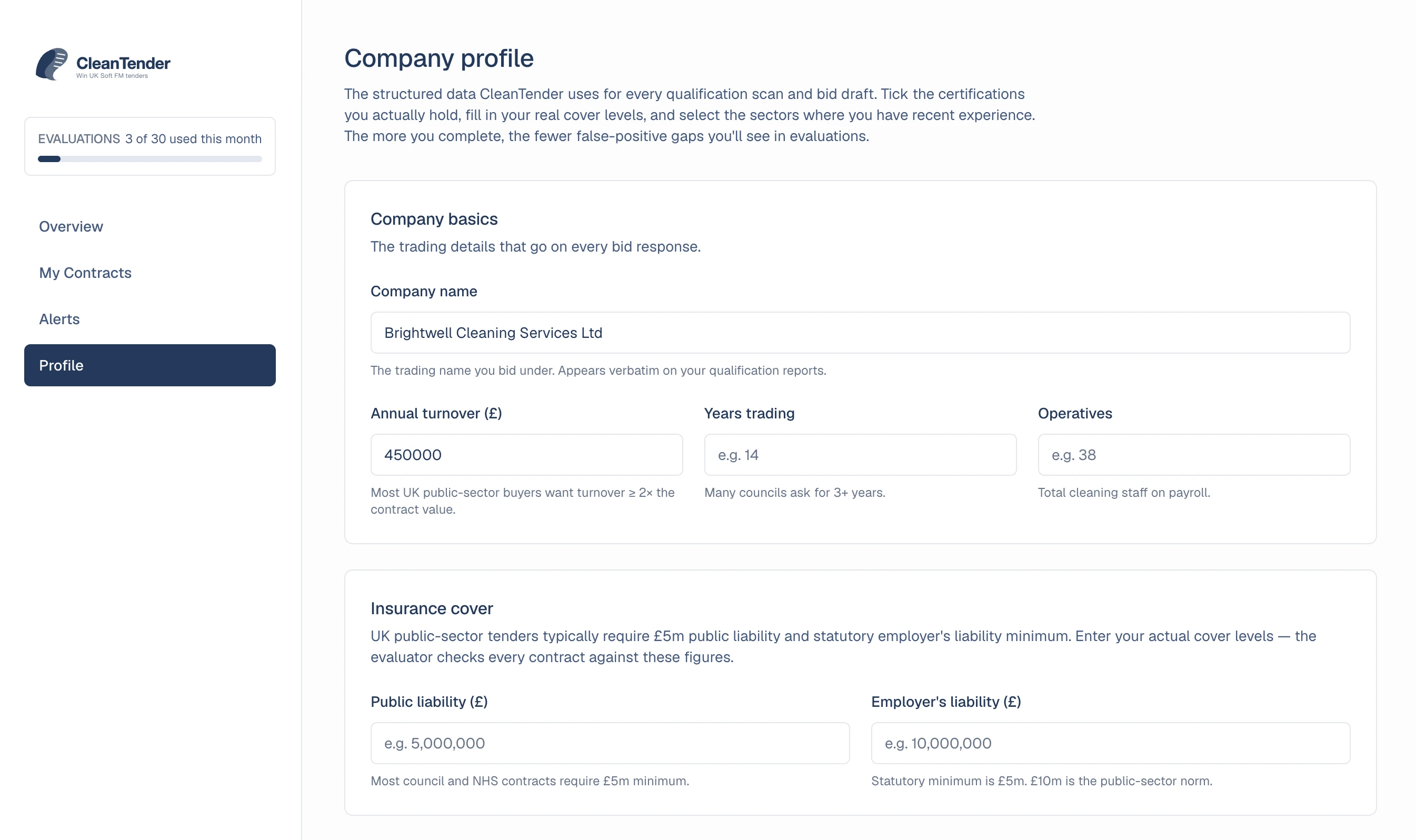
Set your sector to pressure washing, your service regions, CHAS or equivalent SSIP, ISO 9001, ISO 14001, public + employers' liability levels, BS EN 1829-1 fleet schedule, COSHH product schedule, BPR biocide authorisations, BWCA / FWC training credentials, regions and mileage radius, insurance levels, turnover, and operative count. CleanTender uses this to fit-score every live tender against your real capability so you only see the ones you can win.
Profile setup defines what you are bid-ready for Step 2· 5 minutes daily
Open the live pressure washing-tender feed
Every UK every UK council, NHS Trust, MAT, university, MoD, housing association, and transport-body pressure washing, graffiti removal, chewing gum removal, soft washing, and façade cleaning tender tender, in one feed. Pre-filtered to your sector and geography. No false positives, no manual portal-trawling across FTS, Contracts Finder, and dozens of buyer e-procurement portals.
Live feed of in-scope pressure washing tenders, fit-scored Step 3· Daily digest
Get email alerts for new in-scope tenders
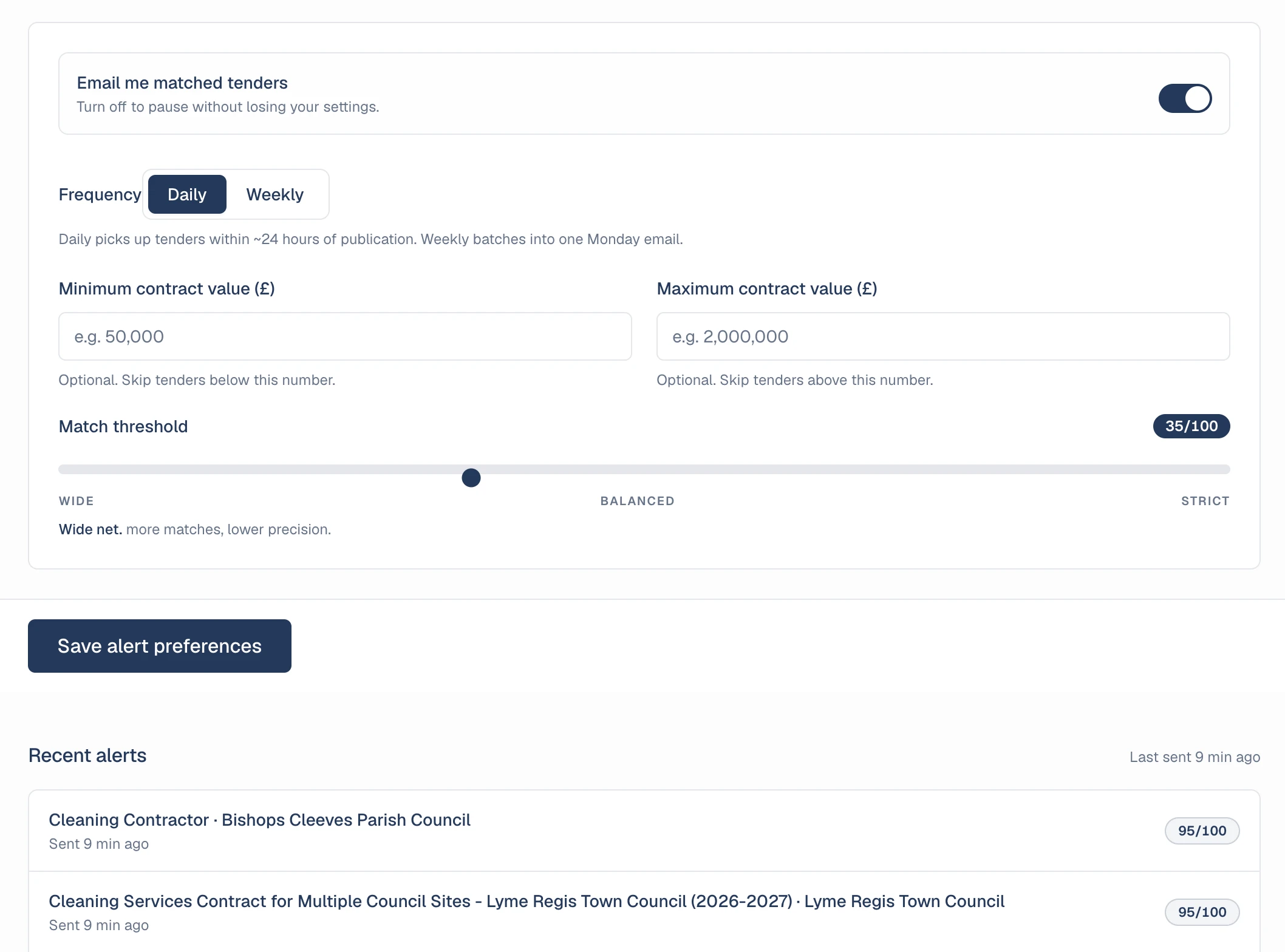
New pressure washing tenders matching your profile land in your inbox the day they publish. CleanTender batches them into a daily digest so you do not get notification fatigue, and links straight back to the in-app fit score.
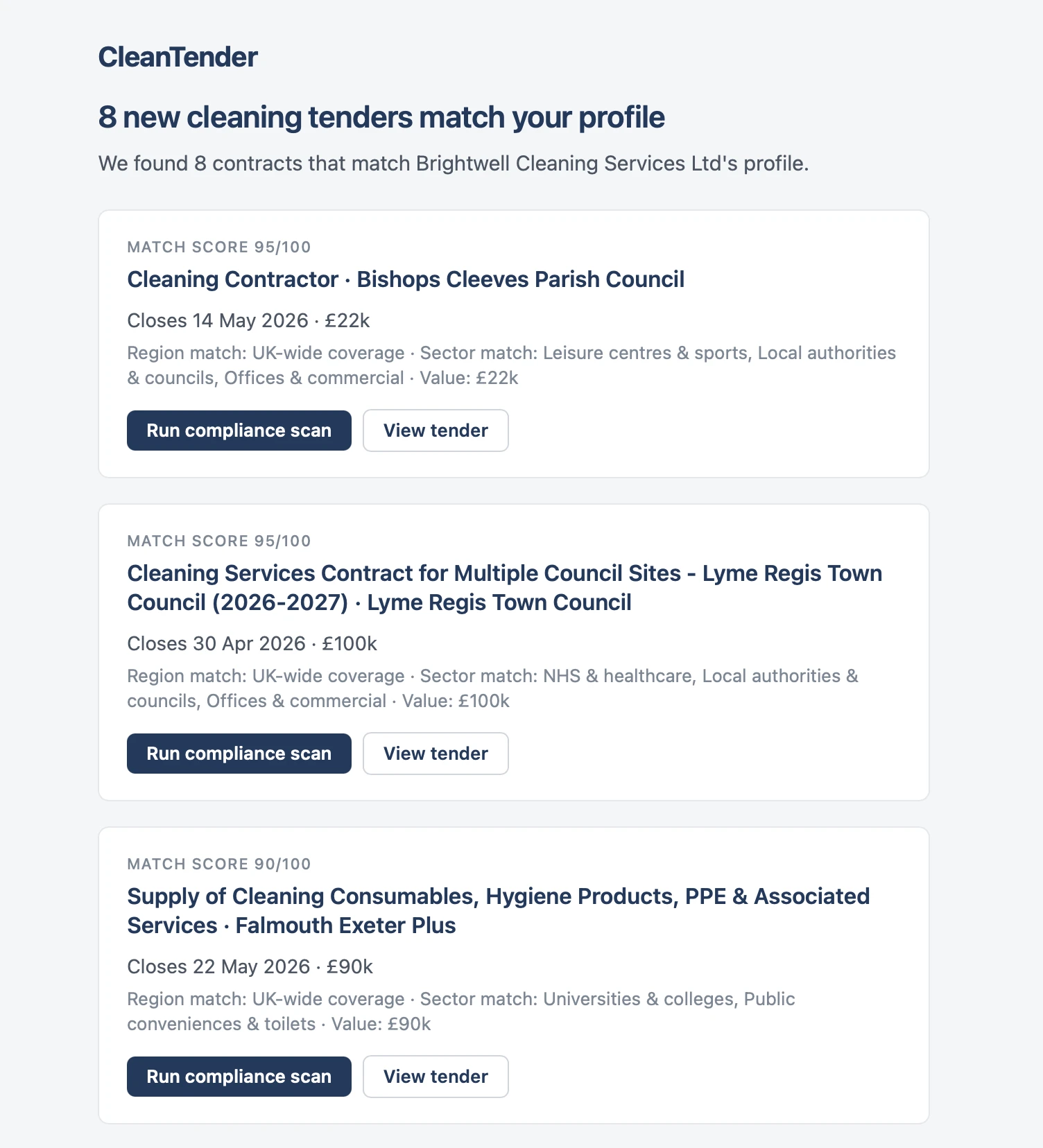
Daily alerts for new in-scope tenders Step 4· 30 seconds
Run a fit-score evaluation on a target tender
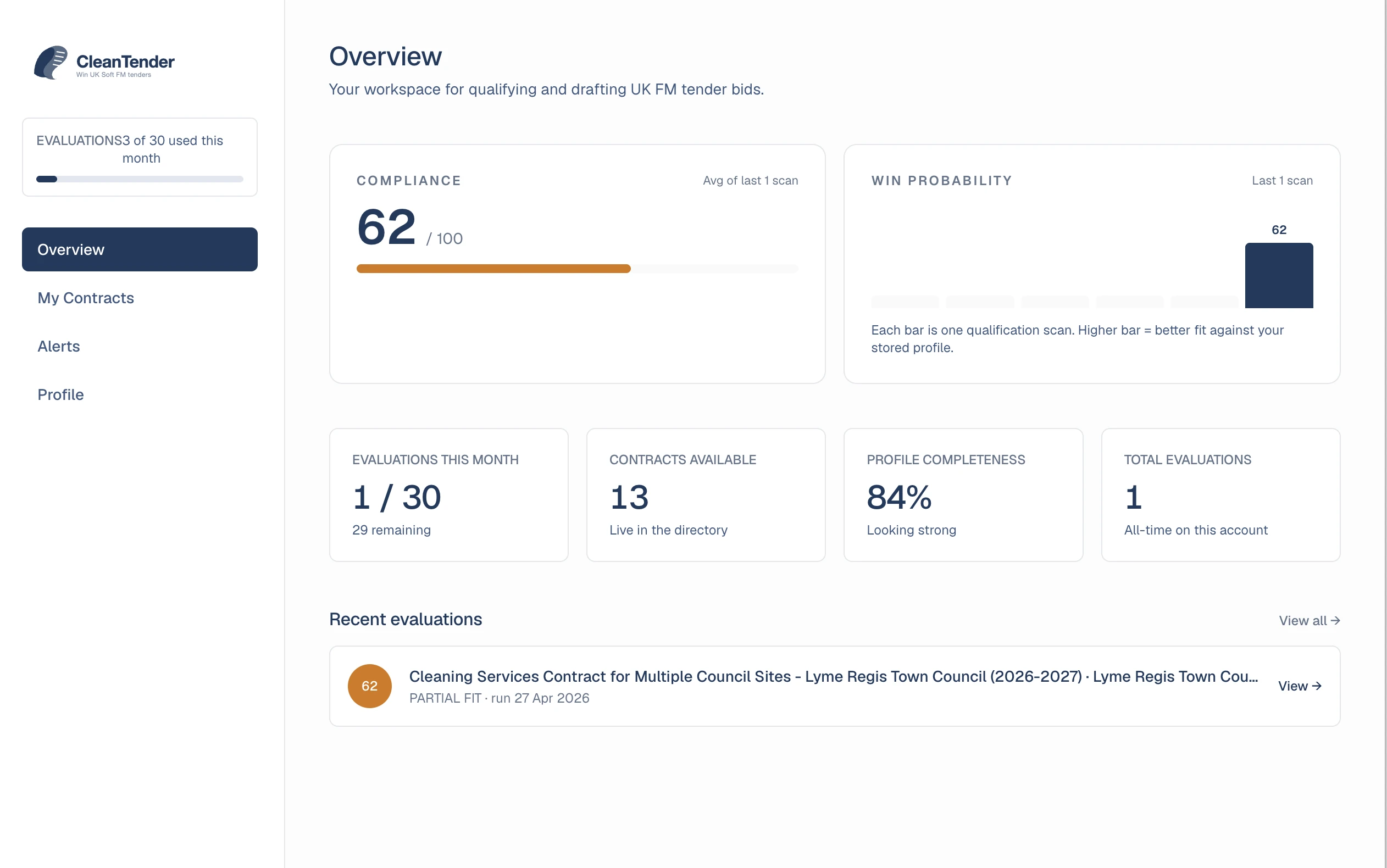
One click runs a CleanTender Evaluation against the tender pack: scope match, geography fit, scale fit, compliance gap, and a plain-English win probability. Stops you bidding contracts you were never going to win.
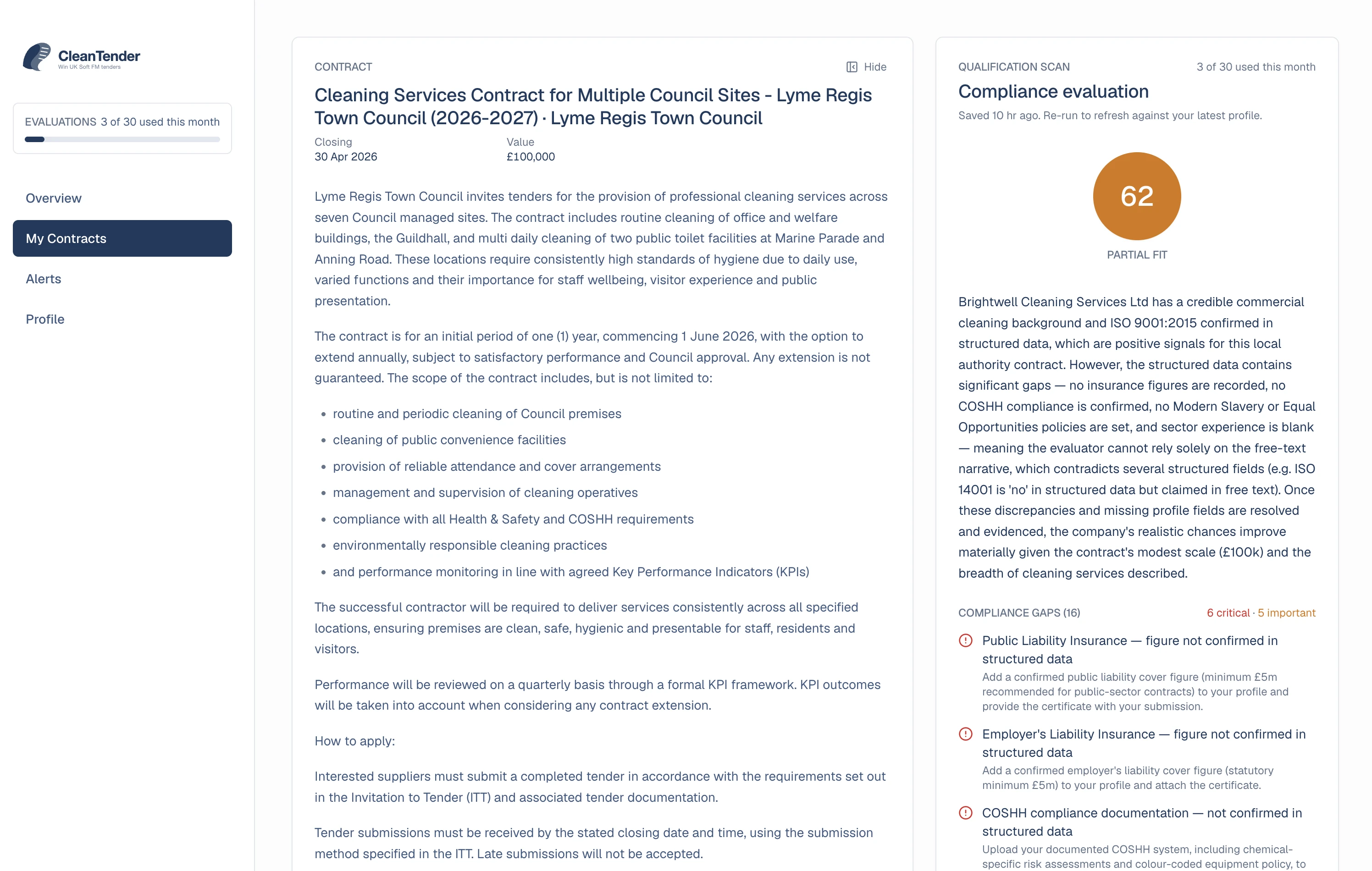
Fit-score and win-probability before you commit a weekend Step 5· 1 minute
Spot compliance gaps before you start drafting
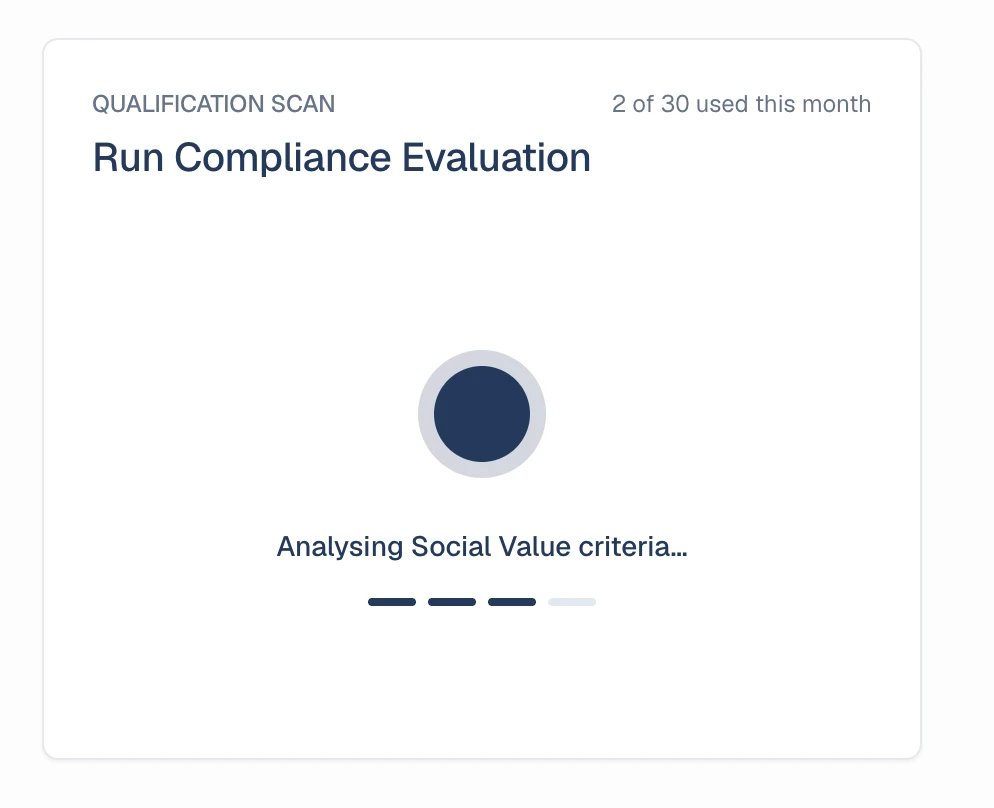
CleanTender runs a named compliance check against the tender pack: GPP 13 wastewater containment, BS EN 1829-1, COSHH, BPR biocide, CHAS, ISO 14001, Working at Height Regs, PPN 002 Social Value, TOMs Outcome 17. Anything missing is flagged before you sink hours into a bid that auto-fails at SQ.
Compliance gaps surfaced before drafting Step 6· 2 minutes generation
Generate a full SQ + method-statement draft
CleanTender drafts a complete Standard Selection Questionnaire response using your profile data and the tender requirements: declaration block, company overview, contract experience, quality, training, COSHH, social value, H&S, insurance schedule. All ten sections, in one pass.
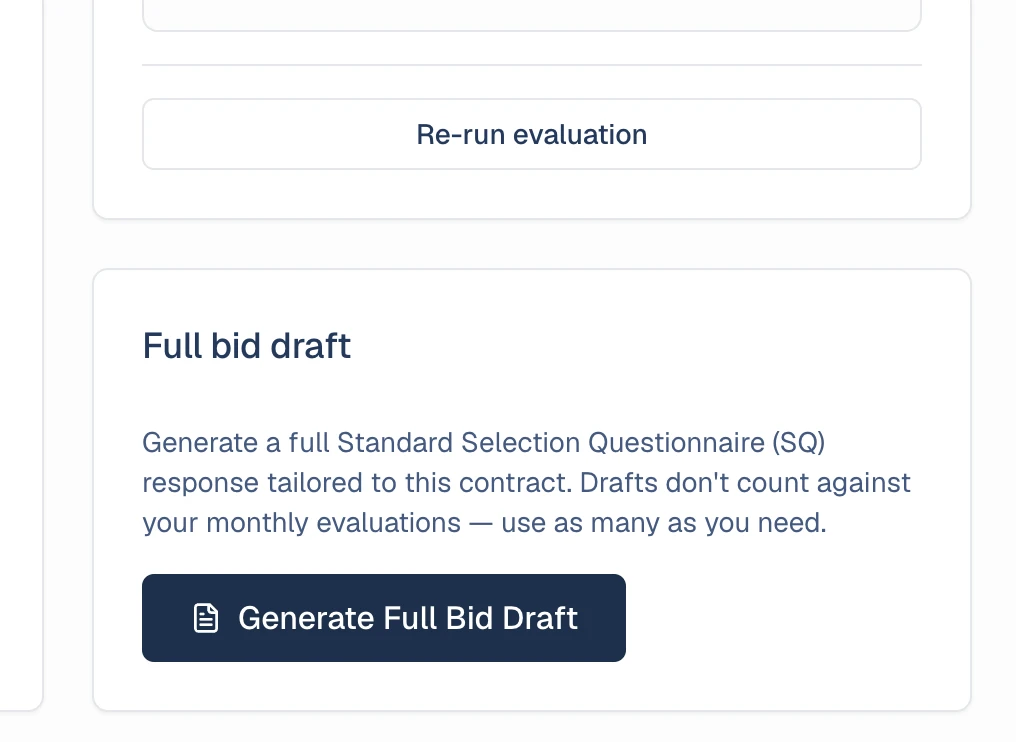
Full SQ draft generated in minutes, not days Step 7· Half a day
Refine, add evidence, and submit
Tune the draft, drop in named referees and certificate numbers, layer your quantified social value commitments, and submit through the buyer's portal. Most users compress a 30-60 hour first bid to 8-12 hours of focused review.
Step 8· Ongoing
Track outcomes and improve
Every bid logs in CleanTender with status, score, and (after standstill) the buyer's feedback. Use the standstill data to tune your next bid. Win rate compounds; first-bid completion is the only thing standing between you and a public-sector revenue line.
Sources
Pressure washing and window cleaning often sit in the same lot. See where window cleaning tenders get published and what buyers ask for at height.
Sources
- Discharges to surface water and groundwater: environmental permits (gov.uk) · Regulatory guidance for England. Underlies the GPP 13 advice on what must not enter surface drains.
- GPP 13: Vehicle washing and cleaning (NetRegs, 2022 update) · Replaces withdrawn PPG 13. Covers high-pressure jet, steam, and hand washing.
- Chewing Gum Task Force (Keep Britain Tidy) · Defra-established scheme. 2026 grant round closed 13 March 2026.
- CHAS — SSIP Certification · Most commonly named SSIP scheme on UK council pressure washing tenders.
- Federation of Window Cleaners (FWC) · British Cleaning Council affiliate. Runs the SAM safety accreditation scheme.
- British Window Cleaning Academy (BWCA) · Training and accreditation in soft washing, roof cleaning, and pressure washing.
- Contracts Finder (gov.uk) · Older procurements started before 24 February 2025. New below-threshold notices now publish on Find a Tender.
- Find a Tender Service (gov.uk) · Lists regulated contracts above £135,018 incl. VAT under the Procurement Act 2023.
- Procurement Act 2023 — guidance (gov.uk) · Most-advantageous-tender rules in force February 2025.
- Social Value Model (PPN 002, gov.uk) · Underlies the TOMs framework used by most English public buyers.
FAQs
Frequently asked questions
- On most council Selection Questionnaires, yes — CHAS or an SSIP-recognised equivalent (SafeContractor, SMAS Worksafe, Acclaim, Constructionline) is the auto-fail line. Without one the technical response is not even read. The accreditation takes 8 to 12 weeks to obtain so start before a bid window opens.
- GPP 13 (Guidance for Pollution Prevention: Vehicle Washing and Cleaning, April 2017) is the UK guidance covering wastewater from high-pressure jet, steam, and hand washing. It replaced PPG 13 when it was withdrawn in December 2015. In Scotland, Wales, and Northern Ireland GPP 13 is directly endorsed by SEPA, Natural Resources Wales, and the Northern Ireland Environment Agency. In England the Environment Agency points to gov.uk regulatory guidance and Water Resources Act 1991 instead. Reference GPP 13 plus the Water Resources Act 1991 in any English bid involving surface drainage risk.
- Public liability £5m and employers' liability of at least £5m (the legal minimum, and most policies carry £10m) are the standard ask. Some council and NHS frameworks require £10m public liability. Always check the SQ insurance clause and have a certificate at the requested level dated within the bid validity period.
- Most councils run a quiet 12 or 24-month rotation. They publish a framework call notice on their own e-procurement portal and (from £30,000 including VAT) on Find a Tender. Submit a short framework SQ with your SSIP, ISO 9001, ISO 14001, COSHH schedule, and unit-rate stack. Once on the framework, you are invited to quote against three-quote mini-comps when jobs land. Watch the council portal directly. Most rotation calls below £30,000 never reach Find a Tender.
- Yes. The Task Force grants go to councils, not contractors. Successful councils subcontract the gum removal work via their normal procurement route, usually a direct invitation off a three-quote framework or a small Find a Tender notice. Keep Britain Tidy publishes the funded council list each year. Set alerts on those councils' e-procurement portals and pitch a gum-specific method statement that cites the 86% reduction benchmark from past Task Force rounds.
- BS EN 1829-1:2021 is the UK-adopted European safety standard for high-pressure water jet machines. PUWER 1998 governs operation. The method statement should name the standard against each machine in the fleet schedule, with PSI, flow rate, nozzle type, hose length, and last PUWER/LOLER inspection date. "All equipment is regularly serviced" is not enough — buyers want named machines and named inspection dates.
- Yes. Biocides used in soft washing (sodium hypochlorite blends, quaternary ammoniums, phenolic compounds) fall under the GB Biocidal Products Regulation (GB BPR) post-Brexit. The product must hold a GB BPR authorisation. Cite the product name, supplier, and GB BPR authorisation reference in the COSHH schedule of the method statement. Environmental procurement reviewers flag missing biocide references as non-compliant.
- Most-Advantageous-Tender (MAT) replaced Most-Economically-Advantageous-Tender (MEAT) in February 2025. Quality, social value, environmental impact, and supplier reliability now sit beside price as scoring axes — price is no longer the implicit default. A transparent unit-rate stack by surface type beats a flat day rate at the same total. Social value sections weighted 10-30% via the TOMs framework are now common.
- Named, quantified, dated. Examples: "80% biodegradable detergent by litre, audited quarterly", "30% reclaimed water on framework jobs above 200m²", "Two out of five vans on HVO by end of year three", "Quarterly free clean for one community asset (war memorial, scout hut) per region". TOMs Theme 4 (Environment), Theme 1 (Jobs), and Theme 5 (Wellbeing) all map well to pressure washing.
- 30 to 45 miles from depot on most council frameworks. Beyond that, hose deployment time, water tank logistics, and effluent disposal mileage erode margin. Some specialist hot-wash and graffiti contracts justify 60+ miles for one-off premium work, but the recurring framework volume only stacks inside a 45-mile radius.