
A commercial cleaning contract is a written agreement between a business and a cleaning provider that defines the scope of cleaning, the frequency of each task, the service levels, the audit method, the TUPE position, the data-handling terms, the insurance evidence, and the pricing.
The buyer cares about a clean, audited, compliant workplace at a defensible price. The contractor cares about a profitable, well-scoped delivery with predictable hours and clear escalation paths. The contract is the document where those two sets of needs are made specific. This guide covers both sides.
The UK commercial cleaning contract landscape in 2026
National Living Wage from 1 April 2026
£12.71
+4.1% rise. Real Living Wage £13.45/hr (London £14.80). The dominant variable in 2026 cleaning prices.
Insurance floor
£5m / £10m
Public liability £5m typical (£10m on large), employers' liability £10m statutory minimum.
Cleaning skills baseline
BICSc CPSS
British Institute of Cleaning Science Professional Skills Suite. 40+ accredited modules.
Healthcare cleanliness standards
NHS NSC 2025
Replaced 2021 standards. Adds ambulance facilities. Required to be written into NHS cleaning contracts.
Find a Tender Service threshold
£135,018
Procurement Act 2023. Contracts above this regulated, must hit FTS notice.
Social Value model
PPN 002
Most English public buyers weight Social Value 10-30% via the TOMs framework.
Related: how to win UK cleaning contracts, cleaning method statement for tenders, COSHH compliance for UK cleaning tenders, TUPE regulations in soft FM tenders, our cleaning tenders overview, and the Procurement Act 2023 for FM suppliers.
What's in this guide
- What a commercial cleaning contract actually is
- The eight clauses every UK contract must include
- How UK commercial cleaning is priced in 2026 (with sector benchmarks)
- Service levels and KPIs: the SLA structure that holds up under audit
- The UK compliance stack: BICSc, NHS NSC 2025, COSHH, BS EN 1276, ISO 9001/14001
- TUPE in commercial cleaning (with worked example)
- GDPR clauses in cleaning contracts
- For BUYERS: how to evaluate a cleaning provider in 10 questions
- For CONTRACTORS: where to find UK commercial cleaning contracts
- For CONTRACTORS: how to get office cleaning contracts
- For CONTRACTORS: bidding methodology and scoring matrix
- For CONTRACTORS: bid or no-bid decision framework
- Outsourced vs in-house cleaning
- How to win, end-to-end, in CleanTender
- FAQs
What a commercial cleaning contract actually is
A commercial cleaning contract is a binding written agreement between a buying organisation (the client) and a service provider (the contractor). It is distinct from a domestic cleaning agreement in three ways: the scope is documented to a room-by-room schedule, the service levels are measurable against a published KPI matrix, and the contract carries TUPE, COSHH, GDPR, and insurance obligations that domestic work does not.
Three contract structures cover roughly 95% of the UK market.
- Fixed-term annual contract. 12 months. Monthly retainer. Auto-renewal unless either party gives 90-day notice. Most common for offices under 50,000 sq ft.
- Multi-year framework contract. 3 to 5 years with annual price-review clauses pegged to RPI, CPI, or Living Wage. Common for NHS Trusts, councils, universities, and housing associations.
- Project / one-off contract. Fixed scope, fixed price, fixed dates. Common for builders' cleans, post-tenancy deep cleans, COVID-era pre-occupancy decontamination, and event clean-down work.
The eight clauses every UK commercial cleaning contract must include
These eight clauses appear in every well-written UK commercial cleaning contract. Missing any of them creates either a buyer dispute risk or a contractor margin trap. Take the list as both a buyer review checklist and a contractor self-audit.
1. Scope schedule (room-by-room)
A room-by-room schedule listing every space in scope. Each row names the area, the surfaces in it (desks, glass, IT kit, kitchens, washrooms), and the agreed cleaning tasks against each surface. Anything not in the schedule is out of scope and chargeable as an extra.
2. Frequency table
A matrix mapping each task to its cleaning frequency. Daily for desks and floors. Weekly for high-touch surfaces. Monthly for windows, light fittings, vents. Quarterly for deep carpet cleaning. Half-yearly for full façade or duct work. Frequency is the variable that flexes price the most.
3. SLA + KPI matrix
Service-level commitments expressed as measurable KPIs. Typical KPIs: 95%+ task-completion compliance score (measured by random audit), response time to ad-hoc requests (4 hours during day, 24 hours overnight), incident reporting within 1 hour, monthly performance report. The KPI table sits at the heart of the contract dispute clause.
4. Audit method
The named method by which task completion is measured. NHS Trusts use the NHS Standards of Healthcare Cleanliness 2025 audit method (a 49-point checklist scored against Functional Risk categories). Other commercial buyers use BICSc's audit framework or an in-house client-rep walk-round template. Whichever, name it.
5. TUPE clause
If the contract is a re-tender of work currently being delivered by an incumbent contractor or by in-house staff, TUPE 2006 applies. The buyer must disclose Employee Liability Information (ELI) before bid submission. The contract must say which party carries the TUPE liability, the indemnity terms, and the consultation timeline.
6. GDPR data processing terms
Cleaners hold keys, hold access fobs, see paperwork on desks, and sometimes view CCTV. The contract must state the lawful basis under UK GDPR for any personal data the contractor processes, the data minimisation commitment, the breach notification timeline (72 hours to ICO), and the subprocessor approval process.
7. Insurance evidence
Named insurance cover with current certificate dates. Public liability £5m minimum for office work, £10m for healthcare, education, or contracts above £150k. Employers' liability £10m (statutory minimum). Professional indemnity £1m on contracts where the contractor advises on cleaning specification or chemical selection.
8. Termination and exit clauses
Three exit triggers: notice (typically 90 days, served in writing), breach (defined by named KPI thresholds missed over consecutive months), and insolvency (immediate). The exit clause should also name handover deliverables: keys returned, files returned, TUPE staff list to incoming contractor, final cleaning audit and snag list.
How UK commercial cleaning is priced in 2026
UK commercial cleaning pricing in 2026 is dominated by labour cost. The National Living Wage rises to £12.71/hour from 1 April 2026 (a 4.1% increase). Real Living Wage employers (including most NHS Trusts, councils, and universities) commit to £13.45/hour (£14.80 in London). Add employer National Insurance, pension auto-enrolment, holiday pay, training time, supervisor overhead, materials, equipment, mobilisation cost, and the contractor's margin, and the published hour-rate to the client lands at roughly 1.7x to 2.4x the operative wage.
Four pricing models cover almost all UK commercial cleaning contracts.
- Hour-based. Client pays for a named number of operative hours per week. Most common in offices, ad-hoc cleans, and ramp-up months. Transparent but exposes the client to scope creep.
- Output-based (per m² or per visit). Client pays for a defined output regardless of hours taken. Most common in NHS, schools, and standardised office estates. Pushes efficiency risk to the contractor.
- Monthly retainer. Fixed monthly sum covering scoped scope and frequency. Most common for multi-year framework contracts. Combines hour-based scope with output-based delivery risk.
- Cost-plus. Client pays operative wage + materials + fixed % margin. Rare outside large healthcare and government. Transparent but admin-heavy.
UK commercial cleaning rates by sector: 2026 benchmarks
Below are 2026 indicative ranges from published UK tender award notices, framework rate cards, and supplier-facing benchmarks. Actual rates flex by region, building complexity, security clearance, and out-of-hours requirement.
| Sector / building type | Hourly rate (operative ex VAT) | Typical annual contract value |
|---|---|---|
| Standard office (under 10,000 sq ft) | £18 - £28 | £15k - £45k |
| Premium office / Grade A central London | £24 - £38 | £40k - £180k |
| NHS Trust general estate | £22 - £34 | £80k - £420k |
| NHS Trust clinical (specialist + deep clean) | £28 - £55 | £140k - £680k |
| School / MAT | £17 - £26 | £18k - £95k |
| University estate | £20 - £32 | £120k - £900k |
| Council civic building | £19 - £30 | £25k - £180k |
| Housing association communal | £18 - £28 | £40k - £280k |
| Retail / supermarket out-of-hours | £17 - £26 | £35k - £220k |
| Industrial / warehouse | £18 - £28 | £25k - £160k |
| MoD estate (security cleared) | £28 - £45 | £140k - £900k |
| Transport (Network Rail, TfL, airports) | £24 - £42 | £180k - £2m+ |
2026 UK commercial cleaning rates. Hourly rates are the published rate to the client (not the operative wage). Annual contract values cover the typical SME-addressable mid-band of each sector.
SLA + KPI structure that holds up under audit
The SLA + KPI matrix is the single most-disputed section of any commercial cleaning contract. Get it specific enough that an evaluator can score the contractor's monthly performance on it without ambiguity, and the contract reads like a defensible document. Vague SLAs ("to a high standard") trigger 4 out of 5 mid-contract disputes.
| KPI | Threshold | Measurement method | Consequence of breach |
|---|---|---|---|
| Task-completion compliance score | ≥ 95% | Monthly random audit of 10% of scoped tasks | 1st month service credit · 2nd consecutive month formal warning · 3rd consecutive month termination right |
| Ad-hoc response time (daytime) | ≤ 4 hours | Helpdesk ticket timestamp to completion | Service credit per missed ticket |
| Ad-hoc response time (overnight) | ≤ 24 hours | Helpdesk ticket timestamp to completion | Service credit per missed ticket |
| Incident reporting | Within 1 hour of identification | Email or portal log to named client rep | Formal warning |
| Operative training compliance | 100% BICSc CPSS Level 1+ | Annual certificate evidence | Operative removed from site until certified |
| Supervisor / site manager presence | Named individual ≥ 80% of shifts | Sign-in log audit | Service credit + manager replacement plan |
| Monthly performance report | By 10th of following month | Email + portal upload | Service credit |
| Customer satisfaction (annual survey) | ≥ 75% positive | Anonymous client-side survey | Improvement plan or termination right |
Eight-point SLA matrix. Most public-sector buyers expect this depth or deeper. Private offices typically run a lighter 4-5 point version.
The UK compliance stack: what every commercial cleaning contract names
A well-written UK commercial cleaning contract names specific standards. Generic compliance claims ("COSHH-compliant", "fully insured", "professional team") score 4/10 against named-standard claims ("BICSc CPSS Level 2 certified operatives, COSHH 2002 chemical schedule audited quarterly, BS EN 1276 surface efficacy verified annually") that score 8-9/10. The named-standard claim is the same job at a higher scoring tier.
- BICSc Cleaning Professional's Skills Suite (CPSS). British Institute of Cleaning Science. 40+ skill modules. Level 1 (operative), Level 2 (advanced operative), Supervisor, Trainer. Most council and NHS commercial cleaning contracts expect CPSS Level 1 or above for all operatives.
- NHS Standards of Healthcare Cleanliness 2025. Replaced the 2021 standards in November 2025. Adds ambulance facilities. Audit method is a 49-point checklist scored against Functional Risk categories (FR1-FR6). Required to be written into NHS cleaning contracts.
- COSHH Regulations 2002. Control of Substances Hazardous to Health. Every chemical product must have a current safety data sheet, GHS classification, and risk assessment. The COSHH schedule is a contract appendix in any serious tender.
- BS EN 1276 (bactericidal efficacy) and BS EN 14476 (virucidal efficacy). The UK-adopted European efficacy standards for disinfectants. Chemical product label must cite the standards. NHS contracts require both.
- BS EN 1276 dilution rates. Buyer audit teams check that operatives are using the product at the dilution rate cited on the BS EN 1276 evidence label. Wrong dilution = no efficacy claim = audit failure.
- ISO 9001 (quality) and ISO 14001 (environmental). Universal expectations on public-sector tenders. Below £40k contracts will often accept commitment-to-attain rather than certification.
- ISO 45001 (health and safety). Increasingly required on healthcare and large estate contracts.
- CHAS, SafeContractor, SMAS Worksafe, or Acclaim Accreditation. SSIP schemes. Mutual recognition under SSIP. Most council and NHS Selection Questionnaires auto-fail without one of these.
- Living Wage Foundation accreditation. Real Living Wage employer. Increasingly required on NHS, council, and university contracts. Sets your operative wage at £13.45/hour (£14.80 in London): above the National Living Wage.
TUPE in commercial cleaning (with worked example)
The Transfer of Undertakings (Protection of Employment) Regulations 2006 apply to most UK commercial cleaning contract changeovers. If a service provider changes (re-tender win) or work transfers between in-house and outsourced, the operatives who worked on the contract transfer to the new contractor on their existing terms. TUPE catches 9 out of 10 UK commercial cleaning changeovers.
Worked example. A council re-tenders its civic building cleaning. The incumbent has 6 cleaners at £12.21/hour (the 2025-26 National Living Wage), all with 3 to 8 years of service. The new contractor must absorb those 6 cleaners on their existing terms, including service-related notice periods, contractual sick pay arrangements, and any contractual pension uplift the incumbent provided. Misprice this and the contractor wins the bid but loses money for the contract's full term.
Three TUPE traps catch first-time contractors out.
- Hidden contractual benefits. The buyer's ELI disclosure must list bonus schemes, health cash plans, additional holiday entitlements, and contractual sick pay. If it does not, ask explicitly before bid submission.
- Unfunded historic pension liabilities. Defined-benefit pension scheme members carry a transfer liability. Public-sector contracts use Best Value Direction or admitted-body status to manage this. Get explicit cover in the contract for any unfunded liability.
- Pre-transfer dismissals. If the incumbent dismisses staff in the period leading up to the transfer to reduce the TUPE workforce, those dismissals are automatically unfair under TUPE and the liability transfers to the new contractor. Audit the workforce list against the previous 6 months of payroll.
GDPR clauses in cleaning contracts
Most commercial cleaning contracts trigger UK GDPR obligations because cleaners hold keys, hold access fobs, see paperwork on desks, sometimes view CCTV, and may move personal-data-bearing assets (recycling bins, document shredders). A compliant contract names the lawful basis, the data categories, the retention period, the subprocessor approval process, and the breach notification timeline. Four clauses cover the bulk of the risk.
- Data Processing Agreement (DPA). Schedule to the main contract identifying the contractor as a data processor and the client as data controller. Names the lawful basis (typically legitimate interests for security or contractual necessity for performance).
- Subprocessor approval. If the contractor uses any subprocessor (a third-party shredding firm, a third-party rota app), the client must approve. The contract should name a 14-day approval window.
- Breach notification. Any data breach must be reported to the client within 24 hours of discovery and to the ICO within 72 hours where required.
- End-of-contract data return / destruction. Keys returned. Access fobs returned. Any client-data held in contractor systems (visitor logs, ID-checking records) returned or destroyed within 30 days.
For buyers: how to evaluate a UK commercial cleaning provider in 10 questions
If you are the client side, these ten questions sort credible UK commercial cleaning providers from the rest. Send the list as a one-page screening document before you ask for a formal proposal. Providers that cannot answer in 24 hours are usually a no.
- What is your SSIP accreditation? CHAS, SafeContractor, SMAS Worksafe, or Acclaim. Ask for the certificate.
- What ISO certifications do you hold? ISO 9001 (quality), ISO 14001 (environmental), ISO 45001 (H&S). Ask for the certificates and audit dates.
- What proportion of your operatives hold BICSc CPSS? Healthy answer: 80%+ at Level 1, supervisors at Level 2+.
- Are you a Real Living Wage employer? Increasingly the dividing line on NHS, council, and university contracts.
- Show me your last three audit scores against the named standard. NHS NSC for healthcare, BICSc for offices, your own audit framework otherwise. Looking for 92%+.
- Show me your COSHH product schedule and BS EN 1276 evidence. Should be a current PDF, not a verbal claim.
- What is your TUPE position on the workforce I am transferring? Looking for a specific cost model and indemnity offer.
- Show me your insurance certificates and current dates. £5m PL minimum, £10m EL statutory, PI if applicable.
- Walk me through a current client at our scale. Reference call, not a logo wall.
- What does your monthly KPI report look like? Ask for an anonymised sample. The format and depth predict the contract relationship.
For contractors: where to find UK commercial cleaning contracts in 2026
Six routes carry the bulk of UK commercial cleaning contract volume. The first three are public-sector. The next two are private-sector. The last is the long tail of three-quote framework work that never appears on a public portal.
- Contracts Finder (gov.uk). Only English procurements that started before 24 February 2025. It is winding down, so check it monthly at most.
- Find a Tender Service (FTS). Since 24 February 2025, new contracts from £12,000 (central government) and £30,000 (councils, schools, NHS) inc VAT, up to multi-year framework calls, NHS Trust estate-wide tenders and MoD estate calls. Filter on CPV 90910000 (cleaning services), 90919200 (office cleaning), 90911200 (residential cleaning), 90911300 (window cleaning).
- Devolved portals. Public Contracts Scotland, Sell2Wales, eSourcing NI. Lower competition than England.
- Procurement consortia. CCS Workplace Services and FM Marketplace (RM6232), YPO Cleaning 1119, ESPO Cleaning 156, NEPO. Framework call-offs across multiple buying units once you are on the lot.
- Private commercial. Office agents (CBRE, JLL, Cushman, Savills) and direct corporate procurement. No public listing. It runs on relationships. Most SMEs underweight this route.
- Under-£30k council framework rotations. Quiet 12 or 24-month rotations published on each council's e-procurement portal. The single largest underserved route for SMEs.
How to get office cleaning contracts
You get office cleaning contracts through four doors: pitching office occupiers directly, getting onto managing agents' supplier lists, subcontracting to facilities management companies, and bidding for public office buildings on the tender portals. The first three are private work with no public notice. The fourth is the only one where you can see every opportunity.
- Direct to the occupier. Owner-occupied offices and single-tenant buildings. The office manager, operations lead or finance director signs. Ask for a walk-round and quote from the site survey, never from floor area alone. Slow, but the contracts stick.
- Managing agents. In a multi-let building the managing agent (CBRE, JLL, Cushman & Wakefield, Savills) buys common-area cleaning on the landlord's behalf. Tenants don't. Get on the approved-supplier list for each agent's regional office, and expect a supplier questionnaire, insurance certificates and a three-quote exercise before any work lands.
- Facilities management companies. Big corporates hand the whole building to an FM provider, who then subcontracts cleaning. Lower margin. Steady volume.
- Public office buildings. Council civic centres, government hubs and NHS admin blocks go to tender on Find a Tender. Set a saved search on CPV 90919200 (office cleaning) and you'll see them the day they publish.
Every door asks for the same proof: the insurance levels above, vetted staff for out-of-hours keyholding, COSHH records, and two or three references from buildings like theirs. Build that pack once.
Our view: a small firm's first handful of office contracts nearly always come from direct approach and referrals. Public tenders come once you have references a scorer can mark. When you're ready for that step, the live cleaning tenders page lists public office and estate contracts as they publish, and how to win UK cleaning contracts covers what the scorer wants to see.
For contractors: the UK bidding methodology and scoring matrix
UK public-sector commercial cleaning bids are scored against a published evaluation matrix. The typical 2026 split is 45% quality (technical), 30% price, 25% social value, though buyers flex this. Each section has its own sub-criteria. Hit the named compliance and named methodology on every sub-criterion and you walk into 8-9 out of 10. Miss them and you cap at 4-5.
| Scoring section | Typical weight | What evaluators look for |
|---|---|---|
| Quality - method statement | 20% | Room-by-room scope, frequency table, named cleaning sequence, supervisor structure, escalation tree |
| Quality - compliance evidence | 15% | BICSc CPSS evidence, NHS NSC alignment (healthcare), ISO 9001/14001/45001 certificates, COSHH schedule, BS EN 1276 efficacy |
| Quality - team and references | 10% | Named site manager, CV evidence, 3 named comparable references with values |
| Price - unit-rate stack | 25% | Transparent unit pricing by hour, by m², by visit, with mobilisation broken out |
| Price - cost stability | 5% | Annual price-review mechanism (Living Wage indexed, RPI-capped) |
| Social Value - environment | 10% | Biodegradable chemical %, dilution control, microfibre vs disposable %, EV / HVO fleet commitment |
| Social Value - jobs and skills | 10% | Local employment %, apprenticeship places, BICSc training pipeline, Real Living Wage commitment |
| Social Value - wellbeing and community | 5% | Quarterly community engagement hours, mental health first-aider commitment, supplier-side EDI evidence |
Typical 2026 UK public-sector commercial cleaning evaluation matrix. Private-sector buyers run a lighter version (price weight is higher, social value weight is lower).
For contractors: bid or no-bid decision framework
A typical SME wastes 12-20 hours writing a commercial cleaning bid. The win rate on poorly-screened bids is under 8%. Six tests applied at the SQ stage protect the win rate of the bids you do submit.
- Distance test. Site outside a 45-mile depot radius without a sub-contractor agreement in place. No-bid. Daily mobilisation kills margin beyond that.
- Accreditation test. Tender names CHAS, SafeContractor, SMAS Worksafe, or Acclaim and you do not hold any of the SSIP-recognised equivalents. No-bid this round, fix for next round (8-12 week lead time).
- TUPE test. Tender pack lists an incumbent workforce in scope. Calculate the cost of the TUPE liability. If it pushes the unit-rate above your competitive range, no-bid.
- Sector test. Healthcare contract requires NHS NSC 2025 alignment and you have no NHS Trust references. No-bid the open-market route; pursue NHS Trust subcontracting first to build references.
- Insurance test. Tender requires £10m public liability and your current policy is £5m. No-bid if the underwriter extension takes longer than the bid validity window (typically 90 days).
- Margin test. Sense-check the unit-rate ceiling implied by the contract value and the FTE-hour requirement. If the implied operative wage drops below the Real Living Wage on a buyer that requires it, no-bid (you cannot win compliantly).
Outsourced vs in-house commercial cleaning
Most large UK organisations outsource cleaning, but the decision is not automatic. Three factors point to in-house. Six point to outsourced. The decision is usually finance-driven on private commercial sites and policy-driven on public sites.
| Factor | Points to in-house | Points to outsourced |
|---|---|---|
| Headcount | Under 8 FTE cleaners on a single site | Multi-site, distributed workforce |
| Security clearance | MoD or similar clearance-mandatory site | Standard commercial |
| Specialist scope | One niche capability the buyer wants to own | Standard cleaning + frequency table |
| Operational flexibility | Want to redirect cleaning staff to other duties | Want fixed-rate, predictable spend |
| TUPE history | Already in-house and stable | Already outsourced and incumbent is solid |
| Compliance burden | Have in-house H&S and HR depth | Want to push BICSc, ISO, SSIP, TUPE to a contractor |
| Cost predictability | Volatile internal labour market | Want contracted unit rates |
| Innovation | Want pilot programmes (robotics, IoT) | Want proven delivery |
| Out-of-hours / 24-7 | Can absorb shift premiums | Want to push shift management to contractor |
Outsourced vs in-house decision factors. Most UK organisations split the decision by building (HQ in-house, satellite offices outsourced) or by service-line (catering in-house, cleaning outsourced).
How to win a UK commercial cleaning tender, step by step
The complete end-to-end flow inside CleanTender. From sector setup to a submitted commercial cleaning bid in the time it used to take to read a single tender pack.
Eight steps from "never bid public sector" to a complete SQ response on the buyer's portal. First scan is free.
Step 1· 10 minutes
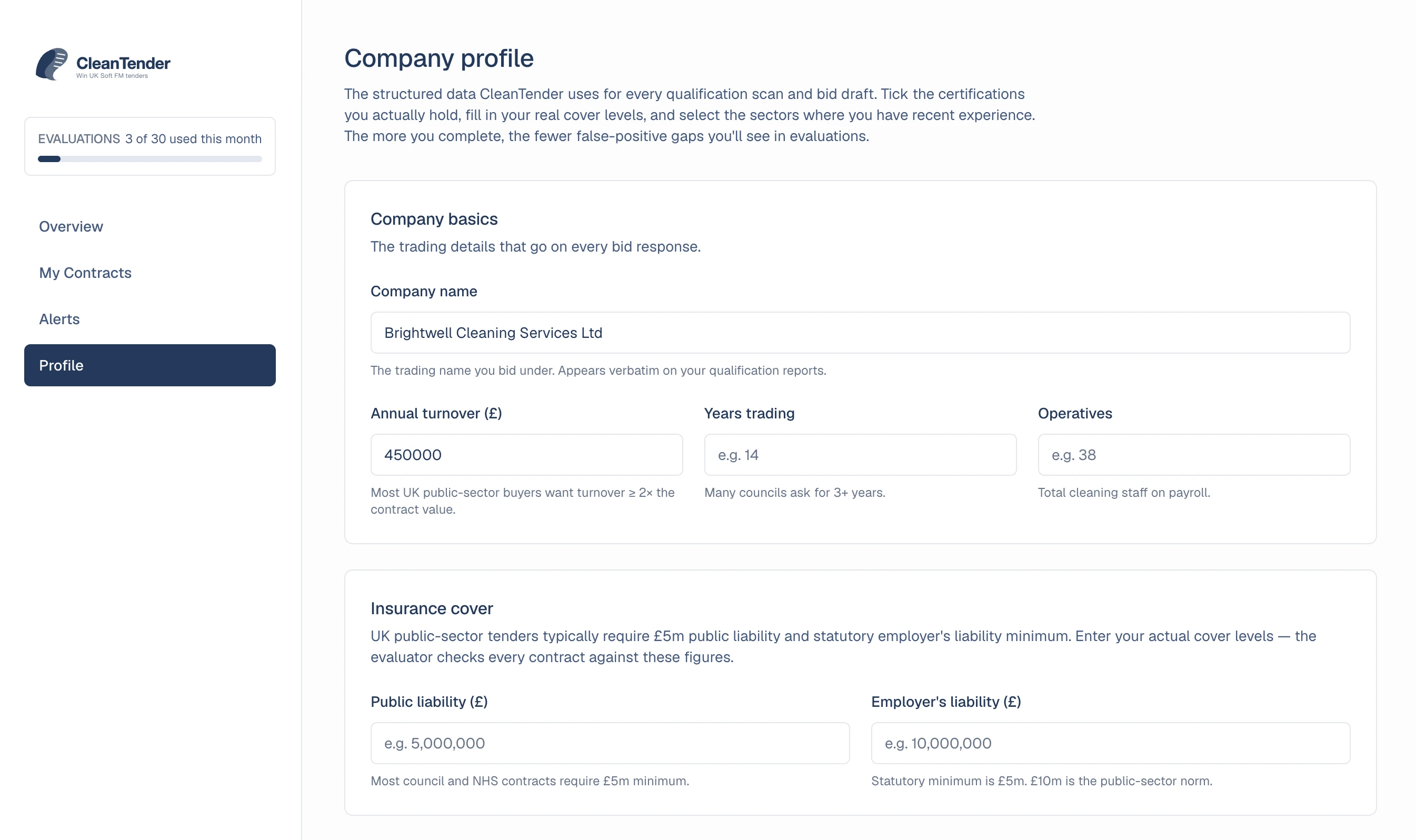
Build your commercial cleaning company profile
Set your sector to commercial cleaning, your service regions, BICSc CPSS evidence, ISO 9001/14001/45001, CHAS or equivalent SSIP, public + employers' liability levels, COSHH product schedule, BS EN 1276 efficacy evidence, Real Living Wage status, regions and mileage radius, insurance levels, turnover, and operative count. CleanTender uses this to fit-score every live tender against your real capability so you only see the ones you can win.
Profile setup defines what you are bid-ready for Step 2· 5 minutes daily
Open the live commercial cleaning-tender feed
Every UK every UK office, NHS Trust, school, university, MoD, council, housing association, retail, industrial, and transport commercial cleaning tender tender, in one feed. Pre-filtered to your sector and geography. No false positives, no manual portal-trawling across FTS, Contracts Finder, and dozens of buyer e-procurement portals.
Live feed of in-scope commercial cleaning tenders, fit-scored Step 3· Daily digest
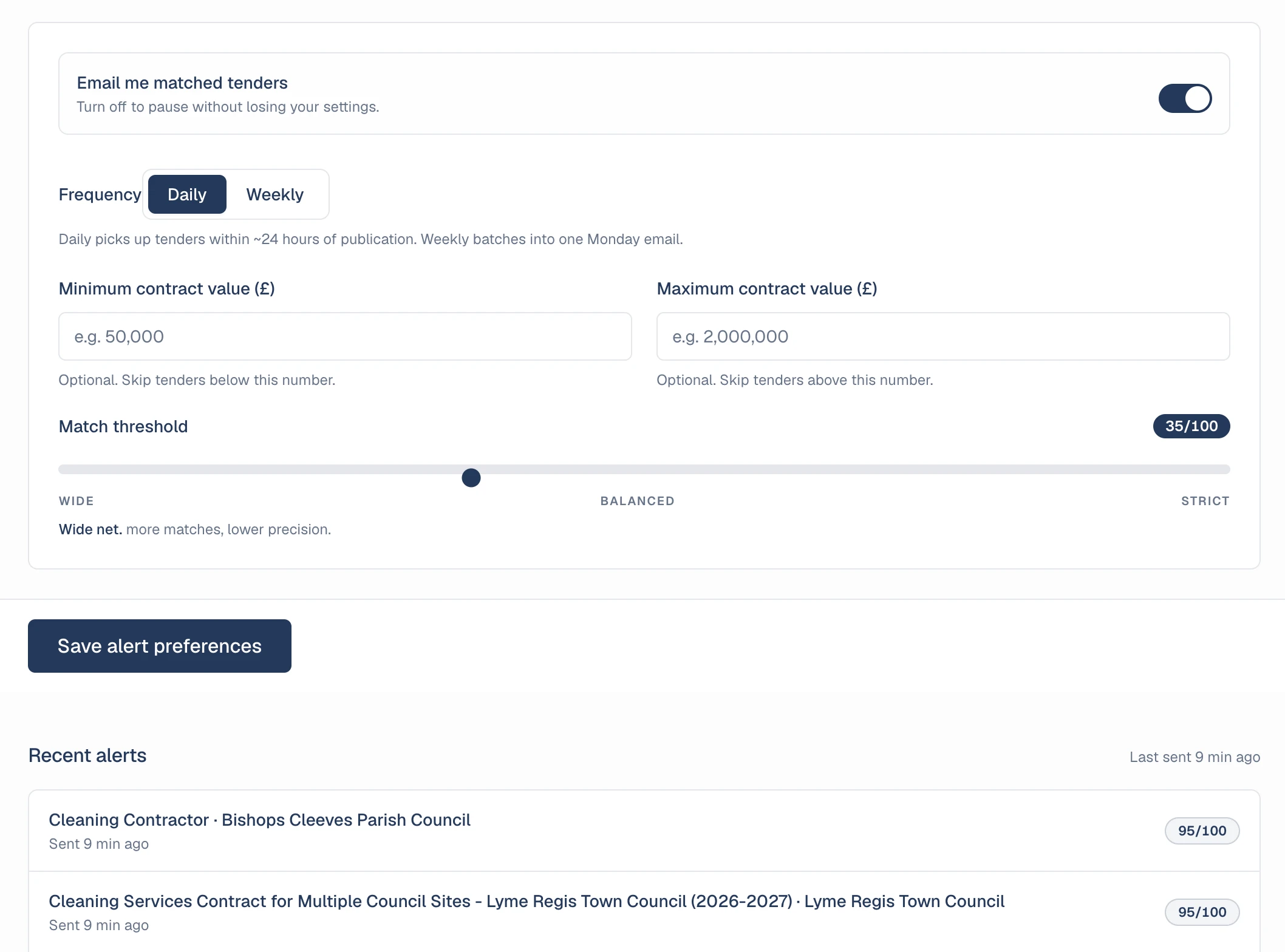
Get email alerts for new in-scope tenders
New commercial cleaning tenders matching your profile land in your inbox the day they publish. CleanTender batches them into a daily digest so you do not get notification fatigue, and links straight back to the in-app fit score.
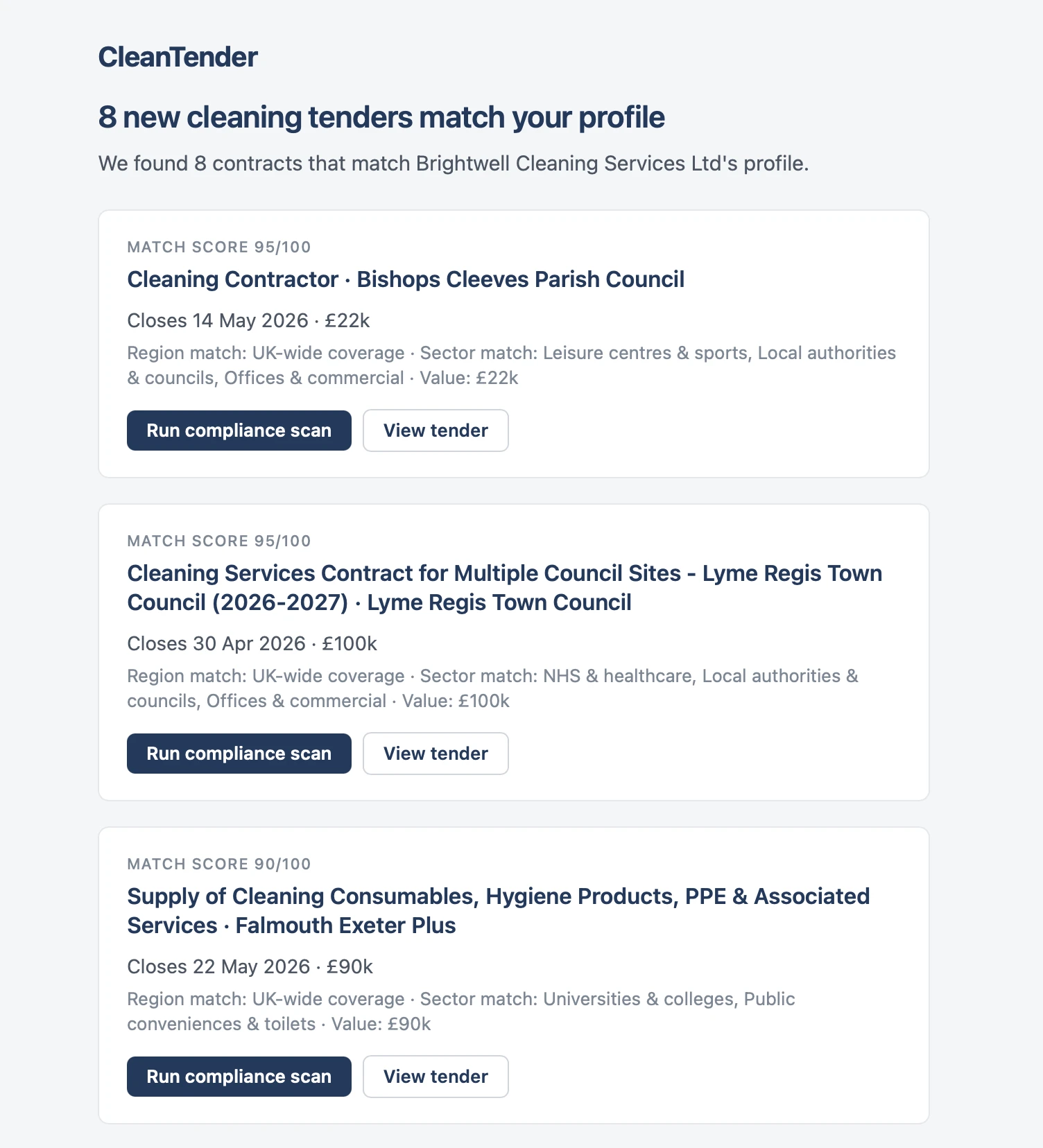
Daily alerts for new in-scope tenders Step 4· 30 seconds
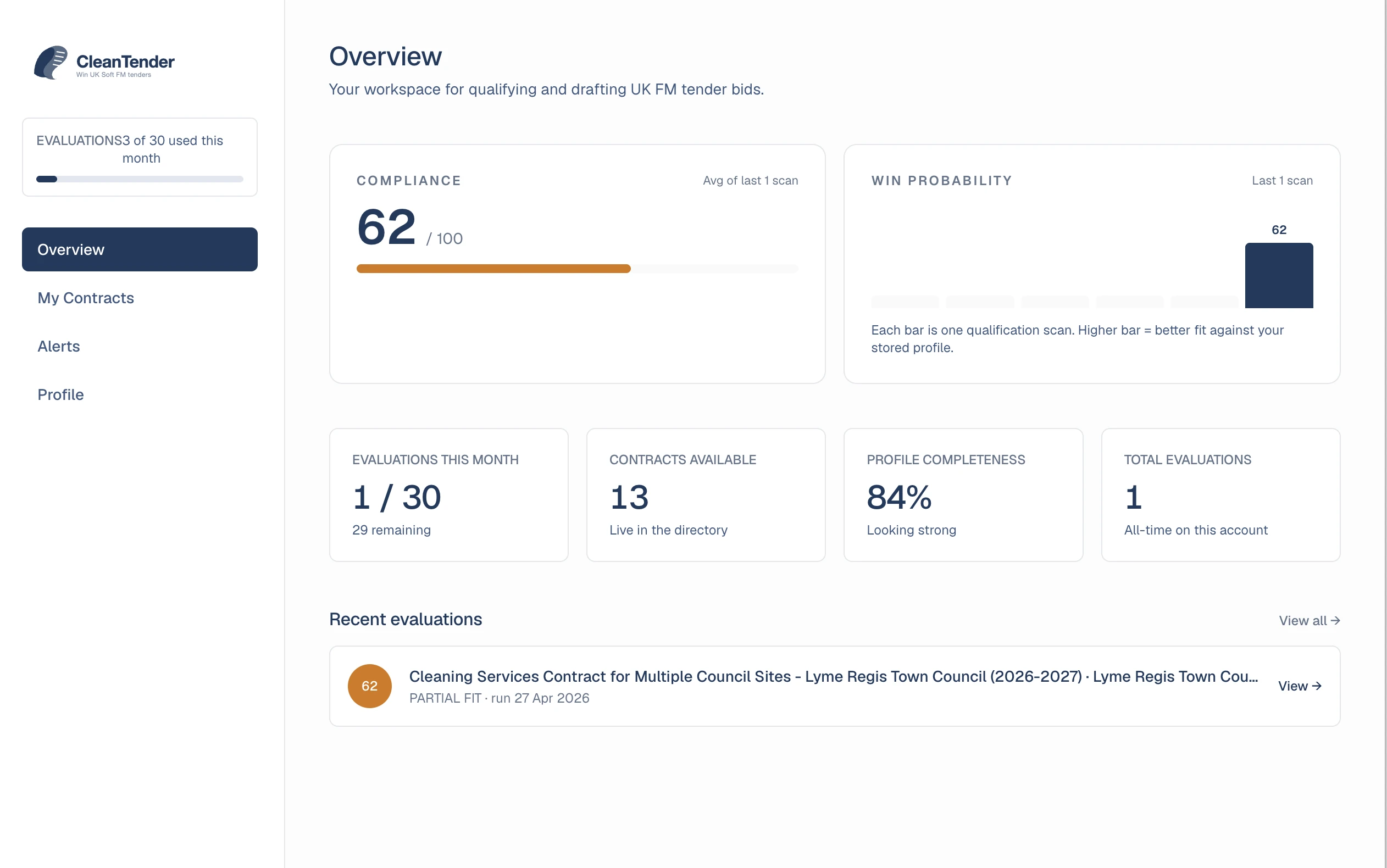
Run a fit-score evaluation on a target tender
One click runs a CleanTender Evaluation against the tender pack: scope match, geography fit, scale fit, compliance gap, and a plain-English win probability. Stops you bidding contracts you were never going to win.
Fit-score and win-probability before you commit a weekend Step 5· 1 minute
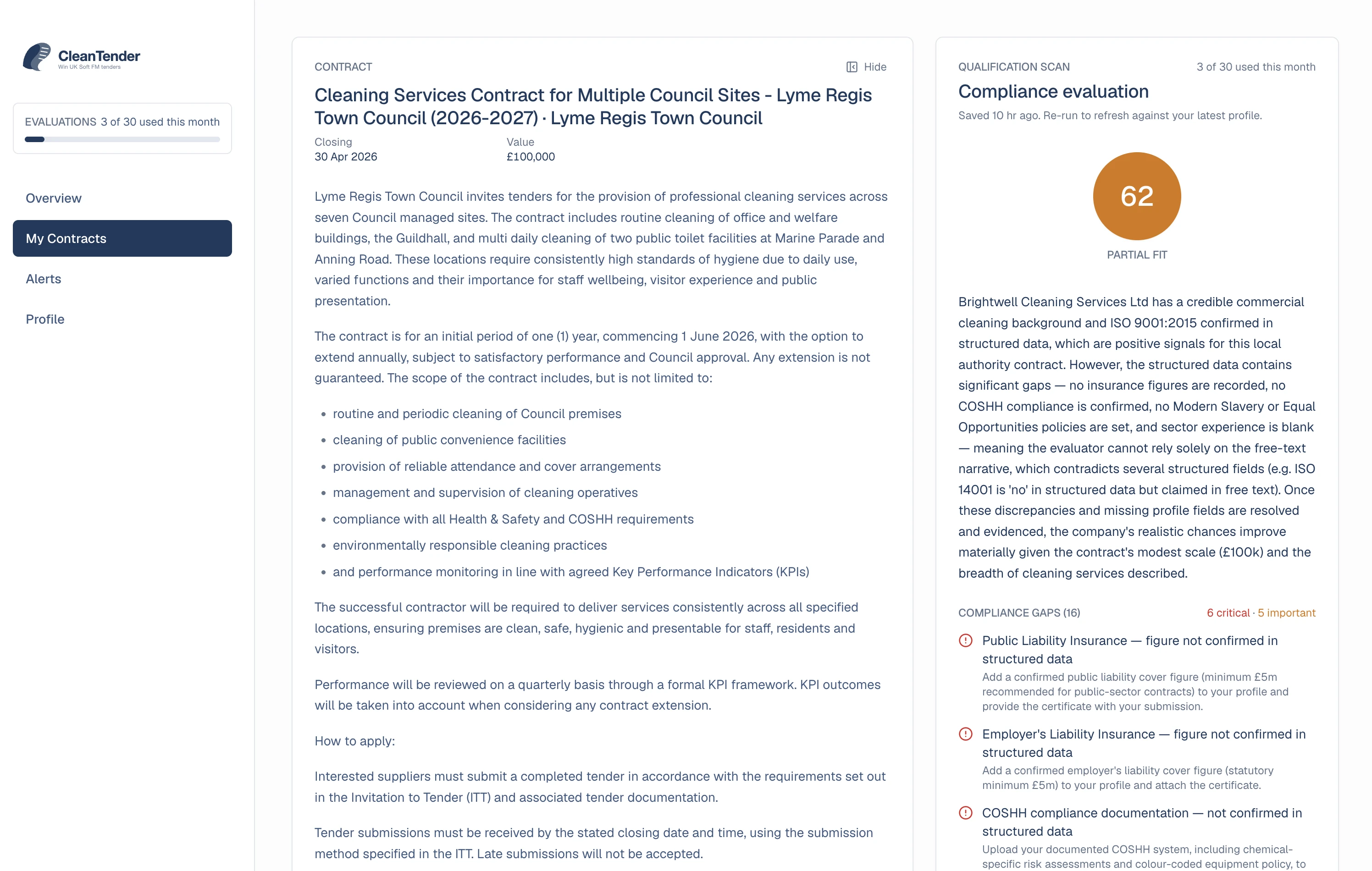
Spot compliance gaps before you start drafting
CleanTender runs a named compliance check against the tender pack: BICSc CPSS, NHS Standards of Healthcare Cleanliness 2025, COSHH 2002, BS EN 1276, BS EN 14476, ISO 9001, ISO 14001, TUPE 2006, GDPR, PPN 002 Social Value. Anything missing is flagged before you sink hours into a bid that auto-fails at SQ.
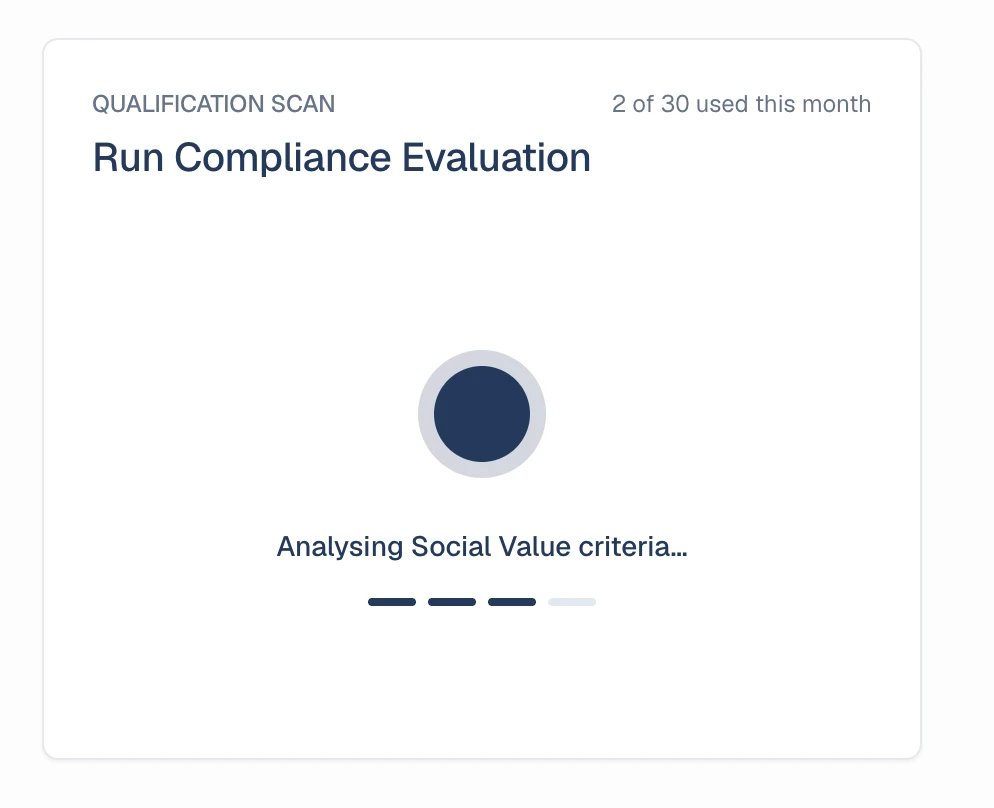
Compliance gaps surfaced before drafting Step 6· 2 minutes generation
Generate a full SQ + method-statement draft
CleanTender drafts a complete Standard Selection Questionnaire response using your profile data and the tender requirements: declaration block, company overview, contract experience, quality, training, COSHH, social value, H&S, insurance schedule. All ten sections, in one pass.
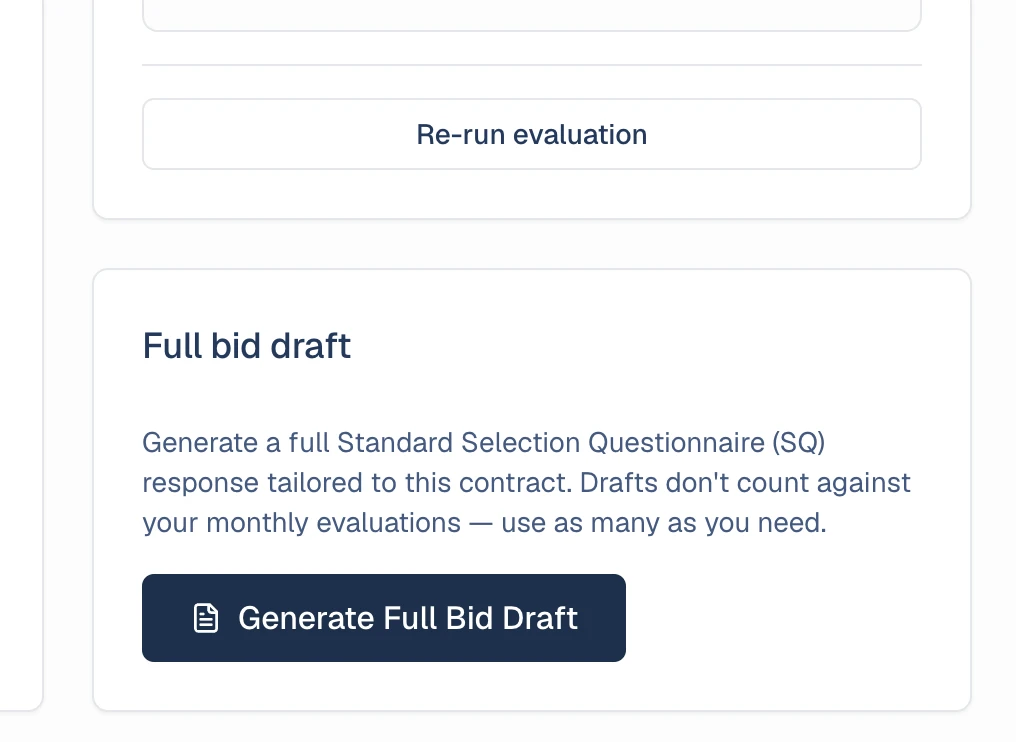
Full SQ draft generated in minutes, not days Step 7· Half a day
Refine, add evidence, and submit
Tune the draft, drop in named referees and certificate numbers, layer your quantified social value commitments, and submit through the buyer's portal. Most users compress a 30-60 hour first bid to 8-12 hours of focused review.
Step 8· Ongoing
Track outcomes and improve
Every bid logs in CleanTender with status, score, and (after standstill) the buyer's feedback. Use the standstill data to tune your next bid. Win rate compounds; first-bid completion is the only thing standing between you and a public-sector revenue line.
Sources
Winning clients one at a time is slow. Some firms buy an existing book instead, which the guide to cleaning contracts for sale weighs up honestly, TUPE and all.
Public education work runs on different rules from office contracts. The guide to school cleaning tenders explains them.
Sources
- National Standards of Healthcare Cleanliness 2025 (NHS England) · Replaced the 2021 standards. Adds ambulance facilities. Required to be written into NHS cleaning contracts.
- British Institute of Cleaning Science (BICSc) · Cleaning Professional's Skills Suite (CPSS). 40+ accredited modules. Industry baseline qualification.
- National Minimum Wage and National Living Wage rates (gov.uk) · Statutory rates including the £12.71/hr National Living Wage from April 2026.
- Living Wage Foundation · Real Living Wage £13.45/hr (London £14.80). Voluntary, but increasingly contractual on NHS, council, and university tenders.
- Contracts Finder (gov.uk) · Older procurements started before 24 February 2025. New below-threshold notices now publish on Find a Tender.
- Find a Tender Service (gov.uk) · Procurement Act 2023 regulated-contract threshold £135,018 incl. VAT.
- Procurement Act 2023: guidance (gov.uk) · Most-Advantageous-Tender (MAT) replaced MEAT in February 2025.
- Social Value Model (PPN 002, gov.uk) · Used by most English public buyers via the TOMs framework (5 themes, 28 outcomes, 147 measures).
- CHAS: SSIP Certification · Most commonly required SSIP scheme on UK commercial cleaning tenders.
- HSE: COSHH (Control of Substances Hazardous to Health) · Underlies every cleaning chemical schedule and risk assessment.
- TUPE Regulations 2006 (legislation.gov.uk) · Catches 9 out of 10 UK commercial cleaning contract changeovers.
- ICO: Data sharing and processing (UK GDPR) · UK GDPR enforcement and guidance.
FAQs
Frequently asked questions
- Start with offices near your existing staff and approach them four ways. Pitch owner-occupied offices directly, asking for a walk-round so you quote from a site survey. Get onto managing agents' approved-supplier lists (CBRE, JLL, Cushman & Wakefield, Savills), because in multi-let buildings the agent buys common-area cleaning, not the tenants. Offer to subcontract for facilities management companies that run whole buildings. And set saved searches on Find a Tender for public office buildings such as council civic centres and NHS admin blocks. Have your insurance certificates, COSHH records, vetted keyholding staff and two or three references ready before you pitch. Most small firms win their first office contracts through direct approach and referrals, then move on to public tenders.
- A commercial cleaning contract is a written agreement between a business and a cleaning provider that defines the scope of cleaning, the frequency of each task, the service levels (SLAs), the audit method, the TUPE position, the data-handling terms (UK GDPR), the insurance evidence, and the pricing. It runs from 12 months to 5 years for most office and estate work. Verbal cleaning arrangements are not commercial contracts.
- Hourly rates to the client run £18-£28 for standard offices, £24-£38 for premium central London, £22-£34 for NHS general estate, £28-£55 for NHS clinical, £20-£32 for universities, £19-£30 for council civic. The dominant variable is the National Living Wage at £12.71/hour from April 2026. Real Living Wage employers (most NHS, councils, universities) pay £13.45/hour (£14.80 London). Total contract value depends on hours per week, frequency, building size, security clearance, and out-of-hours premium.
- Eight clauses are non-negotiable in 2026: (1) room-by-room scope schedule, (2) frequency table by task, (3) SLA + KPI matrix with measurable thresholds, (4) named audit method (NHS NSC 2025 for healthcare, BICSc-based for offices), (5) TUPE 2006 clause naming who carries the liability, (6) UK GDPR data processing terms, (7) insurance evidence (£5m PL minimum, £10m EL statutory), (8) termination and exit clauses with named notice period and breach thresholds.
- Yes, in 9 out of 10 changeovers. The Transfer of Undertakings (Protection of Employment) Regulations 2006 apply where the cleaning service transfers from one provider to another, or between in-house and outsourced. The incumbent workforce transfers to the new provider on their existing terms. The buyer must disclose Employee Liability Information (ELI) before bid submission. Misprice the TUPE liability and the contractor wins the bid but loses money for the contract term.
- BICSc is the British Institute of Cleaning Science. Its Cleaning Professional's Skills Suite (CPSS) is the UK baseline qualification for cleaning operatives. Most public-sector commercial cleaning contracts expect CPSS Level 1 or above for all operatives. Healthcare and university contracts typically require Level 2 for supervisors. Naming BICSc CPSS in the contract turns a generic 'trained staff' claim into a scoring-tier-up named compliance claim.
- The NHS Standards of Healthcare Cleanliness 2025 is the audit and specification framework that applies to all NHS healthcare cleaning. It replaced the 2021 standards in November 2025 and adds explicit responsibilities for ambulance facilities. The audit method is a 49-point checklist scored against Functional Risk categories (FR1-FR6). Any commercial cleaning contract with an NHS Trust must reference NSC 2025 as the audit standard.
- On most public-sector and large private commercial cleaning contracts, yes. CHAS or an SSIP-recognised equivalent (SafeContractor, SMAS Worksafe, Acclaim Accreditation, Constructionline) is the auto-fail line at Selection Questionnaire stage. Without one the technical response is usually not even read. Allow 8-12 weeks to obtain the accreditation if you are starting from scratch.
- Eight common KPIs: task-completion compliance ≥95% (monthly random audit), ad-hoc response ≤4 hours daytime / ≤24 hours overnight, incident reporting within 1 hour, operative training 100% at BICSc CPSS Level 1+, named supervisor present ≥80% of shifts, monthly report by 10th of following month, annual customer satisfaction ≥75%. Breaches trigger service credits, then formal warnings, then termination rights typically after 3 consecutive missed months.
- Three differences. (1) Scope: commercial contracts have room-by-room schedules, domestic contracts cover a whole property under a single line. (2) Compliance: commercial contracts trigger TUPE, COSHH, GDPR, and (for healthcare) NHS NSC obligations, domestic ones do not. (3) Insurance and audit: commercial contracts require £5m+ public liability evidence and a measurable audit method, domestic ones typically run on trust.
- Three durations dominate. (1) 12-month annual contracts with 90-day notice and auto-renewal, common for offices under 50,000 sq ft. (2) Three- to five-year framework contracts with annual price-review clauses, common for NHS Trusts, councils, universities, housing associations. (3) Project / one-off contracts with fixed dates, common for builders' cleans, post-tenancy deep cleans, and event clean-downs.
- Yes. SMEs win disproportionately well on UK public-sector commercial cleaning where (a) the work is geographically constrained within a 45-mile depot radius, (b) the technical scoring rewards specific named compliance (BICSc, COSHH, BS EN 1276) over generic claims, and (c) social value scoring favours local employers, local apprenticeships, and named community engagement. The competitor mix on a typical council framework is 2-4 SMEs against 1-2 national contractors.