
Yes, you can buy private cleaning contracts and rounds in the UK. Business brokers list them, owners sell them directly, and franchise networks resell territories. You can't buy public-sector cleaning contracts. Councils, NHS Trusts and schools award those through tenders, and a contract only moves to a new supplier with the buyer's say-so.
Our take: buying makes sense when you want dense routes fast and the seller's clients are loyal to the service, not the owner. For everything else, and for all public work, bidding is the cheaper route to the same turnover.
If you're new to how commercial contracts are priced and scoped in the first place, start with our commercial cleaning contracts guide. It gives you the hourly rates and contract values you'll need to sanity-check any asking price. And if you're weighing growth routes because the bidding side feels closed to a young company, whether a new business can win a government tender answers that head on (short version: yes).
What's in this guide
- How to assess cleaning contracts for sale, step by step
- Where contracts for sale actually come from
- TUPE: the staff come with the round
- Assignment, novation and client consent
- How valuation works (without made-up multiples)
- Buying vs winning: the cost comparison
- Why public-sector contracts can't be bought
- When buying is the right call
How to assess cleaning contracts for sale, step by step
Run every listing through these seven checks before you talk money. Most deals fail at step two or three, so those come early.
Step 1
Map the sites against your routes
Plot every site on the list against where your teams already work. A round 40 minutes from your nearest site adds travel cost and a supervisor headache. A round that fills gaps in your existing routes is the one worth paying for.
Step 2
Read each contract for assignment and change-of-control clauses
Ask for the signed contracts, not a summary sheet. Look for any clause that says the contract can't pass to another business without the client's written consent, and for a clause letting the client terminate if the seller's ownership changes.
Step 3
Check notice periods and remaining term
A lot of private cleaning agreements run on short notice periods. A contract the client can end on 30 days' notice is worth far less than one with 18 months fixed. Write the real exit date next to every site.
Step 4
Get the TUPE employee information early
Ask for staff names (anonymised is fine at first), hours, pay rates, length of service, holiday owed and any open grievances or claims. This is the liability you inherit on completion.
Step 5
Test client loyalty
Ask how long each client has been with the seller and who the client actually deals with. If every relationship runs through the owner who's leaving, expect some clients to walk.
Step 6
Price on retained revenue, with a holdback
Value the round on the contracts you expect to keep, not the ones on the list. Structure part of the price as deferred or tied to retention after a set period.
Step 7
Get a solicitor to review the sale agreement
Warranties, indemnities for pre-transfer employment claims, and the mechanism for getting client consents all belong in the paperwork. This is not a handshake deal.
Where contracts for sale actually come from
Three channels. Each has a different catch.
- Business brokers and for-sale listing sites. The widest choice and the most competition. Listings describe turnover and site counts, rarely the contract terms. Treat every figure as a claim until you've read the paperwork.
- Franchise resales. A franchisee sells their territory and client book, usually with the franchisor's approval and a transfer fee. You get a system and brand. You also get the franchise agreement's rules.
- Direct approaches. Often the best deals. An owner heading for retirement, a competitor that overstretched, a one-person operator tired of 5am starts. No broker fee, and you can ask awkward questions early. Local trade networks and your own suppliers hear about these first.
What you're buying in every case is a set of private agreements with offices, retailers, managing agents, gyms and the like. Not council work. Not NHS work. More on why below.
TUPE: the staff come with the round
This is the part buyers underprice. When you take over a cleaning round, the cleaners who work on those sites will usually transfer to you under the Transfer of Undertakings (Protection of Employment) Regulations 2006. Regulation 3 covers both a business transfer and a service provision change, where a contractor stops doing the work and a new one starts. A cleaning round sale fits one or both.
- Same terms. Under regulation 4, transferring staff keep their contract terms and length of service. You can't cut pay because the round changed hands.
- Liabilities move too. Holiday owed, unpaid wages and most pre-transfer employment claims pass to you. That's why the indemnity in the sale agreement matters.
- Information comes late unless you ask. Regulation 11 makes the seller give you employee liability information at least 28 days before the transfer. Ask for it before you agree a price, not after.
- Consultation is compulsory. Regulation 13 requires both employers to inform (and in some cases consult) the affected staff. Skip it and you face a compensation claim.
- Share purchase? Different rule.
That last point matters. If you buy the company itself (its shares) rather than its contracts, the employer doesn't change, so TUPE doesn't apply to the sale. The staff stay with the same company and you inherit everything that company owes. For the full picture of what TUPE means in soft FM contracts, including how pensions and pay protection work, read our TUPE guide for soft FM tenders. To put a number on the workforce you'd inherit, run the hours and pay rates through the TUPE cost estimator before you make an offer.
Assignment, novation and client consent
A contract is an agreement between two named parties. The seller can't just hand it to you. Two routes exist.
| Route | What moves | Who has to agree | What to watch |
|---|---|---|---|
| Assignment | The seller's rights under the contract (mainly the right to be paid) | The client, if the contract bans assignment without consent (most well-drafted ones do) | The seller can stay on the hook for obligations. Make sure the sale agreement deals with that. |
| Novation | The whole contract. You replace the seller as a party | Always the client, plus seller and buyer, in a three-way agreement | Cleanest result. Slowest to get signed, because every client has to act. |
| Share purchase | Nothing. The same company keeps the contracts | Usually nobody, unless the contract has a change-of-control clause | You inherit every historic liability. Heavier due diligence. |
Get a solicitor to confirm which route each contract allows. The clause wording decides it, not the label on the sale listing.
Here's the practical risk. Asking a client to consent is also inviting them to reconsider. Some will use the moment to go out to quote. Price that in.
How valuation works (without made-up multiples)
You'll see rules of thumb quoted online, usually a multiple of annual contract value or profit. We haven't found a published, sourced benchmark for UK cleaning rounds that we'd stand behind, so we won't give you a number. What we can give you is how a sensible buyer builds the price.
- Start with the annual profit each contract actually makes after wages, holiday cover, supplies, travel and supervision. Not turnover. A £40,000 contract making 6% is worth less than a £20,000 one making 20%.
- Discount for contracts that could leave soon: short notice periods, owner-dependent relationships, or a client already grumbling about standards.
- Deduct inherited liabilities: accrued holiday, any pay below the rates you'd need to stay legal, pending claims.
- Add value for route density. A round next to yours saves travel and supervisor time. That saving is real money and it's yours, not the seller's.
- Hold back part of the price and release it only for clients still trading with you after an agreed period. Sellers who believe in their book accept this.
Buying vs winning: the cost comparison
Both routes cost money. They cost it in different places. Plug your own figures in below. The numbers in brackets are placeholders for your calculation, not market rates.
| Cost line | Buying a round | Winning a tender yourself |
|---|---|---|
| Upfront price | [Agreed purchase price] | None |
| Professional fees | Solicitor, possibly accountant and broker fee | None, unless you pay a bid writer |
| Staff | Inherited TUPE workforce and their accrued liabilities | Incoming TUPE staff on public re-tenders too (priced into your bid) |
| Time before revenue | Weeks, once consents are signed | Months: tender period, evaluation, standstill, mobilisation |
| Cost per attempt | One deal, one price | [Your hours per bid] x [your hourly cost], repeated until you win |
| Retention risk | Clients can leave at the handover | The contract term is fixed once awarded |
| Access to public work | No | Yes |
Breakeven: buying beats bidding only while [purchase price + fees + inherited liabilities] is lower than [cost per bid x the number of bids you'd need to win the same annual value]. Work out both sides with your own numbers before you sign.
For most small cleaning firms, the bid side of that sum is smaller than they think. A bid costs time, not cash, and every loss comes with buyer feedback you can use on the next one.
Why public-sector contracts can't be bought
Nobody can sell you a council, school or NHS cleaning contract. Public buyers have to award contracts through a procurement under the Procurement Act 2023, and the supplier is part of what they awarded.
Swapping the supplier mid-contract counts as a contract modification. Section 74 and Schedule 8 of the Act set out when a modification is permitted. The one that covers a new supplier is narrow: a novation or assignment following a corporate restructuring or similar circumstance, to a supplier that isn't excluded. On top of the Act, public contracts almost always need the authority's consent before they can be assigned. Paying a stranger for their council contract doesn't fit either test.
So for public work, the only route is tendering. The good news is the work is published and anyone can bid. Live opportunities sit in the UK cleaning tenders directory, and the UK cleaning tenders hub explains where each type of buyer publishes. For the full route in, how to get government cleaning contracts walks through registration, frameworks and your first submission.
See it in CleanTender: winning the contracts nobody can sell
If the public route is the one you want, this is the playbook above automated end-to-end. From setting up your profile to a submitted cleaning bid.
Eight steps from "never bid public sector" to a complete SQ response on the buyer's portal. First scan is free.
Step 1· 10 minutes
Build your commercial cleaning company profile
Set your sector to commercial cleaning, your service regions, BICSc training, COSHH compliance, ISO 9001 status, TUPE experience, insurance levels, sector experience (offices, schools, NHS), insurance levels, turnover, and operative count. CleanTender uses this to fit-score every live tender against your real capability so you only see the ones you can win.
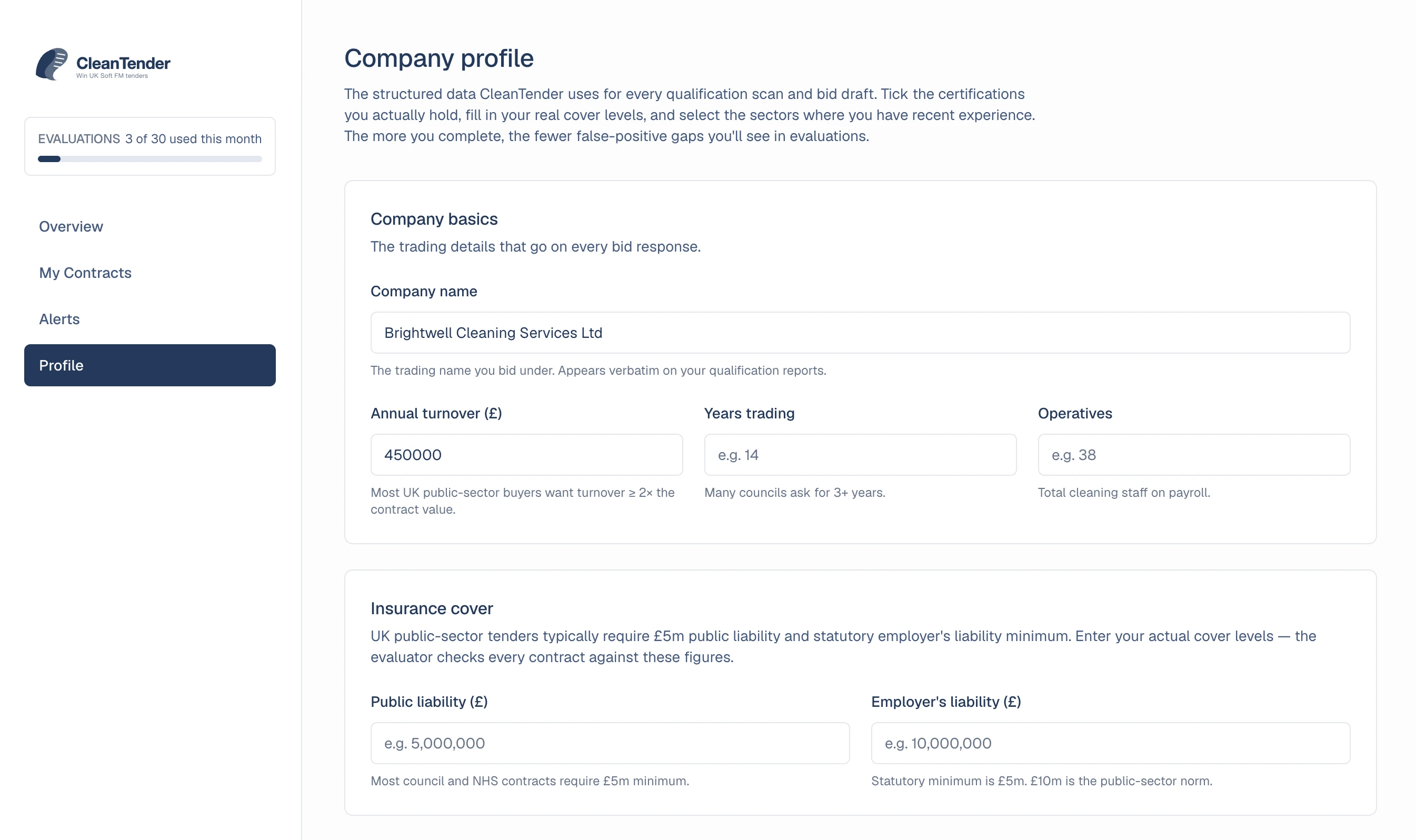
Profile setup defines what you are bid-ready for Step 2· 5 minutes daily
Open the live cleaning-tender feed
Every UK council, NHS Trust, school, university and central government cleaning tender, in one feed. Pre-filtered to your sector and geography. No false positives, no manual portal-trawling across FTS, Contracts Finder, and dozens of buyer e-procurement portals.
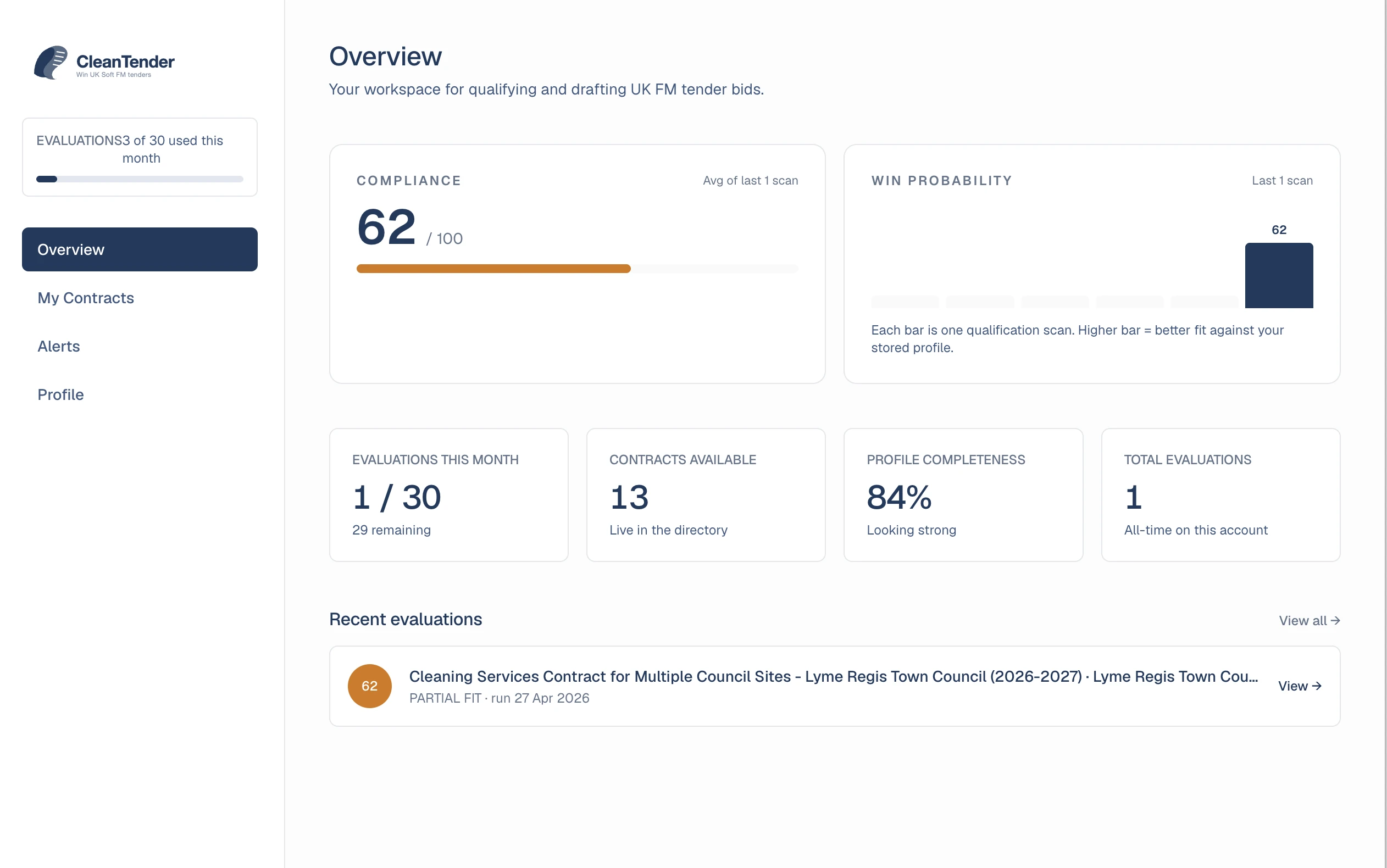
Live feed of in-scope cleaning tenders, fit-scored Step 3· Daily digest
Get email alerts for new in-scope tenders
New commercial cleaning tenders matching your profile land in your inbox the day they publish. CleanTender batches them into a daily digest so you do not get notification fatigue, and links straight back to the in-app fit score.
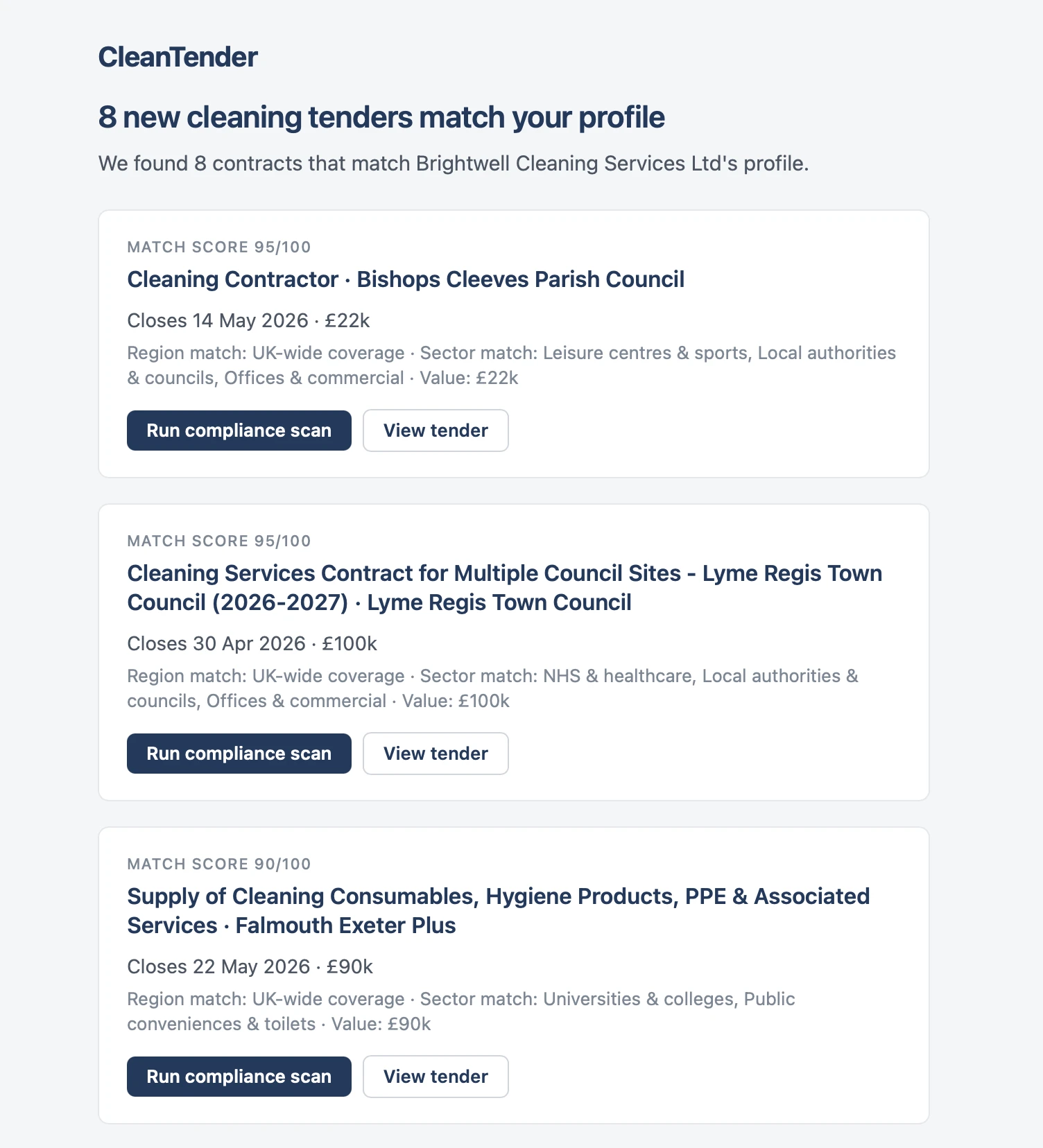
Daily alerts for new in-scope tenders Step 4· 30 seconds
Run a fit-score evaluation on a target tender
One click runs a CleanTender Evaluation against the tender pack: scope match, geography fit, scale fit, compliance gap, and a plain-English win probability. Stops you bidding contracts you were never going to win.
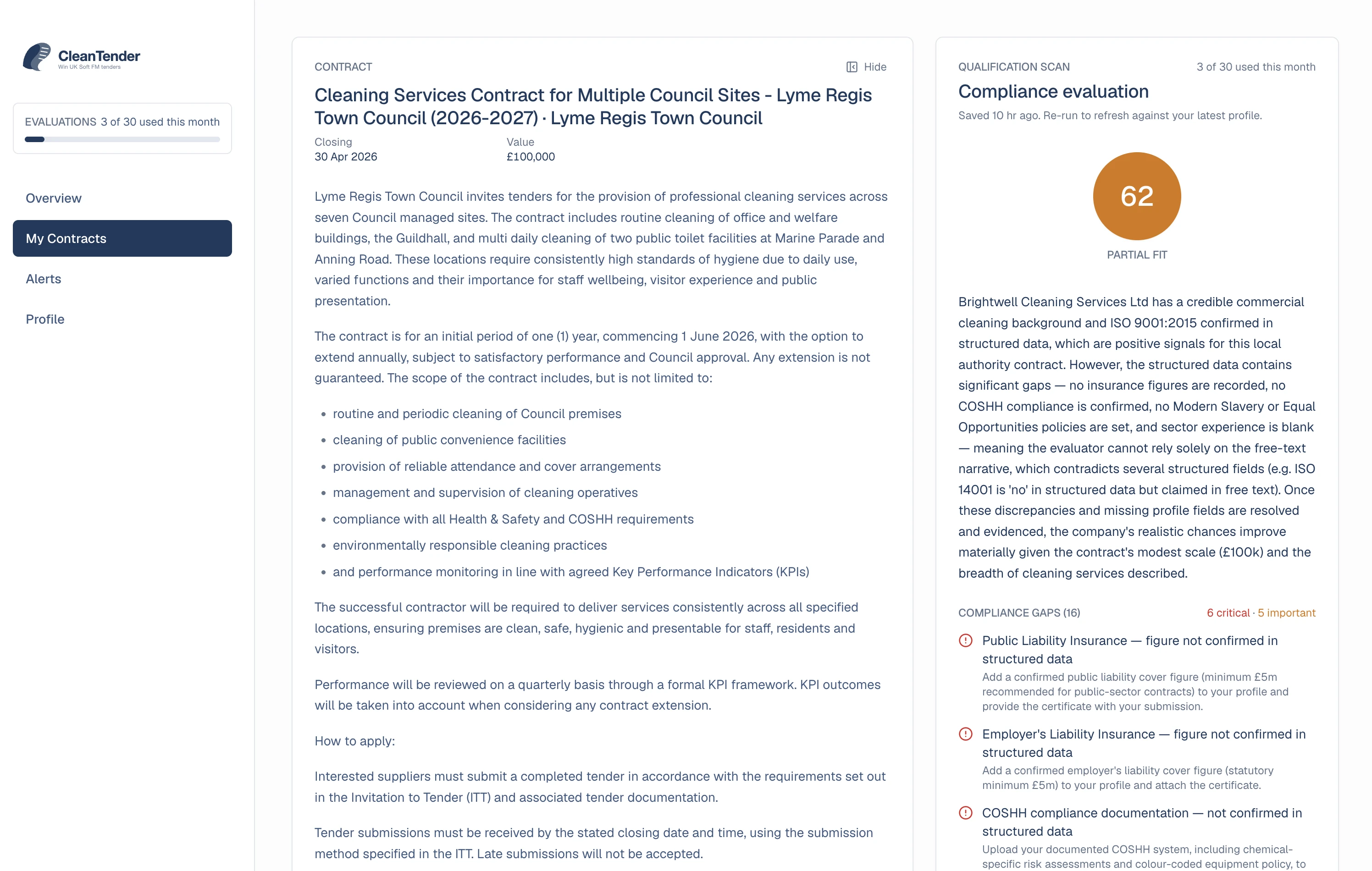
Fit-score and win-probability before you commit a weekend Step 5· 1 minute
Spot compliance gaps before you start drafting
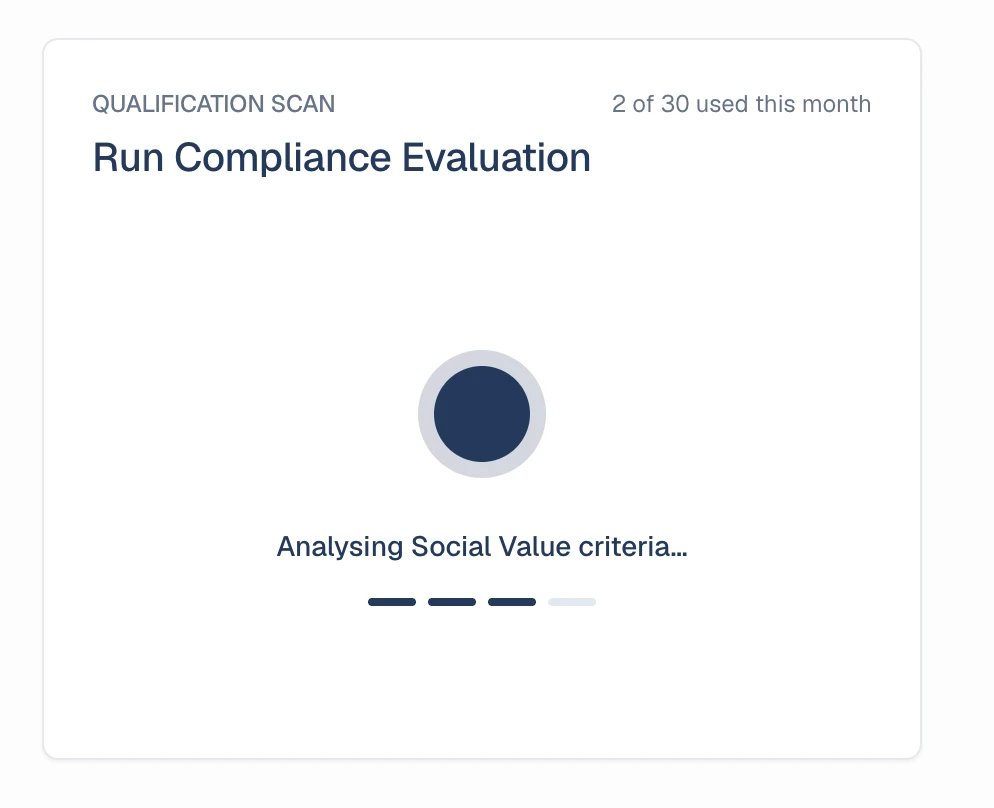
CleanTender runs a named compliance check against the tender pack: BICSc, COSHH, ISO 9001, SSIP (CHAS or SafeContractor), TUPE pack, social value plan, DBS policy. Anything missing is flagged before you sink hours into a bid that auto-fails at SQ.
Compliance gaps surfaced before drafting Step 6· 2 minutes generation
Generate a full SQ + method-statement draft
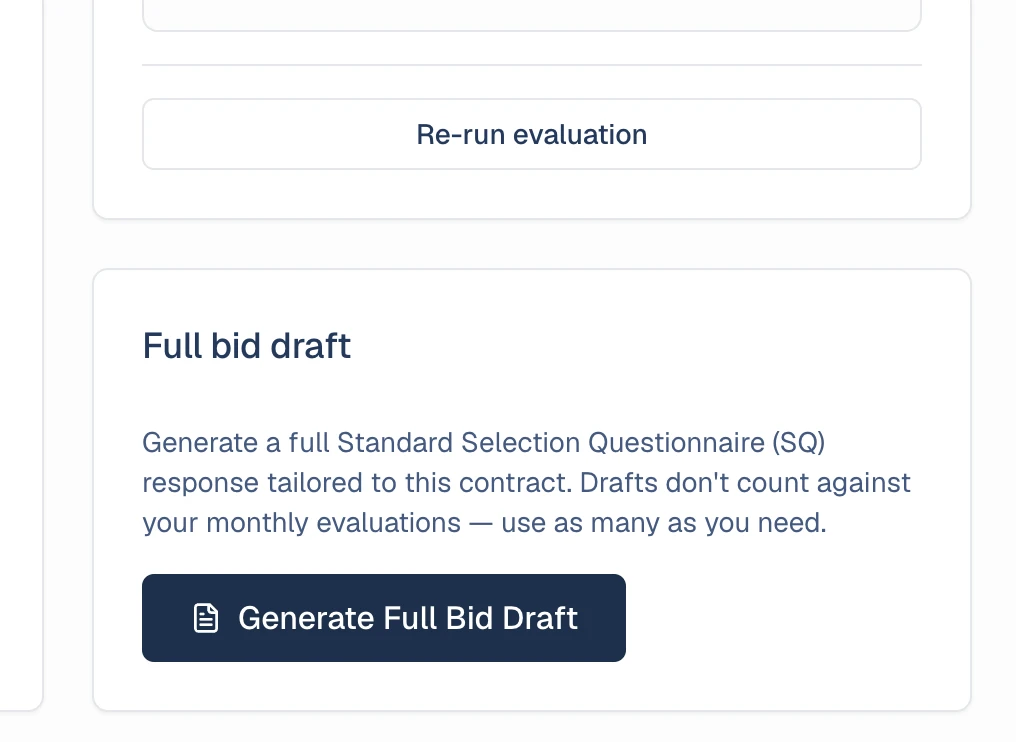
CleanTender drafts a complete Standard Selection Questionnaire response using your profile data and the tender requirements: declaration block, company overview, contract experience, quality, training, COSHH, social value, H&S, insurance schedule. All ten sections, in one pass.
Full SQ draft generated in minutes, not days Step 7· Half a day
Refine, add evidence, and submit
Tune the draft, drop in named referees and certificate numbers, layer your quantified social value commitments, and submit through the buyer's portal. Most users compress a 30-60 hour first bid to 8-12 hours of focused review.
Step 8· Ongoing
Track outcomes and improve
Every bid logs in CleanTender with status, score, and (after standstill) the buyer's feedback. Use the standstill data to tune your next bid. Win rate compounds; first-bid completion is the only thing standing between you and a public-sector revenue line.
When buying is the right call
We lean towards bidding. But buying wins in four situations, and it would be dishonest to pretend otherwise.
- The round sits inside your existing routes. Density turns a thin-margin contract into a decent one.
- The seller's staff are good and you need people. Recruitment is the real bottleneck for a lot of growing firms.
- You want private-sector revenue fast and have the cash. Offices, retail and managing agents rarely tender formally, so buying is a genuine shortcut there.
- The contracts have long fixed terms and the clients have already agreed in writing to the transfer.
Outside those four, walk away. The worst deal in this market is a scattered round of short-notice contracts held together by one owner's mobile number. You pay for the list, the owner leaves, and the clients follow them out.
If you'd rather grow by winning, apply the same discipline you'd use on a purchase. Score each opportunity with the bid/no-bid decision tool before you write. Then follow the step-by-step process in how to bid for cleaning contracts, read the seven mistakes cleaning companies make in public tenders so you don't repeat them, and use our strategy for winning your first cleaning contract to pick which ones to chase. Or just browse live contracts and see what's open near your routes this week.
Sources
- Transfer of Undertakings (Protection of Employment) Regulations 2006 (SI 2006/246) · The full regulations.
- TUPE 2006, regulation 3: relevant transfers and service provision changes
- TUPE 2006, regulation 4: effect on contracts of employment
- TUPE 2006, regulation 11: employee liability information (28 days)
- TUPE 2006, regulation 13: duty to inform and consult
- GOV.UK: Business transfers, takeovers and TUPE
- Acas: TUPE transfers
- Procurement Act 2023, section 74: modifying a public contract
- Procurement Act 2023, Schedule 8: permitted modifications (paragraph 9, transfer on corporate restructuring)
FAQs
Frequently asked questions
- Yes, private ones. Business brokers, franchise resales and direct approaches to retiring owners all put private cleaning contracts and rounds on the market. What you actually buy is either the contracts themselves (which usually need each client's consent to transfer) or the company that holds them (a share purchase). Staff working on those sites normally come with the work under TUPE on their existing terms. Public-sector contracts are different. Councils, NHS Trusts and schools award them through tenders, and a new supplier can only step in mid-contract in narrow cases such as a corporate restructuring, with the authority's consent. For public work, you have to bid.
- Usually yes. If you buy the contracts and take over the work, the cleaners assigned to those sites transfer to you under TUPE 2006, keeping their pay, hours and length of service. Liabilities like accrued holiday and most pre-transfer claims come with them. The seller must give you employee liability information at least 28 days before the transfer, and both of you have to inform the affected staff. The exception is a share purchase: you buy the company, the employer stays the same, and TUPE doesn't apply to the sale. You still inherit everything the company owes. Take legal advice on which structure fits the deal.
- On profit you can keep, not turnover. A sensible buyer starts with the annual profit each contract makes after wages, cover, supplies and travel, then discounts contracts with short notice periods or owner-dependent relationships, deducts inherited staff liabilities, and adds value for route density next to their own work. Online rules of thumb quote multiples, but we haven't found a sourced UK benchmark worth repeating. The safest structure pays part of the price upfront and holds back the rest until clients have stayed with you for an agreed period.
- No. Public contracts are awarded through procurement under the Procurement Act 2023, and the supplier is part of what the buyer awarded. Changing supplier mid-contract is a modification, and Schedule 8 only permits a novation or assignment to a new supplier after a corporate restructuring or similar circumstance. Public contracts also usually need the authority's written consent to assign. So a private sale of a council contract to an unrelated business doesn't work. To get public cleaning work you bid for it when it's advertised, which is open to any business that meets the requirements.
- For most small firms, winning is cheaper, and for public work it's the only option. Buying costs a purchase price, legal fees and inherited staff liabilities, and some clients leave at handover. Tendering costs your time: each bid takes hours, and your first few may lose. Compare the two with your own figures: purchase price plus fees plus liabilities, against your cost per bid times the number of bids you'd need to win the same annual value. Buying wins when the round is dense, next to your existing routes and on long fixed terms.
- Read the signed contracts, not a summary. Check each one for an assignment or change-of-control clause, the notice period and the remaining fixed term. Get the staff list with pay, hours, service length and holiday owed, plus any open grievances or claims. Ask how long each client has been with the seller and who they deal with day to day. Map every site against your current routes. Then have a solicitor review the sale agreement for warranties, an indemnity for pre-transfer employment claims, and how client consents will be obtained.