
UK public bodies spend over £300 billion a year buying goods, works and services. From 24 February 2025 every pound of that runs through a new framework, the Procurement Act 2023, which replaced the Public Contracts Regulations 2015.
If you're an SME wondering how to win your first government contract, the law has actually moved in your favour. One Central Digital Platform you register on once. Three procedures instead of seven. Social value mandatory at 10% minimum from 1 October 2025. And a 30-day payment rule that protects you when you subcontract.
Here's the version that matters. Skip the corporate procurement-jargon take. This is what to gather, where to look, and what wins.
If you're brand new to the word, what a tender actually means in business covers the plain definition, the difference between public and private sector tenders, and the acronyms (ITT, RFP, SQ, PQQ) you'll see in every pack.
What's in this guide
- How to bid for a UK government contract, step by step (CleanTender walkthrough)
- What counts as a UK government contract
- What the Procurement Act 2023 actually changed
- The UK tender process explained in 7 steps
- Where contracts live (the five free portals)
- The Central Digital Platform, your once-only profile
- Open vs Competitive Flexible vs Direct Award
- Frameworks, Dynamic Markets, single contracts
- The exclusion regime and the central debarment list
- Social value: PPN 002 and what scores
- Pricing, 30-day payment, Project Bank Accounts
- AI disclosure under PPN 017
- First-time bidder paperwork checklist
- What to do when you lose
How to win a UK soft FM tender, step by step
The complete end-to-end flow inside CleanTender. From sector setup to a submitted soft FM bid in the time it used to take to read a single tender pack.
Eight steps from "never bid public sector" to a complete SQ response on the buyer's portal. First scan is free.
Step 1· 10 minutes
Build your soft FM company profile
Set your sector to soft FM, your service regions, sector specialism (cleaning / security / grounds / waste / catering), ISO certifications, sector accreditations (CHAS / SafeContractor / SIA ACS / BICSc / NPTC / FHRS), insurance levels, turnover, operative count, insurance levels, turnover, and operative count. CleanTender uses this to fit-score every live tender against your real capability so you only see the ones you can win.
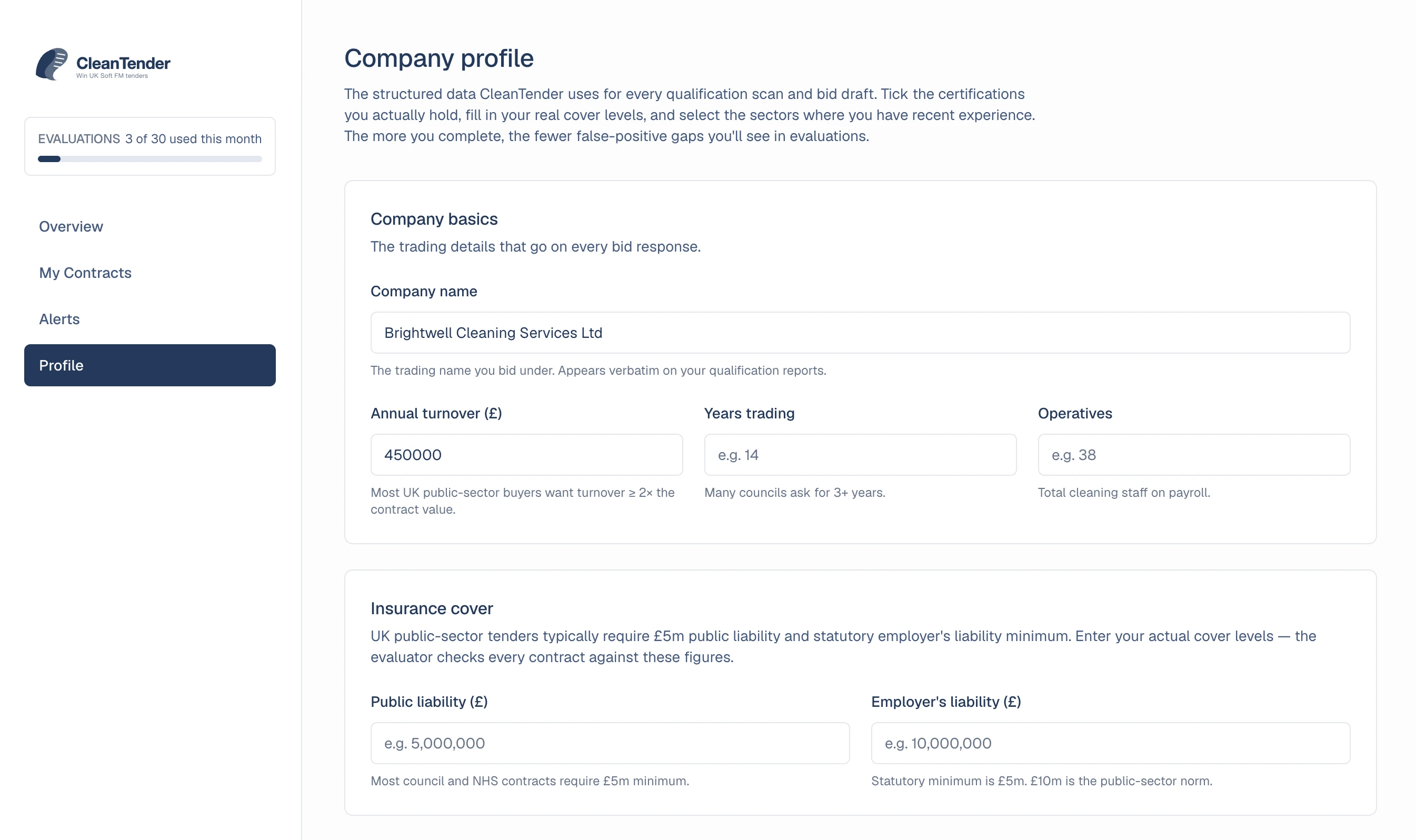
Profile setup defines what you are bid-ready for Step 2· 5 minutes daily
Open the live soft FM-tender feed
Every UK council, NHS Trust, school, university, MoD, and central government soft FM tender, in one feed. Pre-filtered to your sector and geography. No false positives, no manual portal-trawling across FTS, Contracts Finder, and dozens of buyer e-procurement portals.
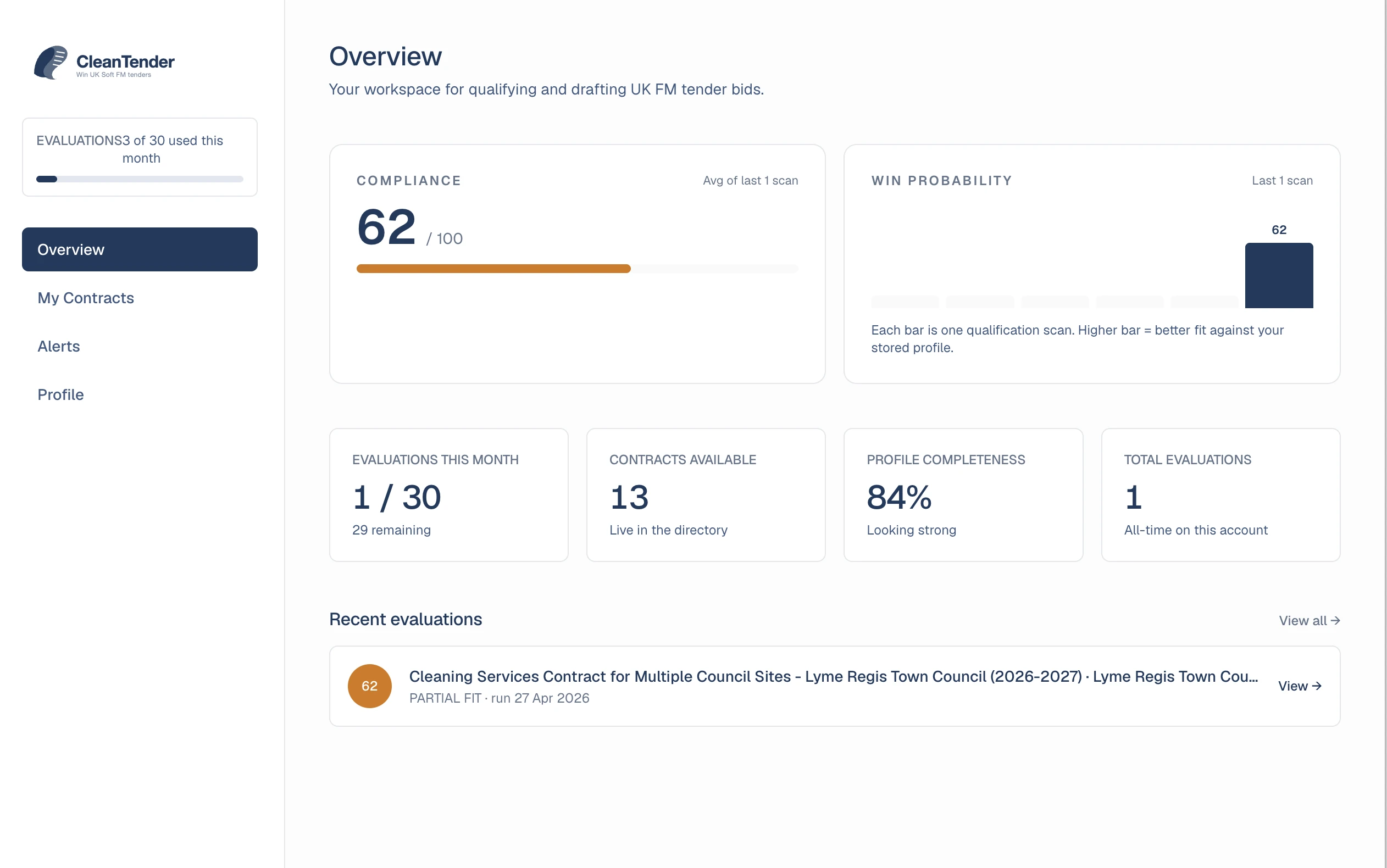
Live feed of in-scope soft FM tenders, fit-scored Step 3· Daily digest
Get email alerts for new in-scope tenders
New soft FM tenders matching your profile land in your inbox the day they publish. CleanTender batches them into a daily digest so you do not get notification fatigue, and links straight back to the in-app fit score.
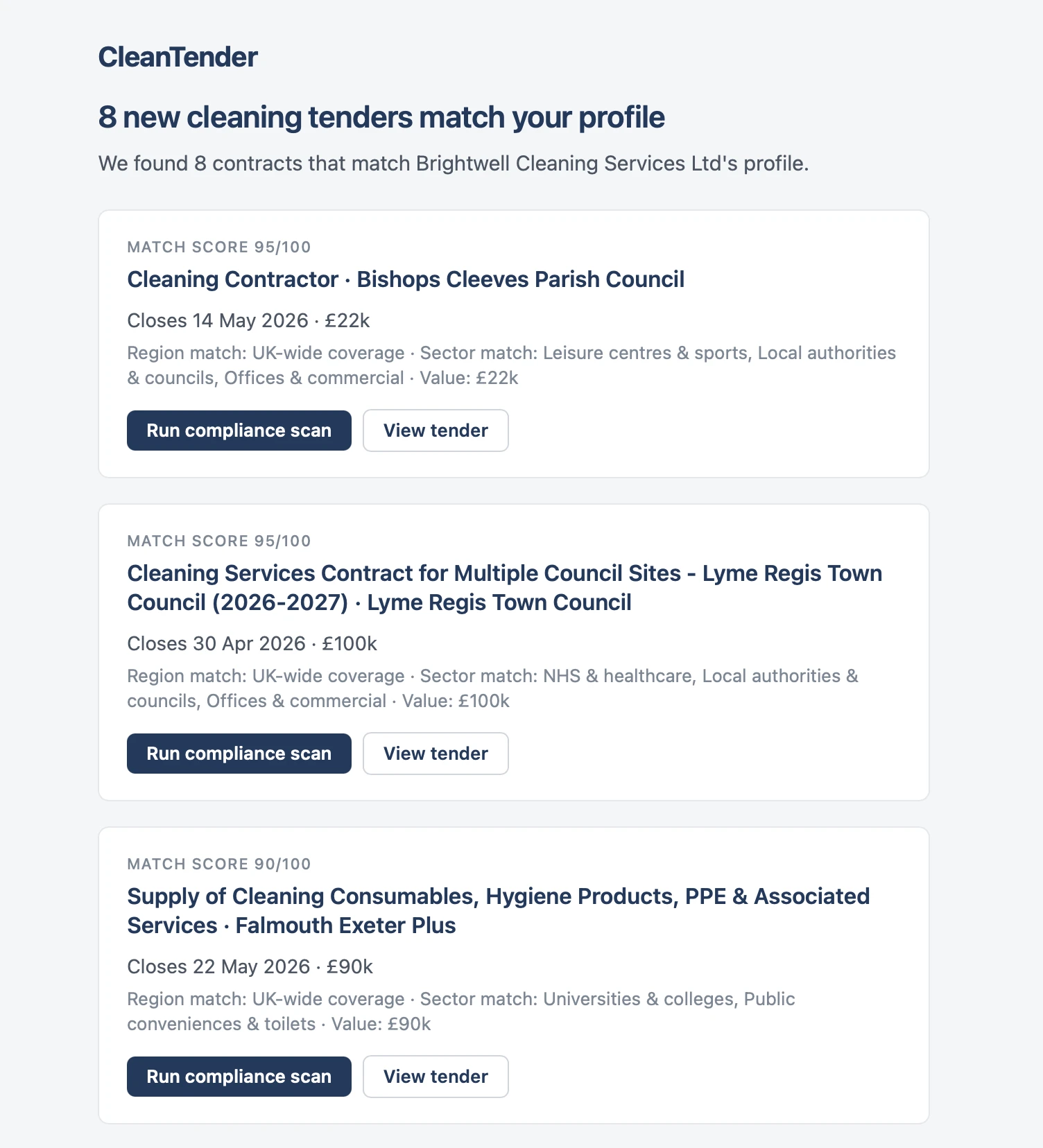
Daily alerts for new in-scope tenders Step 4· 30 seconds
Run a fit-score evaluation on a target tender
One click runs a CleanTender Evaluation against the tender pack: scope match, geography fit, scale fit, compliance gap, and a plain-English win probability. Stops you bidding contracts you were never going to win.
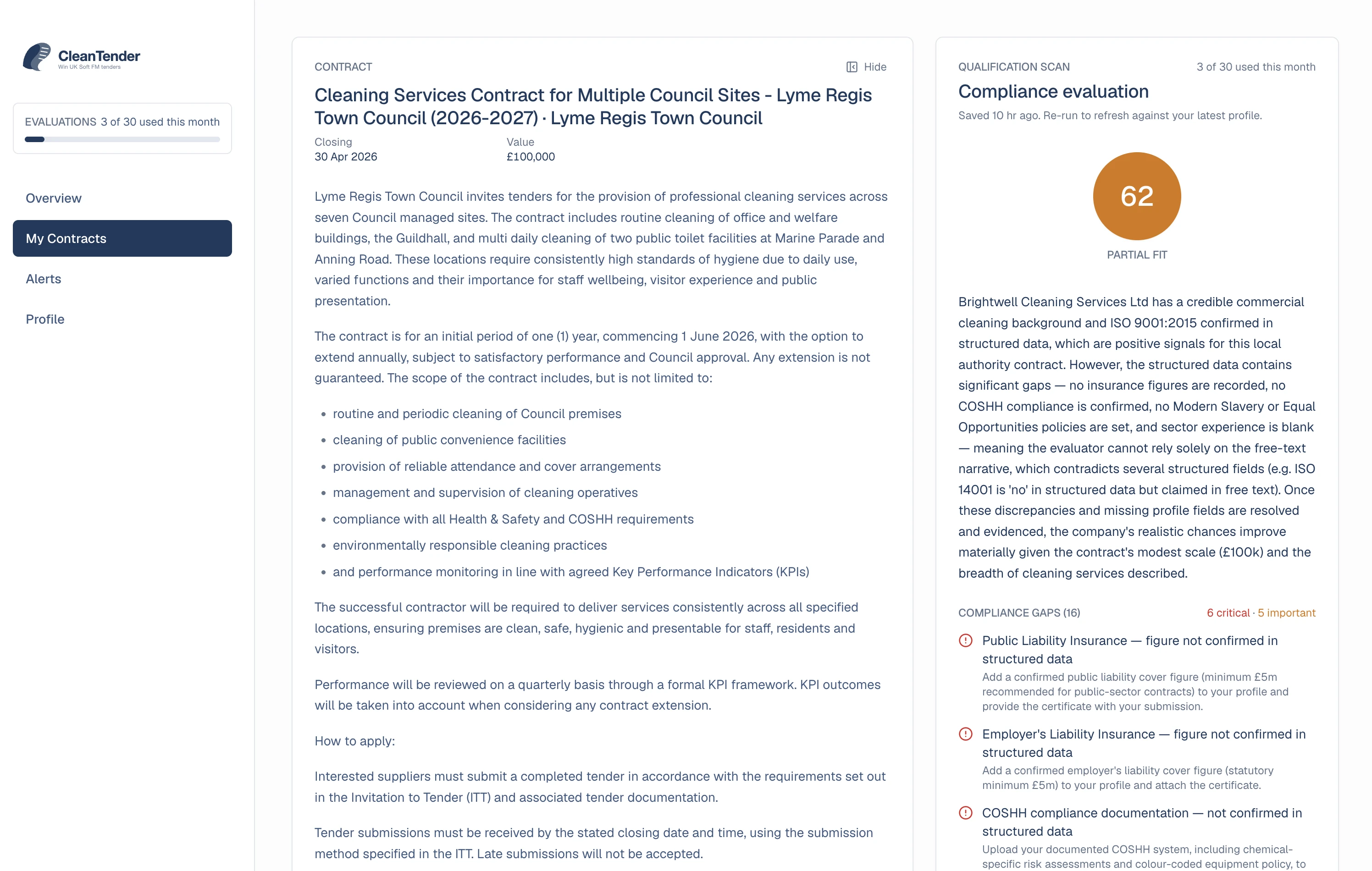
Fit-score and win-probability before you commit a weekend Step 5· 1 minute
Spot compliance gaps before you start drafting
CleanTender runs a named compliance check against the tender pack: sector accreditations, ISO 9001, ISO 14001 increasingly required, SSIP, social value plan, modern slavery policy, equal opportunities policy, environmental policy. Anything missing is flagged before you sink hours into a bid that auto-fails at SQ.
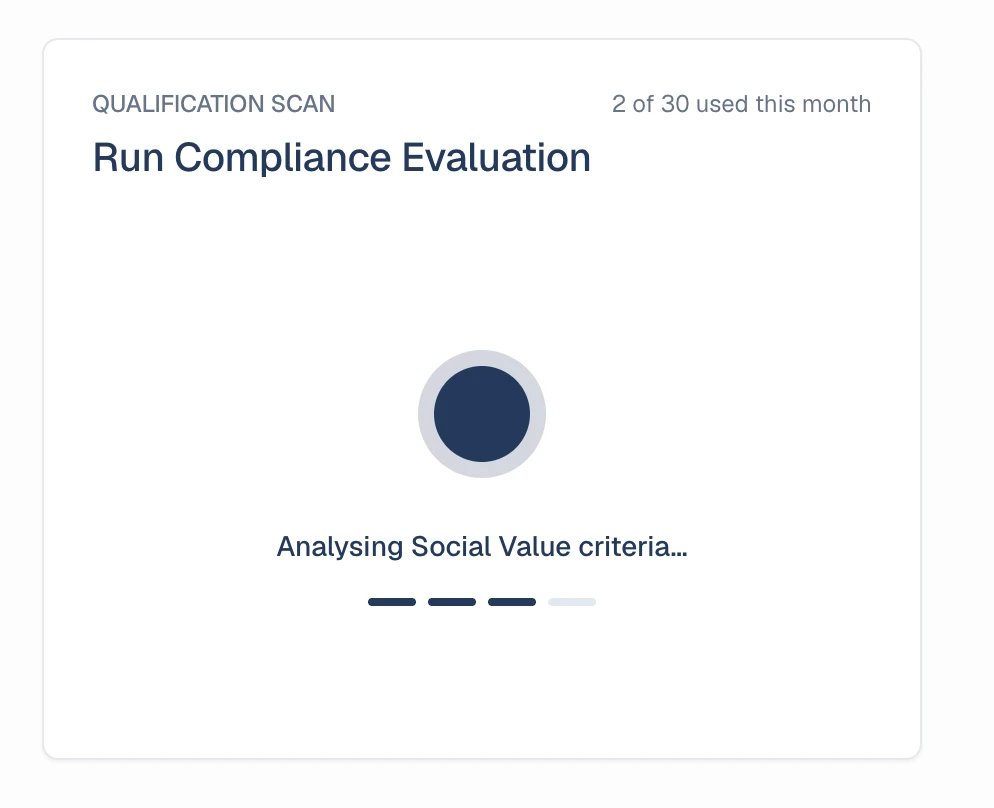
Compliance gaps surfaced before drafting Step 6· 2 minutes generation
Generate a full SQ + method-statement draft
CleanTender drafts a complete Standard Selection Questionnaire response using your profile data and the tender requirements: declaration block, company overview, contract experience, quality, training, COSHH, social value, H&S, insurance schedule. All ten sections, in one pass.
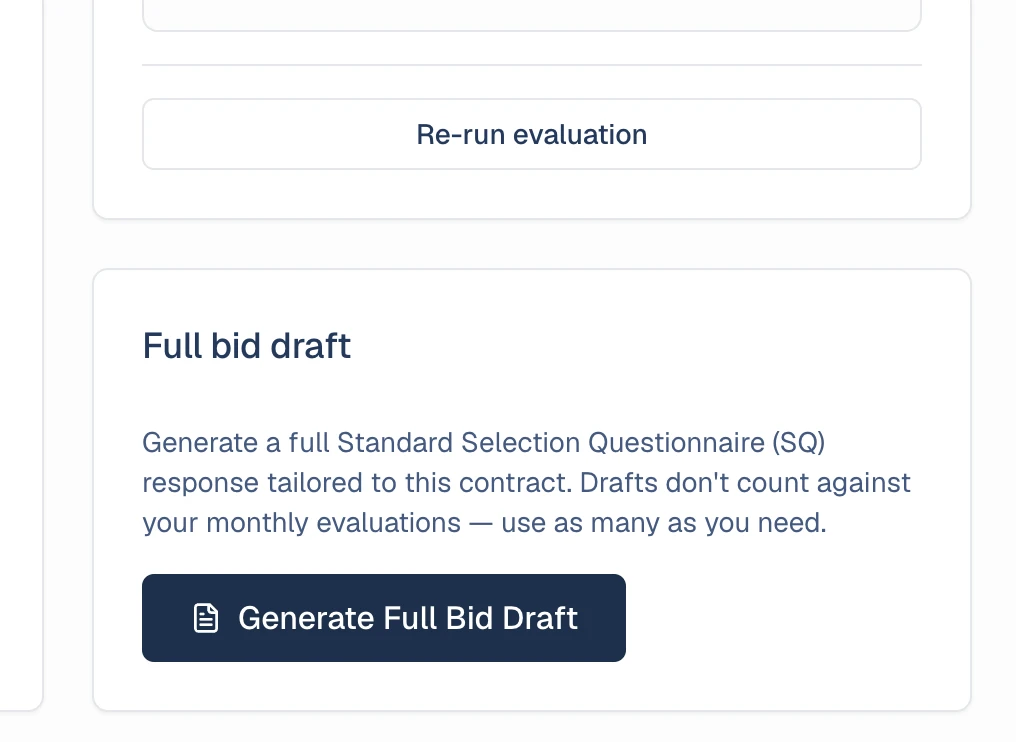
Full SQ draft generated in minutes, not days Step 7· Half a day
Refine, add evidence, and submit
Tune the draft, drop in named referees and certificate numbers, layer your quantified social value commitments, and submit through the buyer's portal. Most users compress a 30-60 hour first bid to 8-12 hours of focused review.
Step 8· Ongoing
Track outcomes and improve
Every bid logs in CleanTender with status, score, and (after standstill) the buyer's feedback. Use the standstill data to tune your next bid. Win rate compounds; first-bid completion is the only thing standing between you and a public-sector revenue line.
What counts as a UK government contract
"Government contract" is loose talk in everyday English. The Procurement Act covers the lot.
- Central government departments and their agencies. HMRC, DWP, MoJ, Cabinet Office, the lot.
- NHS Trusts, Integrated Care Boards, NHS Property Services.
- County, district, unitary, and parish councils.
- Schools, academies and academy trusts (when they buy direct rather than via the LA).
- Universities, FE colleges, and student unions.
- Police, fire, and rescue.
- Housing associations and registered providers.
- Devolved-government bodies in Scotland, Wales, and Northern Ireland (each runs its own portal but the rules track each other).
Utilities (water, energy, transport, postal) sit under a parallel regime. Defence and security have carve-outs. Everything else lives under the rules in this guide.
What the Procurement Act 2023 actually changed
Royal Assent in October 2023. Live on 24 February 2025. The Act replaced PCR 2015, the Concession Contracts Regulations 2016, and the Defence and Security Public Contracts Regulations 2011 with one regime.
Six things matter for an SME.
- Three procedures instead of seven. Less to learn, fewer ways for buyers to confuse the market.
- A Central Digital Platform. One supplier profile, reused on every bid.
- Pipeline notices for any contract over £2 million in the next 18 months. You can see what's coming before it hits tender.
- Contract performance notices on contracts over £5 million. Buyers publish KPI scores annually. Reliable suppliers can prove a track record on the public record.
- A central debarment list, maintained by the Procurement Review Unit. Bad actors get blocked nationally instead of buyer by buyer.
- Statutory 30-day payment that extends down the supply chain. SME subcontractors are protected from main-contractor delays.
Detail sits across the Act's eleven parts plus a string of Procurement Policy Notes. The headline ones in force right now are PPN 002 (Social Value Model, March 2025), PPN 017 (AI use disclosure), and PPN 018 (transition guidance). The full text of the Act is at legislation.gov.uk.
The UK tender process explained in 7 steps
To bid for a UK government contract you spot it, register, read the pack, ask questions, submit, get scored, then wait out a standstill before signing. Seven steps. The Procurement Act 2023 has fixed that order for every above-threshold public tender since 24 February 2025, and the legal clock at each stage is public, so you can plan around it.
- Spot it early. Pipeline notices and preliminary market engagement (Section 16) come before the tender. Market engagement is the only stage where a supplier can still influence the spec, so turn up.
- Register on the Central Digital Platform. Once. Covered below.
- Read the tender notice and pack. Procedure, lots, conditions of participation (Section 22), award criteria, deadline. For an Open procedure with electronic bids and all documents out on day one, the minimum bid window is 25 days. It can drop to 10 if the buyer published a qualifying planned procurement notice (Section 54).
- Ask clarification questions. The step most SMEs skip. A clarification that pins down vague volumes or TUPE numbers is worth more than a week of polishing answers.
- Submit. Evidence that you meet the conditions of participation, plus quality, social value and price answers against the published criteria.
- Scoring and award. Every bidder gets an assessment summary of its own scores before the buyer publishes the contract award notice (Section 50).
- Standstill, then contract. Eight working days between the award notice and signature (Section 51). That's your window to challenge if the scoring looks wrong. A contract details notice follows within 30 days of signing (Section 53).
Steps 1 to 3 decide more wins than step 5. If a notice fails a quick fit check at step 3, drop it. The bid/no-bid decision tool takes ten minutes. And if you're wondering whether a young company stands a chance at all, can a new business win a UK government tender gives the straight answer.
Where UK government contracts live
Five free official portals. No paid aggregator carries notices the official portals don't already have, by law. Register on every portal that covers a region you can deliver to.
| Portal | Threshold | Buyers |
|---|---|---|
| Find a Tender Service | Over £135,018 incl. VAT | All UK public + utilities sector |
| Contracts Finder | Older procurements started before 24 Feb 2025 only | Central government, English local authorities, schools |
| Public Contracts Scotland | All thresholds | Scottish public sector + NHS Scotland |
| Sell2Wales | All thresholds | Welsh public-sector bodies |
| eTendersNI | All thresholds | NI departments, councils, health trusts |
UK official tender portals. All free. All carry the legally-required notice set.
Find a Tender now carries seventeen new UK notice types (UK1 through UK17) introduced by the Procurement Act. UK1 is a Pipeline Notice for contracts over £2 million in the next 18 months. UK17 is a Payments Compliance Notice. Buyers report quarterly on whether they paid valid invoices within 30 days.
If a paid platform claims to surface notices the official portals don't have, ask which buyer pays them to publish privately. The answer is no buyer.
The Central Digital Platform, your once-only profile
The Central Digital Platform (CDP) is the bit of the new regime that saves you the most time. Built into Find a Tender, live since 24 February 2025. Enter your data once, reuse on every bid.
Suppliers create a profile and upload a core dataset.
- Companies House registration, registered name, trading name, registered address.
- Connected persons: directors, parent companies, beneficial owners with significant control.
- Last two years of accounts.
- Self-declarations against mandatory and discretionary exclusion grounds (Schedules 6 and 7).
- Insurance certificates (public liability, employer's liability, professional indemnity).
- SSIP accreditation: CHAS, SafeContractor, SMAS, or Constructionline.
- Quality, environmental, and H&S management certs (ISO 9001, ISO 14001, ISO 45001).
- per-sector accreditations (BICSc for cleaning, SIA ACS for security, BALI for grounds).
When you bid, the buyer pulls this from your CDP profile automatically. You don't re-key it. The bid response then focuses on the per-contract narrative. Method statement, relevant experience, social value, pricing.
Open vs Competitive Flexible vs Direct Award
Section 20 of the Act sets out three procedures. The buyer picks one and explains the choice in the tender notice.
Open Procedure
One stage. Any interested supplier submits a tender. Most council cleaning, security and grounds contracts run Open. Used when the buyer wants the price and quality answered in one shot, not negotiated.
Competitive Flexible Procedure
Bespoke. The buyer designs a multi-stage process to match the requirement. Replaces PCR 2015's Restricted, Competitive Dialogue, Competitive with Negotiation, and Innovation Partnership procedures all in one. Common features: shortlisting, market engagement events, site visits, negotiations, phased reductions of bidders. Used for complex, high-value, or innovative work.
Direct Award
No competition. Allowed only in narrow circumstances under sections 41 to 43: extreme urgency, protection of life, or where one supplier alone can credibly deliver. The buyer publishes a Transparency Notice before making the award so other suppliers can challenge if the conditions don't actually apply.
Frameworks, Dynamic Markets, single contracts
Three contract structures you'll meet in practice.
- Single contracts. One buyer, one tender, one supplier. Procurement Act procedures apply.
- Frameworks (s.45-48). A pre-approved supplier list buyers call off from for up to four years on most goods/services. Suppliers compete to get on, then compete (or are direct-awarded) on individual call-offs.
- Dynamic Markets (s.34-40). The successor to Dynamic Purchasing Systems. Always-open: suppliers join at any point. The market sets qualification once, buyers run mini-competitions among qualified suppliers.
For an SME, frameworks and Dynamic Markets are the better entry point than single high-value tenders. Lower qualification bar per call-off, smaller volumes, the relationship is in place before the work starts. Win one call-off, build a reference, win the next.
The exclusion regime and the debarment list
Schedules 6 and 7 set out when a buyer must, or may, exclude a supplier. The grounds replace and unify the equivalent regimes from PCR 2015, the Concessions Regulations, and the Defence and Security Regulations.
Mandatory grounds (Schedule 6)
Authorities must exclude. Examples: serious criminal convictions for bribery, fraud, money laundering, tax evasion, terrorism or organised crime, modern slavery, labour-market enforcement breaches. Convictions of associated persons (directors, beneficial owners) trigger the same exclusion.
Discretionary grounds (Schedule 7)
Authorities may exclude. Professional misconduct. Insolvency. Environmental misconduct. Breach of contract on a previous public contract that resulted in damages or termination. KPI failure. Buyers weigh these case by case.
The central debarment list
Sections 59 to 66. Maintained by the Procurement Review Unit (PRU) on behalf of a Minister of the Crown. Following an investigation, a Minister may add a supplier where an exclusion ground applies and the circumstances are continuing or likely to recur. Suppliers can appeal. Self-cleaning evidence (management changes, training, contract-monitoring fixes) is the route back.
Events more than five years old generally can't be the basis of an exclusion. Entries stay on the list until the underlying issue is resolved or the supplier successfully applies for removal.
Self-cleaning evidence is the route back. A supplier excluded for past KPI failure can return by documenting the management changes, training programmes, and contract-monitoring fixes that addressed the weakness.
Procurement Review Unit
Social value: PPN 002 and what actually scores
Social value is no longer a tick-box. PPN 002 (the Social Value Model, updated March 2025) becomes mandatory across central government on 1 October 2025. Councils and the NHS run their own variants of the same model, often weighted higher.
- Central government: minimum 10% weighting on social value, scored under PPN 002.
- Local authorities: National TOMs framework (Themes, Outcomes, Measures). 15-25% weightings normal. Some councils run 30%+.
- NHS: NHS Social Value Model with Model Award Criteria mapped to TOMs. Starts at 10%, often higher on Trust frameworks.
- Carbon Reduction Plans (PPN 06/21): required on contracts over £5 million per year.
What actually scores is SMART commitments. Specific, Measurable, Achievable, Relevant, Time-bound. Evaluation panels are tired of vague "local hiring" promises and reject them on scoring.
Commitments that score well for SMEs
- Local employment: recruit X full-time-equivalent residents from the contract postcode area within Y months. Apprenticeships for 16-24-year-old NEETs. Targeted hiring of care leavers, prison leavers, long-term unemployed.
- Environment: a number-with-units reduction in MTCDE annually. Switch to ecolabel-certified products. Electric or hybrid fleet within Z months. Diverting a defined tonnage of waste from landfill.
- Community: pro-bono volunteering hours for named local VCSEs (Voluntary, Community, Social Enterprises). Career talks at named local schools. A defined percentage of contract spend committed to local SMEs and VCSEs.
The National TOMs framework assigns financial proxy values to each commitment so buyers can compare bids on a like-for-like basis. Proxy values update annually in January or February. Use the current year's table when costing your social value commitments.
Pricing, 30-day payment, Project Bank Accounts
Two SME-friendly rules from the Act change cash flow on public contracts.
- Statutory 30-day payment. Public buyers must pay valid, undisputed invoices within 30 days. The duty extends down the supply chain. Main contractors must pay subcontractors on the same 30-day basis. Buyers publish quarterly performance via UK17 Payments Compliance Notices.
- Project Bank Accounts. Used on construction and major works to ring-fence supply-chain payments and protect SME subcontractors from main-contractor insolvency. Less common in routine soft FM but worth knowing if you ever subcontract on larger frameworks.
On pricing, the public sector now runs mostly on Most Economically Advantageous Tender. A weighted score across price, quality, social value, sometimes innovation. Pure lowest-price awards are rarer than they were under PCR 2015 and aren't the default.
AI disclosure under PPN 017
If you use an AI tool to draft any part of a tender response, PPN 017 (the successor to PPN 02/24) tells you to disclose it. The disclosure is short. Which tool. Which part of the response it produced. The human review you applied.
Buyers don't ban AI. They want transparency so they can evaluate the response on its own merits. Declare honestly, edit for accuracy, and never let a tool claim a certification or a track record you don't actually hold. Misrepresentation in a bid is a discretionary exclusion ground. It can land you on the central debarment list.
First-time bidder paperwork checklist
Build the pack once, save it in one place, update each cert when it renews. The first SQ takes a weekend. The fifth takes an hour.
- Companies House registration. Last two years of audited or certified accounts.
- Public liability insurance. £5 million is the cleaning floor. £10 million for security and larger council estates.
- Employer's liability insurance. £5 million statutory minimum. £10 million the public-sector norm.
- Professional indemnity if the contract involves advice or design.
- One SSIP accreditation: CHAS Standard, SMAS Worksafe, SafeContractor, Constructionline. The Deem-to-Satisfy rule passports you between schemes if a buyer asks for a different one.
- ISO 9001 (Quality). Nice to have for council work under £100k. Increasingly mandatory above.
- ISO 14001 (Environmental). Strongly preferred when the bid carries a sustainability weighting.
- ISO 45001 (Occupational H&S). Replaces OHSAS 18001.
- per-sector accreditations. BICSc for cleaning. SIA ACS for security. BALI or RHS for grounds.
- Modern Slavery Act, Equal Opportunities, Health and Safety, and Environmental policies. One page each is fine for sub-£100k work.
- DBS policy for any contract involving schools, healthcare, or vulnerable users.
- Two or three reference contacts. Named, contactable, on similar previous contracts.
On the SSIP shopping decision, our best SSIP scheme for small business UK comparison covers the four big schemes. For tender-discovery options that don't cost anything, best free tender sites in the UK walks through the official portals plus what's worth registering on. And if you're wondering how to actually write the bid once you've found one, bid writer vs AI bid tool has the maths.
What to do when you lose
The first three bids will probably lose. That's normal. Treat them as paid training.
If you lose, you have a statutory right to feedback under section 50 of the Act. Before it publishes the Contract Award Notice, the buyer must send every bidder an Assessment Summary. It explains the winning bid's relative advantages, usually a comparative scoring breakdown across each award criterion. You can request a more detailed debrief within ten days of the standstill notice.
Use the feedback structurally. If your social value answer scored 2 out of 5 and the winner scored 4, the gap is real money. The £20,000 of contract value the SMART-commitments framework would have captured. Apply the lesson to the next bid in the same buyer's pipeline.
What good looks like
- Read the contract pack in full. The award criteria, the weightings, and the KPIs are usually buried. They're what you're scored against.
- Match every claim to evidence. Tick ISO 9001, attach the certificate. Commit to local hiring, name the postcode area and the headcount.
- Use the buyer's vocabulary. If the spec says "colour-coded equipment to BICSc standard" and you write "colour-coded mops", you've changed the criterion they're scoring against. Quote the spec wording back.
- Don't pad. Word counts on public bids are caps, not targets. A focused 480-word answer beats a 750-word answer that loops on itself.
- Submit 24 hours before the deadline. Portals slow or break in the final hour. Late submissions are excluded.
Treat the first three bids as paid training. Submit on time. Ask for the feedback you're entitled to. Apply the lessons to bid four.
Hard-won lesson
If you want a faster route from notice to qualified shortlist, register on CleanTender and run a free fit check on the next live tender that catches your eye.
For real-looking answers to copy the structure of, see these examples of bid writing for UK tenders.
Your first answers will be weaker than you think. Paste one into the free bid answer grader and see the score an evaluator would likely give it, plus three fixes.
Sources
- Procurement Act 2023, Section 54 (time limits) · Minimum bid windows, including 25 days for a standard electronic Open procedure
- Procurement Act 2023, Section 51 (standstill periods) · Eight working days between contract award notice and signature
- Procurement Act 2023 (full text) · Royal Assent October 2023, in force 24 February 2025
- Find a Tender Service · Every UK public-sector contract over £135,018 incl. VAT
- Contracts Finder · English central + local-authority work down to £12,000 thresholds
- Procurement Policy Notes · PPN 002 (Social Value Model), PPN 017 (AI disclosure), PPN 06/21 (Carbon Reduction Plans)
- National TOMs framework · Local-authority social value measurement framework
FAQs
Frequently asked questions
- Register once on the Central Digital Platform through Find a Tender, then set saved searches on Find a Tender for your service and region. When a notice fits, download the pack, check the conditions of participation and award criteria, and ask clarification questions before the deadline. Submit your evidence, quality, social value and price answers through the buyer's portal. Under the Procurement Act 2023 you then get an assessment summary of your scores, and the buyer must wait eight working days after the award notice before signing. Budget at least 25 days from notice to deadline on a standard Open procedure. Bid fewer tenders, better matched: fit decides more wins than writing.
- Register on the official portals. Find a Tender carries every UK public-sector contract over £135,018 incl. VAT. It also carries below-threshold work from £12,000 (central) and £30,000 (councils, NHS), inc VAT. Contracts Finder only holds older procurements started before February 2025. Add Public Contracts Scotland, Sell2Wales, and eTendersNI for the devolved nations. All free. All carry the legally-required notice set under the Procurement Act 2023. Set up saved-search alerts on each by the CPV codes that match your services. No paid aggregator carries notices the official portals don't have.
- Three things matter. The Central Digital Platform: register once, submit core company data and accounts, reuse on every bid. Procedures simplified from seven to three (Open, Competitive Flexible, Direct Award). Social value mandatory at 10% minimum from 1 October 2025 under PPN 002, which favours well-rooted local SMEs over national contractors who can't credibly commit to local employment in every postcode. The 30-day statutory payment rule extends down the supply chain, so SME subcontractors don't get squeezed by main-contractor cash flow.
- Not always. Sub-£100,000 council cleaning, security or grounds work usually asks for an SSIP accreditation (CHAS Standard, SMAS Worksafe, SafeContractor, or Constructionline) plus public liability insurance. ISO 9001 becomes effectively mandatory above £100,000, especially on NHS and major council frameworks where it's listed as a minimum. ISO 14001 (environmental) is increasingly expected when the bid carries a sustainability weighting under PPN 06/21.
- The CDP is the Procurement Act's once-only supplier registration system. It's built into Find a Tender and went live with the Act on 24 February 2025. Suppliers create a profile with Companies House details, addresses, connected persons (directors, parent companies, beneficial owners), last two years of accounts, and self-declarations against the exclusion grounds in Schedules 6 and 7. Buyers pull this data automatically when you bid. You don't re-key it on every tender.
- Minimum 10% on central-government contracts under PPN 002, mandatory from 1 October 2025. Local authorities run 15 to 25% via the National TOMs framework. Some councils run 30%+ to align with net-zero or local-economy strategies. NHS uses the NHS Social Value Model with Model Award Criteria mapped to TOMs, starting at 10%. Contracts over £5 million per year need a Carbon Reduction Plan under PPN 06/21. SMART local commitments score better than vague aspirational language.
- Realistically, nine to eighteen months from first submission to first award. The first three bids are usually training. Submit on time, ask for the section 50 feedback you're entitled to, apply the lessons to bid four. Most cleaning, security, or grounds SMEs win their first call-off on bid four to seven, normally off a framework or Dynamic Market they joined earlier rather than a single high-value tender. Frameworks and Dynamic Markets are the gentler entry point.
- You can still bid in future. Discretionary exclusions under Schedule 7 (prior KPI failure, insolvency, professional misconduct) apply case by case. Submit self-cleaning evidence under the Procurement Review Unit's process: documentation showing the management changes, training, and contract-monitoring fixes you put in place to address the underlying issue. Events more than five years old generally can't be used as a basis for exclusion. Mandatory exclusions under Schedule 6 (serious criminal convictions) are stricter and harder to overcome.
- Yes, under PPN 017 (the successor to PPN 02/24). The disclosure is short. Which AI tool, which part of the response it produced, and the human review you applied. Buyers don't ban AI use, they want transparency. The bigger risk is misrepresentation. Never let an AI tool claim a certification or capability you don't actually hold. That's a discretionary exclusion ground under Schedule 7 and lands you on the central debarment list.