
PAS 91 was a Publicly Available Specification published by the British Standards Institution: a standard pre-qualification questionnaire UK public-sector buyers used to vet construction and facilities management suppliers before they could bid. BSI withdrew it in April 2023. Most public-sector cleaning and FM tenders now use the Standard Selection Questionnaire under PPN 03/23 instead.
Withdrawal didn't kill it outright. Some buyers still attach PAS 91 to tender packs because nobody updated the template. If a council has just asked for "your PAS 91," here's what that question actually means in 2026.
PAS 91 to SQ to CAS, the dates that matter
Three names, one job: proving you're safe to let onto a public-sector site before anyone talks price.
PAS 91
BSI pre-qualification questionnaire
Withdrawn
No longer maintained by BSI. Still legally usable if a buyer chooses to, but nothing about it gets updated again.
bsigroup.comSQ
Standard Selection Questionnaire
Default replacement
The form most public-sector cleaning and soft FM tenders use today. Same ground as PAS 91, tidier format.
gov.ukCAS
Common Assessment Standard
£5m+ threshold
PPN 03/24. Advised for construction-adjacent work over roughly £5m in value; applied proportionally below that line, not as a blanket rule.
gov.uk (PPN 03/24)None of this matters much until you're actually filling in a pack. For the mechanics of that, see our step-by-step guide to bidding for cleaning contracts.
What's in this guide
- What PAS 91 was, plainly
- Why BSI pulled it
- What replaced it for FM and cleaning
- Why you'll still see PAS 91 in tender packs
- Sections that bite cleaning firms hardest
- Build a profile once, reuse it forever
- See the walkthrough in CleanTender
- When to step up to CAS
What PAS 91 was, plainly
PAS stands for Publicly Available Specification. BSI publishes PAS documents as light-touch standards. They fall short of full British Standards but carry the same authority for what they cover. The number 91 is just a serial.
The job of PAS 91 was to give construction and FM buyers a single common pre-qualification form. Suppliers got to fill in one version instead of five different ones for five different councils. It covered company details, exclusion grounds, financial standing, insurance, health and safety, equality, environment and quality.
Most cleaning contractors only ever saw it as a PDF attached to a tender pack. The form sat in front of the bid itself, gating who was allowed to submit a priced response.
Why BSI pulled it
BSI formally withdrew PAS 91 in April 2023. The procurement world had moved on. The Standard Selection Questionnaire under PPN 03/23 already covered the same ground for in-scope public buyers. Tightening H&S requirements after the Building Safety Act made parts of PAS 91 stale.
Withdrawn doesn't mean banned. PAS 91 is still legally permitted because it stays consistent with the procurement regulations. Buyers can keep using it.
What replaced PAS 91 for FM and cleaning
Three replacements matter, depending on the size and shape of the work.
- Standard Selection Questionnaire (SQ) under PPN 03/23. The default form.
- Common Assessment Standard (CAS) under PPN 03/24, in force from 27 June 2024 and pitched at construction-adjacent projects over roughly £5 million, applied proportionally below that line rather than as a flat mandate. SSIP grades that map to it include CHAS Elite and Worksafe Pro.
- Specialist FM systems like Facilitiesline, used on a handful of frameworks that want sector evidence beyond what the SQ asks for.
All three ask similar questions: insurance, accounts, H&S, equality, environment, quality. The difference is depth and threshold. The SQ is the working horse. CAS is for higher-risk, higher-value work. Specialist tools sit on top of either, not instead.
Why you'll still see PAS 91 in tender packs
Two reasons. Some councils are slow to refresh their tender templates. They republish last year's pack with PAS 91 attached because nobody's been told to swap it out.
Some regional frameworks have said openly they'll keep accepting PAS 91 during the transition to CAS, rather than force every supplier to re-qualify overnight.
What to do when it happens: read the cover letter. Answer the version they actually ask for. If the pack attaches both PAS 91 and an SQ, raise a clarification question. Buyers have to publish their answer to every bidder, so you give nothing away by asking.
The over-policing problem
Most small cleaning firms are over-policed on pre-qualification for the risk they pose. A two-person window-cleaning company doesn't need the same H&S documentation as a national firm running NHS sites with 300 cleaners. The procurement world hasn't fully caught up.
Templates get written for the worst-case supplier and applied to everyone. If a council asks you to prove £10m public liability cover for a £30k school cleaning contract, push back. Send a clarification question and cite proportionate requirements under the Procurement Act 2023.
Sections that bite cleaning firms hardest
PAS 91 had the same five sections that almost every successor form still carries. The questions that catch small cleaning firms out are usually the same ones.
| Section | What the buyer wants | What you send |
|---|---|---|
| Health and safety | Proof of competent management of safety risks. Accident record. Named competent person. | One SSIP accreditation (CHAS, SMAS, SafeContractor, Constructionline). RIDDOR record for the last three years. H&S policy signed and dated. |
| Financial standing | Confidence the firm won't fold mid-contract. | Last two years of accounts. Sometimes a turnover ratio test (turnover at least 2x annual contract value). Bank reference for larger contracts. |
| Insurance | Cover that protects the buyer if something goes wrong. | £10m employer's liability (legal minimum if you employ anyone). £5m public liability as a floor. Sometimes £10m public liability for NHS or large estates. |
| Environment | Evidence you handle waste and chemicals responsibly. | Written environmental policy. Waste handling procedure. ISO 14001 if you have it. Real Living Wage commitment is increasingly expected. |
| Quality | A method for delivering consistent service and dealing with complaints. | Quality management policy. KPI plan. Complaints handling process. ISO 9001 helps but isn't a deal-breaker for sub-£100k council work. |
The five sections that show up in every PAS-91-shaped form, and what a small cleaning firm typically needs to send.
NHS-facing cleaning tenders go further. They reference the National Standards of Healthcare Cleanliness and ask for product evidence against BS EN 1276 (bactericidal) and EN 14476 (virucidal) disinfectant standards. If you're chasing NHS work, get your supplier to send you the test certificates and keep them on file.
Build a profile once, reuse it forever
The trick with PAS 91 and every successor form is to maintain a single, dated profile and copy-paste from it. When a tender drops, swap in the paragraphs that change per contract and submit.
Refresh the profile when accounts roll over and insurance renews. Twice a year, half a morning each time. The first SQ takes you a weekend. The fifth one takes an hour.
See the walkthrough in CleanTender
The profile-once habit above, built into the product. Set it up once and every SQ, CAS return, or stray PAS 91 form pulls from the same source.
Eight steps from "never bid public sector" to a complete SQ response on the buyer's portal. First scan is free.
Step 1· 10 minutes
Build your soft FM company profile
Set your sector to soft FM, your service regions, your SSIP accreditation, insurance schedule, and financial references, insurance levels, turnover, and operative count. CleanTender uses this to fit-score every live tender against your real capability so you only see the ones you can win.
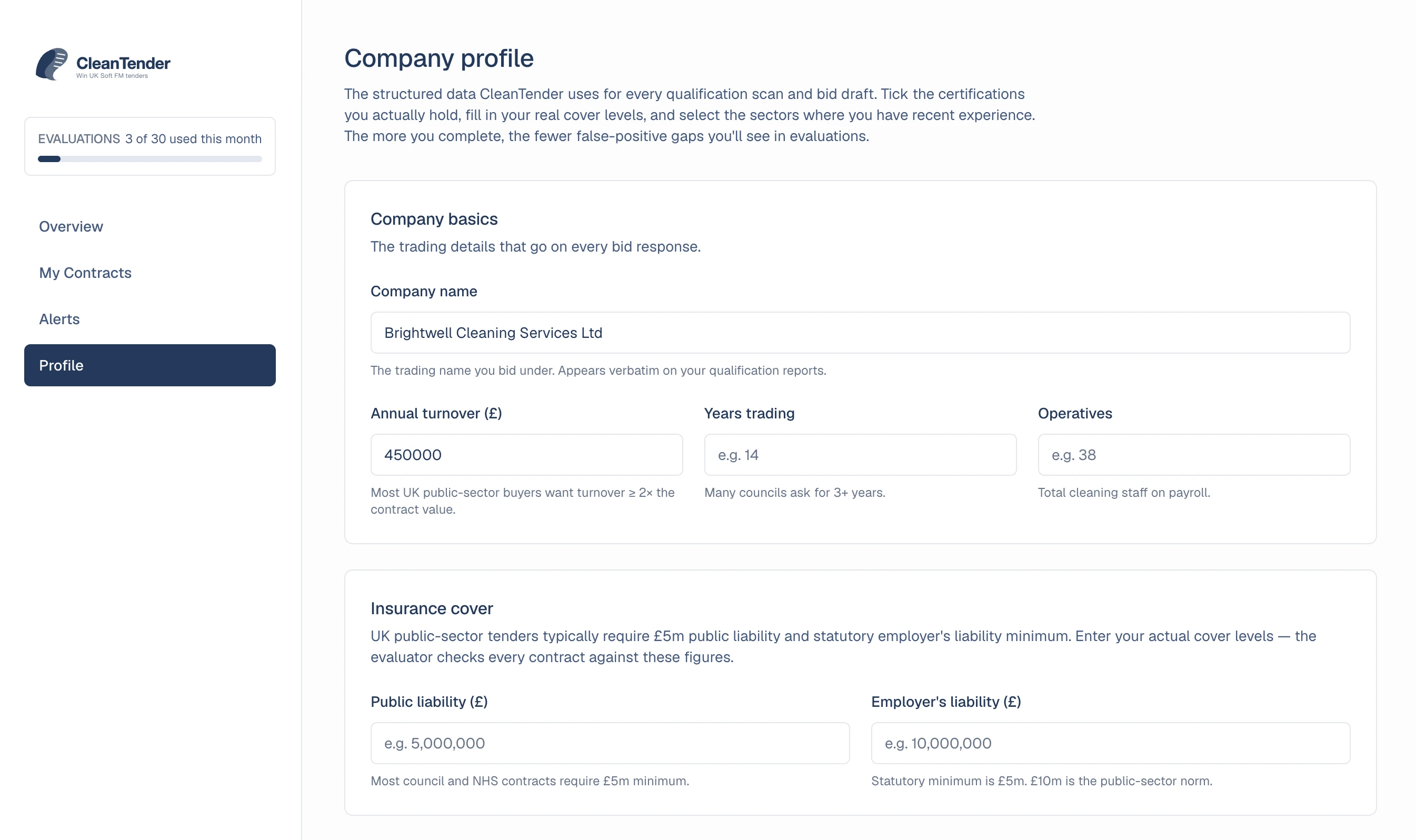
Profile setup defines what you are bid-ready for Step 2· 5 minutes daily
Open the live soft FM-tender feed
Every UK cleaning, security, grounds, waste, and catering tender, in one feed. Pre-filtered to your sector and geography. No false positives, no manual portal-trawling across FTS, Contracts Finder, and dozens of buyer e-procurement portals.
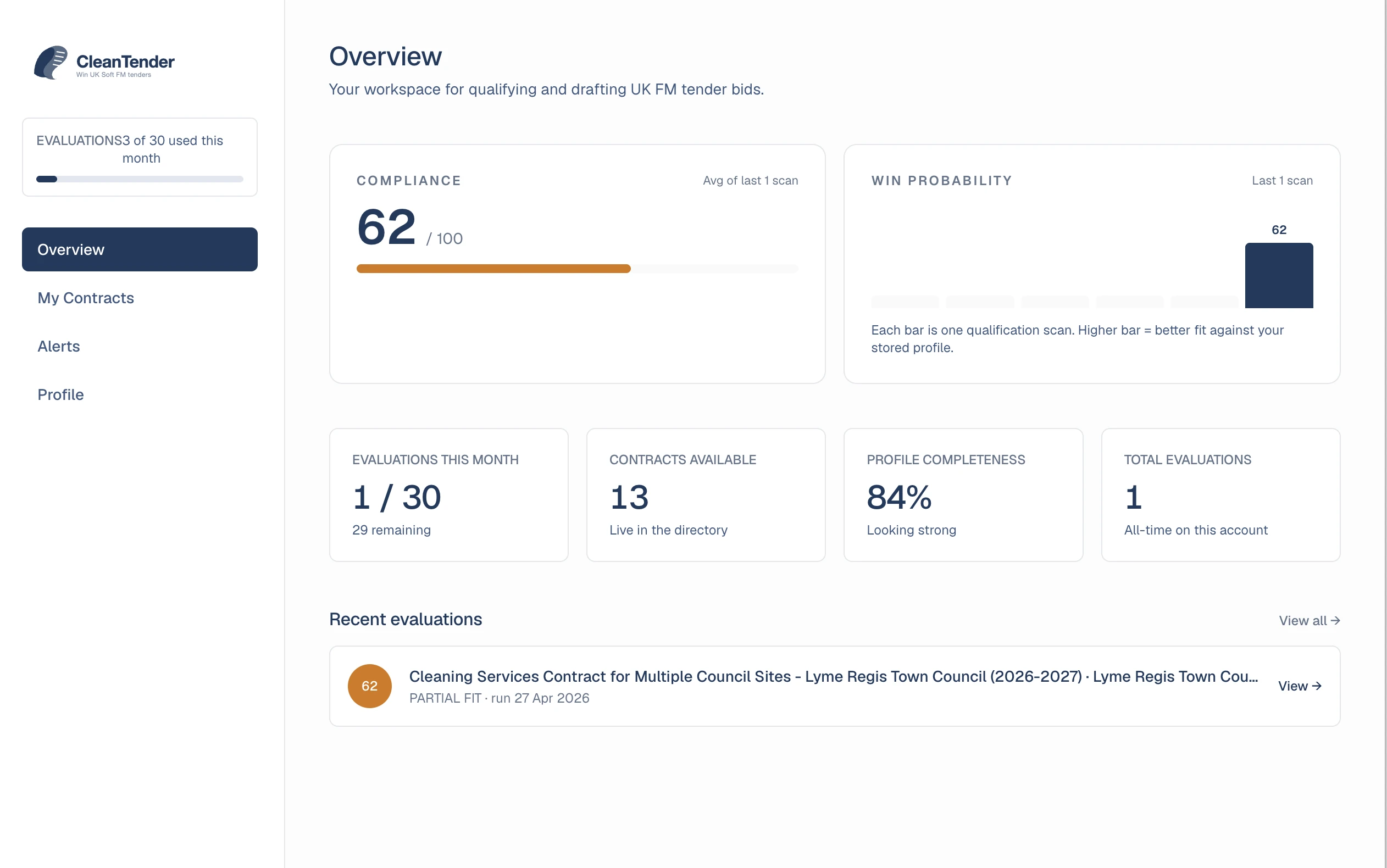
Live feed of in-scope soft FM tenders, fit-scored Step 3· Daily digest
Get email alerts for new in-scope tenders
New soft FM tenders matching your profile land in your inbox the day they publish. CleanTender batches them into a daily digest so you do not get notification fatigue, and links straight back to the in-app fit score.
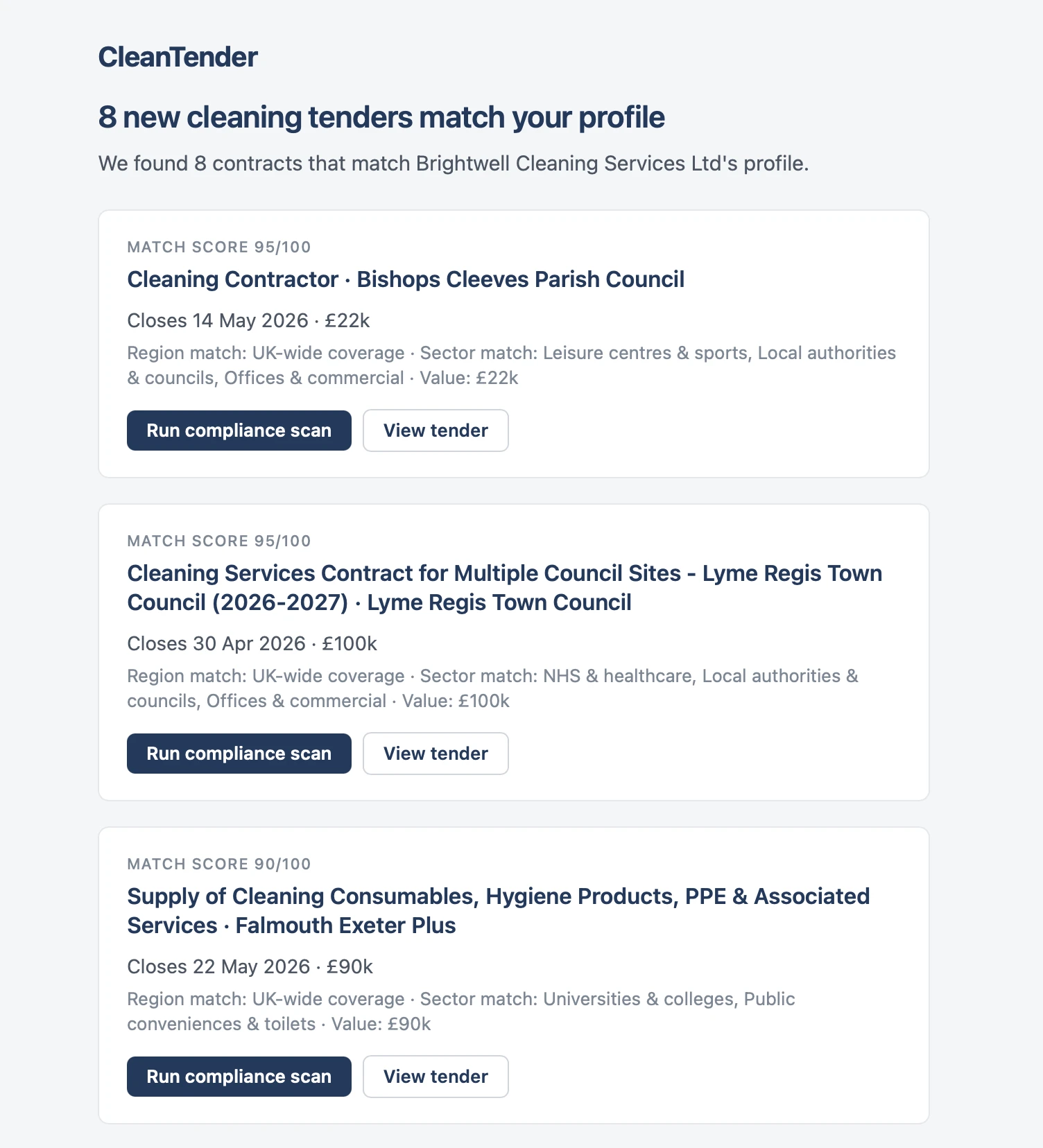
Daily alerts for new in-scope tenders Step 4· 30 seconds
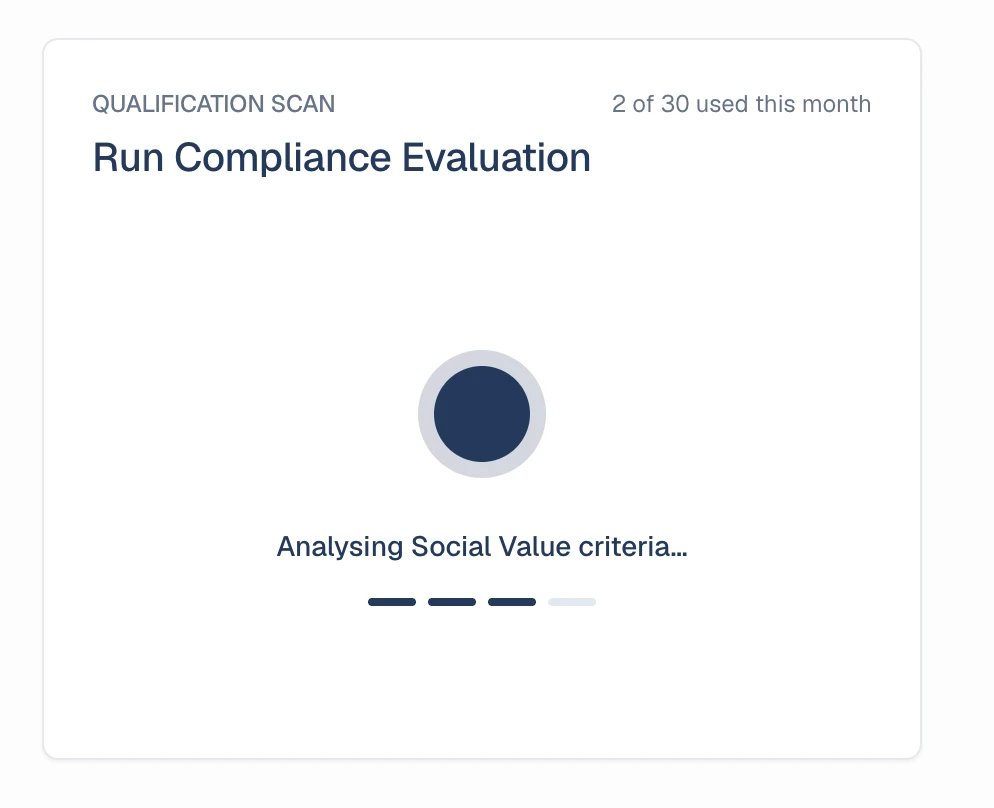
Run a fit-score evaluation on a target tender
One click runs a CleanTender Evaluation against the tender pack: scope match, geography fit, scale fit, compliance gap, and a plain-English win probability. Stops you bidding contracts you were never going to win.
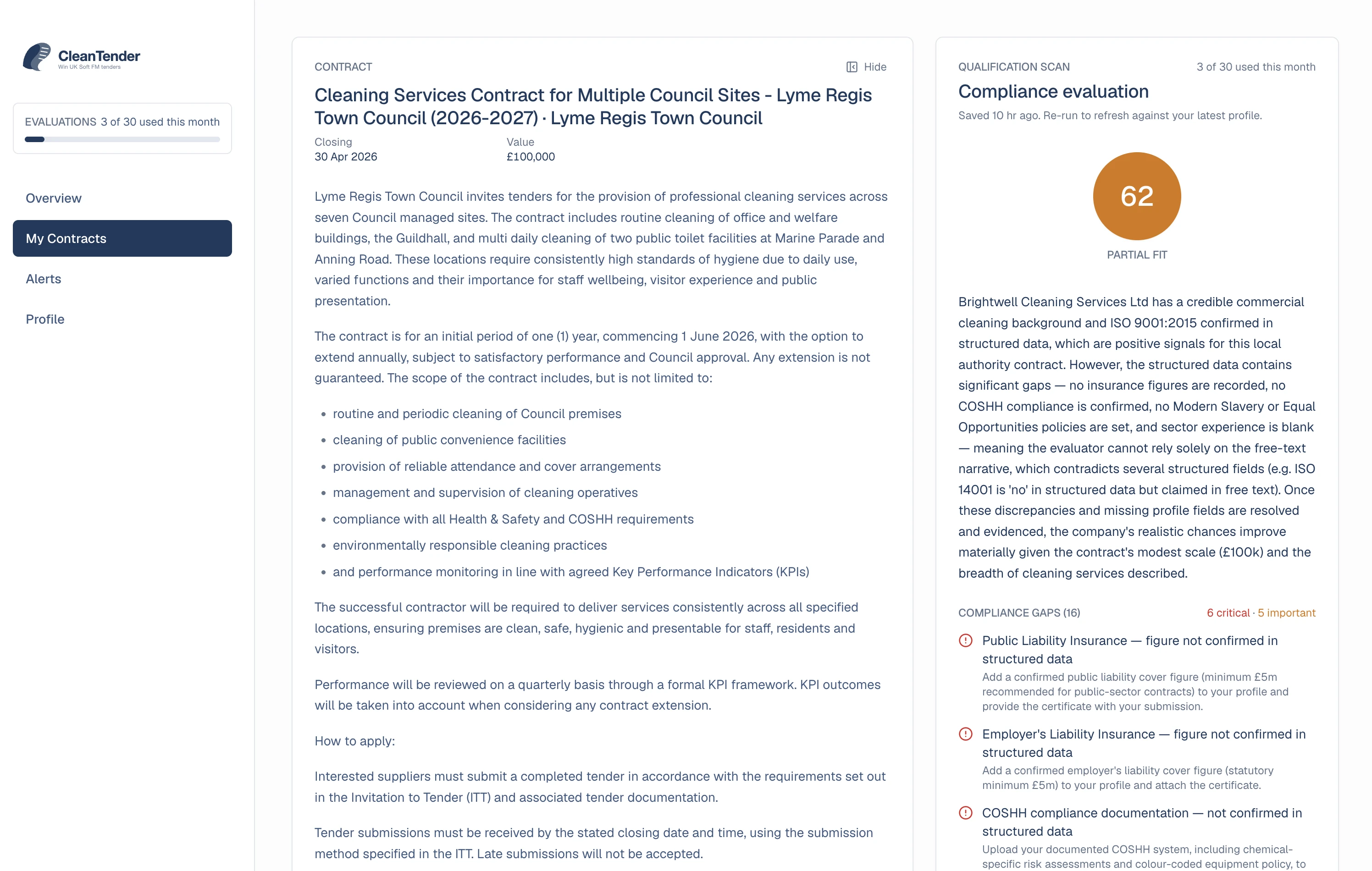
Fit-score and win-probability before you commit a weekend Step 5· 1 minute
Spot compliance gaps before you start drafting
CleanTender runs a named compliance check against the tender pack: SSIP accreditation, insurance thresholds, H&S policy, and financial standing. Anything missing is flagged before you sink hours into a bid that auto-fails at SQ.
Compliance gaps surfaced before drafting Step 6· 2 minutes generation
Generate a full SQ + method-statement draft
CleanTender drafts a complete Standard Selection Questionnaire response using your profile data and the tender requirements: declaration block, company overview, contract experience, quality, training, COSHH, social value, H&S, insurance schedule. All ten sections, in one pass.
Full SQ draft generated in minutes, not days Step 7· Half a day
Refine, add evidence, and submit
Tune the draft, drop in named referees and certificate numbers, layer your quantified social value commitments, and submit through the buyer's portal. Most users compress a 30-60 hour first bid to 8-12 hours of focused review.
Step 8· Ongoing
Track outcomes and improve
Every bid logs in CleanTender with status, score, and (after standstill) the buyer's feedback. Use the standstill data to tune your next bid. Win rate compounds; first-bid completion is the only thing standing between you and a public-sector revenue line.
When to step up to CAS
For a small UK cleaning contractor working below £5m turnover, CAS is overkill on most jobs. CHAS Standard or Worksafe SSIP gets you through the door for council and school cleaning. The fee is a fraction of CAS-level memberships.
Step up to CAS-level accreditation if you're chasing high-value NHS work, sub-contracting under a Tier 1 FM provider that mandates it, or moving towards multi-million-pound contracts. Until then, basic SSIP plus a tidy compliance pack will hold most of what you bid for.
What this means for your next bid
PAS 91 isn't gone. It just isn't being updated. For most small cleaning and FM contractors, the SQ under PPN 03/23 is the form you'll actually fill in this year. Build the profile once. Keep it current. Reuse it.
Once your PAS 91 answers are tidy and ready, the bid itself becomes the easy part. For the mechanics of writing one that wins, see our step-by-step guide to bidding for cleaning contracts. If the whole tender process is still new to you, the primer on what a tender actually is is a faster read.
PAS 91 questions now sit inside the Procurement Act 2023 selection stage. Check your evidence pack with our free SQ readiness checker.
Sources
- Procurement Policy Notes (Cabinet Office collection) · PPN 03/23 (SQ)
- PPN 03/24: Standard Selection Questionnaire (SQ) update · Common Assessment Standard, in force from 27 June 2024
- Procurement Act 2023 (legislation.gov.uk) · Proportionality principle for SQ requirements
- BSI Group · Publisher of PAS 91 (withdrawn April 2023)
- Safety Schemes in Procurement (SSIP) · CHAS, SMAS, SafeContractor, Constructionline + Deem to Satisfy
FAQs
Frequently asked questions
- No buyer can mandate PAS 91 today in the way they once did. BSI withdrew it in April 2023, so it's not maintained, updated, or promoted as a current standard. It isn't banned either, so a council running an old template can still legally attach it. What actually decides whether you need "PAS 91 compliance" is the tender pack sitting in front of you right now: most ask for the SQ under PPN 03/23, works contracts over the PPN 03/24 threshold ask for CAS, and a handful of slow-to-update buyers still name PAS 91 directly. Check the pack, not the standard's status.
- The British Standards Institution withdrew PAS 91 in April 2023. The standard is no longer maintained or updated, so there won't be a revised version to check against. Buyers can still use it because it stays consistent with the procurement regulations, but for most public-sector cleaning and FM tenders the Standard Selection Questionnaire under PPN 03/23 has taken its place. If you're bidding today and a pack names PAS 91 directly, treat it as a legacy attachment rather than a current standard, and answer whatever the buyer actually confirms they want.
- The Standard Selection Questionnaire (SQ) under PPN 03/23 is the main replacement for most public-sector cleaning and FM tenders, and it's the form you'll fill in on the majority of council and school bids. For high-value construction-adjacent work over roughly £5 million, PPN 03/24 introduced the Common Assessment Standard (CAS), in force from 27 June 2024. Both cover similar ground, insurance, financial standing, health and safety, but apply at different value thresholds, so check which one the tender pack actually names before you start answering.
- Send what they ask for. Some councils still attach old PAS 91 forms because their procurement templates haven't been refreshed since the withdrawal, not because they've made a deliberate choice to keep using it. If the pack attaches both PAS 91 and an SQ, raise a clarification question rather than guessing. Buyers have to publish the answer to every bidder, so you give nothing away by asking, and it's usually quicker than filling in both forms speculatively. Whichever version they confirm, fill that one in cleanly and keep a note of which one you sent for the audit trail.
- Probably not. PPN 03/24 mandates CAS-level accreditation on public-sector projects over £5 million. Below that threshold, an entry-level SSIP membership like CHAS Standard or Worksafe SSIP is normally enough for council and school cleaning work. If a buyer asks for CAS on a contract under £5 million, ask them to justify it under the proportionality principle in the Procurement Act 2023.
- Health and safety, financial standing, insurance, environment, and quality. Most buyers ask for one SSIP accreditation, last two years of accounts, employer's liability and public liability insurance at the levels named in the pack, a written environmental policy, and a quality management process with a complaints procedure. NHS-facing work also asks for product evidence against BS EN 1276 and EN 14476 disinfectant standards, so keep supplier test certificates on file well before you need them. Health and safety and insurance are usually where small firms lose the most marks, so start those two sections first.
- Yes, and you should. Almost every public buyer asks the same questions in slightly different boxes, whether the pack calls it PAS 91, an SQ, or CAS. Maintain one master profile. Accounts, insurance certificates, SSIP membership, equality and environmental policies, three named referees, and your standard method statement. Update it when accounts roll over and insurance renews, roughly twice a year for most small firms. Each new bid is then mostly copy-paste with a few paragraphs that change per contract, which turns a weekend-long first submission into an hour of editing by your fifth or sixth bid.