
UK public buyers spend about £1.2 billion a year on private security. Manned guarding at council civic centres. Mobile patrol on housing estates. Concierge in NHS Trust receptions. CCTV monitoring in city-centre control rooms. Door supervision at leisure centres. Most of it goes to a handful of national contractors who learned to bid 30 years ago and a long tail of regional SMEs who keep winning on local presence and TUPE knowledge.
Bidding for it isn't the same as bidding for cleaning. Security adds three regimes on top of the Procurement Act 2023. SIA licensing for every operative. The ACS Approved Contractor Scheme audit on the company. And BS 7858 vetting that buyers will check on every name on the rota.
Here's the path. What to gather. Where to look. What gets you binned.
Bidding security for the first time? Start with how UK tenders work in plain English. The Procurement Act 2023 procedures and portal map are the same regardless of sector. The security extras (SIA licensing, ACS audit, BS 7858 vetting) sit on top of that base.
What's in this guide
- How to bid for a UK security contract, step by step (CleanTender walkthrough)
- What public buyers buy under "security"
- SIA licensing in plain English
- ACS, the Approved Contractor Scheme
- BS standards every security buyer references
- Insurance and indemnity (the £10m floor)
- Where security tenders live
- TUPE, the bit most new bidders trip on
- Pricing manned guarding without going broke
- Common SQ questions for security
- Procurement Act 2023 + AI disclosure
- First-time bidder paperwork checklist
How to win a UK security tender, step by step
The complete end-to-end flow inside CleanTender. From sector setup to a submitted security bid in the time it used to take to read a single tender pack.
Eight steps from "never bid public sector" to a complete SQ response on the buyer's portal. First scan is free.
Step 1· 10 minutes
Build your security company profile
Set your sector to security, your service regions, SIA ACS membership, BS 7858:2019 vetting status per officer, NSI Gold or BSIA membership if held, incident management platform, response times, fleet for mobile patrol, insurance levels, turnover, and operative count. CleanTender uses this to fit-score every live tender against your real capability so you only see the ones you can win.
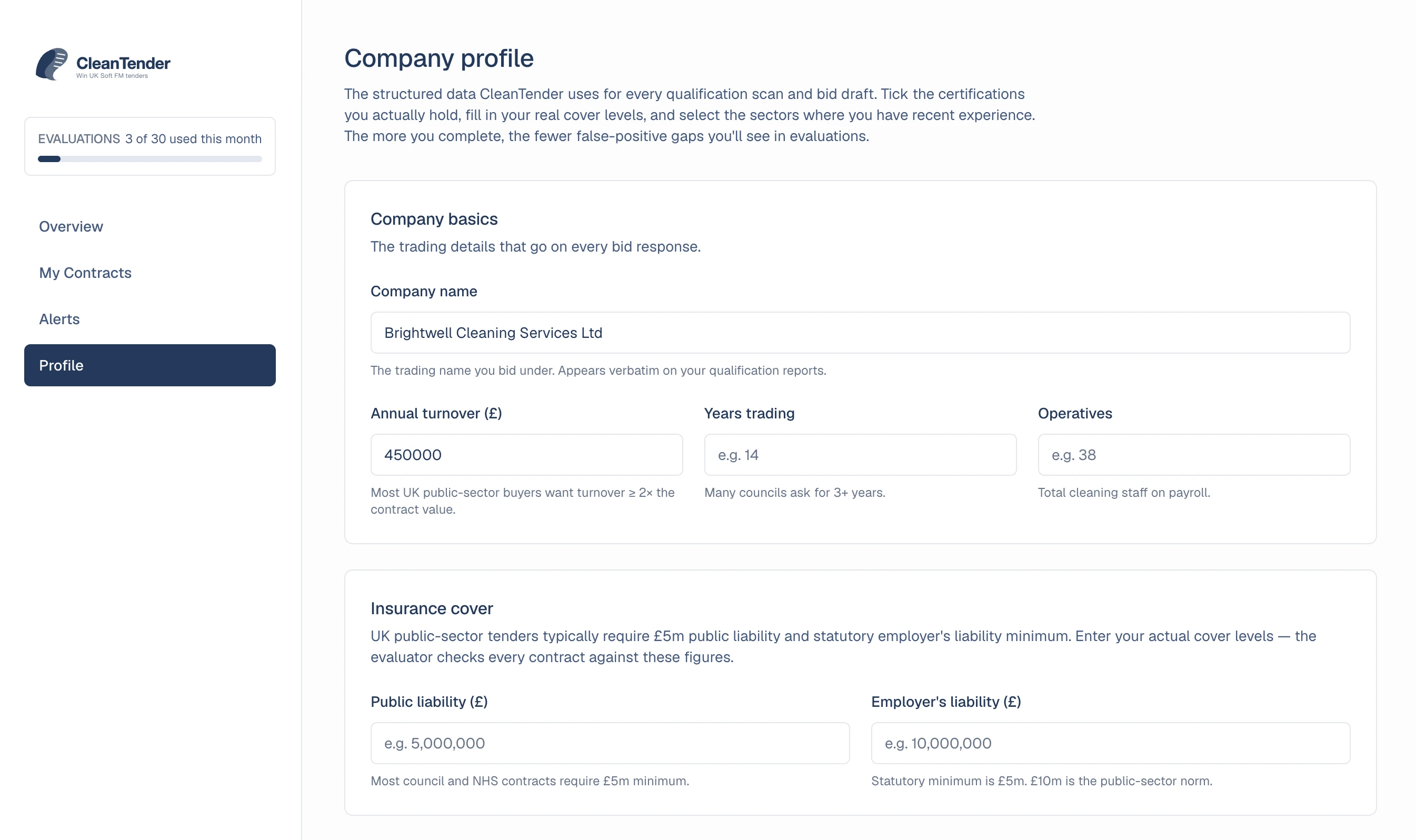
Profile setup defines what you are bid-ready for Step 2· 5 minutes daily
Open the live security-tender feed
Every UK NHS Trust, council, school, university, court (MoJ), HMPPS, MoD, and central government security tender, in one feed. Pre-filtered to your sector and geography. No false positives, no manual portal-trawling across FTS, Contracts Finder, and dozens of buyer e-procurement portals.
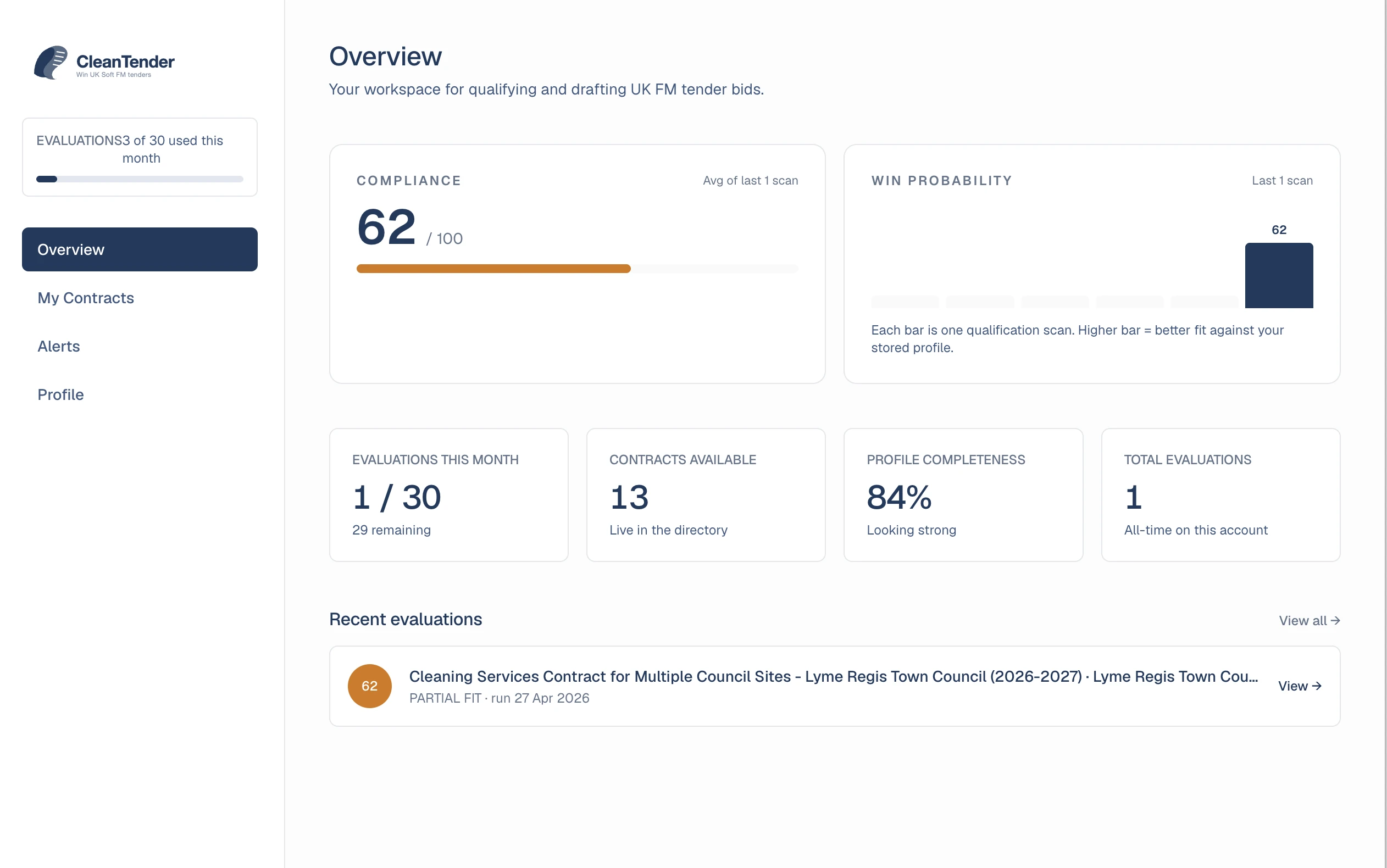
Live feed of in-scope security tenders, fit-scored Step 3· Daily digest
Get email alerts for new in-scope tenders
New security tenders matching your profile land in your inbox the day they publish. CleanTender batches them into a daily digest so you do not get notification fatigue, and links straight back to the in-app fit score.
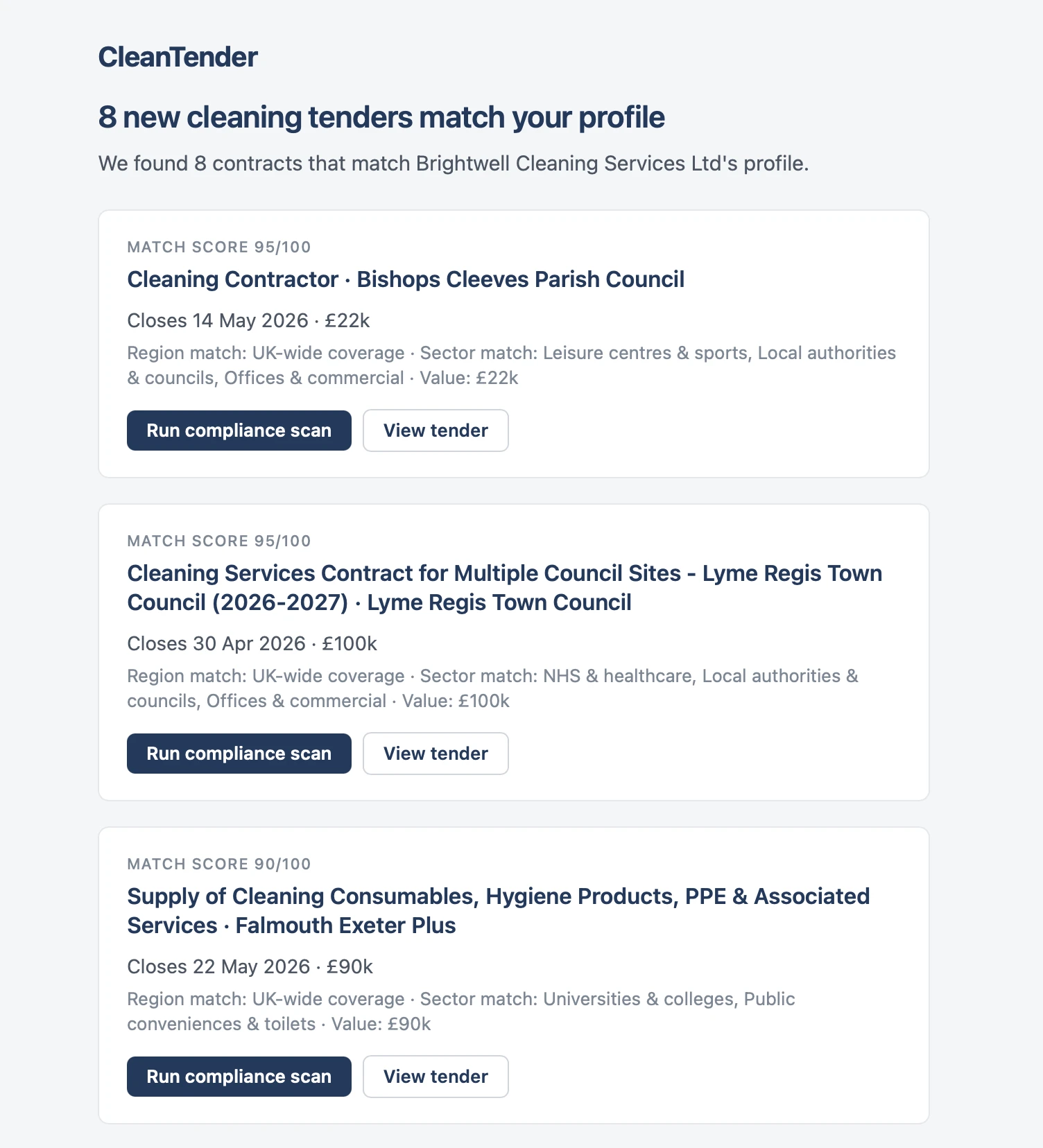
Daily alerts for new in-scope tenders Step 4· 30 seconds
Run a fit-score evaluation on a target tender
One click runs a CleanTender Evaluation against the tender pack: scope match, geography fit, scale fit, compliance gap, and a plain-English win probability. Stops you bidding contracts you were never going to win.
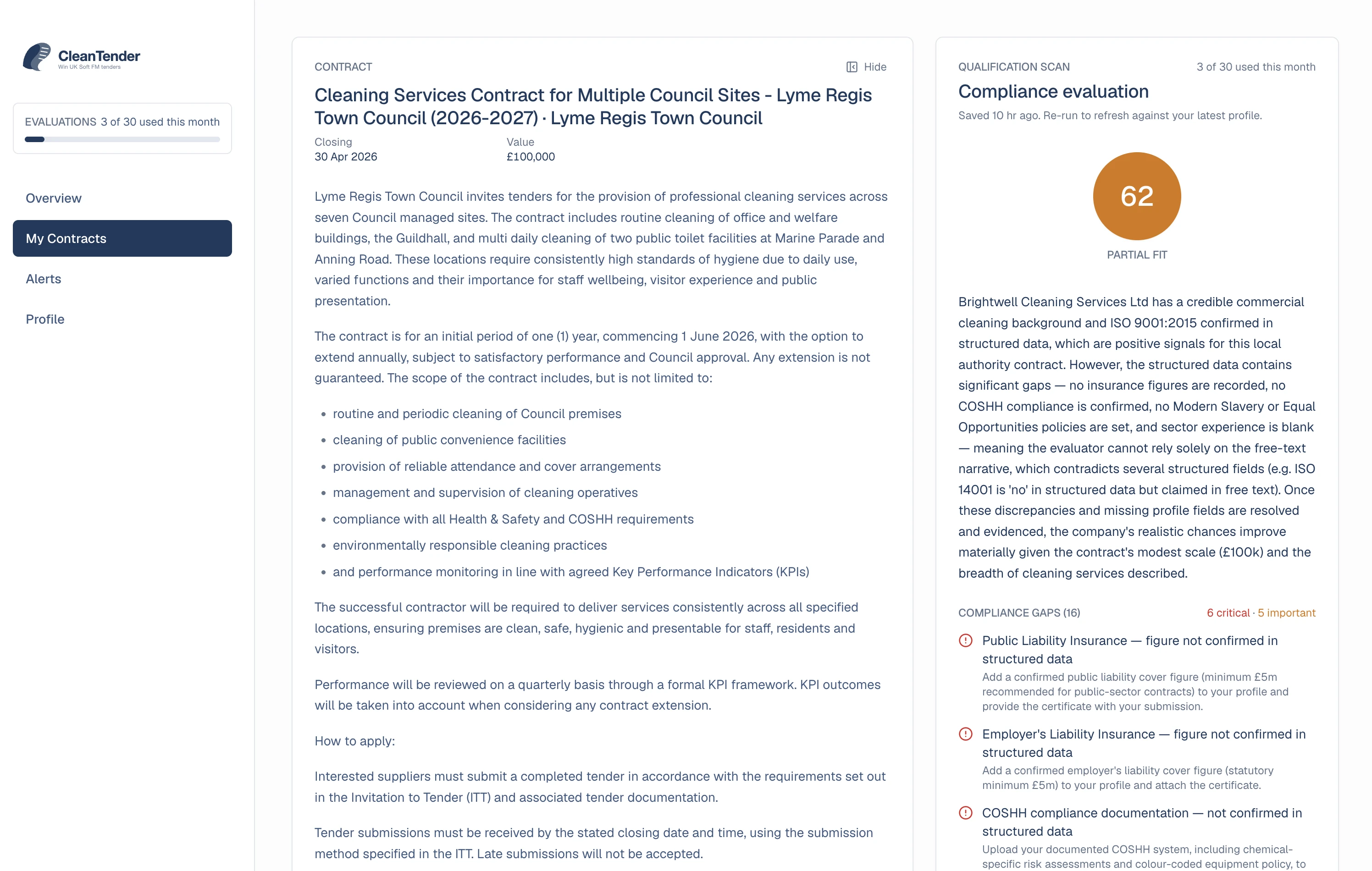
Fit-score and win-probability before you commit a weekend Step 5· 1 minute
Spot compliance gaps before you start drafting
CleanTender runs a named compliance check against the tender pack: SIA ACS, BS 7858:2019 vetting evidence, ISO 9001 + ISO 14001 + ISO 45001 if held, SSIP, GDPR for CCTV, social value plan, Martyn's Law tier where applicable. Anything missing is flagged before you sink hours into a bid that auto-fails at SQ.
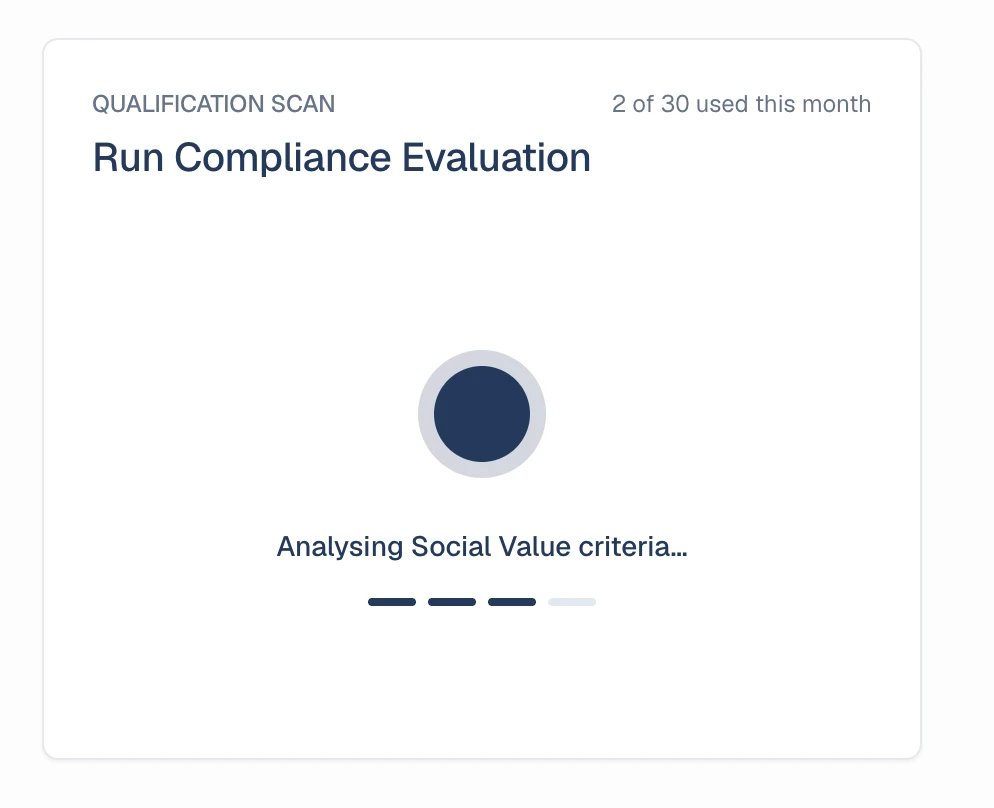
Compliance gaps surfaced before drafting Step 6· 2 minutes generation
Generate a full SQ + method-statement draft
CleanTender drafts a complete Standard Selection Questionnaire response using your profile data and the tender requirements: declaration block, company overview, contract experience, quality, training, COSHH, social value, H&S, insurance schedule. All ten sections, in one pass.
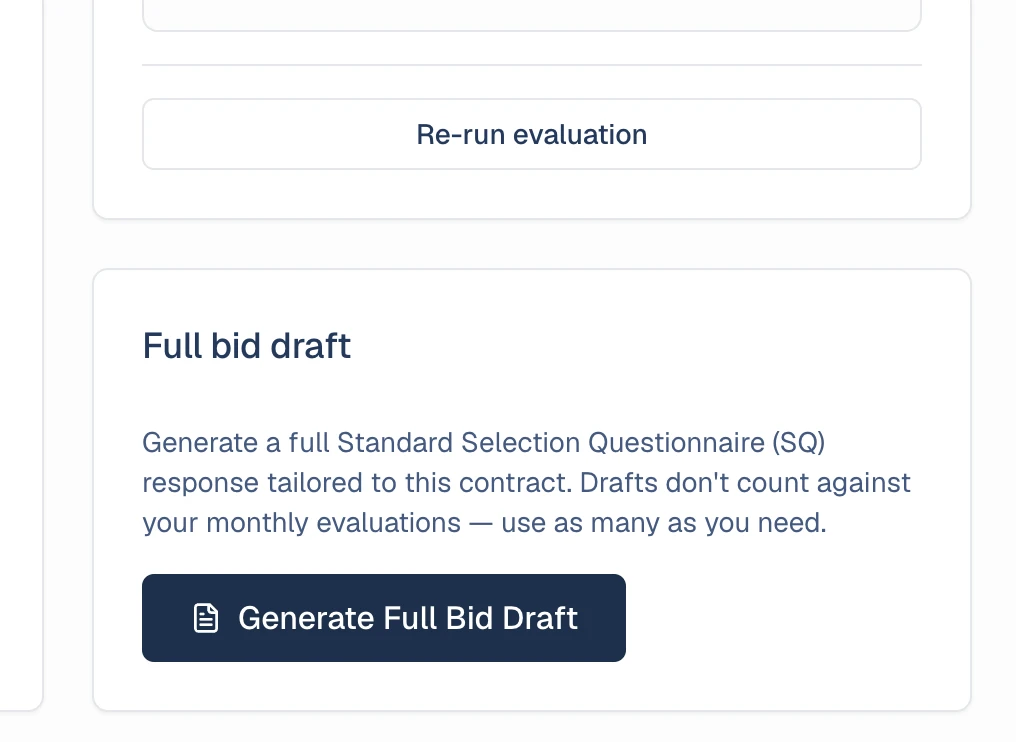
Full SQ draft generated in minutes, not days Step 7· Half a day
Refine, add evidence, and submit
Tune the draft, drop in named referees and certificate numbers, layer your quantified social value commitments, and submit through the buyer's portal. Most users compress a 30-60 hour first bid to 8-12 hours of focused review.
Step 8· Ongoing
Track outcomes and improve
Every bid logs in CleanTender with status, score, and (after standstill) the buyer's feedback. Use the standstill data to tune your next bid. Win rate compounds; first-bid completion is the only thing standing between you and a public-sector revenue line.
What public buyers buy under "security"
"Security contract" is loose. Most public buyers procure one or two of the following.
- Manned guarding. Static officers at a fixed site. Reception, gate, internal patrol. Council civic centres, NHS Trust head offices, leisure centres, schools out of hours.
- Mobile patrol. A van crew that visits multiple sites overnight. Housing estates, retail parks, council depots, school estates.
- Key holding and alarm response. The crew that turns up when an alarm goes off. Often paired with mobile patrol.
- CCTV monitoring. Public-space surveillance from a control room. Local-authority town-centre cameras, NHS Trust security operations centres.
- Door supervision. Leisure centres, council-run nightclubs (rare), licensed council events.
- Close protection. Senior politicians, judges, witnesses. Niche, restricted, usually direct-award.
- Concierge and front-of-house. Reception duties with security duties layered on. Care homes, university halls, mixed-use council buildings.
Each one carries its own SIA licence sub-category and its own buyer expectations. A bid for manned guarding at a primary school is not the same kind of bid as one for CCTV monitoring at a city-centre operations room. Read the spec. Match the response.
SIA licensing in plain English
The Private Security Industry Act 2001 made it illegal to work in front-line security in the UK without an individual licence from the Security Industry Authority (SIA). It's not a company licence. Every operative needs one in their pocket while on duty.
Front-line licences cover named roles.
- Door Supervision (DS), licensed premises, public events.
- Security Guard (SG), manned guarding, static officer, gate work.
- Public Space Surveillance (CCTV), operating CCTV equipment to monitor public space, usually from a control room.
- Close Protection (CP), bodyguarding individuals.
- Cash and Valuables in Transit (CVIT), armoured-van crews.
- Key Holding (KH), alarm response, key custody.
A non-front-line licence covers managers, supervisors, and directors of a regulated company. They don't need it to do the work, they need it because they direct people who do. Three-year licence cycle. Renewal needs the SIA-approved training updated.
Bidding tip: in your SQ, name the licence sub-categories your team holds. Don't write "all our staff hold SIA licences". Write "100% of front-line operatives hold a current SIA SG (Security Guard) licence; 100% of CCTV monitoring staff hold an SIA CCTV licence; supervisors hold SIA non-front-line licences". The buyer's evaluator can score that. They can't score the vague version.
ACS, the Approved Contractor Scheme
The SIA also runs ACS. Voluntary on paper, effectively mandatory in public-sector procurement. ACS is a company-level audit (independent assessor, annual review) against operational, training, and management standards. It's the security-industry equivalent of CHAS or Constructionline plus an extra layer.
Most public-sector security tenders ask for ACS as a minimum standard at SQ stage. Some specify a minimum ACS score (the assessor scores you across nine indicators; 175 is a common floor, 200+ is competitive). Frameworks at NHS Shared Business Services, Crown Commercial Service RM6248 (Facilities Management Services), and most county council framework agreements ask for ACS.
If you're not on ACS, you're not winning any public-sector security work above £25,000 ish. Get on it before you bid, not after.
BS standards every security buyer references
Public-sector security specs lean on a small set of British Standards. You don't need every one for every contract. You need to know which ones the buyer cites and meet those.
- BS 7858, Screening of individuals working in a secure environment. Vetting standard. Five-year work history check, two named referees, identity verification, criminal record check. Ends every public-sector security contract that touches schools, NHS, courts, or central government.
- BS 7499, Code of practice for static guarding, mobile patrol, and key-holding. The operational baseline.
- BS 7960, Code of practice for door supervision (license-required door supervision premises).
- BS 7958, CCTV operations in public space surveillance. Required for any council-run public-space CCTV control room.
- BS 5979, Code of practice for the planning and operation of remote centres for alarm systems (alarm receiving centres).
- BS 8418, Detector-Activated Security Remote Surveillance Systems. The CCTV-to-police-response chain.
- ISO 18788, Management system for private security operations. The international cousin of BS 7499. Useful on contracts that touch infrastructure or international supply chains.
When the spec quotes one of these, your method statement should use the same number. "Vetting carried out to BS 7858:2019" beats "thorough vetting".
Insurance and indemnity
The security floor on insurance is higher than cleaning.
- Public liability: £10 million standard. Some council framework agreements ask for £15 million on city-centre patrol or large estates.
- Employer's liability: £10 million. Statutory minimum is £5m but the public-sector norm is £10m.
- Professional indemnity: £2 million typical. Required when the contract involves risk assessment, security audit, or design work.
- Crime (fidelity) cover: £100,000 to £250,000 depending on whether you're handling cash or keys.
Get the broker to write a single Insurance Schedule that lists all four cover types with current expiry dates. Upload it to your Central Digital Platform profile. You'll attach it to every bid.
Where UK security tenders live
Same five free portals as every other public-sector procurement. The CPV codes change.
| CPV code | Coverage |
|---|---|
| 79710000 | Security services (parent) |
| 79711000 | Alarm-monitoring services |
| 79713000 | Guard services |
| 79714000 | Surveillance services |
| 79715000 | Patrol services |
| 79716000 | Security certification services |
| 79993000 | Building and facilities management (soft FM bundle, often includes security) |
CPV codes for UK security procurement. Set saved-search alerts on Find a Tender + Contracts Finder against these.
Set saved-search alerts on Find a Tender. Since February 2025 it carries new English, Welsh and NI notices from £12,000 (central) and £30,000 (councils, NHS) inc VAT, as well as every above-threshold contract. Contracts Finder only holds older procurements. Add Public Contracts Scotland, Sell2Wales, and eTendersNI for the devolved nations. All free.
If you want a soft-FM-vertical view that filters CPV-pure security plus the adjacent verticals you'd realistically bid on (cleaning, grounds, waste, FM bundles), our live tender directory. For the wider picture of where UK security tenders are posted across every free portal, see the UK security tenders hub. For the deeper take on what the Procurement Act 2023 changed, the government contracts guide covers the regime end-to-end.
TUPE, the bit most new bidders trip on
TUPE (Transfer of Undertakings (Protection of Employment) Regulations 2006) applies to almost every public-sector security re-tender. When the contract changes hands, the incumbent contractor's staff transfer to you on their existing terms and conditions. You inherit their pay rate, their pension, their holiday balance, their length-of-service rights.
Three things matter for the bid.
- Employee Liability Information (ELI). The incumbent must give you the staff list, pay rates, pension status, and disciplinary history at least 28 days before the transfer. Demand it during the tender process if the buyer hasn't included it. You can't price the bid without it.
- Inherited cost base. If the incumbent has been paying £14.50 an hour to staff who've been on site for 12 years, you're paying £14.50 from day one. You cannot drop their pay, change their holiday, or cut their hours without a clear ETO (Economic, Technical, Organisational) reason that survives a tribunal.
- Pension. Many incumbent staff are in the LGPS (Local Government Pension Scheme) or a defined-benefit scheme on "admitted body" status. You may have to keep them in it. Get the actuary's certificate before pricing.
Bid feedback patterns: SMEs lose security tenders not because their methodology is weak but because they price as if TUPE doesn't apply, then find out it does and either pull out (which gets you a contractual headache) or run the contract at a loss for two years until they can renegotiate.
Pricing manned guarding without going broke
Manned guarding pricing is hourly. The buyer wants a charge-out rate per officer-hour, often broken down by shift type.
Build the rate from the ground up.
- Direct wage. National Living Wage in 2026 is £12.21 per hour for over-21s. Public-sector security usually pays above NLW because of TUPE inheritance. Assume £13 to £15 per hour for new hires.
- Holiday accrual. 28 days statutory equals roughly 12% on top.
- Employer's NI. 13.8% above the secondary threshold.
- Pension auto-enrolment. 3% employer minimum on qualifying earnings.
- Sick pay reserve. 2 to 4% depending on contract length.
- Training and licensing. SIA renewal every 3 years (~£190), plus annual refresher training, plus first-aid renewals. Allow 2% of wage cost.
- Uniform, equipment, radios. £200 to £400 per officer per year.
- Management overhead. Operations, supervision, payroll, HR. 10 to 15%.
- Insurance, ACS, software, vehicle. 4 to 6%.
- Profit margin. 5 to 8% is typical for SME security. Below 5% you're undercutting yourself; above 10% you're losing on price.
Realistic public-sector charge-out in 2026: £14 to £18 per officer-hour for routine static guarding. £18 to £22 for higher-risk patrol or ARC-monitored response. Night and weekend uplifts of 10 to 15% are normal.
Don't try to win on price alone. Most public-sector security awards run on weighted MEAT. Quality and social value carry 50 to 70% of the score. A price 5% above the lowest bidder still wins if your method statement and TOMs commitments score better.
Hard-won lesson
Common SQ questions for security
Public-sector security SQs ask the same questions in slightly different orders. Build a stock answer for each. Tweak per contract.
- How do you vet officers? Answer: BS 7858:2019 with named verification steps. Five-year work history, two referees, ID, DBS Enhanced where children or vulnerable adults are involved.
- How do you train? SIA licensing baseline plus per-contract induction. Conflict management, customer service, fire safety, first aid, equality and diversity refresher annually.
- How do you supervise? Named contract manager, named area supervisor, named on-call manager. Site visits monthly, audited check-calls hourly, body-cam and DAR (Daily Activity Report) review weekly.
- How do you handle TUPE? Day-1 transfer plan with the incumbent. Consultation meetings with transferring staff. ELI integration into your payroll. Keep pay, terms, pension. ETO changes flagged early.
- How do you measure performance? Named KPIs. Attendance compliance (target 99.5%). Incident response times. Audit scores. Quarterly review with named operational and contractual stakeholders.
- How do you handle complaints? Named complaint route, 24-hour response target, root-cause analysis, action tracking, monthly KPI report.
- Social value? SMART local commitments. Local hire targets, community engagement, environmental fleet plan.
Procurement Act 2023 and AI disclosure
All the Procurement Act 2023 stuff applies. Three procedures (Open, Competitive Flexible, Direct Award). Central Digital Platform once-only registration. Schedules 6 and 7 exclusion grounds. PPN 002 social value mandatory from 1 October 2025. PPN 017 AI disclosure.
The full breakdown sits in the government contracts guide. Security buyers apply the same regime. Two security notes worth flagging: contract performance notices are usually triggered when KPI failure means staff turnover above the contractual threshold, and the central debarment list catches security suppliers fast when they breach licensing or vetting standards.
First-time bidder paperwork checklist
- Companies House registration. Last two years of audited or certified accounts.
- Public liability £10m, employer's liability £10m, professional indemnity £2m.
- ACS Approved Contractor Scheme certification. Score on the certificate.
- SIA licence list. Front-line and non-front-line, by sub-category, with renewal dates.
- BS 7858 vetting policy and procedure. Dated, version-controlled.
- BS 7499 (or BS 7960 / BS 7958 / BS 5979 depending on contract type) operational policy.
- ISO 9001 (Quality Management). Increasingly mandatory above £100k.
- ISO 14001 (Environmental). Asked for on most council and NHS framework agreements.
- ISO 45001 (Occupational H&S). Replaces OHSAS 18001.
- Modern Slavery Act, Equal Opportunities, H&S, Environmental policies.
- Two or three reference contacts on similar contracts. Named, contactable, willing.
- DBS policy. Enhanced DBS for any contract touching schools, NHS, courts, vulnerable adults.
- TUPE process. Documented transfer methodology with named consultant or HR lead.
On the SSIP shopping decision, our best SSIP scheme for small business UK comparison covers CHAS, SMAS, SafeContractor, and Constructionline. For the bid-writing economics, bid writer vs AI bid tool has the maths.
If you're moving from "interested" to "writing the response", register on CleanTender and run a free fit check on the next live security tender that catches your eye.
Sources
- Procurement Act 2023 · Royal Assent October 2023, in force 24 February 2025
- Private Security Industry Act 2001 · The legislation that created the SIA and licensing regime
- Security Industry Authority · Licensing, ACS, training requirements, register search
- BS 7858:2019 Screening of individuals · Vetting standard cited in most public-sector security specs
- Find a Tender Service · All UK public + utilities tenders over £135,018 incl. VAT
- Crown Commercial Service RM6248 FM Services · The Cabinet Office framework that bundles security with other soft FM
FAQs
Frequently asked questions
- The company doesn't bid with a licence, but every front-line operative on the contract needs an individual SIA licence under the Private Security Industry Act 2001. The right sub-category for the work (Security Guard, Door Supervisor, CCTV, Close Protection, Cash and Valuables in Transit, Key Holding). Managers, supervisors, and directors need a non-front-line licence. Without these, the buyer's evaluator scores you nil on the technical capability question.
- ACS is the SIA's Approved Contractor Scheme. An annual independent audit of your company against operational, training, and management standards. It's voluntary on paper, effectively mandatory in public-sector procurement. Most council, NHS, and central-government security tenders ask for ACS at SQ stage. Some specify a minimum score (175 is a common floor, 200+ is competitive). Get on it before you bid for anything above £25,000.
- Public liability £10 million is the security floor. Some councils ask £15 million on city-centre patrol or large estates. Employer's liability £10 million (statutory minimum is £5m but public-sector norm is £10m). Professional indemnity £2 million for risk-assessment or design work. Crime / fidelity cover £100,000 to £250,000 if you're handling cash or keys. Get the broker to write a single Insurance Schedule covering all four with current expiry dates.
- TUPE (the Transfer of Undertakings Regulations 2006) applies to almost every public-sector security re-tender. When the contract changes hands, the incumbent's staff transfer to you on their existing terms. Pay rate, pension, holiday balance, length of service. The incumbent must give you the Employee Liability Information (ELI) at least 28 days before transfer. You inherit the cost base, you can't drop pay or terms without a defensible Economic, Technical, or Organisational reason, and many transferring staff are in defined-benefit pension schemes you may have to maintain.
- In 2026, public-sector manned guarding charges out at £14 to £18 per officer-hour for routine static guarding, £18 to £22 for higher-risk patrol or ARC-monitored response. Night and weekend uplifts of 10 to 15% are normal. Build the rate up: NLW base (£12.21/hr in 2026), holiday accrual 12%, employer's NI 13.8%, pension 3%, sick pay reserve, training, equipment, management overhead 10-15%, insurance 4-6%, profit 5-8%. Don't undercut the floor. Public-sector awards run on weighted MEAT, not lowest price.
- Find a Tender Service for new public-sector notices from £12,000 (central) and £30,000 (councils, NHS) inc VAT upwards, including every above-threshold contract. Contracts Finder only for older procurements started before February 2025. Public Contracts Scotland, Sell2Wales, eTendersNI for the devolved nations. Set saved-search alerts on each by CPV code: 79710 (security services), 79711 (alarm monitoring), 79713 (guard services), 79714 (surveillance), 79715 (patrol). Add 79993 for soft FM bundles that include security. All five portals are free.
- BS 7858 is the security-industry vetting standard. Five-year work history check, two named referees, identity verification, criminal record check, financial probity check. Most public-sector security buyers ask for it. Enhanced DBS is the wider Disclosure and Barring Service criminal record check, deeper than the Standard or Basic level. It's required on top of BS 7858 for any contract involving children, vulnerable adults, healthcare settings, or court premises. Both, on every name, with audit-ready records.
- No, but PPN 017 requires you to disclose AI use. Short disclosure: which tool, which part of the response it produced, the human review you applied. Buyers want transparency, not abstinence. The bigger risk is misrepresentation. Never let an AI tool claim an SIA licence, an ACS score, or a contract reference you don't actually hold. Misrepresentation is a discretionary exclusion ground under Schedule 7 of the Procurement Act 2023 and lands you on the central debarment list.
- A typical Selection Questionnaire response for a UK security tender takes a contractor several days to complete by hand. The hours go on gathering SIA ACS evidence, BS 7858 vetting records, PMVA training certificates, ISO 18788 documentation, plus writing a TOMs-aligned Social Value response from scratch. The largest framework lots (Ministry of Justice, NHS national procurement, TfL DPSes) can run a week or more for a single submission. AI tender drafting tools compress this to minutes by drafting against a stored compliance profile, with the security sector vocabulary (SIA ACS, BS 7858, BS 7499, BS 7984, ISO 18788, PMVA, TOMs framework, PPN 002) baked into the prompts so first drafts land closer to ready-to-submit.