
A security tender is a public invitation to bid for a manned guarding, mobile patrol, CCTV monitoring, key-holding or event-security contract. UK buyers publish them free on six routes: Find a Tender, Contracts Finder, Public Contracts Scotland, Sell2Wales, eTendersNI and individual buyer e-procurement portals. From 1 January 2026, contracts worth £207,720+ (inc VAT) from councils, NHS trusts and housing associations must appear on Find a Tender.
That removes the biggest myth in this market: that finding security tenders needs a paid subscription. It does not. Access is free everywhere. The real problems are volume, scatter across councils, NHS, MoD, transport and retail buyers, and the SIA ACS gate that auto-fails a bid before anyone reads the method statement.
The UK security tender market in 2026 numbers
Find a Tender threshold (sub-central)
£207,720
Inc VAT, from 1 Jan 2026 per PPN 023. Applies to councils, NHS trusts, housing associations. Central government (MoD): £135,018.
Below-threshold notice floor
£30,000
Councils and NHS trusts must publish notifiable contracts worth £30k+ (inc VAT). Central government from £12,000. Procurement Act 2023.
The head CPV code for security services
79710000
Plus 79711000 (alarm monitoring) and 79713000 (guard services). Add 79952000 for event-security notices, which the head code alone can miss.
Bristol City Council manned guarding award
£375,000
Manned guarding, cash and valuables in transit, mobile patrols. Won by Amulet Security. An illustrative value reference, not a current award.
Liverpool event-security award, 2025
£63,034
Radio 1 Big Weekend event stewarding and security, won by Compact Security Services. CPV 79952000.
SIA licences in force nationally
500,000+
Individual operative licences (Door Supervisor, Security Guard, CCTV and more) issued under the Private Security Industry Act 2001, SIA Annual Report 2024-25.
This is the discovery hub. When you are ready to write, the full playbooks are how to bid for security contracts in the UK (the process, stage by stage) and how to win security tenders (the scoring). If your last bid came back unsuccessful, why security tender bids fail covers the recurring reasons before you write the next one.
What's in this guide
- How to find and win a UK security tender, step by step
- Where UK security tenders are published (and the 2026 thresholds)
- Free security tender alerts: setup on every official portal
- Who buys security and what the contracts are worth
- SIA ACS and BS 7858: the gate before the quality score
- The under-£30k work that never reaches a portal
- From found to won: the condensed bid path
- FAQs
How to win a UK security tender, step by step
The complete end-to-end flow inside CleanTender. From sector setup to a submitted security bid in the time it used to take to read a single tender pack.
Eight steps from "never bid public sector" to a complete SQ response on the buyer's portal. First scan is free.
Step 1· 10 minutes
Build your security company profile
Set your sector to security, your service regions, SIA ACS registration number, BS 7858 vetting evidence, licensed operative count, insurance levels, insurance levels, turnover, and operative count. CleanTender uses this to fit-score every live tender against your real capability so you only see the ones you can win.
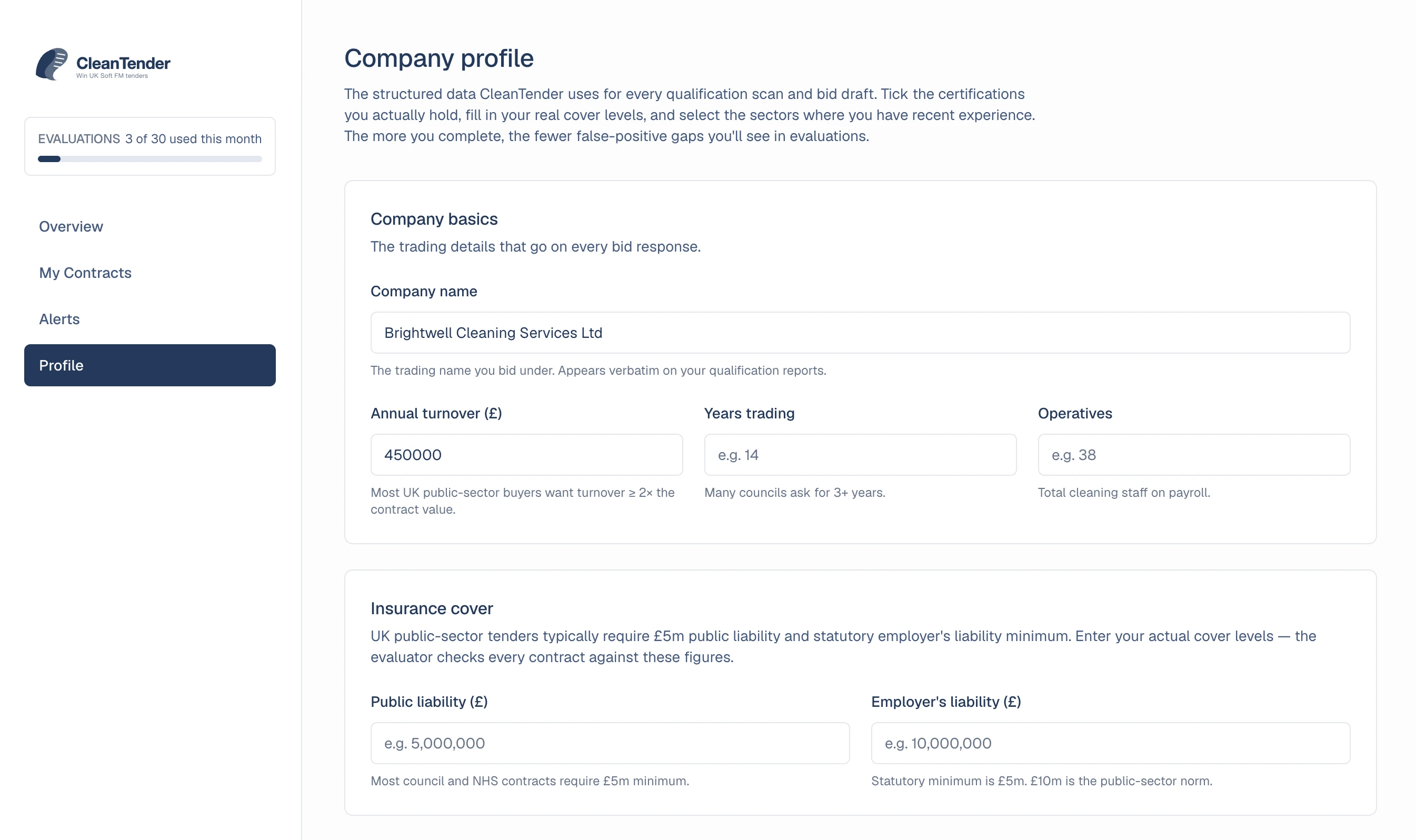
Profile setup defines what you are bid-ready for Step 2· 5 minutes daily
Open the live security-tender feed
Every UK council, NHS, MoD, transport, retail and housing-association security tender, in one feed. Pre-filtered to your sector and geography. No false positives, no manual portal-trawling across FTS, Contracts Finder, and dozens of buyer e-procurement portals.
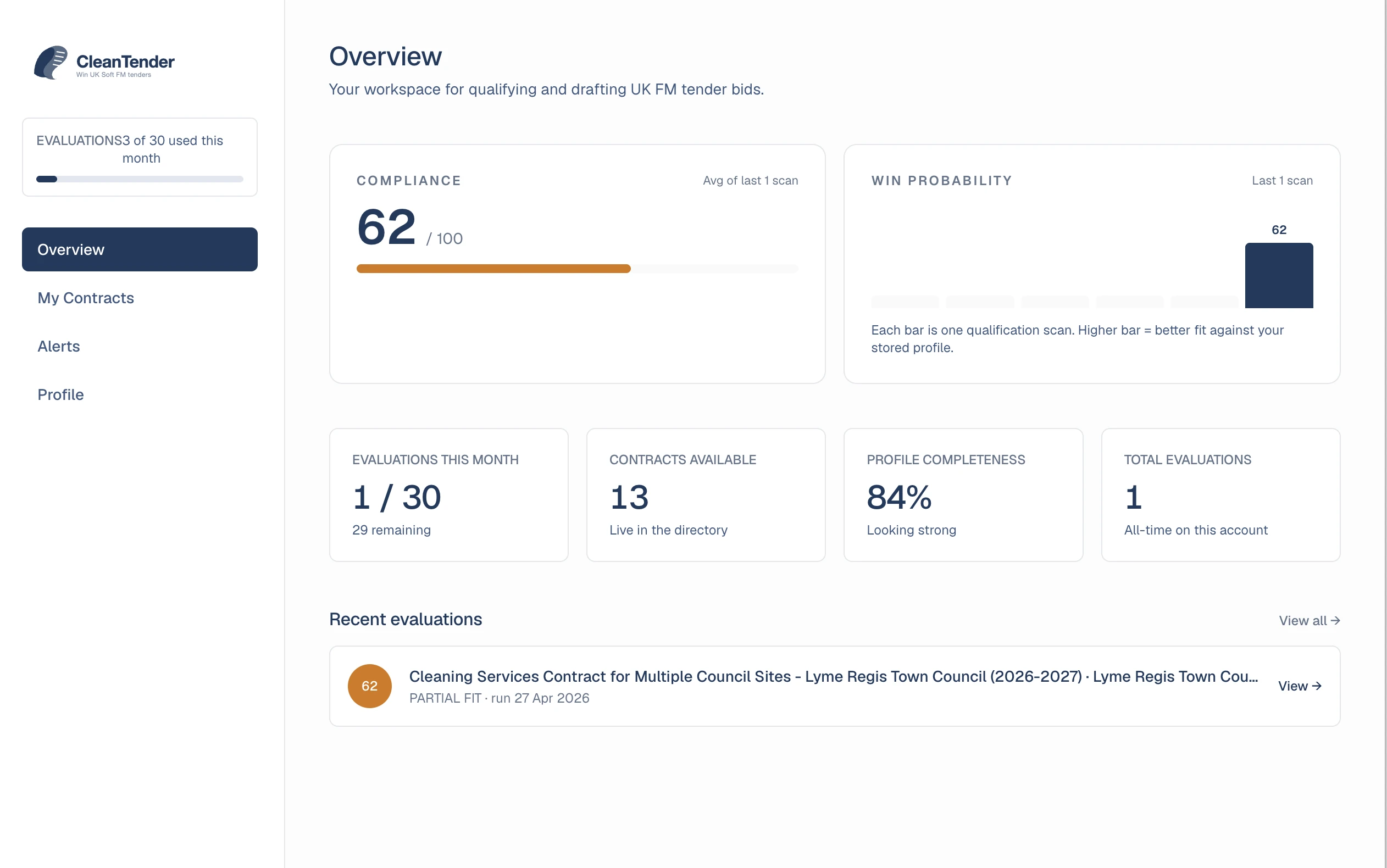
Live feed of in-scope security tenders, fit-scored Step 3· Daily digest
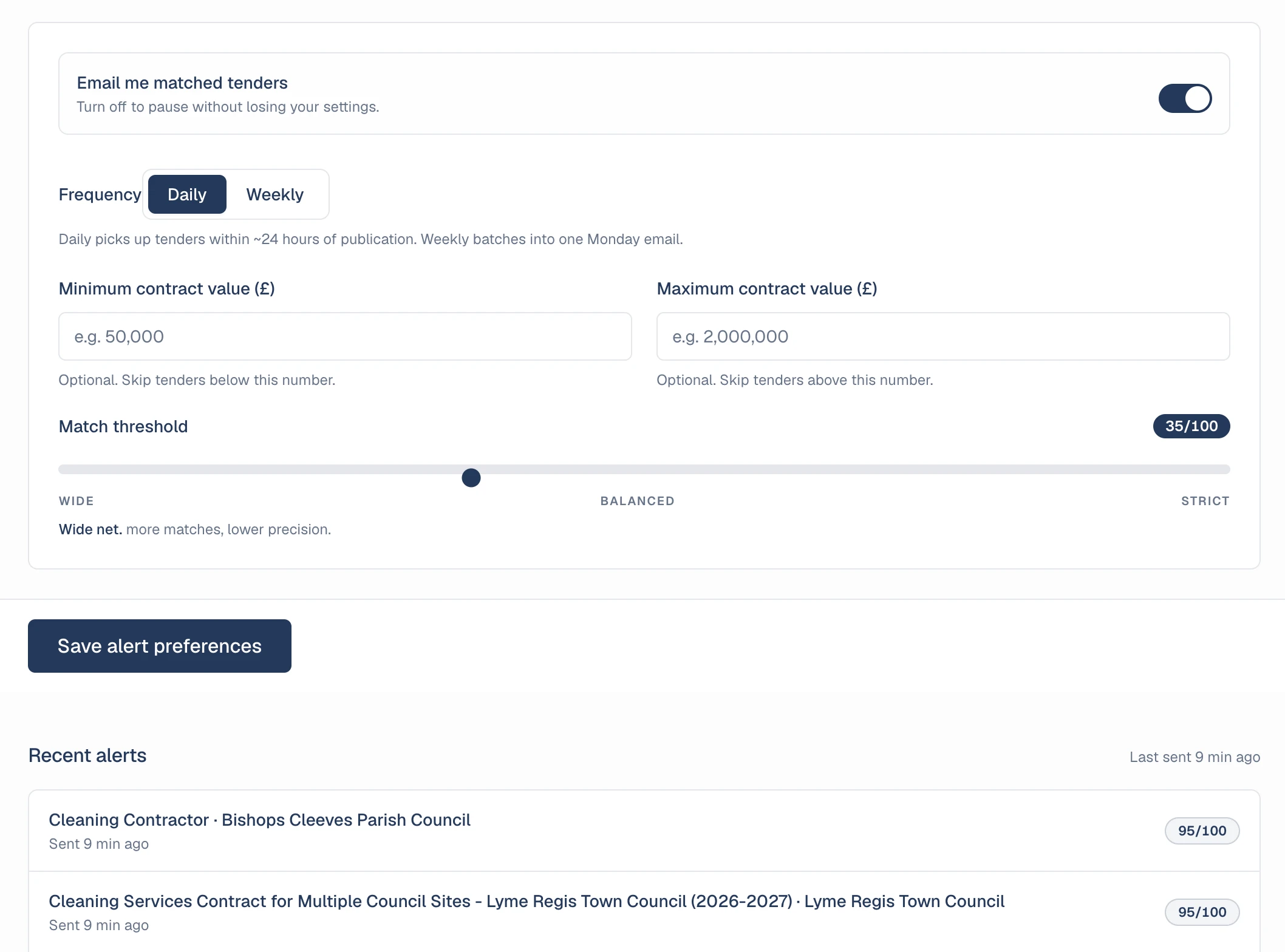
Get email alerts for new in-scope tenders
New security tenders matching your profile land in your inbox the day they publish. CleanTender batches them into a daily digest so you do not get notification fatigue, and links straight back to the in-app fit score.
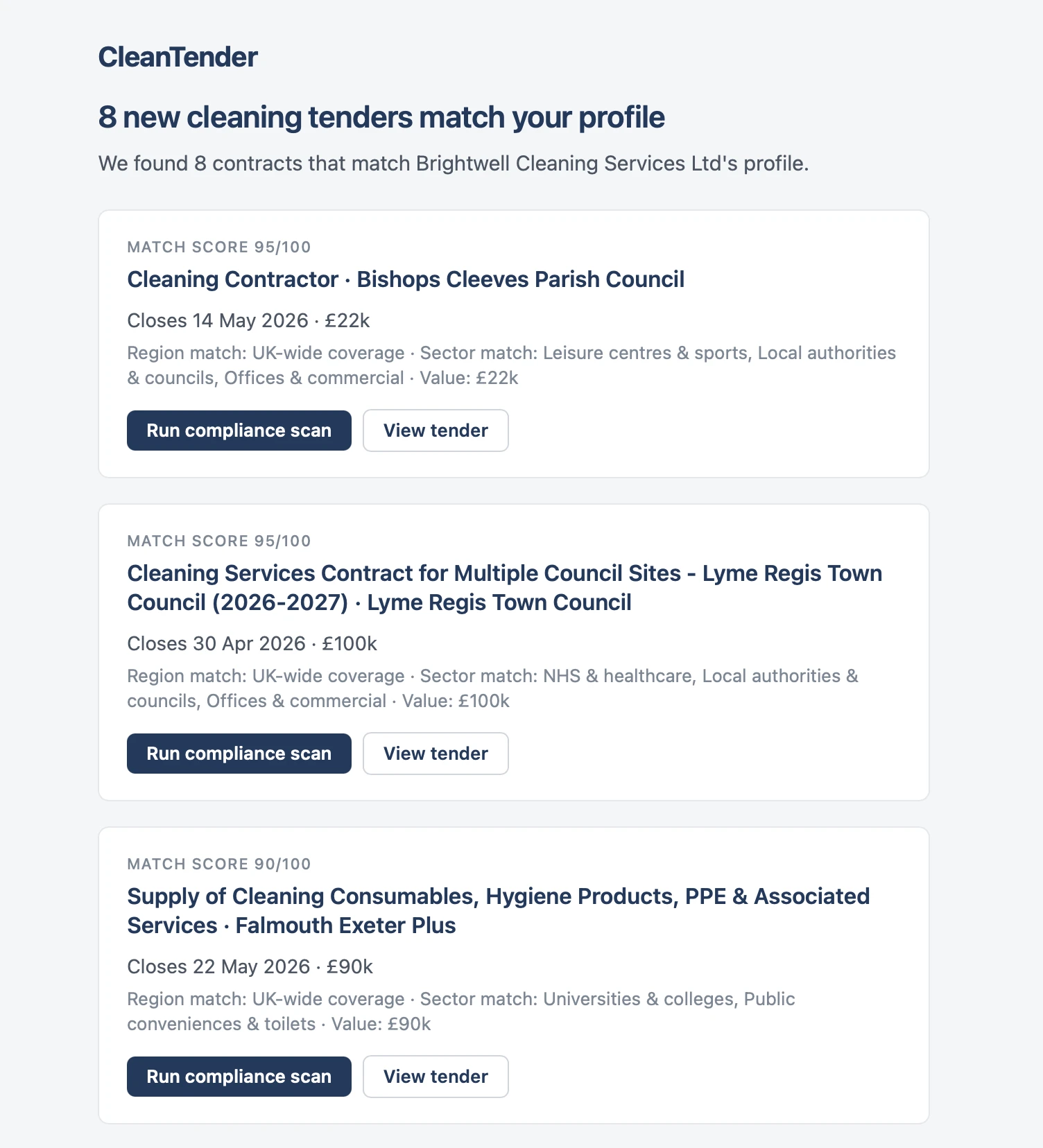
Daily alerts for new in-scope tenders Step 4· 30 seconds
Run a fit-score evaluation on a target tender
One click runs a CleanTender Evaluation against the tender pack: scope match, geography fit, scale fit, compliance gap, and a plain-English win probability. Stops you bidding contracts you were never going to win.
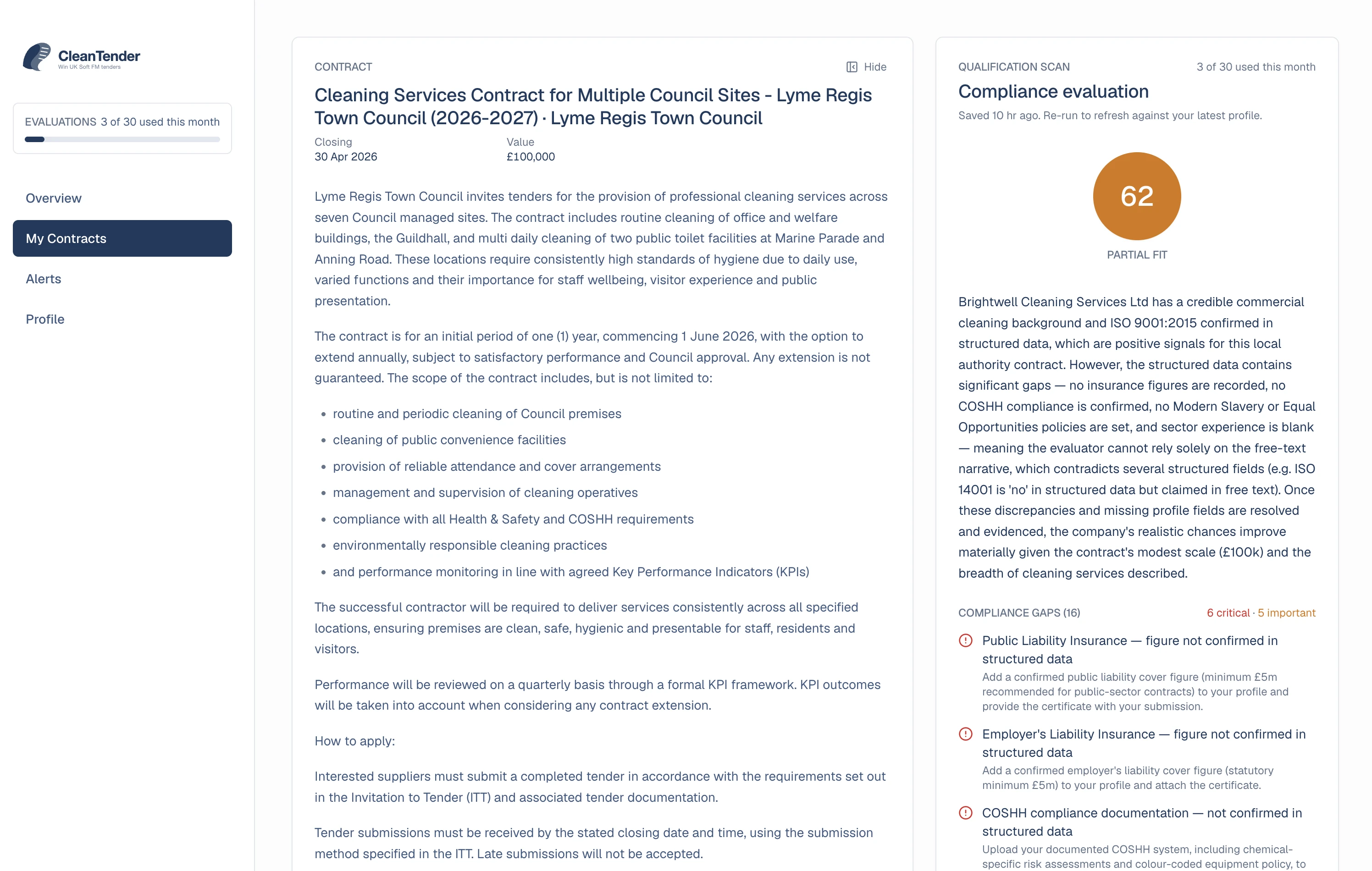
Fit-score and win-probability before you commit a weekend Step 5· 1 minute
Spot compliance gaps before you start drafting
CleanTender runs a named compliance check against the tender pack: SIA ACS approval, BS 7858 personnel vetting, SIA operative licence coverage, insurance schedules, Martyn's Law readiness where relevant. Anything missing is flagged before you sink hours into a bid that auto-fails at SQ.
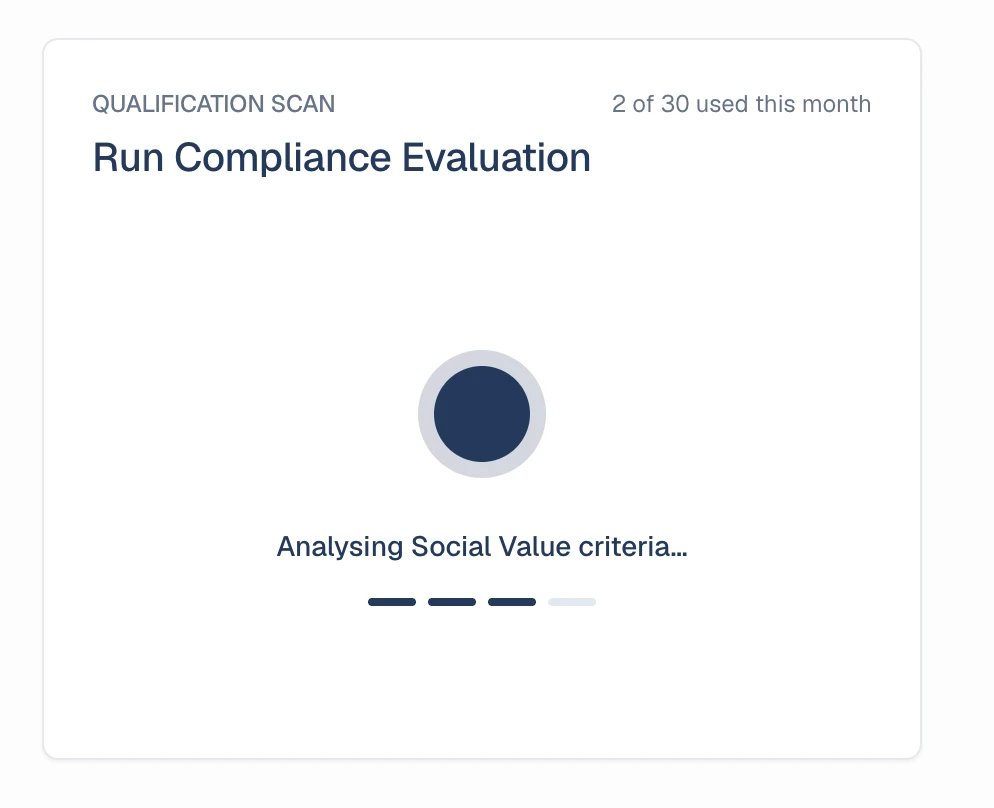
Compliance gaps surfaced before drafting Step 6· 2 minutes generation
Generate a full SQ + method-statement draft
CleanTender drafts a complete Standard Selection Questionnaire response using your profile data and the tender requirements: declaration block, company overview, contract experience, quality, training, COSHH, social value, H&S, insurance schedule. All ten sections, in one pass.
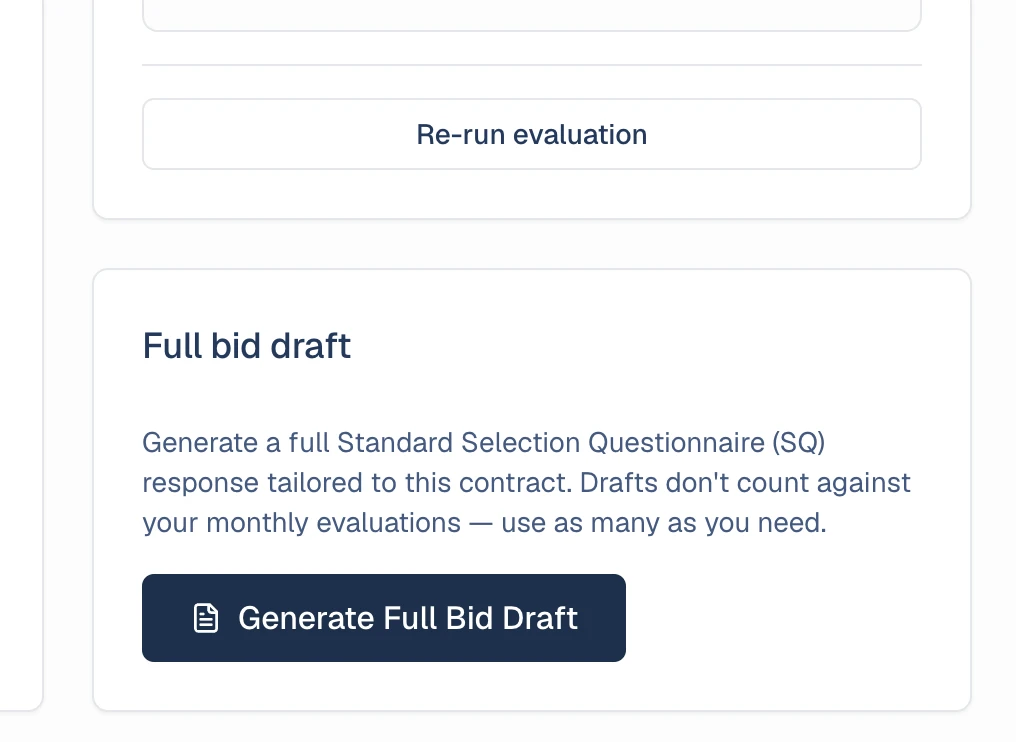
Full SQ draft generated in minutes, not days Step 7· Half a day
Refine, add evidence, and submit
Tune the draft, drop in named referees and certificate numbers, layer your quantified social value commitments, and submit through the buyer's portal. Most users compress a 30-60 hour first bid to 8-12 hours of focused review.
Step 8· Ongoing
Track outcomes and improve
Every bid logs in CleanTender with status, score, and (after standstill) the buyer's feedback. Use the standstill data to tune your next bid. Win rate compounds; first-bid completion is the only thing standing between you and a public-sector revenue line.
Where UK security tenders are published right now
Six routes carry the whole public market. Which portal a tender lands on depends on two things: the buyer's nation and the contract's value against the Procurement Act 2023 thresholds.
- Find a Tender (find-tender.service.gov.uk). Since 24 February 2025, the home of new contracts in England, Wales and NI, above and below threshold. Below-threshold notices start at £12,000 (central government) and £30,000 (councils, NHS), inc VAT. The full above-threshold regime applies from that means £207,720+ (inc VAT) for councils, NHS trusts and housing associations, and £135,018+ for central government and MoD, per PPN 023. Multi-site estate guarding, NHS trust-wide security, framework competitions.
- Contracts Finder (contractsfinder.service.gov.uk). England only, and only procurements that started under the old rules before 24 February 2025. It is winding down. New SME-sized guarding, patrol and key-holding tenders go on Find a Tender.
- Public Contracts Scotland (publiccontractsscotland.gov.uk). All Scottish public buyers. Free supplier registration.
- Sell2Wales (sell2wales.gov.wales). All Welsh public buyers. Free supplier registration.
- eTendersNI (etendersni.gov.uk). Northern Ireland's portal. Free registration; you need a free D-U-N-S number to sign up.
- The Defence Sourcing Portal (DSP). MoD's own e-sourcing system for below-threshold defence opportunities, roughly from £10,000. Above-threshold MoD work still routes through Find a Tender. Register separately; DSP is not Contracts Finder.
One warning on the thresholds, and it applies to this site as much as anyone else's. The old central-government figure of £135,018 died on 31 December 2025. If a tender-portal marketing page (ours included, in one older article we are correcting) still quotes £135,018 or a £25,000 publication floor in 2026, or still sends you to Contracts Finder for new small contracts, the content is stale. The current figures are £135,018 / £207,720 for Find a Tender and £12,000 / £30,000 for below-threshold notices, all inc VAT.
Free security tender alerts
Every official UK portal sends free email alerts. Paid resellers charge for repackaging this data with a nicer interface. If you bid fewer than 20 tenders a year, that money buys you nothing you cannot get below in under an hour of setup.
Find a Tender alerts (England, Wales and NI, from £12,000)
- Go to find-tender.service.gov.uk and create a free GOV.UK One Login account. Searching needs no login, but saved searches and email updates do.
- Search security, or search by CPV code 79710000 (security services). CPV is the buyer's own classification, so it catches notices whose titles never say "security" ("soft FM services, Lot 3").
- Add the narrower codes that match your work: 79711000 alarm monitoring, 79713000 guard services, 79714000 surveillance, 79715000 patrol services.
- If event or festival security is part of your book, add 79952000 (event services) as a separate saved search. It catches notices the security-only codes miss.
- Filter to your regions and to open-deadline notices.
- Save the search, then switch on email updates in your account settings.
- Repeat for each region and code combination you cover. Find a Tender alerts are literal: one saved search per variation.
That last code earns its place. The 2025 Radio 1 Big Weekend event stewarding and security contract awarded by Liverpool City Council was classified under CPV 79952000, not the security head code. A saved search on 79710000 alone would have missed it.
Contracts Finder (older procurements only)
Contracts Finder only carries English procurements that started under the old rules before 24 February 2025. Nothing new gets added, so it thins out every month. Run the same CPV search there once a month to catch late stages of older procurements, and put your daily attention on Find a Tender.
Scotland, Wales, Northern Ireland and MoD
- Public Contracts Scotland. Register free as a supplier, then build an Alert Profile from commodity categories, keywords, CPV codes and geographic areas. The Notice Alert Service emails you every match.
- Sell2Wales. Register free, then set your Alerts Profile (product categories plus locations) in the Supplier Control Panel. You get a daily email listing matching opportunities.
- eTendersNI. Register free (grab a free D-U-N-S number first), then save your chosen CPV codes to your profile under EO administration. Matching notices arrive by email.
- Defence Sourcing Portal. MoD's own registration. Below-threshold defence security opportunities (guarding, patrol, key holding on defence estates) publish here, separately from Find a Tender.
The catch with portal alerts, and the fix
Six separate portals means six separate alert streams, six sets of saved searches to maintain, and zero judgement. The portals tell you a tender exists. They do not tell you whether you can win it. A multi-site NHS trust guarding contract and a single-building key-holding job arrive in your inbox looking identical, and neither one tells you whether your ACS status even qualifies you to bid.
CleanTender's free tier does the merge for you: every UK security tender from all of the sources above in one feed, scored against your company profile (including your ACS and BS 7858 status) so the ones you can actually win rise to the top. The official portals stay free either way. What you are buying back is the daily half hour and the misjudged bids.
Who buys security, and what the contracts are worth
Five buyer types publish nearly all UK public security tenders: councils, NHS trusts, MoD and defence estates, transport (Network Rail, TfL and equivalents), and retail, events or housing associations. Each wants a different flavour of security work, from manned guarding to CCTV monitoring to void-property key holding, and the values swing hard depending on which one it is.
| Service type | Typical buyer | Typical annual value |
|---|---|---|
| Manned guarding (single site) | Council civic building, NHS site | £40k - £220k |
| Mobile patrol / key holding | Council void properties, housing association estates | £15k - £90k |
| CCTV monitoring (control room) | Council town centre, transport hub | £60k - £300k |
| Event security and stewarding | Council-run festivals, sports venues | £10k - £150k per event or season |
| MoD estate guarding (cleared personnel) | Defence estates | £150k - £1m+ |
| Multi-site framework guarding | NHS trust, housing association group | £300k - £4m+ |
Typical annual contract values by service type, UK security, 2026. CleanTender editorial planning bands, not award data. Multi-year totals multiply accordingly.
Two months. £63,034.20. Radio 1 Big Weekend. That is what Liverpool City Council paid Compact Security Services for event stewarding and security in 2025, classified under CPV 79952000. Bristol City Council awarded £375,000 to Amulet Security (then trading as Churchill Security Solutions) for manned guarding, cash and valuables in transit, and mobile patrol and response, a seven-month contract under CPV 79710000. That Bristol award is from 2019, not current, so treat it as a value reference rather than a recent example. It still tells you something useful: manned guarding contracts at this scale have sat in the low-to-mid six figures for years, and that has not moved much.
Retail and events buyers need one caveat. Stewarding-only roles at events, directing people to seats, toilets or first aid, do not require an SIA licence. Licensed security roles on the same site (bag searches, crowd control at pinch points, ejections) do. A single event-security tender can bundle both, so read the specification closely before you assume every headcount needs a licence.
Housing associations are a market most security firms underrate. Void-property security, patrol and key holding sits inside wider works frameworks as often as it sits in a standalone security tender, so it will not always show up on a CPV-only search. Worth a manual scan of housing association procurement portals if that is your niche.
The buyer-by-buyer detail (what each SQ actually asks for, scoring weightings, framework routes) lives in how to bid for security contracts in the UK.
SIA ACS and BS 7858: the gate before the quality score
SIA ACS (Approved Contractor Scheme) is voluntary under the Private Security Industry Act 2001. On UK public-sector security tenders it functions as a hard gate anyway. Council, NHS and MoD selection questionnaires, plus Crown Commercial Service frameworks, specify ACS by name. Miss it and the bid fails at qualification before anyone reads the method statement.
BS 7858:2019 sits alongside ACS and covers something different. ACS audits the company. BS 7858 vets the individual, five-year employment history, character references, identity checks, right-to-work confirmation, and a criminal record check for every guard, patroller or CCTV operator deployed on the contract. Most council and NHS tenders ask for both, named separately in the SQ.
There is over 500,000 SIA-licensed operatives in the UK at any given time and several hundred companies on the ACS register, per the SIA's 2024-25 annual reporting. That is a lot of competition holding the same baseline paperwork. ACS and BS 7858 get you into the room. They do not win the bid on their own.
Not live yet. Worth tracking anyway: Martyn's Law, the Terrorism (Protection of Premises) Act 2025. Royal Assent landed 3 April 2025, and statutory guidance published in April 2026 confirmed two tiers, a standard tier for venues with 200-799 capacity and an enhanced tier for 800+. Government has said enforcement starts at least 24 months after Royal Assent, so no earlier than April 2027, without yet naming the exact date. Bid on transport, retail or event-security work and it is worth naming ACT (Action Counters Terrorism) awareness training in your method statement now. Buyers are already asking about it ahead of the law actually biting.
For the full accreditation timeline, cost and application process, the SIA ACS guide covers the five audit areas, the assessing bodies, and when applying is not worth it.
The under-£30k work that never reaches a portal
Below the £30,000 notice floor (councils and NHS trusts) or £12,000 (central government), buyers do not have to advertise at all. Most councils' contract standing orders require three written quotes for this band instead. The buyer emails three firms it already knows. Two quote. One wins. The contract never touches Find a Tender.
In security this band is bigger than most people assume: single-site key holding, out-of-hours alarm response, a void property patrol contract for a small housing scheme, weekend event stewarding for a village fete. Individually small. Collectively, the fastest route to public-sector references for a firm with none, and a genuine on-ramp before you carry the cost of ACS.
Getting onto the quote list takes no portal. Email the facilities or estates contact at every council, NHS trust and housing association within your patch. One page: who you are, your SIA licence coverage, your patch, two references. Ask to be added to the supplier list for security quotes under £30k. Ten minutes per buyer. Most of your competitors never send it.
From found to won: the condensed bid path
The walkthrough above is the full flow. In compressed form, a security bid has five gates.
- Qualify before you write. ACS status, BS 7858 vetting coverage, licensed operative headcount against the contract's shift pattern, insurance level, implied margin. Fail any gate, no-bid and move on.
- Pass the Selection Questionnaire. ACS reference number, insurance certificates, accounts, references. This stage is binary; missing paperwork auto-fails.
- Write the method statement to the scoring guide. Deployment plan, supervision structure, named SIA licence categories per role, BS 7858 vetting process, incident-reporting procedure. Named beats generic on every criterion.
- Price from the wage floor up. Labour is the cost. Build from 2026 SIA-sector wage rates through NI, pension, holiday, uniform, equipment and supervision to your rate. Backwards-priced bids win contracts and lose money on unsociable-hours cover.
- Add quantified social value. Local recruitment, apprenticeships through SIA licence sponsorship, community safety hours, with numbers attached. Public buyers commonly weight this 10-20% of the total score.
Each gate has its own full guide: the security bid process stage by stage, what evaluators score and how to beat it, and if you have already lost a security bid and want to know why, why security tender bids fail runs through the recurring reasons before you write the next one.
Sources
Sources
- PPN 023: 2026 threshold amounts (gov.uk) · The 1 January 2026 thresholds: £135,018 central government, £207,720 sub-central, both inc VAT.
- Procurement Act 2023 guidance: below-threshold contracts (gov.uk) · Notifiable-contract floors: £12,000 central government, £30,000 sub-central, inc VAT.
- Find a Tender · Above-threshold notices. Free GOV.UK One Login account gives saved searches and email notifications.
- Contracts Finder overview (gov.uk) · Notices from £12,000 inc VAT. Free account adds email updates and saved searches.
- Public Contracts Scotland · Free supplier registration and Notice Alert Service.
- Sell2Wales · Free registration; daily alert emails from the Alerts Profile.
- Register as a supplier on eTendersNI (Dept of Finance NI) · Free registration; free D-U-N-S number required.
- Security Industry Authority (SIA), organisation page (gov.uk) · UK regulator for the private security industry; runs ACS and operative licensing.
- Learn about our Approved Contractor Scheme (gov.uk) · Official ACS explainer: voluntary status, assessment areas, why buyers specify it.
- Apply for ACS approval (gov.uk) · Official ACS application process and requirements.
- Register of Approved Contractors (SIA) · Live, searchable register of every current ACS-approved contractor.
- SIA annual report and accounts 2024 to 2025 (gov.uk) · Source for SIA licence and ACS-membership scale figures.
- BS 7858:2019, screening of individuals working in a secure environment (BSI) · The current personnel-vetting standard for security guarding staff.
- The Terrorism (Protection of Premises) Act 2025 (gov.uk) · Martyn's Law. Royal Assent 3 April 2025; requirements not yet enforceable, at least 24 months' lead time.
- Check if you need an SIA licence to work as an event steward (gov.uk) · Confirms stewarding-only event roles do not require an SIA licence, unlike licensed security roles on the same contract.
- Award notice: Liverpool City Council / Compact Security Services, £63,034.20 · Event Stewarding & Security, Radio 1 Big Weekend. CPV 79952000, awarded 1 April 2025.
- Award notice: Bristol City Council / Amulet Security, £375,000 · Manned guarding, cash and valuables in transit, mobile patrol. CPV 79710000, awarded 28 May 2019. Illustrative value reference, not current.
FAQs
Frequently asked questions
- Six free routes cover the public market. Find a Tender lists new contracts in England, Wales and NI from £12,000 (central government) and £30,000 (councils and NHS) inc VAT, up through the 2026 thresholds (£207,720 for councils, NHS trusts and housing associations; £135,018 for central government and MoD). Contracts Finder only holds older English procurements started before February 2025. Scotland uses Public Contracts Scotland, Wales uses Sell2Wales, Northern Ireland uses eTendersNI. MoD's below-threshold work publishes on the Defence Sourcing Portal, separate from Find a Tender. All are free to search. CleanTender merges them into one fit-scored feed if you would rather not check six sites.
- Yes, on every official portal. Contracts Finder and Find a Tender both let you save a search and switch on email updates with a free account. Public Contracts Scotland's Notice Alert Service, Sell2Wales's daily Alerts Profile emails, and eTendersNI's CPV-based alerts are all free too. Set them up with CPV codes 79710000 (security services), 79711000 (alarm monitoring) and 79713000 (guard services) rather than the keyword "security" alone, and add 79952000 if event or festival work is part of your book, since CPV catches notices whose titles never mention security. CleanTender's free tier merges all portals into a single alert stream scored against your ACS and BS 7858 status.
- It depends heavily on service type. Manned guarding on a single council or NHS site typically runs £40,000-£220,000 a year. Mobile patrol and key holding on housing association estates sits lower, around £15,000-£90,000. CCTV control room monitoring for a town centre or transport hub can reach £60,000-£300,000. Multi-site NHS or housing-association framework guarding runs from £300,000 into several million. A real 2025 event-security award (Liverpool City Council, Radio 1 Big Weekend) came in at £63,034. A manned guarding contract for Bristol City Council was awarded at £375,000, though that was in 2019 and should be read as a value reference rather than a current figure.
- Not legally. ACS (Approved Contractor Scheme) is voluntary under the Private Security Industry Act 2001. In practice, most council, NHS and MoD selection questionnaires name ACS outright, and Crown Commercial Service frameworks require it too. Miss it and the bid usually fails at qualification before the quality team reads a word of your method statement. Small below-threshold contracts (under £30k) sometimes accept individual SIA operative licences without company-level ACS, so it is worth checking each SQ rather than assuming you are locked out without it.
- Start with 79710000, the head code for security services, which covers manned and mobile guarding, key holding, escorting and front-of-house supervision. Add 79711000 for alarm-monitoring services and 79713000 for guard services. If you cover surveillance or patrol contracts, 79714000 and 79715000 are the narrower codes buyers use. Event and festival security notices sometimes classify under 79952000 (event services) instead of the security codes, so run that as a separate saved search if events are part of your work. Use full 8-digit codes on Contracts Finder, Find a Tender, Public Contracts Scotland and eTendersNI.
- Only above the notice floors. Under the Procurement Act 2023, central government (including MoD) must publish notifiable contracts worth £12,000+ (inc VAT) and councils and NHS trusts from £30,000+ (inc VAT). Above £207,720 (sub-central) or £135,018 (central government), the contract must be advertised on Find a Tender. Below £30,000, buyers usually follow their own standing orders, and most councils' standing orders require three written quotes instead of an advert. That under-£30k band never appears on any portal, so the way in is direct contact with buyers, not alerts.
- ACS is a company-level accreditation. An SIA operative licence is held by each individual guard, patroller or CCTV operator and is mandatory under the Private Security Industry Act 2001 for licensable roles. A firm can employ fully licensed operatives without holding ACS itself, but most public-sector SQs ask for both: the company's ACS reference and confirmation every deployed operative holds a current, role-matched licence. Over 500,000 individual SIA licences are in force in the UK, per the SIA's 2024-25 annual reporting.
- Yes, most often on single-site or below-threshold work rather than multi-site frameworks. Void-property patrol contracts, single-building key holding, and event stewarding for local council-run events are all in reach of a small firm with SIA-licensed staff and, where required, ACS. The path is usually: build references on under-£30k quote-list work first, get ACS in place once you are targeting anything above roughly £100k, then move up to single-site guarding contracts before competing for multi-site frameworks against national contractors.
- Five gates. First qualify: ACS status, BS 7858 vetting coverage, licensed operative headcount against the contract's shift pattern, insurance and margin, and no-bid anything that fails. Second, pass the Selection Questionnaire with your ACS reference, insurance certificates and references; missing paperwork auto-fails. Third, write a method statement to the published scoring guide naming your deployment plan, supervision structure and vetting process. Fourth, price from the wage floor up, since labour and unsociable-hours cover dominate security cost. Fifth, add quantified social value commitments. A first bid typically takes 30-60 hours by hand; CleanTender compresses it to a day by drafting the SQ and method statement from your stored profile.
- Martyn's Law, the Terrorism (Protection of Premises) Act 2025, received Royal Assent on 3 April 2025. Statutory guidance published in April 2026 confirmed two tiers: a standard tier for venues with 200-799 capacity and an enhanced tier for 800+. Government has said the duties will not be enforceable for at least 24 months after Royal Assent, meaning no earlier than April 2027, without yet confirming the exact commencement date. It is not live on tenders yet, but transport, retail and event-security buyers are already asking bidders to show terrorism-protection awareness (ACT training, exercise programmes) in method statements ahead of the law biting.