
AI tools cut a first-time UK government bid from 30-60 hours of writing time to 8-12 hours. They do not raise win rates from 5% to 50%. They raise win rates by improving the bids you submit and by killing the bids you should not have started. Used correctly, AI on a first government bid is fit scoring before you write, SQ drafting from your stored compliance vault, method statement scaffolds against the buyer's marking matrix, and social value commitments mapped to the five PPN 002 themes. Used incorrectly, it generates marketing copy that loses points and breaches PPN 017's disclosure rule.
The order matters more than the tool choice. A first-time bidder who runs the qualification scan first, then drafts the SQ, then drafts the method statement, then maps social value, wins more bids than one who picks the most expensive AI tool but uses it in the wrong order.
Have you used AI or machine learning tools, including large language models, to assist in any part of your tender submission? This may include using these tools to support the drafting of responses to Award questions.
PPN 017, Annex B, Question 1 (verbatim)
What's in this guide
- How to win your first UK government tender, step by step (CleanTender walkthrough)
- Where AI helps vs where it hurts on a first government bid
- The 6-step plan with AI in the right places
- PPN 017 disclosure: pre-write once, reuse forever
- Realistic first-time targets (and what to skip)
- Cost stack for an AI-assisted first bid
- Common first-time mistakes that AI cannot fix
How to win a UK first government tender (using AI) tender, step by step
The complete end-to-end flow inside CleanTender. From sector setup to a submitted first government tender (using AI) bid in the time it used to take to read a single tender pack.
Eight steps from "never bid public sector" to a complete SQ response on the buyer's portal. First scan is free.
Step 1· 10 minutes
Build your first government tender (using AI) company profile
Set your sector to first government tender (using AI), your service regions, sector specialism (cleaning / security / grounds / waste / catering), ISO certifications, sector accreditations, insurance levels, turnover, operative count, insurance levels, turnover, and operative count. CleanTender uses this to fit-score every live tender against your real capability so you only see the ones you can win.
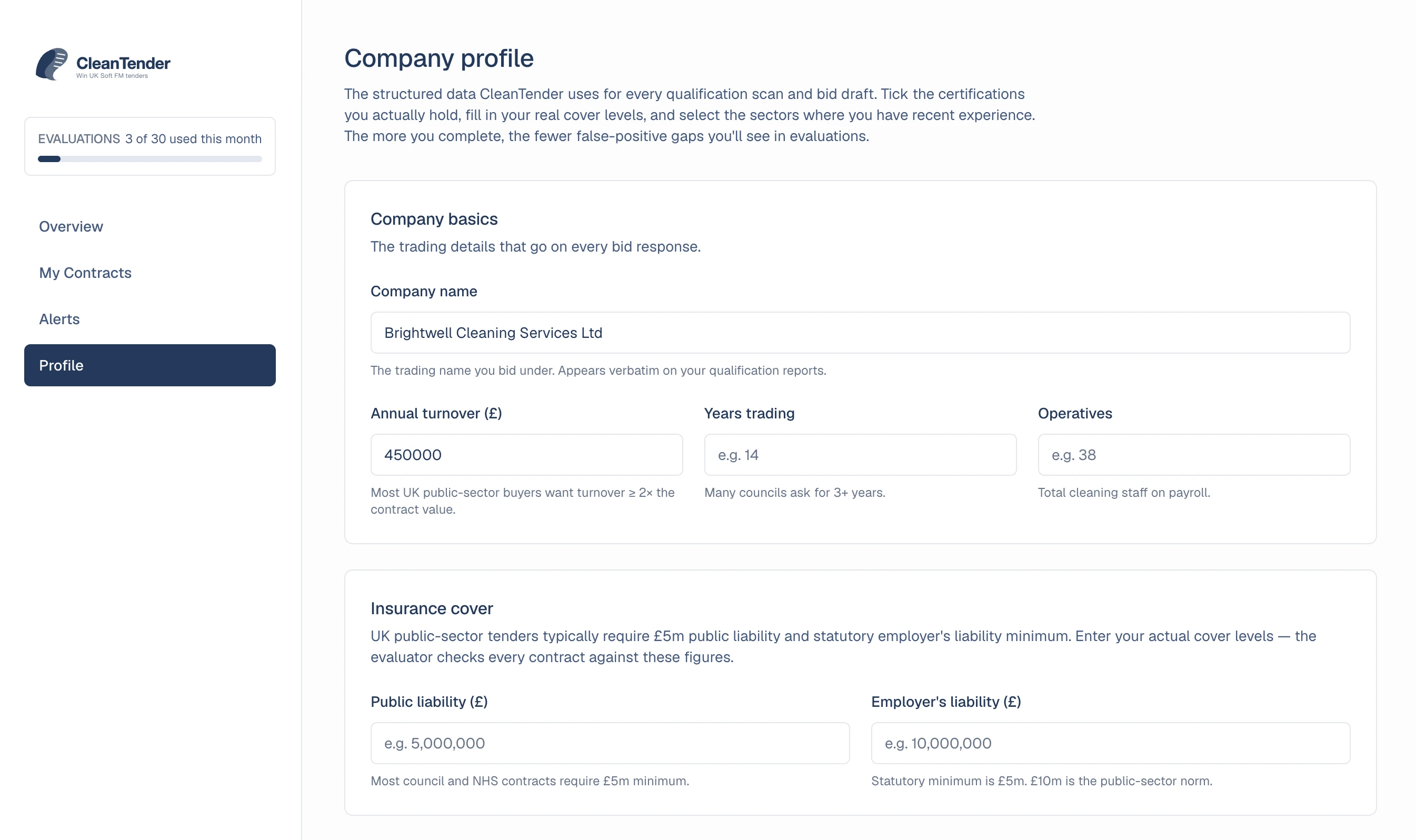
Profile setup defines what you are bid-ready for Step 2· 5 minutes daily
Open the live first-time-tender feed
Every UK below-threshold (£12k-£139k) and above-threshold (>£139k) UK public-sector tender, in one feed. Pre-filtered to your sector and geography. No false positives, no manual portal-trawling across FTS, Contracts Finder, and dozens of buyer e-procurement portals.
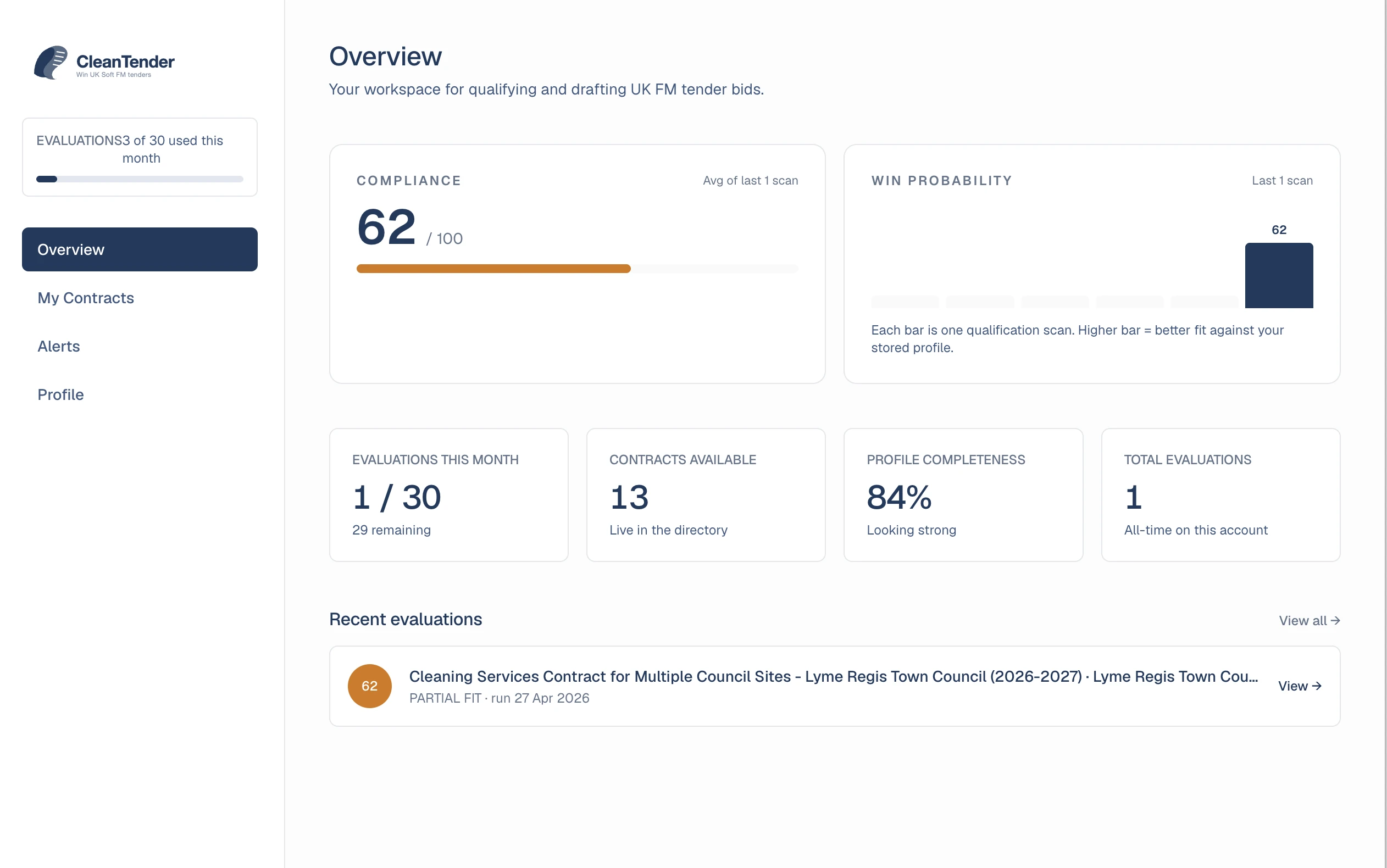
Live feed of in-scope first-time tenders, fit-scored Step 3· Daily digest
Get email alerts for new in-scope tenders
New first government tender (using AI) tenders matching your profile land in your inbox the day they publish. CleanTender batches them into a daily digest so you do not get notification fatigue, and links straight back to the in-app fit score.
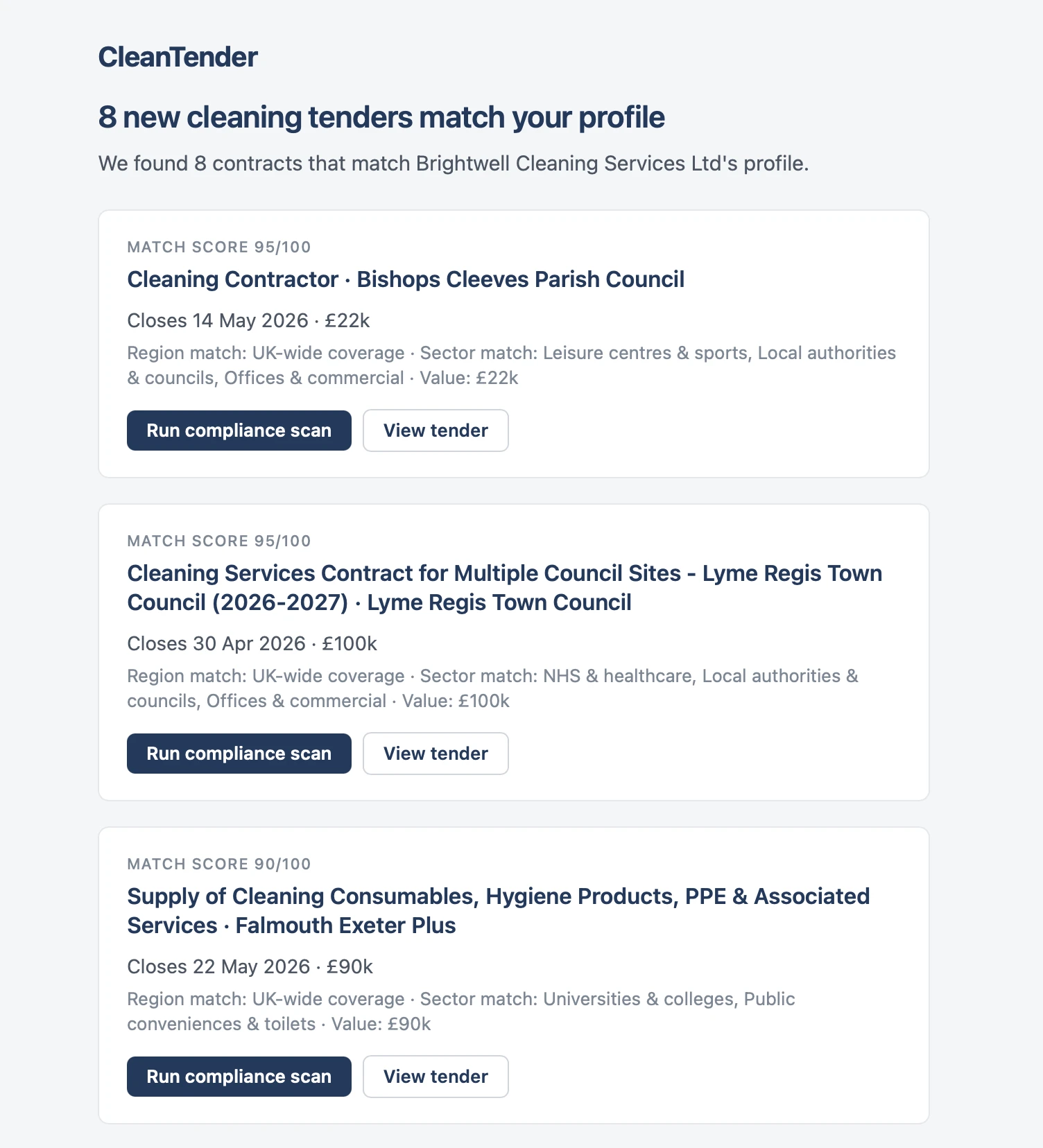
Daily alerts for new in-scope tenders Step 4· 30 seconds
Run a fit-score evaluation on a target tender
One click runs a CleanTender Evaluation against the tender pack: scope match, geography fit, scale fit, compliance gap, and a plain-English win probability. Stops you bidding contracts you were never going to win.
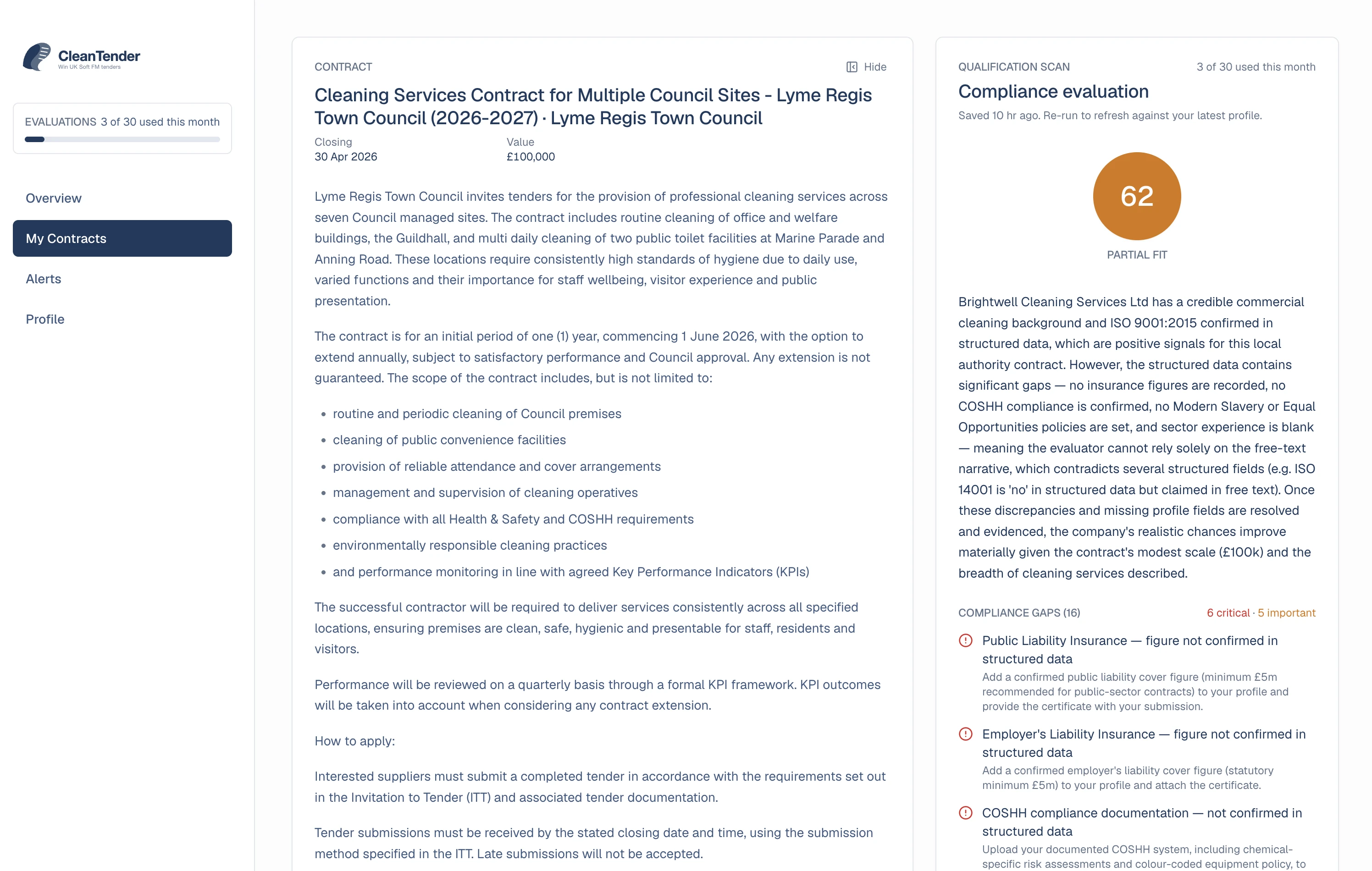
Fit-score and win-probability before you commit a weekend Step 5· 1 minute
Spot compliance gaps before you start drafting
CleanTender runs a named compliance check against the tender pack: sector accreditations, ISO 9001, SSIP, social value plan, modern slavery policy, equal opportunities policy, PPN 017 AI-disclosure where applicable. Anything missing is flagged before you sink hours into a bid that auto-fails at SQ.
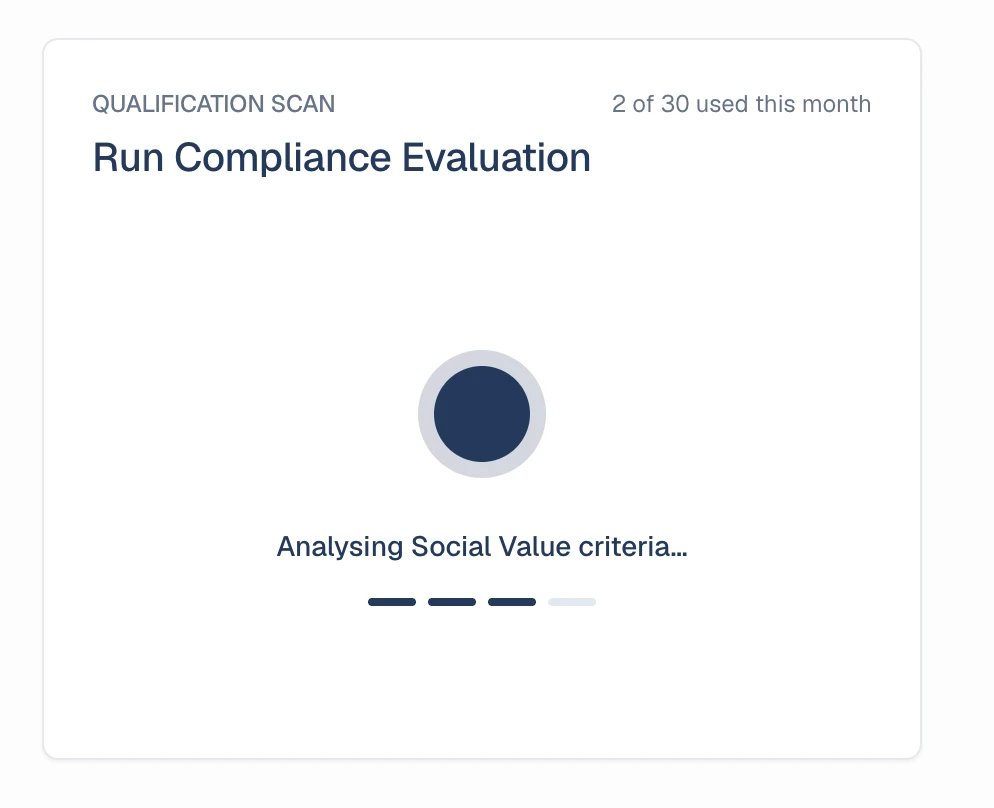
Compliance gaps surfaced before drafting Step 6· 2 minutes generation
Generate a full SQ + method-statement draft
CleanTender drafts a complete Standard Selection Questionnaire response using your profile data and the tender requirements: declaration block, company overview, contract experience, quality, training, COSHH, social value, H&S, insurance schedule. All ten sections, in one pass.
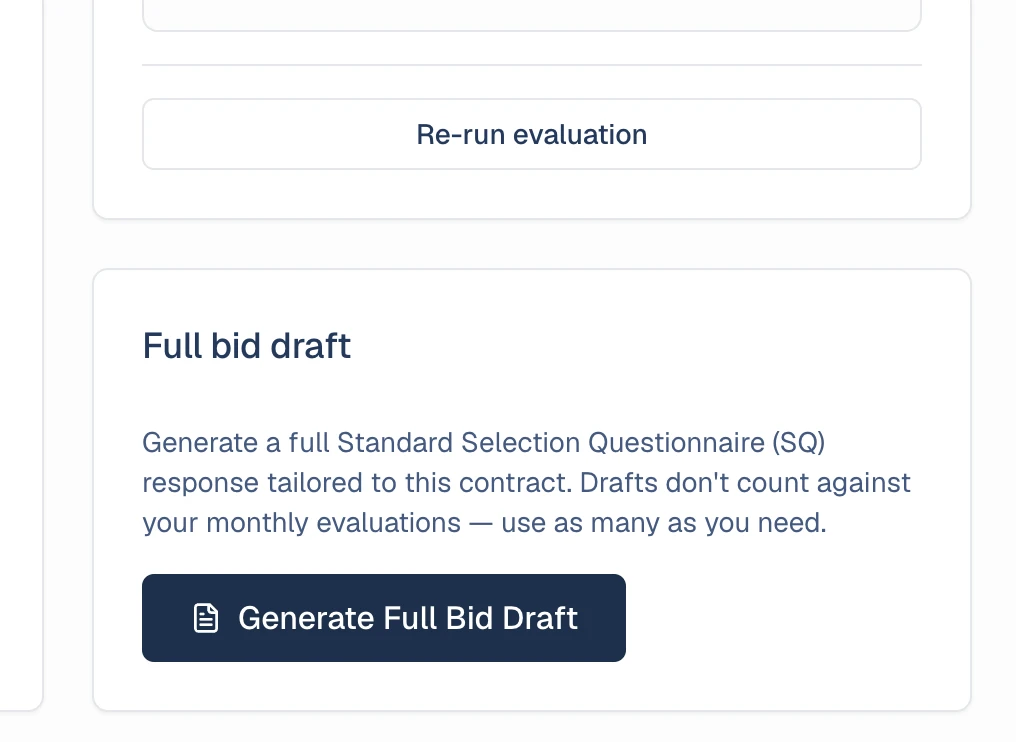
Full SQ draft generated in minutes, not days Step 7· Half a day
Refine, add evidence, and submit
Tune the draft, drop in named referees and certificate numbers, layer your quantified social value commitments, and submit through the buyer's portal. Most users compress a 30-60 hour first bid to 8-12 hours of focused review.
Step 8· Ongoing
Track outcomes and improve
Every bid logs in CleanTender with status, score, and (after standstill) the buyer's feedback. Use the standstill data to tune your next bid. Win rate compounds; first-bid completion is the only thing standing between you and a public-sector revenue line.
Where AI helps vs where it hurts
| Bid task | AI helps | AI hurts |
|---|---|---|
| Fit scoring (read spec, score business against it) | Yes, dramatically. Saves 4-8 hours per spec, kills wrong-fit bids before you write. | No |
| Standard Selection Questionnaire drafting | Yes, when grounded in your stored compliance vault (insurance, accreditations, case studies). | When generic LLM invents an insurance level you do not hold. |
| Method statement scaffold | Yes, when prompted with the buyer's marking matrix and your equipment/staffing model. | When AI generates brochure copy without site-by-site detail. Scores 4/10. |
| Social value commitments | Yes, when mapped to PPN 002 themes and verified against your delivery capacity. | When AI invents quantified commitments you cannot deliver. Misrepresentation triggers exclusion. |
| Pricing model | Limited. Useful for comparing pricing structures, calculating TUPE liability scenarios. | When AI recommends a price below your real cost. Loses you money on a contract you win. |
| Final QA | Yes, for grammar, consistency, missing-section detection, page-limit checks. | When AI-only QA replaces a human reviewer. PPN 017 follow-up requires confirmed human review. |
| Submission portal upload | No, you do this manually. AI cannot operate the buyer's portal. | Generic AI tools sometimes hallucinate URLs and password requirements. |
AI on a first UK government tender: where it actually helps and where it makes things worse.
The 6-step plan with AI in the right places
| Step | Time | What AI does | What you do |
|---|---|---|---|
| 1. Fit scoring | 30 mins | Reads spec, compares against your stored business profile, returns fit score (0-100), flags accreditation gaps and TUPE risk | Decide: walk if score <60 |
| 2. Standard Selection Questionnaire | 1-2 hours | Drafts each SQ section from your stored compliance vault: insurance, accreditations, financial standing, case studies | Verify every figure, attach evidence, sign off |
| 3. Method statement scaffold | 2-4 hours | Generates draft per section against the buyer's marking matrix: scope, frequencies, equipment, staffing, monitoring, escalation | Add site-by-site detail, named products, named supervisor names, edit for voice |
| 4. Social value mapping | 1 hour | Maps your standing 5 commitments (one per PPN 002 theme) to the contract's geography and population | Verify deliverability, sign off on commitments |
| 5. Pricing model | 1-2 hours | Compares pricing structures, models TUPE-in liability scenarios, flags margin risk | Set the price (only you can do this) |
| 6. Human QA + PPN 017 disclosure | 1-2 hours | Spell-check, page-limit, missing-section detection | Read every section. Sign the PPN 017 Annex B disclosure answers. Upload to portal 24h before deadline. |
First UK government bid timeline with AI used in the right places.
Total: 8-12 hours instead of the 30-60 hours a first-time manual bidder typically spends. The time saving comes from the SQ and method statement scaffolds. The win-rate improvement comes from step 1: walking from bids you should not have started.
If your business is genuinely new (under 2 years), see the new-business reality check on UK government tenders for the substitute evidence you can use in place of two years of accounts. AI tools cannot generate accounts you do not have, but they can structure the substitute evidence (cash flow forecast, banker's reference, parent guarantee) into the SQ format the buyer expects.
PPN 017 disclosure: pre-write once, reuse forever
Procurement Policy Note 017 (effective 24 February 2025) requires UK contracting authorities to ask three Annex B questions about AI use in tender responses. Pre-write your three answers once, save them with your master Standard Selection Questionnaire, and reuse them on every bid. They change once a year, not every submission.
- Did you use AI or machine learning tools to assist any part of your tender submission? Answer: Yes (or No), with the named tool. Confirm the AI output was checked and verified for accuracy by a named human reviewer.
- Where exactly was AI used? Answer: list the sections (e.g. "AI-drafted initial responses for sections 4.1 (method statement), 4.3 (social value), and 4.5 (mobilisation plan). All output reviewed and edited by [Director Name] on [date]. Final wording is the bidder's own.")
- Are AI or machine learning technologies used as part of the products/services you intend to provide? Answer: usually No for soft FM SMEs. If Yes, describe the integration.
The verbatim Annex B questions, what disqualifies, and the practical 6-step compliance checklist are in the plain-English PPN 017 guide for cleaning SMEs. The data security side (UK GDPR, ISO 27001, training-data retention) is in the AI bid tool GDPR compliance guide. Both worth a read before your first AI-assisted bid.
Realistic first-time targets (and what to skip)
| Path | Bid this | Skip this |
|---|---|---|
| Below-threshold council contracts (£30k-£100k) | Yes. Often single-site, simple scope, council prefers a credible local SME. | Above £200k single-site work where you have no comparable case study. |
| Council Dynamic Markets | Yes. Open application via Central Digital Platform; members-only competitions easier than open tenders. | Hard FM Dynamic Markets if you only deliver soft FM. |
| Subcontracting role with an established prime | Yes. Established prime carries the SQ history; you carry the on-the-ground delivery. | Sub-subcontracting through 3+ tiers; payment risk is significant. |
| Single-site primary school catering | Yes, for catering SMEs. Some MATs run single-school procurements. | Multi-academy trust frameworks for first-bid catering. Scale and case studies usually fail. |
| Crown Commercial Service national workplace services | No, not as first bid. £200k-£20m per lot, expects a bid team and 3+ years of public-sector references. | Walk for now. Build a track record on smaller contracts first. |
| NHS Shared Business Services frameworks | Sometimes, on smaller regional lots if you have NHS-relevant references. | Total Workplace Solutions national lots without prior NHS work. |
Where a first-time UK government bidder should focus and what to walk from.
Cost stack for an AI-assisted first bid
| Item | Cost (year 1) | Notes |
|---|---|---|
| Find a Tender Service / Central Digital Platform registration | Free | Free across all UK supplier registrations and saved searches. |
| Purpose-built tender tool (CleanTender or equivalent) | £99-£149 per month or £990-£1,490 per year | Includes fit scoring, SQ drafting, method statement scaffold, social value framework. Earns back if it kills one wrong bid per quarter. |
| SSIP-recognised health and safety certificate (CHAS Standard, SafeContractor, or SMAS Worksafe) | £345-£429 first year + £200-£300 surveillance | Hard SQ gate on most council and NHS soft FM tenders. |
| Insurance uplift to £5m public liability minimum | £200-£800 per year extra premium | Most council contracts require £5m PL + £10m EL. Many SMEs hold £2m PL on standard business policy. |
| Your own senior time (8-12 hours per first bid) | £440-£840 (at £55/hr fully-loaded) | Director, ops manager, bookkeeper time. Lower in subsequent bids as templates compound. |
| First-bid total | £1,500-£3,500 | Compared to £2,700-£5,700 for a fully manual first bid. Plus the time saving (8-12h vs 30-60h). |
Approximate UK 2026 cost stack for a first-time AI-assisted public-sector bid.
Common first-time mistakes AI cannot fix
- Bidding wrong-fit contracts. AI can flag the fit score; only you can decide to walk. Most first-time losers spent 40 hours on a contract that was never going to fit.
- Insurance shortfall. AI cannot sell you a £5m public liability policy. Get the broker quote done before the next bid.
- Missing SSIP scheme. AI cannot pass your CHAS / SafeContractor / SMAS audit. The application takes 4-6 weeks; start it now, not before the next bid.
- Over-promised social value. AI will helpfully draft "hire two long-term unemployed local residents in year one" because it sounds good. If you cannot actually deliver that, you have created misrepresentation risk under the Procurement Act 2023 exclusion grounds. Verify every commitment against delivery capacity.
- Late submission. AI cannot beat the portal closing time. Build a D-7 / D-3 / D-1 pre-submission cadence and stick to it.
- Confidentiality breach. AI cannot stop you pasting a confidential tender annex into a free consumer LLM. Use a contracted tender tool or a paid Enterprise tier with a no-training-data clause.
If you have not seen them yet, the seven mistakes that kill UK public-sector cleaning bids (applicable to first-time bidders in any soft FM sector) covers the qualification gates that catch out new businesses regardless of how clever the AI scaffolding is.
What to do this week
- Register on the Central Digital Platform via Find a Tender Service. Free, mandatory, takes 30 minutes.
- Pre-write your three PPN 017 Annex B disclosure answers. Save them with your master Standard Selection Questionnaire. Reuse on every bid.
- Pick a purpose-built tender tool with PPN 017-aligned data handling and an SQ-friendly compliance vault. Trial for a month.
- Apply for one SSIP-recognised certificate (CHAS Standard, SafeContractor, or SMAS Worksafe). Without one, most council and NHS tenders auto-fail.
- Pick the next 5 below-threshold council contracts in your patch. Run the AI fit scan on each. Walk from any with a fit score under 60. Bid the rest.
Sources
- PPN 017: Improving Transparency of AI use in Procurement · Live for procurements commenced from 24 February 2025; Annex B disclosure questions
- PPN 002: Social Value Model · Mandatory from 1 October 2025; minimum 10% social value scoring weight on UK central government tenders
- PPN 03/24: Standard Selection Questionnaire · Single supplier-information template across UK public buyers; substitute evidence rules for new businesses
- Procurement Act 2023 (legislation.gov.uk) · Live for new procurements from 24 February 2025; underlying framework for the new regime
- Find a Tender Service / Central Digital Platform · Where new businesses register and where most tender notices publish from April 2026
- Transforming Public Procurement (Cabinet Office) · Buyer + supplier guidance on the new regime
FAQs
Frequently asked questions
- Yes, with realistic targeting. AI tools cut a first-time UK government bid from 30-60 hours of writing time to 8-12 hours. They do not raise win rates from 5% to 50%; they raise win rates by improving the bids you submit and by killing the bids you should not have started. Use AI in this order: fit scoring first (saves 4-8 hours and tells you to walk from wrong-fit contracts), Standard Selection Questionnaire drafting from your stored compliance vault, method statement scaffold against the buyer's marking matrix, social value commitments mapped to the five PPN 002 themes, then human QA. Realistic first-time targets are below-threshold council contracts (£30k-£100k), council Dynamic Markets, and small framework call-offs.
- Yes, on most central government tenders, under PPN 017 (live 24 February 2025). Annex B contains three example disclosure questions that contracting authorities are encouraged to include in the Invitation to Tender. The questions are typically marked "For Information Only" and not formally scored, but ticking No when you did use AI is misrepresentation under the Procurement Act 2023 exclusion grounds, which is much worse than honestly disclosing. Pre-write your three answers once, save them with your master Standard Selection Questionnaire, and reuse them on every bid. They change once a year, not every submission.
- Roughly £1,500-£3,500 in year one. Free elements: Central Digital Platform registration, Find a Tender Service alerts and saved searches, downloading tender packs. Paid elements: a purpose-built tender tool (£99-£149/month or £990-£1,490/year for fit scoring, SQ drafting, method statement scaffolds, social value framework), one SSIP-recognised certificate (£345-£429 first year for CHAS Standard, SafeContractor, or SMAS Worksafe), and an insurance uplift to £5m public liability minimum (£200-£800 extra annual premium). Plus 8-12 hours of your own senior time per first bid (worth £440-£840 fully loaded). Total cost compares favourably to the £2,700-£5,700 a fully manual first bid usually costs, plus the time saving.
- Using AI to write more bids instead of using AI to bid fewer, better contracts. The win-rate improvement on UK government tenders comes from killing wrong-fit bids before you start, not from cleverer answers on bids you should not have submitted. The fit scoring step (which takes AI 30 minutes) replaces 4-8 hours of manual qualification work and tells you to walk from contracts where the geography, scale, scope, accreditation, or insurance does not match. First-time bidders who use AI for this step typically halve their bid count and double their win rate within a quarter. First-time bidders who skip this step and use AI only for drafting submit more bids, lose more bids, and conclude AI doesn't work.
- Only if you use the wrong tool. PPN 017 explicitly forbids using confidential government tender documents as training data for large language models. The free consumer tier of ChatGPT, Claude, and Gemini retains inputs for training by default, which means pasting a confidential tender annex into them is a breach. The fix: use either ChatGPT Enterprise / Claude for Enterprise / Gemini Workspace (which contractually do not train on input) or a purpose-built UK tender tool that has a UK GDPR Data Processing Agreement and contractually does not retain inputs. Always verify the DPA before signing up. The three GDPR checks: data residency (UK / EEA preferred), training-data retention (must be No in writing), and a written Article 28 DPA.