
A tender is the buyer asking for bids. A contract is the legal agreement signed with the winner. A framework is a pre-qualified pool of suppliers that buyers can call off from again and again. Frameworks are not tenders themselves. They are a way of running many future tenders without re-qualifying you each time.
Side-by-side at a glance
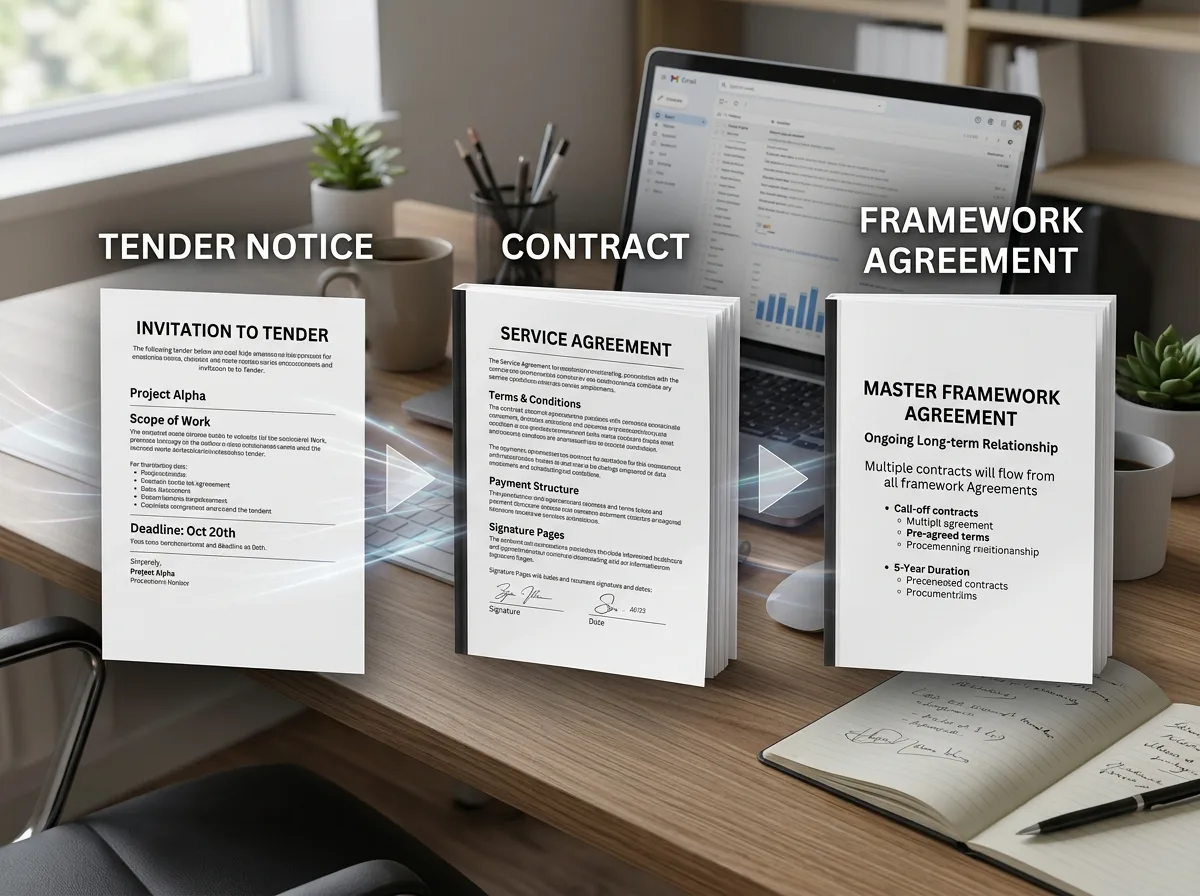
| Term | What it is | Example |
|---|---|---|
| Tender | The bidding process. The buyer publishes a notice, the spec and the rules. Suppliers send a priced bid against those rules. | Hull City Council publishes a notice on Find a Tender for a 5-year cleaning contract. That's a tender. |
| Contract | The legal agreement signed between the winning supplier and the buyer. Sets duration, scope, KPIs, payment terms. | After the bid window closes, Hull awards the contract to the supplier with the highest MAT score and signs a 5-year agreement. |
| Framework | A pre-qualified pool of suppliers, set up by one or more buyers, who can call off contracts from the pool over time. | Crown Commercial Service runs a 4-year cleaning framework with 30 approved suppliers. Any government department can call off without re-qualifying anyone. |
The three words and what they actually are.
What is a tender
A tender is a process, not a piece of paper. The buyer publishes a tender notice on Find a Tender or Contracts Finder. The notice says what they want, when they want it by, and how bids will be scored. Suppliers download the tender pack, write a response and price, and submit by the deadline. The buyer reads every bid, scores against the published criteria, and picks a winner.
If 'tender' is still fuzzy, the longer what is a tender explainer covers the full definition and the procedures used under the Procurement Act 2023.
What is a contract
A contract is the legal agreement signed at the end of a tender. It sets out the duration, scope, price, KPIs, payment terms, change rules and exit clauses. Once it is signed, you stop being a bidder and start being a supplier. The buyer monitors performance against the contract and pays you against the schedule.
Public-sector contracts under the Procurement Act 2023 are public documents. For contracts over £5 million, the buyer must publish a redacted copy within 120 days. For other above-threshold contracts, a contract details notice goes out within 30 days. So when you win, the value, term, and KPIs are visible to your competitors.
What is a framework
A framework is a pre-qualified pool of suppliers. The buyer (or group of buyers) runs one big tender, picks the suppliers who get on the framework, and then awards individual contracts (called call-offs) to those suppliers without running a fresh tender each time.
Frameworks are popular because they save buyers time. A council that runs a 4-year cleaning framework can call off a school cleaning contract in weeks instead of months. They do not have to re-check insurance and accreditations because they did all that at framework stage.
If you are not on the framework, you cannot win the call-offs. Whoever ran the original tender decides who gets in and who does not. That is why getting on the right frameworks is one of the most important things a UK soft FM SME can do for pipeline.
How call-offs work
There are two main ways a buyer awards a call-off from a framework.
| Method | How it works | When it's used |
|---|---|---|
| Direct award | The buyer picks a supplier from the framework based on published rules (often lowest price, or geographic fit, or rotation). | Smaller, simpler call-offs. Often used for routine cleaning or one-off events. |
| Mini-competition | The buyer runs a short tender between framework members only. Suppliers re-bid on price and scope. | Larger or more complex call-offs. Common on multi-site cleaning, NHS catering, security DPS work. |
Two ways frameworks award call-offs.
Frameworks under the Procurement Act 2023
The Procurement Act 2023 changed two things about frameworks that materially help SMEs.
| Topic | Pre-2025 (PCR 2015) | Post-Feb-2025 (PA 2023) |
|---|---|---|
| Maximum duration | 4 years for most. Closed once awarded. | 8 years for an Open Framework. 4 years for a closed framework. 8 years for defence, security and utilities. |
| New entrants mid-term | Locked out for the framework's life. | Open Frameworks must re-open to new suppliers within 3 years, then again within 5. |
| DPS / Dynamic Markets | DPS only. Buyer could call off without a fresh tender notice. | DPS replaced by Dynamic Markets. Apply any time. Buyer must publish a tender notice for each competition. |
| SME duty | No specific lots duty. | Buyer must consider whether the contract can be split into lots. Must explain in writing if not split. |
Old framework rules vs new under PA 2023.
For the full set of changes the Act brought in, see the Procurement Act 2023 guide for FM suppliers.
Frameworks vs Dynamic Markets
Frameworks and Dynamic Markets do similar jobs but differ in how you get in and stay in.
| Feature | Framework | Dynamic Market |
|---|---|---|
| Entry window | Closed after the original tender. Open Frameworks re-open at set intervals. | Always open. Apply any time, get accepted, stay on. |
| Maximum duration | Up to 8 years (Open Framework). Otherwise 4 years. | No fixed maximum. Lasts until the buyer ends it. |
| How buyers award work | Direct award or mini-competition between framework members. | Mini-competition between DM members. Buyer must publish a tender notice each time. |
| Best for | Recurring large-volume work where the buyer wants quality control. | Sectors where new suppliers enter often and the buyer wants flexibility. |
Framework vs Dynamic Market under PA 2023.
How they fit together
The simplest way to picture it. A framework is a list. A tender is the process to get on the list, or to win a call-off from it. A contract is what you sign at the end of any of those tenders. So a single framework can produce dozens of tenders, each ending in a separate contract. The supplier (you) bids the framework once and bids each call-off as it comes up.
What this means for soft FM SMEs
- Hunt frameworks first, individual tenders second. A spot on the right framework is worth ten one-off bids.
- Watch for Open Framework re-opening windows. Under PA 2023, you have at least two chances to join during a framework's life.
- Apply to every relevant Dynamic Market. Entry is continuous so there is no reason to wait. Most have minimum criteria you already meet.
- Read the call-off mechanism carefully before joining. Direct-award frameworks reward existing relationships. Mini-competition frameworks reward bid quality.
- Track when your incumbent frameworks end. Re-procurement usually starts 6 to 12 months before contract expiry, and pipeline notices give you a forward look.
When you find a framework worth joining, the bid mechanics live in the step-by-step UK government contracts guide. For the acronyms the framework pack will throw at you, the procurement acronyms cheat sheet has the lot. For the FM tenders overview, including how bundled soft FM lots get structured, see our facilities management tenders guide.
One last thing
Tender, contract and framework are not interchangeable. If a procurement officer says 'we're tendering a new framework', they mean they are running the bidding process to set up a new pre-qualified pool. If they say 'we're awarding a call-off contract', they mean they are signing a new agreement with a supplier already on the framework. Knowing which one you are looking at saves you weekends.
Sources
- Procurement Act 2023 (legislation.gov.uk) · Primary law governing UK public-sector tenders, contracts and frameworks from 24 February 2025.
- Transforming Public Procurement (Cabinet Office) · Buyer and supplier guidance on Open Frameworks, Dynamic Markets and call-offs.
- Crown Commercial Service · Runs the largest UK government frameworks across cleaning, security, catering and FM bundles.
- Find a Tender Service · UK above-threshold tender notices including framework competitions and call-offs.
FAQs
Frequently asked questions
- No. A framework is a pre-qualified pool of suppliers, not a tender itself. The buyer ran a tender to set up the framework, and now uses it to award individual contracts (call-offs) to suppliers on the framework. Each call-off is itself a small tender or a direct award. If you are not on the framework, you cannot win the call-offs, no matter how good your bid would be.
- A call-off contract is an individual contract awarded under a framework agreement. The buyer either picks a supplier directly from the framework based on published rules, or runs a short mini-competition between framework members. Call-offs typically run for 1 to 5 years and the framework itself runs for 4 to 8 years, so a single framework can produce dozens of call-offs over its life.
- Under the Procurement Act 2023, a closed framework can run for up to 4 years. An Open Framework can run for up to 8 years and must re-open to new suppliers within 3 years and again within 5. Defence, security and utilities frameworks can run for up to 8 years even when closed. The change is intended to stop multi-year frameworks locking out SMEs who join the market mid-term.
- A framework is a pre-qualified pool that closes (or partially closes) once the original tender is awarded. A Dynamic Market is always open. You can apply to a Dynamic Market any time, get assessed against the published rules, and stay on the list. Buyers run a tender notice and a mini-competition for each piece of work. Dynamic Markets replaced the old Dynamic Purchasing Systems (DPS) under the Procurement Act 2023.
- Yes. Plenty of UK public contracts are tendered openly with no framework involved. Below-threshold contracts (above £12,000 for central government, £30,000 for sub-central) are usually run as one-off Open procedures. Above-threshold contracts can be tendered openly too. But for recurring sector work like council cleaning or NHS catering, frameworks and Dynamic Markets are the dominant route.
- Existing call-off contracts continue under their own terms, even after the parent framework expires. The framework expiring just means no new call-offs can be awarded from it. So a 5-year cleaning call-off awarded in year 3 of a 4-year framework will run for another 4 years past the framework's end. Any new work after that goes through a fresh framework or open tender.
- Often, yes. Many UK housing associations run their own framework agreements or use shared frameworks (Procurement for Housing, Fusion 21, LHC). Housing associations are regulated by the Regulator of Social Housing and use NHF model contracts. TUPE applies to all retenders and the Real Living Wage is increasingly specified. Procurement Act 2023 covers housing associations that are 'contracting authorities'.
- Usually not. Most UK public-sector frameworks include price-review mechanisms tied to indexation (CPI or RPI) or to specific cost drivers like the National Living Wage. Soft FM frameworks often allow annual review against NLW changes, since cleaning, security and grounds rates are heavily wage-driven. Read the framework's price-variation clause carefully before bidding.