
The Standard Selection Questionnaire (SQ) is the pre-qualification questionnaire that sits in front of every UK public-sector tender. It asks suppliers to self-declare basic information, exclusion grounds and selection criteria. It was introduced by Procurement Policy Note 8/16 in September 2016 to replace the old standard PQQ, and is now formalised under the Procurement Act 2023. Buyers cannot ask additional questions in Parts 1 or 2 without breaching the standard.
If the broader tender process is new to you, the plain-English tender meaning for UK businesses covers where the SQ fits in the wider procurement journey: tender notice, SQ, ITT, evaluation, award.
What's in this guide
- What the SQ is and what replaced the PQQ
- The three parts of the SQ in detail
- What buyers can and cannot change
- How the SQ is used in different procurement procedures
- What 'self-certification' means and when evidence is needed
- Common SQ mistakes that get bids binned
- SQ-ready checklist for soft FM SMEs
What is the SQ and what replaced the PQQ
The Standard Selection Questionnaire is a pre-qualification tool. Before a public buyer reads your priced bid, they need to know whether you are a viable supplier at all. Have you got the right insurance. Are your accounts solvent. Do you have any disqualifying convictions. Do you hold the right policies on modern slavery, GDPR and equal opportunities.
PPN 8/16, issued by Crown Commercial Service in September 2016, replaced the older standard PQQ with the SQ. The SQ aligned UK supplier selection with the European Single Procurement Document (ESPD) at the time and introduced a self-declaration approach. Under the Procurement Act 2023, the SQ continues as the mandatory selection tool for above-threshold public contracts.
The three parts of the SQ
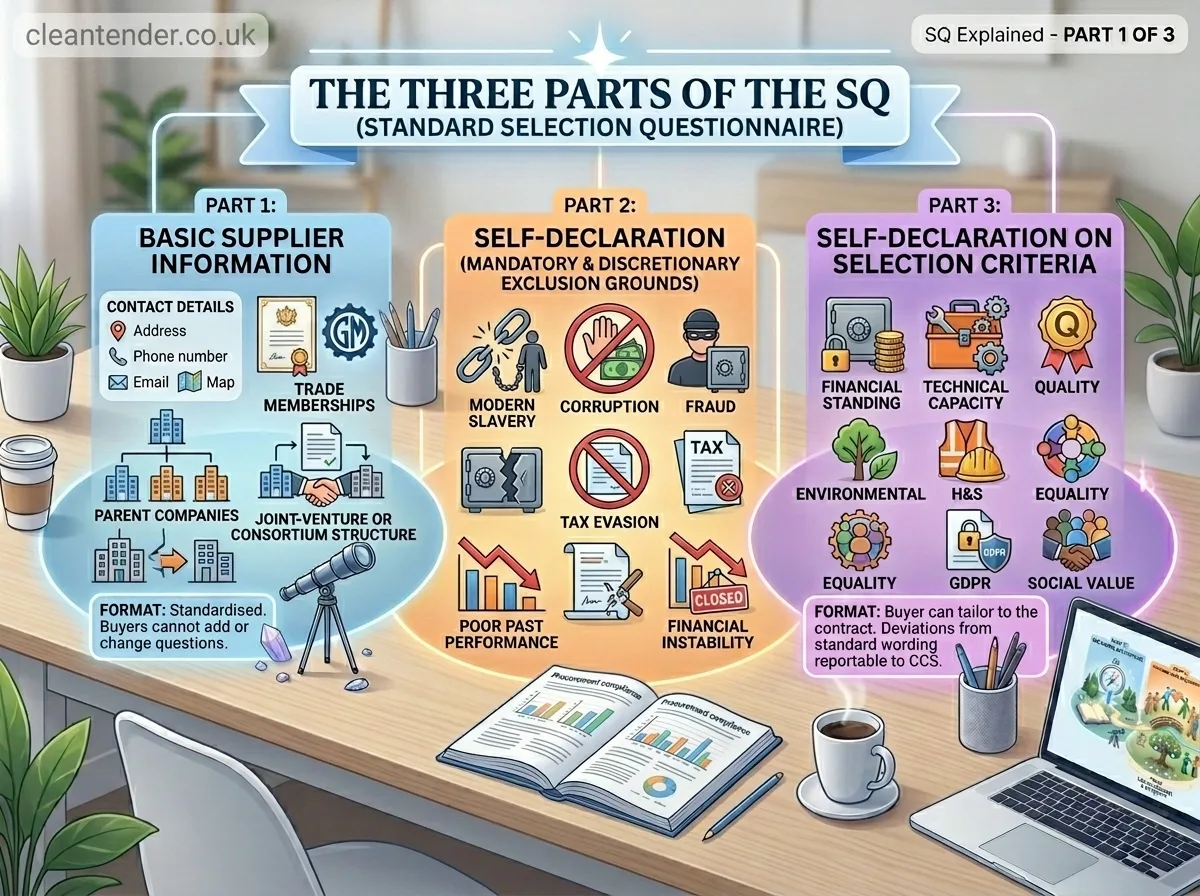
| Part | Topic | Format |
|---|---|---|
| Part 1 | Basic supplier information. Contact details, trade memberships, parent companies, joint-venture or consortium structure. | Standardised. Buyers cannot add or change questions. |
| Part 2 | Self-declaration on the mandatory and discretionary exclusion grounds (fraud, modern slavery, corruption, tax evasion, poor past performance, financial instability, etc.). | Standardised. Buyers cannot add or change questions. |
| Part 3 | Self-declaration on selection criteria. Financial standing, technical capacity, quality, environmental, H&S, equality, GDPR, social value. | Buyer can tailor to the contract. Deviations from the standard wording are reportable to CCS. |
What each part of the SQ covers.
Part 1: Basic supplier information
Part 1 is the easy part. Company name. Companies House number. VAT number. Registered address. Main trading address. Contact name and email. Trade body memberships. Parent companies. Whether you are bidding alone or as part of a consortium / joint venture. Bank account details if requested.
Two things to watch. If you are bidding as a consortium, every member fills in their own Part 1 and Part 2. The lead bidder consolidates them. And if you rely on a parent company or essential subcontractor to meet the selection criteria, that organisation must also complete Part 1 and Part 2.
Part 2: Exclusion grounds
Part 2 lists the mandatory and discretionary grounds for excluding a supplier from public contracts. You self-declare whether any of them apply to you, your directors or, where relevant, your subcontractors.
| Type | Examples | Effect |
|---|---|---|
| Mandatory grounds | Convictions for fraud, bribery, corruption, modern slavery offences, tax evasion, money laundering, terrorism financing, organised crime. | Buyer must exclude the supplier. No discretion. |
| Discretionary grounds | Breach of environmental or labour law, insolvency, prior poor performance, tax non-compliance, conflicts of interest, undue influence on the procurement. | Buyer may exclude. Discretion based on facts. |
The two types of exclusion grounds in Part 2 of the SQ.
If a ground does apply to you, you can use the 'self-cleaning' provision. Explain what happened, what you have done to fix it, and the steps you have taken to stop it happening again. The buyer then decides whether the rectification is enough. Under the Procurement Act 2023, debarment decisions sit with the centralised Procurement Review Unit, not individual buyers.
Part 3: Selection criteria
Part 3 is the longest section and the one buyers can tailor. It covers whether you have the financial muscle and the technical capability to deliver this specific contract.
- Economic and financial standing: last 2 to 3 years of audited accounts, turnover, profitability, going concern statement.
- Insurance levels: usually £5m Employers Liability and £5m Public Liability minimum. Some larger contracts ask for £10m. Professional Indemnity if relevant.
- Technical capacity: similar contracts delivered, references, named contract manager, key personnel CVs.
- Quality management: ISO 9001 (UKAS-accredited) or equivalent QMS.
- Environmental management: ISO 14001 (UKAS-accredited), environmental policy.
- Health and safety: ISO 45001 or equivalent, SSIP membership (CHAS, SMAS, etc.), H&S policy signed within 12 months.
- Equality and diversity: written policy and evidence of practice.
- Modern Slavery Statement: required if you have 50+ staff or £36m+ turnover. Even smaller firms should have one for tender purposes.
- GDPR / Data Protection: written policy and ICO registration where applicable.
For a refresher on the difference between insurance levels, ISO certs and SSIP schemes, see the procurement acronyms cheat sheet. For SSIP scheme choice, the best SSIP scheme for small businesses review covers pricing.
What buyers can and can't change
This is the part most bidders do not realise. The SQ format is largely fixed.
| Part | Can the buyer change it? | What this means for you |
|---|---|---|
| Part 1 | No. Buyers must use the standard questions exactly. | Your Part 1 answers stay the same across every bid. Save them once and re-use. |
| Part 2 | No. The exclusion grounds are set in legislation. | Your Part 2 answers also stay the same. Update only when something changes. |
| Part 3 | Yes, but limited. Buyers can choose which standard questions apply and add proportionate ones for the contract. Deviations are reportable to CCS. | Read Part 3 carefully on each tender. The required minimums (insurance, ISOs, accounts) often vary. |
Buyer's freedom to change SQ questions across the three parts.
If you spot a buyer who has rewritten Part 1 or Part 2, or added clearly disproportionate Part 3 questions (a £40,000 cleaning contract that demands 5 years of similar £5m+ contracts), you can challenge through the Public Procurement Review Service. The Procurement Act 2023 strengthened those challenge rights.
How the SQ is used in different procedures
| Procedure | When SQ is completed | Notes |
|---|---|---|
| Open procedure | Submitted alongside the priced bid in a single round. | Most common for soft FM. SQ and bid arrive together. Buyer scores the bid first, then checks SQ on the leading supplier. |
| Competitive Flexible procedure | Submitted at the start. Used to shortlist who progresses to later stages. | Multi-stage. Suppliers who fail SQ are dropped early. |
| Frameworks | Submitted at framework qualification stage. Updated periodically. | Once you are on the framework, call-offs do not usually need a fresh SQ. |
| Dynamic Markets | Submitted on application to join. Updated as required by the buyer. | Apply once. The buyer can ask for updates during the DM's life. |
| Below-threshold contracts | Cannot use a separate pre-qualification stage. SQ-style questions can be embedded in the main tender. | Buyers must keep the questions proportionate to the value. |
Where the SQ sits in each procurement procedure.
Self-certification and when evidence is needed
The SQ uses a self-declaration model. At SQ stage, you tick the boxes and sign the declarations. You do not have to upload every certificate yet. The buyer will only ask the winning bidder (or the bidder on the verge of being awarded) to produce the underlying evidence. That keeps the burden off losing bidders.
What this means in practice. You should hold all the underlying documents at the time you submit the SQ, even if the buyer does not ask for them. If they ask later and you do not have them, you lose the contract. Keep current copies of insurance certificates, ISO certs, last 3 years' accounts, H&S policy, modern slavery statement, GDPR policy and signed declarations on file.
Common SQ mistakes
- Expired insurance certificate. Buyers check the validity date. A certificate that runs out before contract start is a fail.
- Insurance below the buyer's stated minimum. £5m is the most common floor. Some larger contracts require £10m. Read Part 3 carefully on each tender.
- Missing Modern Slavery Statement. Mandatory if you have 50+ staff or £36m+ turnover. Recommended for everyone bidding public contracts.
- Unsigned declarations. The SQ has multiple declaration boxes. Each must be signed by a named director.
- Wrong company name on certs. Insurance and ISO certs must be in the bidding entity's exact registered name.
- Stale accounts. Most public buyers want the latest 2 to 3 years of audited accounts. Drafts not yet filed at Companies House are usually rejected.
- Self-cleaning skipped. If a discretionary exclusion ground applies, you must use the self-cleaning provision in writing. Saying 'no' is the wrong answer if it actually does apply.
- Missing UKAS accreditation. ISO certs from a non-UKAS-accredited body are usually rejected. Check yours via the UKAS database.
- Inconsistent answers. Part 1 says you have 12 staff. Part 3 social value says you will create 10 apprenticeships. Buyers spot it.
For the full set of documents that sit alongside the SQ in a tender pack, see what are tender documents and which ones really matter.
SQ-ready checklist for soft FM SMEs
Before you submit your next SQ, run this list.
- Employers Liability insurance, minimum £5m, certificate within validity dates, in the exact bidding-entity name.
- Public Liability insurance, minimum £5m, same checks. £10m if the contract spec asks for it.
- Professional Indemnity if relevant (consultancy, design, advisory work).
- Last 2 to 3 years of audited accounts, filed at Companies House.
- ISO 9001 (Quality), UKAS-accredited, in date.
- ISO 14001 (Environment), UKAS-accredited, in date.
- ISO 45001 (Occupational H&S), UKAS-accredited, in date if asked.
- SSIP scheme membership (CHAS, SMAS Worksafe, Acclaim or other recognised scheme), in date.
- H&S Policy, signed by a named director, dated within 12 months.
- Modern Slavery Statement, even if you are below the 50-staff threshold.
- GDPR / Data Protection Policy, with ICO registration if applicable.
- Equality, Diversity and Inclusion policy, signed and dated.
- Environmental Policy, signed and dated.
- Two to three case studies of similar work, with references that have agreed to be contacted.
- Named contract manager with a CV, BICSc / SIA / NPTC qualifications as appropriate to sector.
- Bank details and registered company information up to date on the Central Digital Platform.
One last thing
Most public-sector bids fail at the SQ, not at the evaluation. The SQ is admin, not strategy. Get every document on the list current and stored in one place. Re-use Part 1 and Part 2 across every bid. Update Part 3 to match each contract. Win or lose on the bid itself.
For the full picture of tender documents the SQ sits inside, see what are tender documents and which ones really matter for FM contracts. For why PAS 91 is no longer the main pre-qualification route, the PAS 91 explainer has the answer.
Want a quick score before you start the form? Use the free SQ readiness checker to see which modules you can already answer.
Sources
- PPN 8/16: Standard Selection Questionnaire (Crown Commercial Service) · Original PPN that introduced the SQ in September 2016, replacing the standard PQQ.
- Procurement Act 2023 (legislation.gov.uk) · Formalises the SQ as the mandatory selection tool for new procurements from 24 February 2025.
- Transforming Public Procurement (Cabinet Office) · Buyer and supplier guidance on SQ use under PA 2023.
- List of Mandatory and Discretionary Exclusions · Government list of grounds for exclusion in Part 2.
- UKAS · Lookup for ISO accreditation. Buyers verify ISO certs here.
FAQs
Frequently asked questions
- The SQ is the Standard Selection Questionnaire. It is the pre-qualification tool used by UK public-sector buyers before they read your priced bid. It was introduced by Procurement Policy Note 8/16 in September 2016 to replace the standard PQQ, and is now formalised under the Procurement Act 2023 for new procurements from 24 February 2025. The SQ has three parts: basic supplier information, exclusion grounds and selection criteria.
- SQ stands for Selection Questionnaire. PQQ stood for Pre-Qualification Questionnaire. They cover the same kinds of questions: company information, financial accounts, insurance, accreditations, modern slavery, GDPR. The PQQ was the older form. PPN 8/16 in September 2016 introduced the standard SQ to replace it. Some buyers and bid writers still use the word PQQ loosely. In practice, on a UK public-sector tender today, you will be filling in an SQ.
- Only in Part 3. Parts 1 (basic supplier information) and 2 (exclusion grounds) are standardised. Buyers must use the questions exactly as published and cannot add to them. Part 3 selection criteria can be tailored to the contract, but only proportionate questions, and buyers must report deviations from the standard wording to Crown Commercial Service. So your Part 1 and Part 2 answers can be re-used identically across every bid.
- You must declare it. You can also use the 'self-cleaning' provision: explain what happened, what you have done to remedy it, and what steps you have taken to stop it happening again. The buyer then decides whether the rectification is enough to consider your bid. Lying or omitting on Part 2 is itself a discretionary exclusion ground and can lead to debarment under the Procurement Act 2023's centralised debarment list.
- No. The SQ uses a self-declaration model. At SQ stage, you tick the boxes and sign the declarations. The buyer asks the winning bidder (or the bidder about to be awarded) for the underlying evidence before contract signing. But you should hold all the documents at submission. If you cannot produce them when asked, you lose the contract.
- Most UK public-sector tenders ask for £5m Employers Liability and £5m Public Liability as a minimum. Some larger contracts (NHS multi-site, county-wide cleaning, manned guarding for high-risk sites) require £10m. Professional Indemnity is asked for on consultancy and design work. The exact requirement is in Part 3 of each SQ, since Part 3 is the part buyers can tailor. Check before bidding and increase your cover if needed.
- Strictly, the Modern Slavery Act 2015 requires a published statement for businesses with £36m+ turnover. But most public-sector buyers ask for one in Part 3 regardless of size. If you have 50+ staff, expect to need one. Even at 10-20 staff, having a short, signed statement on file makes you SQ-ready and removes one common reason small bids get binned.
- Sometimes. ISO 9001 is rarely a legal requirement, but it is a common minimum in NHS, Crown Commercial Service and large local authority tenders. Below-threshold or smaller contracts often accept an equivalent quality management system: documented procedures, customer feedback process, internal audits. Read each Part 3 carefully. If ISO 9001 is listed as 'mandatory', do not bid without it. If it is listed as 'desirable', explain your alternative QMS and lean on case studies.
- Self-cleaning is a provision that lets a supplier with a relevant exclusion ground argue that they have remedied the issue and should still be allowed to bid. It is not a free pass. You explain in writing what happened, what you have done about it (compensation paid, processes changed, training delivered, leadership replaced) and what you have done to stop it happening again. The buyer then exercises judgement. Under the Procurement Act 2023, similar arguments can be made to remove yourself from the centralised debarment list.
- Usually no. The SQ is completed at the framework qualification stage. Once you are on the framework, the buyer running a call-off relies on the SQ data already on file. They may ask you to confirm nothing has changed (an updated insurance certificate, fresh accounts year), but you do not redo the full SQ. Frameworks are popular partly for this reason: they remove the SQ workload from each individual call-off.