
A Framework Agreement is a pre-qualified pool of suppliers that a UK public buyer can call off contracts from over a set period without running a new tender each time. For an established soft FM SME (cleaning, security, grounds, waste, catering), one place on a relevant framework can replace 10-20 individual tender bids a year. The trade-off: the framework itself is a one-off competition, won or lost, with a 4-year wait for the next window.
The Procurement Act 2023 (live 24 February 2025) changed two things. First, it consolidated framework rules into Sections 45-49. Second, it introduced Open Frameworks under Section 49, which run for up to 8 years and re-open periodically to let new suppliers join mid-term. That is genuinely new and SME-friendly.
A framework provides for the award of future public contracts through two primary methods: a Competitive Selection Process (Section 46) where the authority invites suppliers on the framework to bid for a specific contract, or a Direct Award where the framework terms clearly set out the conditions.
Procurement Act 2023, Part 3 Chapter 4
What's in this guide
- How to get on a UK soft FM framework, step by step (CleanTender walkthrough)
- What a Framework Agreement actually is (under the new regime)
- Standard vs Open Frameworks: the Section 49 change
- Major UK soft FM frameworks SMEs target
- How to apply (timeline + evidence)
- What scores at framework qualification (different from regular tender)
- After joining: the call-off cadence
- When NOT to apply
How to win a UK soft FM framework tender, step by step
The complete end-to-end flow inside CleanTender. From sector setup to a submitted soft FM framework bid in the time it used to take to read a single tender pack.
Eight steps from "never bid public sector" to a complete SQ response on the buyer's portal. First scan is free.
Step 1· 10 minutes
Build your soft FM framework company profile
Set your sector to soft FM framework, your service regions, sector specialism, ISO certifications, sector accreditations, framework experience, lot-by-lot capacity, regions covered, turnover, operative count, insurance levels, turnover, and operative count. CleanTender uses this to fit-score every live tender against your real capability so you only see the ones you can win.
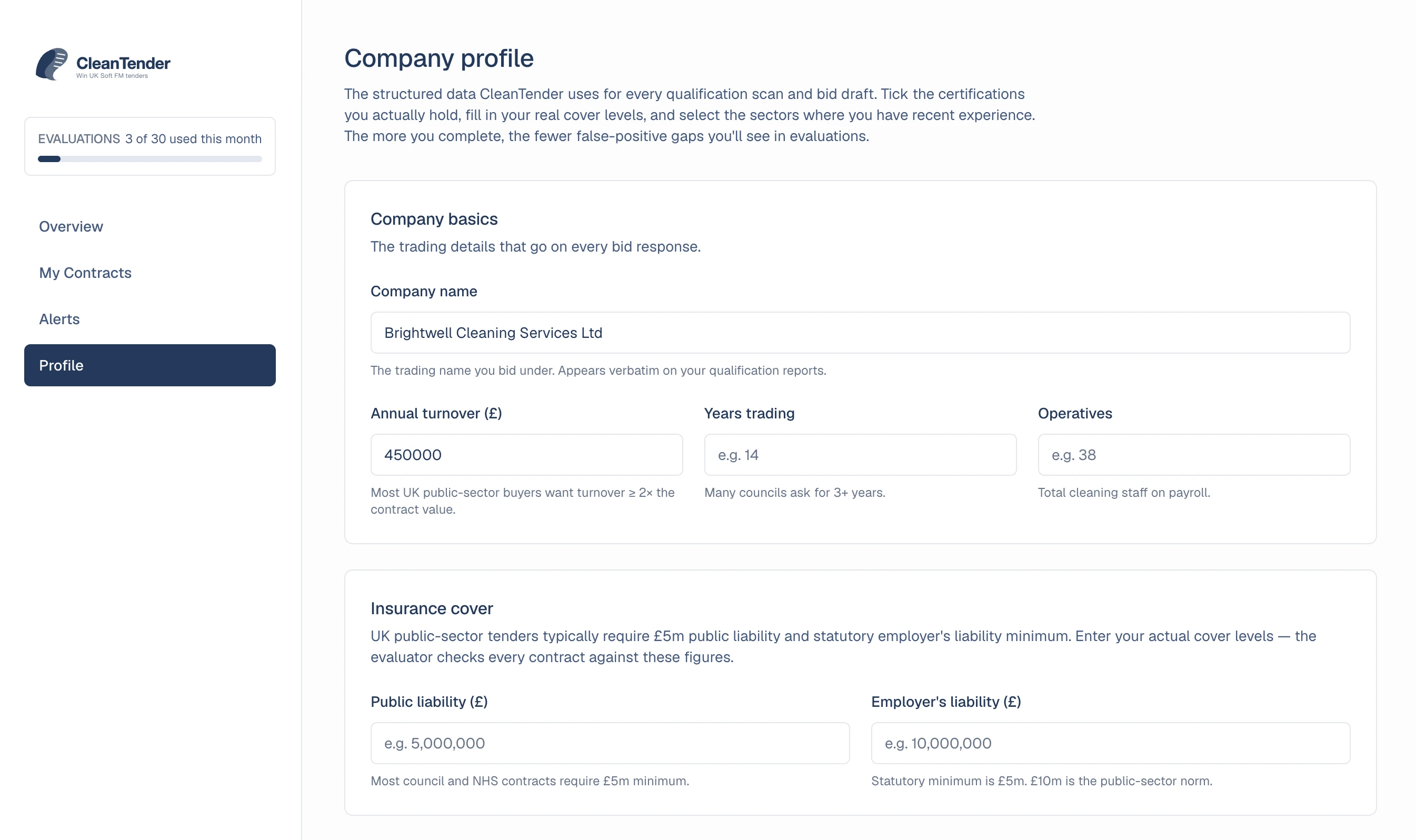
Profile setup defines what you are bid-ready for Step 2· 5 minutes daily
Open the live framework-tender feed
Every UK central government (CCS, NHS Supply Chain), local authority consortia (YPO, ESPO, NEPO), and education (TUCO) framework tender, in one feed. Pre-filtered to your sector and geography. No false positives, no manual portal-trawling across FTS, Contracts Finder, and dozens of buyer e-procurement portals.
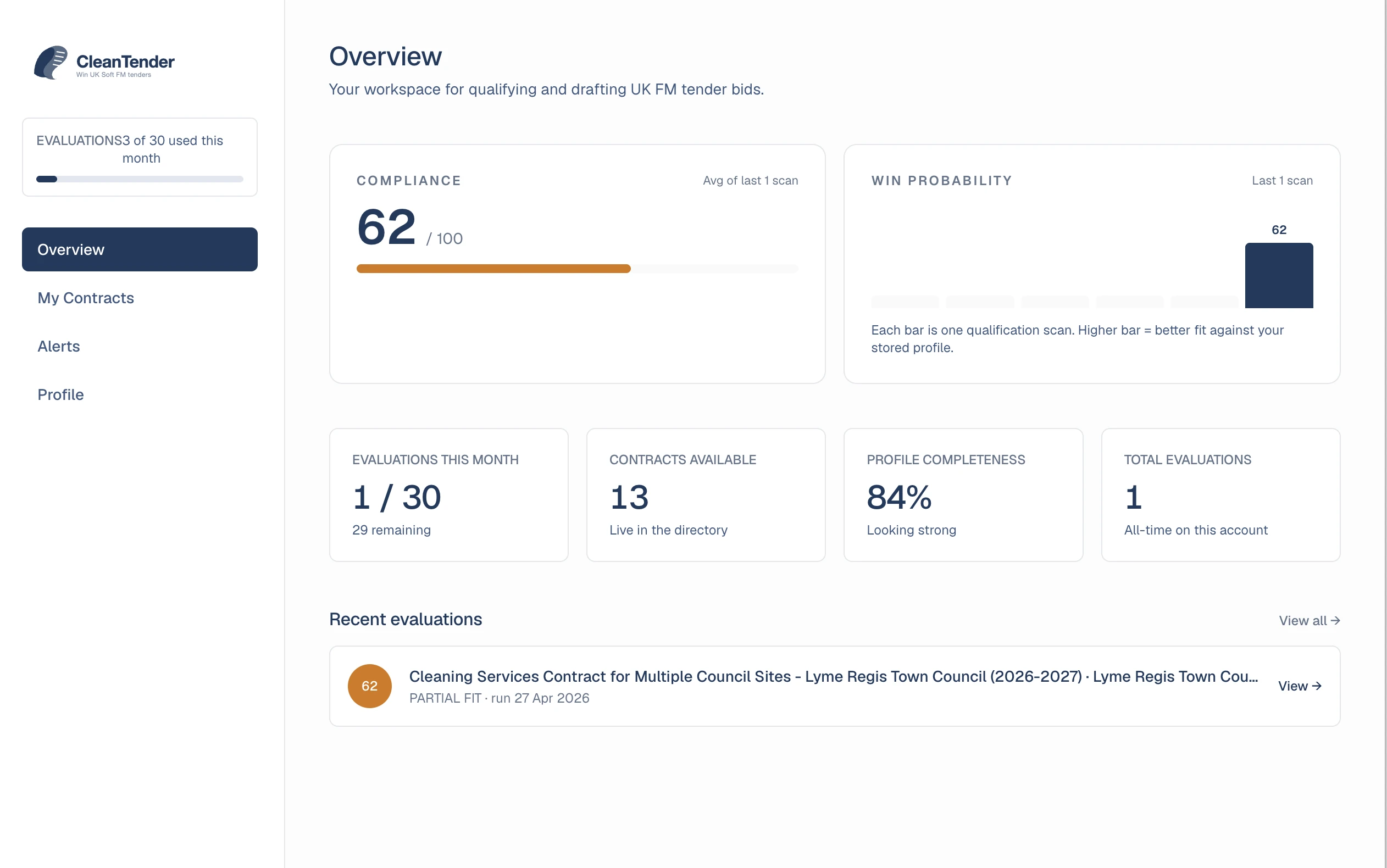
Live feed of in-scope framework tenders, fit-scored Step 3· Daily digest
Get email alerts for new in-scope tenders
New soft FM framework tenders matching your profile land in your inbox the day they publish. CleanTender batches them into a daily digest so you do not get notification fatigue, and links straight back to the in-app fit score.
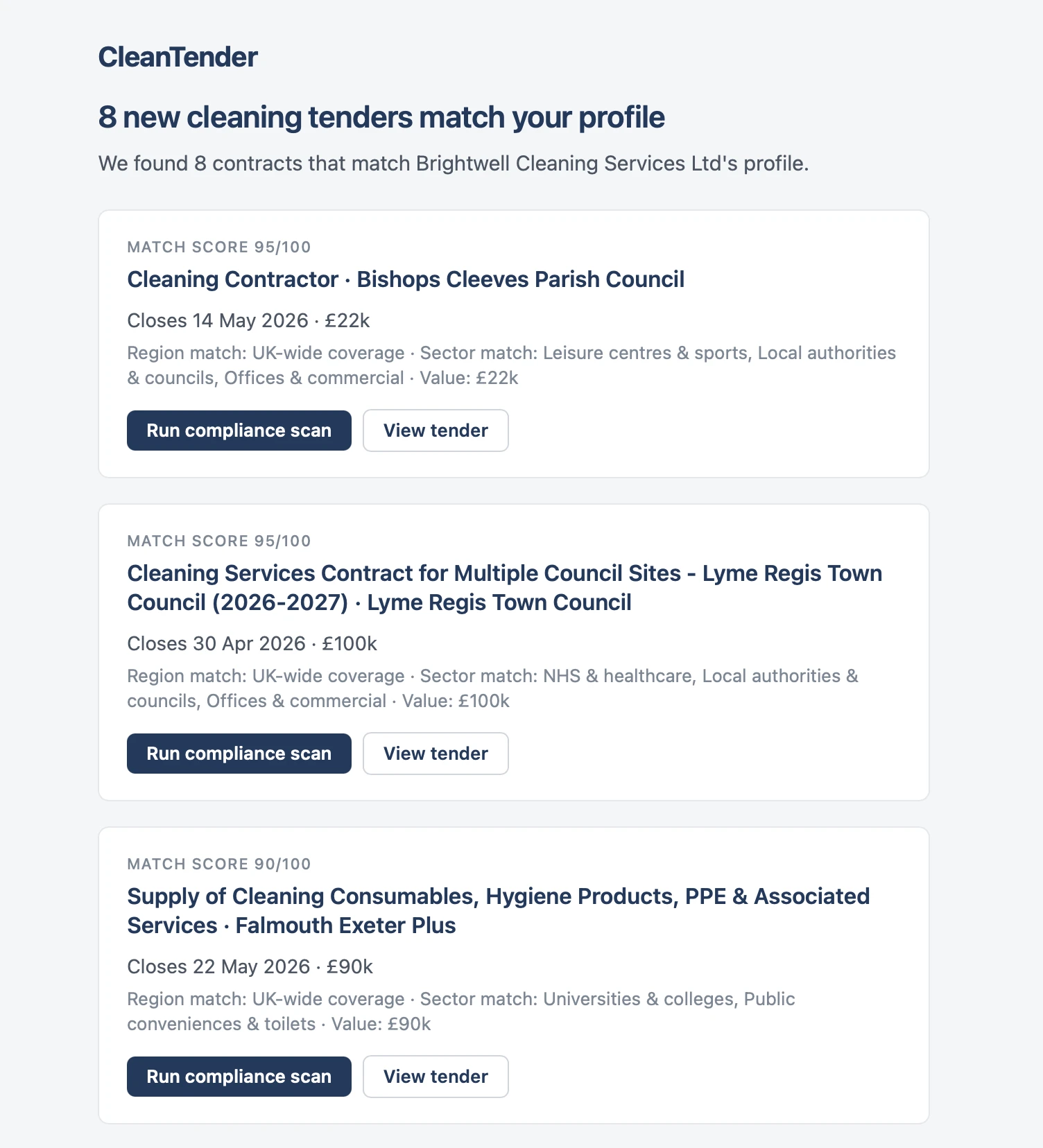
Daily alerts for new in-scope tenders Step 4· 30 seconds
Run a fit-score evaluation on a target tender
One click runs a CleanTender Evaluation against the tender pack: scope match, geography fit, scale fit, compliance gap, and a plain-English win probability. Stops you bidding contracts you were never going to win.
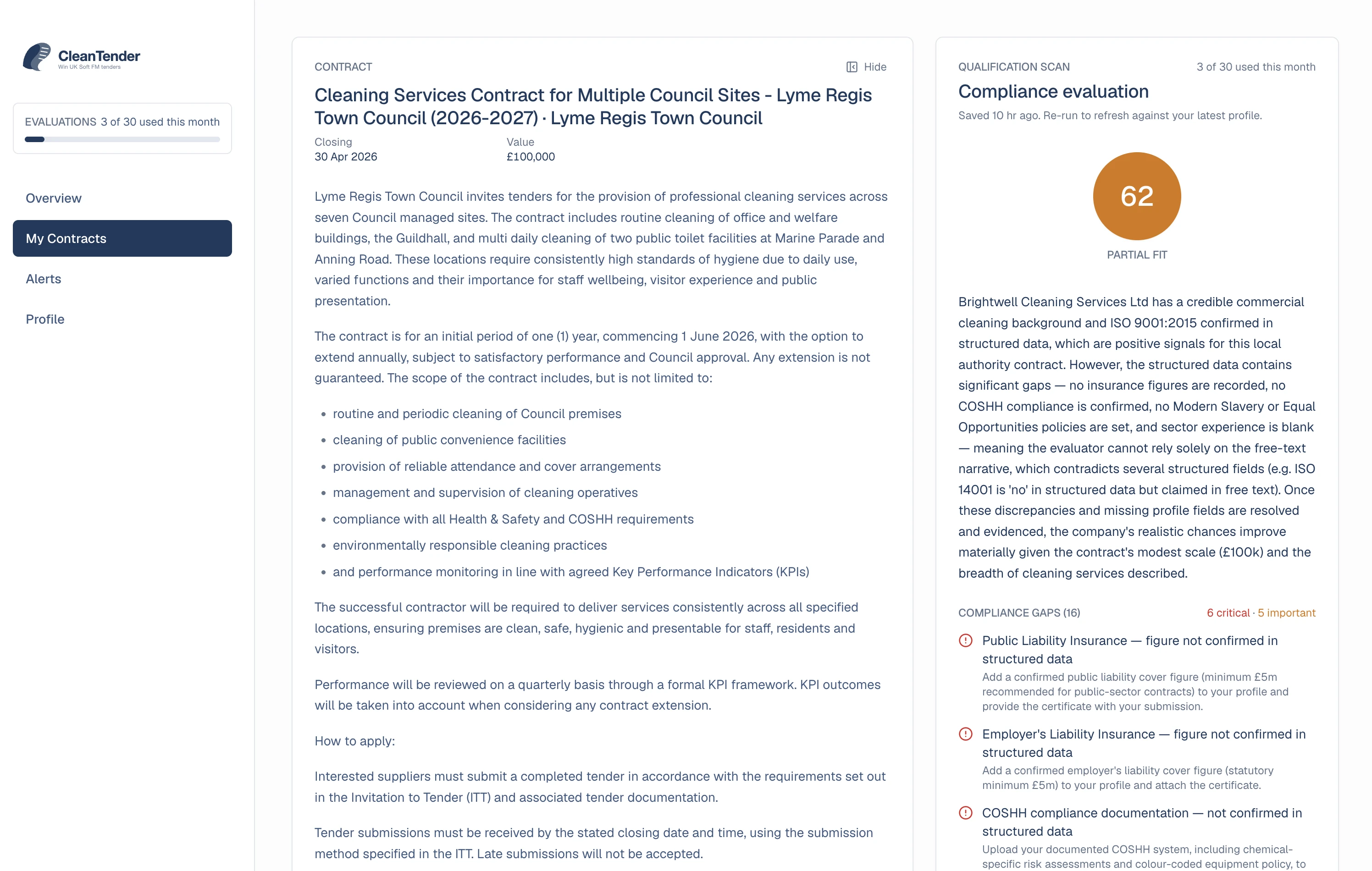
Fit-score and win-probability before you commit a weekend Step 5· 1 minute
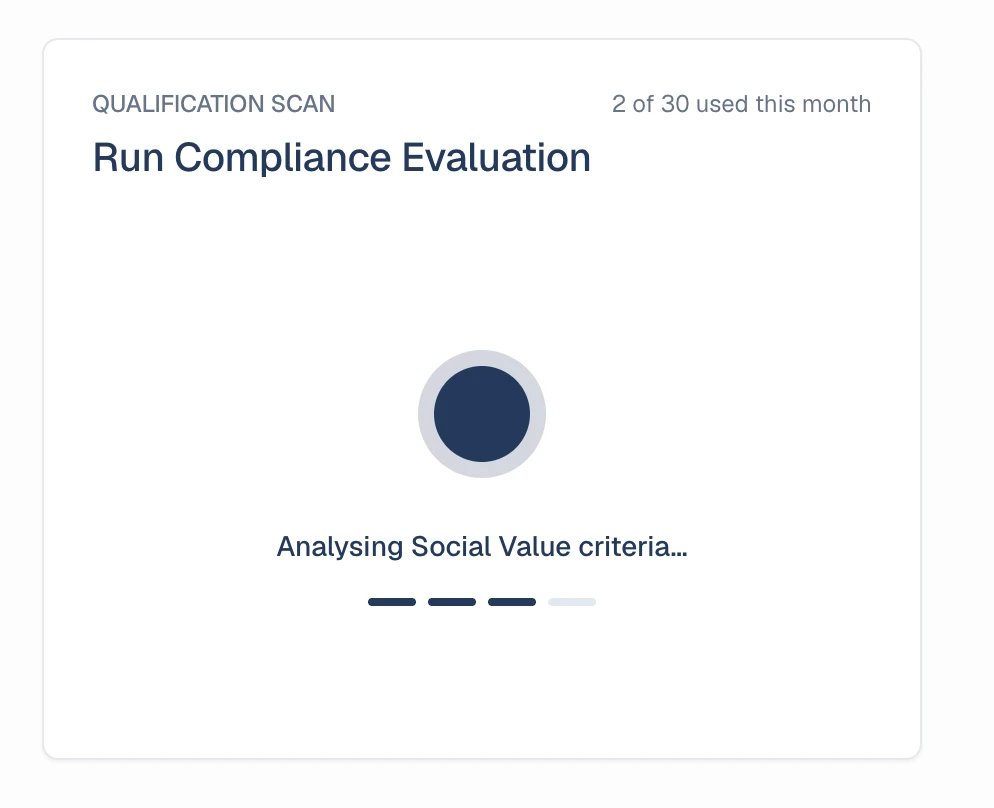
Spot compliance gaps before you start drafting
CleanTender runs a named compliance check against the tender pack: sector accreditations, ISO 9001, ISO 14001 increasingly required, SSIP, framework lot capacity, social value plan, decarbonisation pathway. Anything missing is flagged before you sink hours into a bid that auto-fails at SQ.
Compliance gaps surfaced before drafting Step 6· 2 minutes generation
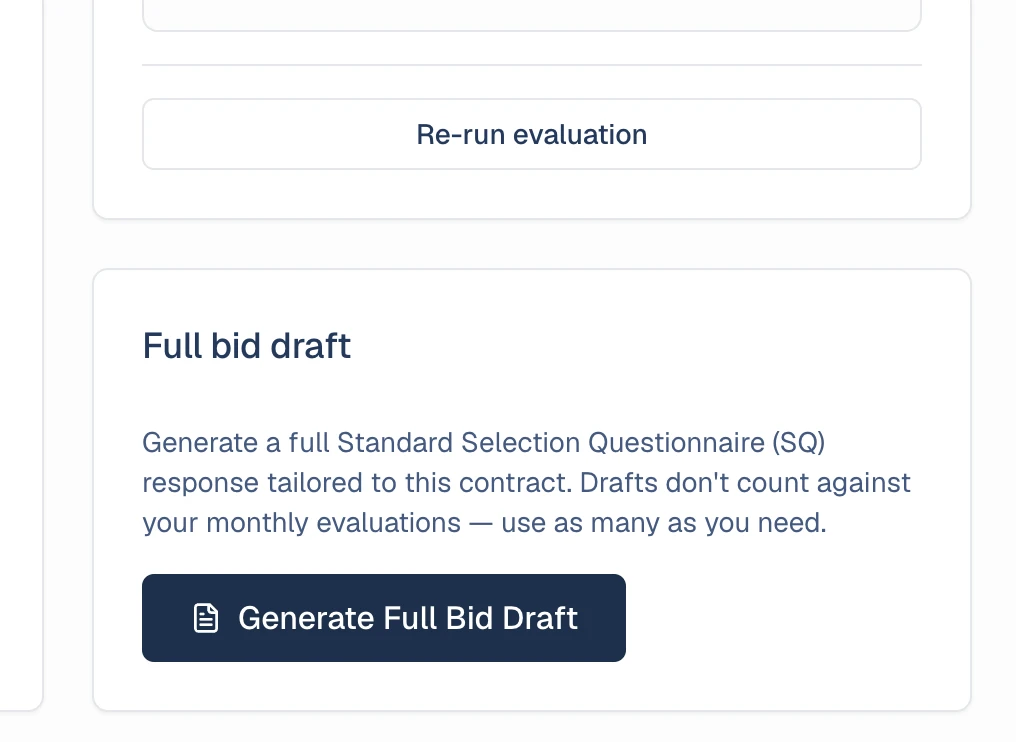
Generate a full SQ + method-statement draft
CleanTender drafts a complete Standard Selection Questionnaire response using your profile data and the tender requirements: declaration block, company overview, contract experience, quality, training, COSHH, social value, H&S, insurance schedule. All ten sections, in one pass.
Full SQ draft generated in minutes, not days Step 7· Half a day
Refine, add evidence, and submit
Tune the draft, drop in named referees and certificate numbers, layer your quantified social value commitments, and submit through the buyer's portal. Most users compress a 30-60 hour first bid to 8-12 hours of focused review.
Step 8· Ongoing
Track outcomes and improve
Every bid logs in CleanTender with status, score, and (after standstill) the buyer's feedback. Use the standstill data to tune your next bid. Win rate compounds; first-bid completion is the only thing standing between you and a public-sector revenue line.
What a Framework Agreement actually is
A Framework Agreement establishes the terms (price, scope, service levels) for future contracts of a particular category. The buyer runs one big competition to populate the framework. Suppliers who win get a place on the framework. For the next 4 to 8 years, that buyer (or any buyer named in the framework) can award individual contracts ("call-offs") to suppliers on the list without a fresh tender.
Two call-off methods exist under the Procurement Act 2023:
- Competitive selection process (Section 46): a mini-competition restricted to framework members. Faster than a full tender, but you still write a bid for each call-off.
- Direct award: the framework terms specify objective conditions (geography, capability, price band) that determine which framework member gets the work without a new competition. Faster again, but only available where the framework was set up to allow it.
Frameworks often confuse with Dynamic Markets. The mechanical difference is open vs closed: Dynamic Markets accept new suppliers any time, frameworks are closed-list. The Dynamic Markets / DPS guide for soft FM SMEs covers Dynamic Markets in detail.
Standard vs Open Frameworks: the Section 49 change
This is the meaningful change. Procurement Act 2023 Section 49 Open Frameworks are the genuinely new mechanism, distinct from the older DPS (Dynamic Purchasing Systems) approach: 8-year duration, periodic mid-term re-opening for new suppliers, and a much shorter wait if you miss the first window.
| Feature | Standard Framework (Section 47) | Open Framework (Section 49, NEW) |
|---|---|---|
| Maximum duration | Typically 4 years (varies by authority and contract type) | Up to 8 years |
| New entrant access | Closed once established. Suppliers who missed the OJEU/FTS window wait until the next framework re-procurement. | Re-opens at set intervals (typically every 2-3 years) to admit new suppliers |
| Application risk if you miss the window | 4-year wait | Wait until the next re-opening (months to ~3 years), not 4-8 years |
| SME suitability | Suits SMEs that already trade in the sector and can submit at the original window | Suits new entrants and growing SMEs that build capability over time and apply at the next re-opening |
| Common use cases (2026) | Existing NHS SBS, ESPO, CCS framework agreements established before Feb 2025 | Newly-established frameworks under the Act, increasingly common for soft FM |
Standard vs Open Frameworks under the Procurement Act 2023.
If you missed an existing Standard Framework window, the practical strategy is to monitor for new Open Framework establishments in your sector. The Procurement Act 2023 makes Open Frameworks the new default for sectors with high SME participation, and soft FM is exactly that.
Major UK soft FM frameworks
| Provider | Coverage | Soft FM lots typically |
|---|---|---|
| NHS Shared Business Services (NHS SBS) | NHS Trusts across England | Total Workplace Solutions (cleaning, catering, security, grounds bundled). High value, long terms. |
| ESPO (Eastern Shires Purchasing Organisation) | Local authorities, blue-light, education across East Midlands and beyond | Cleaning Services framework, Catering, Grounds Maintenance, Waste, Security separately listed |
| YPO (Yorkshire Purchasing Organisation) | Public sector across Yorkshire, plus national reach | Cleaning, Catering, Grounds, Waste, Security |
| Crown Commercial Service (CCS) | Central government departments, executive agencies, NDPBs | RM6232 Workplace Services (national), RM6315 Catering, sector-targeted lots within larger frameworks |
| Procurement for Housing (PfH) | Housing associations across England, Wales, Scotland | Cleaning, Grounds, Pest Control, Waste |
| London Universities Purchasing Consortium (LUPC) | London-area universities | Cleaning Services, Security |
| Procurement Partnerships (PPL) | Welsh public sector, blue-light | Cleaning, Catering, Grounds across Welsh public bodies |
Major UK Framework Agreements that soft FM SMEs apply to in 2026.
Most established UK soft FM SMEs hold three to five framework places across these. The geographic and sector mix matters: a Yorkshire grounds maintenance firm without a YPO place is leaving easy work on the table; a London cleaning firm without LUPC is unusual.
How to apply
| Stage | Timeline | What you do |
|---|---|---|
| Tender Notice (TN) | Day 0 | Framework establishment notice publishes on Find a Tender Service. Read the scope, lots, value, duration, and selection criteria. Decide which lots to bid. |
| Pre-qualification (Selection Stage) | Days 1-30 | Submit Standard Selection Questionnaire (SQ) data via the Central Digital Platform. Insurance, accounts, accreditations, case studies in the right scope and value band. |
| Award Stage (quality + price) | Days 30-60 | Submit method statements, social value plan, pricing schedules per lot. Quality and price weightings vary; soft FM frameworks typically run 50-60% quality, 30-40% price, 10-20% social value. |
| Standstill | Days 60-70 | 10-day standstill after award notification. Successful and unsuccessful suppliers can request feedback. Challenge window opens. |
| Framework Live | Day 70+ | Members on the framework. Call-off competitions begin. Authorities run mini-competitions (Section 46) or direct awards on framework terms. |
Typical UK framework application timeline from notice to award.
What scores at framework qualification stage
Frameworks are won at the qualification stage by demonstrating sustained capability, not by writing a clever bid. The scoring logic is different from a one-off tender:
- Track record in scope: case studies in the same sector, same value band, same audience type. Not adjacent. A cleaning firm bidding an NHS SBS framework needs NHS or healthcare references, not council references.
- Geographic coverage: frameworks usually have multiple lots split by region. Bid the lots you can credibly serve. A 3-van Birmingham operation bidding a national lot fails on technical capacity.
- Financial standing: 2 years of accounts at minimum. Turnover ratio (the buyer's expected annual call-off value should be no more than ~25% of your turnover) determines which lots you can credibly bid.
- Social value: usually weighted 10-15% even at framework stage. Pre-write five quantifiable commitments mapped to PPN 002 themes (jobs, growth, wellbeing, environment, equal opportunity).
- Mobilisation plan: how would you onboard a £500k contract within 8 weeks of call-off? Buyers want a credible answer, not generic best-practice copy.
If your method statements still read as brochure copy at framework stage, you're losing points before you start. The eight-section method statement structure covers what scores 8-9 out of 10 against UK public-sector marking matrices, with worked examples for council and NHS.
After joining: the call-off cadence
What is a call-off contract?
A call-off contract is the actual individual piece of work awarded to a supplier who is already on a framework agreement. The framework is the pre-qualified list; the call-off is the live contract that runs against it. Buyers award call-offs through either a Section 46 competitive selection process (mini-competition between framework members) or direct award where the framework terms set the conditions.
Once you are on a framework, the work changes. You stop writing full SQs for every opportunity. You start tracking call-off competitions and responding fast.
- Set up alerts for call-off competitions on your framework. Most contracting authorities publish these as Contract Award Notices or via the framework provider's portal.
- Build a call-off response template tuned to that framework's marking matrix. Reuse with site-by-site adaptations.
- Watch the response window. Mini-competitions usually run 2-4 weeks, much faster than full tenders. A standing template gets you out the door in days, not weeks.
- Track your win rate by call-off type. If you are winning 30%+ of mini-competitions, the framework is paying back. Below 10%, your scope or pricing is off and the framework is not the right fit.
- Stay clean on exclusion grounds (Section 48). Authorities check exclusion status before EACH call-off award. A late filing or director disqualification mid-term costs you call-offs even though you are still nominally on the framework.
When NOT to apply
- Geography mismatch. Bidding a national lot when you operate from one region. Mobilisation cost destroys the margin even if you win.
- Scale mismatch. Total framework value is more than 4x your annual turnover. Buyers worry about supplier collapse and exclude on financial standing.
- Sector mismatch. Bidding a hard FM framework because the cleaning category was bundled in. The hard FM lots will not feed your business and the application work goes to waste.
- Existing pipeline at capacity. If you cannot bid call-offs because you are at margin capacity, joining the framework just generates email noise.
- Less than 12 months of trading. Frameworks ask for 2 years of accounts. Substitute evidence rarely passes for framework-stage qualification (different from below-threshold tenders).
If you are under 2 years old and want to start winning UK public-sector contracts, the new-business reality check covers the realistic targets (below-threshold council bids, Dynamic Markets, subcontracting) before frameworks become viable.
What to do this week
- Map your existing pipeline against the frameworks above. Pick three that match your geography, sector, and scale.
- Set saved searches on Find a Tender Service for "Framework Agreement" + your sector keywords. Add "Open Framework" specifically to catch Section 49 establishments.
- Build a framework-grade Standard Selection Questionnaire pack (insurance, 2 years of accounts, 3 case studies in scope, ISO 9001 + ISO 14001 + SSIP, social value plan).
- If your business is under 2 years old, focus on Dynamic Markets and below-threshold council work. Frameworks come later.
- When a Tender Notice publishes for a framework you want, mark the deadline 30 days before submission. Frameworks reward preparation, not last-minute writing.
Sources
- Procurement Act 2023, Part 3 Chapter 4 (Sections 45-49) · Statutory framework for Framework Agreements; live 24 February 2025
- Find a Tender Service · Where Framework Agreement Tender Notices publish
- NHS Shared Business Services Frameworks · Total Workplace Solutions and other soft FM frameworks for NHS Trusts
- ESPO Frameworks · Local authority and education-sector framework agreements
- YPO · Public-sector procurement consortium with national framework reach
- Crown Commercial Service Agreements · Central government framework agreements including RM6232 Workplace Services
- Procurement for Housing (PfH) · Housing association soft FM frameworks
FAQs
Frequently asked questions
- Duration and access. Standard Frameworks (Section 47 of the Procurement Act 2023) typically run for a maximum of 4 years and are closed to new entrants once established. If you miss the establishment window, you wait for the next re-procurement. Open Frameworks (Section 49, new under the 2023 Act) run for up to 8 years and re-open at set intervals (typically every 2-3 years) to admit new suppliers. Open Frameworks are SME-friendlier because the wait between joining opportunities is months to a few years instead of 4-8 years. They are the new default for sectors with high SME participation, including soft FM.
- Typically 60-90 days from Tender Notice to framework live. The breakdown: 30 days for the pre-qualification (Selection) stage where you submit Standard Selection Questionnaire data, 30 days for the Award stage where you submit method statements, social value plan, and pricing schedules, then a 10-day standstill before the framework goes live. The work to prepare a credible application typically takes 100-150 hours across multiple lots. Plan to start preparation the week the Tender Notice publishes, not 30 days before deadline.
- Depends on geography, scale, and sector. The most-targeted by soft FM SMEs in 2026 are: NHS Shared Business Services (NHS SBS) for healthcare cleaning, catering, security, and grounds; ESPO for East Midlands and beyond local authority work across all soft FM categories; YPO for Yorkshire and national reach; Crown Commercial Service (CCS) for central government, especially RM6232 Workplace Services; Procurement for Housing (PfH) for housing association work; and London Universities Purchasing Consortium (LUPC) for London-area universities. Most established soft FM SMEs hold 3-5 framework places across these. Pick by where you actually deliver, not by where the marketing pitch is loudest.
- Mini-competition (Section 46 of the Procurement Act 2023, also called "competitive selection process") is a restricted competition where the contracting authority invites suppliers on the framework to bid for a named contract. You write a short response, the authority scores, and the highest score wins. Direct award is allowed when the framework terms set out objective conditions (geography, capability, price band) that determine which framework member gets the work without a new competition. Direct awards are faster but only available where the framework was deliberately set up to permit them. For soft FM frameworks, mini-competition is the more common route.
- Yes, under defined conditions. Section 48 of the Procurement Act 2023 implies a right to terminate into every framework if a supplier (or an associated person) becomes an excluded or excludable supplier during the framework's term. Common triggers: addition to the central debarment list, a new mandatory exclusion ground (e.g. director disqualification), or a serious breach of an existing public contract. Section 45 also requires authorities to check supplier exclusion status before EACH individual call-off award, not just at framework establishment. Practical answer: stay clean on Companies House filings, insurance currency, and accreditations throughout the framework's life. Mid-term issues cost you call-offs even before formal removal.